The 
Columbian 
Exchange: 
A History of Disease, Food and Ideas
Outline of Presentation 
• What is the Columbian Exchange (CE) 
• What effect the CE had on the OLD WORLD 
• What Effect the CE had on the New WORLD 
• What effect the CE had on Africa
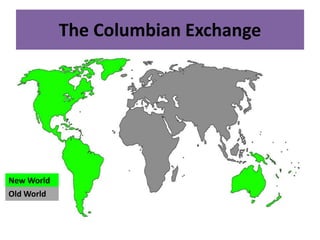
The Columbian Exchange 
New World 
Old World
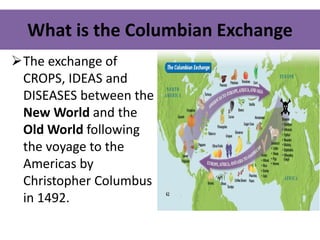
What is the Columbian Exchange 
The exchange of 
CROPS, IDEAS and 
DISEASES between the 
New World and the 
Old World following 
the voyage to the 
Americas by 
Christopher Columbus 
in 1492.
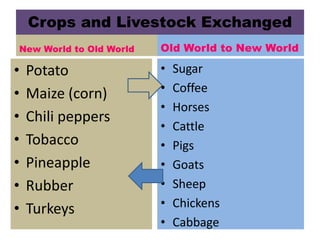
Crops and Livestock Exchanged 
New World to Old World 
• Potato 
• Maize (corn) 
• Chili peppers 
• Tobacco 
• Pineapple 
• Rubber 
• Turkeys 
Old World to New World 
• Sugar 
• Coffee 
• Horses 
• Cattle 
• Pigs 
• Goats 
• Sheep 
• Chickens 
• Cabbage
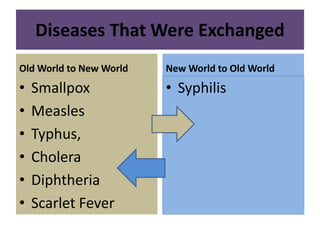
Diseases That Were Exchanged 
Old World to New World 
• Smallpox 
• Measles 
• Typhus, 
• Cholera 
• Diphtheria 
• Scarlet Fever 
New World to Old World 
• Syphilis
Effect of the Columbian 
Exchange 
Gains 
• Crops taken from the NEW WORLD to the OLD 
WORLD did so well (i.e. The Potato) 
• Likewise crops from OLD to NEW World did 
well (i.e. Sugar) 
• The discovery of Quinine (a malaria drug)
Effects of CE: The Potato 
• The New World crop that had the largest 
impact on the Old World 
– It explains the 12% increase in the average 
population of the Old World Countries that 
adopted it as staple food i.e. Irish Republic 
– It has effect on urbanization in the Old World
The Effects of CE: The Sugar Cane 
• The Sugarcane is an example of Old World crop 
that was effectively cultivated in the New World. 
• This resulted in the large-scale production of 
sugar in the New World, that, for the first time in 
human history, there was a large enough supply 
of the commodity that it could be consumed by 
the commoner in Europe. 
• Hersh and Voth (2009) estimate that the increase 
in sugar availability between 1600 and1850 
increased English welfare by an amazing 8%
Effects of CE: Why Old World Crops 
Performed Better in The New World 
• The fact that Old World crops flourished in the 
New World, and New World crops flourished in 
the Old, is not just a coincidence. 
a) The two regions were isolated for thousands of 
years. The isolation caused separate evolutions 
of plants, parasites, and pests. Therefore, 
transplanted crops often flourished because they 
were able to escape the pests and parasites that 
had coevolved with them in their native habitat 
b) Similar Climates
Effects of CE: The Diseases 
• The smallpox, measles, whooping cough, 
chicken pox, bubonic plague, typhus etc that 
spread from the Old World to the New World 
had devastating effects 
• Since native populations in the New World 
had no previous contact with Old World 
diseases, they were immunologically 
defenseless
Effects of CE: 
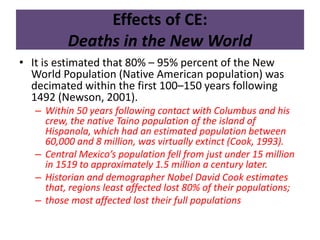
Deaths in the New World 
• It is estimated that 80% – 95% percent of the New 
World Population (Native American population) was 
decimated within the first 100–150 years following 
1492 (Newson, 2001). 
– Within 50 years following contact with Columbus and his 
crew, the native Taino population of the island of 
Hispanola, which had an estimated population between 
60,000 and 8 million, was virtually extinct (Cook, 1993). 
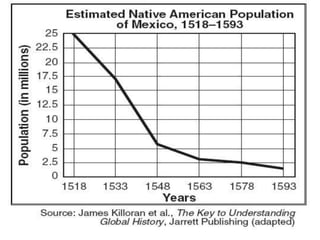
– Central Mexico’s population fell from just under 15 million 
in 1519 to approximately 1.5 million a century later. 
– Historian and demographer Nobel David Cook estimates 
that, regions least affected lost 80% of their populations; 
– those most affected lost their full populations
Effect of CE: Slavery and voluntary 
migration 
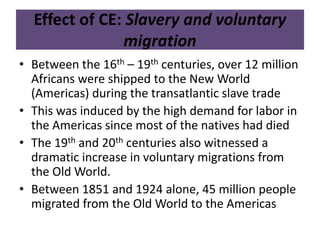
• Between the 16th – 19th centuries, over 12 million 
Africans were shipped to the New World 
(Americas) during the transatlantic slave trade 
• This was induced by the high demand for labor in 
the Americas since most of the natives had died 
• The 19th and 20th centuries also witnessed a 
dramatic increase in voluntary migrations from 
the Old World. 
• Between 1851 and 1924 alone, 45 million people 
migrated from the Old World to the Americas
Effects of CE: Discovery of Quinine 
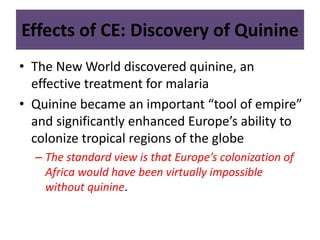
• The New World discovered quinine, an 
effective treatment for malaria 
• Quinine became an important “tool of empire” 
and significantly enhanced Europe’s ability to 
colonize tropical regions of the globe 
– The standard view is that Europe’s colonization of 
Africa would have been virtually impossible 
without quinine.
Effect of CE: Syphilis - A New World 
Disease 
• originated in the New World and was spread in 
1493 by Christopher Columbus and his crew, who 
acquired it from the natives of Hispaniola through 
sexual contact. 
• Upon return to Spain, some of these men joined 
the military campaign of Charles VIII of France 
and laid siege to Naples in 1495. 
• the disease was known to have caused great 
social disruption throughout the Old World but 
not a lot of deaths
References 
Crosby, Alfred W. The Columbian Exchange: Biological and Cultural 
Consequences of 1492. Westport, CT: Praeger Publishers, 2003. 
Diamond, Jared. Guns, Germs and Steel. New York: W. W. Norton and 
Company, 1997. 
Dobyns, Henry F. “Disease Transfer at Contact.” Annual Review of 
Anthropology vol. 22 (1993) 273–91. 
Nunn, Nathan and Nancy Qian. “The Potato’s Contribution to Population and 
Urbanization: Evidence from an Historical Experiment.” NBER Working 
Paper 15157 (2009). 
Nunn, Nathan and Nancy Qian. “The Columbian Exchange: A History of 
Disease, Food, and Ideas.” Journal of Economic Perspectives Vol. 24, No. 2 
(Spring 2010): 163–188.

The columbian exchange

  • 1.
    The Columbian Exchange: A History of Disease, Food and Ideas
  • 2.
    Outline of Presentation • What is the Columbian Exchange (CE) • What effect the CE had on the OLD WORLD • What Effect the CE had on the New WORLD • What effect the CE had on Africa
  • 3.
    The Columbian Exchange New World Old World
  • 4.
    What is theColumbian Exchange The exchange of CROPS, IDEAS and DISEASES between the New World and the Old World following the voyage to the Americas by Christopher Columbus in 1492.
  • 5.
    Crops and LivestockExchanged New World to Old World • Potato • Maize (corn) • Chili peppers • Tobacco • Pineapple • Rubber • Turkeys Old World to New World • Sugar • Coffee • Horses • Cattle • Pigs • Goats • Sheep • Chickens • Cabbage
  • 6.
    Diseases That WereExchanged Old World to New World • Smallpox • Measles • Typhus, • Cholera • Diphtheria • Scarlet Fever New World to Old World • Syphilis
  • 7.
    Effect of theColumbian Exchange Gains • Crops taken from the NEW WORLD to the OLD WORLD did so well (i.e. The Potato) • Likewise crops from OLD to NEW World did well (i.e. Sugar) • The discovery of Quinine (a malaria drug)
  • 8.
    Effects of CE:The Potato • The New World crop that had the largest impact on the Old World – It explains the 12% increase in the average population of the Old World Countries that adopted it as staple food i.e. Irish Republic – It has effect on urbanization in the Old World
  • 9.
    The Effects ofCE: The Sugar Cane • The Sugarcane is an example of Old World crop that was effectively cultivated in the New World. • This resulted in the large-scale production of sugar in the New World, that, for the first time in human history, there was a large enough supply of the commodity that it could be consumed by the commoner in Europe. • Hersh and Voth (2009) estimate that the increase in sugar availability between 1600 and1850 increased English welfare by an amazing 8%
  • 10.
    Effects of CE:Why Old World Crops Performed Better in The New World • The fact that Old World crops flourished in the New World, and New World crops flourished in the Old, is not just a coincidence. a) The two regions were isolated for thousands of years. The isolation caused separate evolutions of plants, parasites, and pests. Therefore, transplanted crops often flourished because they were able to escape the pests and parasites that had coevolved with them in their native habitat b) Similar Climates
  • 11.
    Effects of CE:The Diseases • The smallpox, measles, whooping cough, chicken pox, bubonic plague, typhus etc that spread from the Old World to the New World had devastating effects • Since native populations in the New World had no previous contact with Old World diseases, they were immunologically defenseless
  • 12.
    Effects of CE: Deaths in the New World • It is estimated that 80% – 95% percent of the New World Population (Native American population) was decimated within the first 100–150 years following 1492 (Newson, 2001). – Within 50 years following contact with Columbus and his crew, the native Taino population of the island of Hispanola, which had an estimated population between 60,000 and 8 million, was virtually extinct (Cook, 1993). – Central Mexico’s population fell from just under 15 million in 1519 to approximately 1.5 million a century later. – Historian and demographer Nobel David Cook estimates that, regions least affected lost 80% of their populations; – those most affected lost their full populations
  • 14.
    Effect of CE:Slavery and voluntary migration • Between the 16th – 19th centuries, over 12 million Africans were shipped to the New World (Americas) during the transatlantic slave trade • This was induced by the high demand for labor in the Americas since most of the natives had died • The 19th and 20th centuries also witnessed a dramatic increase in voluntary migrations from the Old World. • Between 1851 and 1924 alone, 45 million people migrated from the Old World to the Americas
  • 15.
    Effects of CE:Discovery of Quinine • The New World discovered quinine, an effective treatment for malaria • Quinine became an important “tool of empire” and significantly enhanced Europe’s ability to colonize tropical regions of the globe – The standard view is that Europe’s colonization of Africa would have been virtually impossible without quinine.
  • 16.
    Effect of CE:Syphilis - A New World Disease • originated in the New World and was spread in 1493 by Christopher Columbus and his crew, who acquired it from the natives of Hispaniola through sexual contact. • Upon return to Spain, some of these men joined the military campaign of Charles VIII of France and laid siege to Naples in 1495. • the disease was known to have caused great social disruption throughout the Old World but not a lot of deaths
  • 17.
    References Crosby, AlfredW. The Columbian Exchange: Biological and Cultural Consequences of 1492. Westport, CT: Praeger Publishers, 2003. Diamond, Jared. Guns, Germs and Steel. New York: W. W. Norton and Company, 1997. Dobyns, Henry F. “Disease Transfer at Contact.” Annual Review of Anthropology vol. 22 (1993) 273–91. Nunn, Nathan and Nancy Qian. “The Potato’s Contribution to Population and Urbanization: Evidence from an Historical Experiment.” NBER Working Paper 15157 (2009). Nunn, Nathan and Nancy Qian. “The Columbian Exchange: A History of Disease, Food, and Ideas.” Journal of Economic Perspectives Vol. 24, No. 2 (Spring 2010): 163–188.