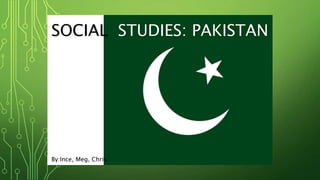
SOCIAL STUDIES: PAKISTAN
By:Ince, Meg, Chris
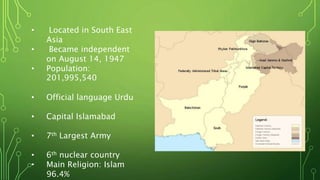
• Located in South East
Asia
• Became independent
on August 14, 1947
• Population:
201,995,540
• Official language Urdu
• Capital Islamabad
• 7th Largest Army
• 6th nuclear country
• Main Religion: Islam
96.4%
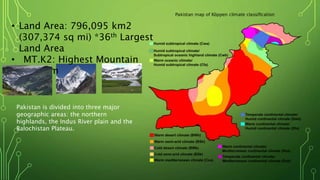
• Land Area: 796,095 km2
(307,374 sq mi) *36th Largest
Land Area
• MT.K2: Highest Mountain
8,611m
Pakistan is divided into three major
geographic areas: the northern
highlands, the Indus River plain and the
Balochistan Plateau.
Military rule
• 1951 - Jinnah's successor Liaquat Ali Khan is
assassinated.
• 1956 - Constitution proclaims Pakistan an Islamic
republic.
• 1958 - Martial law declared and General Ayyub Khan
takes over.
• 1960 - General Ayyub Khan becomes president.
War and secession
• 1965 - Second war with India over Kashmir.
• 1969 - General Ayyub Khan resigns and General
TIME LINE
Zia takes charge
1977 - Riots erupt over allegations of vote-
rigging by Zulfiqar Ali Bhutto's Pakistan People's
Party (PPP). General Zia ul-Haq launches military
coup.
1978 - General Zia becomes president, ushers in
Islamic legal system.
1980 - US pledges military assistance to Pakistan
following Soviet intervention in Afghanistan.
1986 - Zulfiqar Ali Bhutto's daughter Benazir
returns from exile to lead PPP in campaign for
fresh elections.
1988 August - General Zia, US ambassador, and
top army brass die in air crash.
Bhutto comeback
• 1988 November - Benazir Bhutto's PPP wins general election.
• 1990 - Benazir Bhutto dismissed as prime minister on charges
of incompetence and corruption.
• 1991 - Prime Minister Nawaz Sharif begins economic
liberalisation programme. Islamic Sharia law formally
incorporated into legal code.
• 1992 - Government launches campaign to stamp out violence
by Urdu-speaking supporters of the Mohajir Quami Movement.
• 1993 - Prime Minister Sharif resigns under pressure from
military. General election brings Benazir Bhutto back to power.
• Bhutto killed, Musharraf resigns
• 2007 December - State of emergency lifted.

Social studies Pakistan

  • 1.
  • 2.
    • Located inSouth East Asia • Became independent on August 14, 1947 • Population: 201,995,540 • Official language Urdu • Capital Islamabad • 7th Largest Army • 6th nuclear country • Main Religion: Islam 96.4%
  • 3.
    • Land Area:796,095 km2 (307,374 sq mi) *36th Largest Land Area • MT.K2: Highest Mountain 8,611m Pakistan is divided into three major geographic areas: the northern highlands, the Indus River plain and the Balochistan Plateau.
  • 4.
    Military rule • 1951- Jinnah's successor Liaquat Ali Khan is assassinated. • 1956 - Constitution proclaims Pakistan an Islamic republic. • 1958 - Martial law declared and General Ayyub Khan takes over. • 1960 - General Ayyub Khan becomes president. War and secession • 1965 - Second war with India over Kashmir. • 1969 - General Ayyub Khan resigns and General TIME LINE
  • 5.
    Zia takes charge 1977- Riots erupt over allegations of vote- rigging by Zulfiqar Ali Bhutto's Pakistan People's Party (PPP). General Zia ul-Haq launches military coup. 1978 - General Zia becomes president, ushers in Islamic legal system. 1980 - US pledges military assistance to Pakistan following Soviet intervention in Afghanistan. 1986 - Zulfiqar Ali Bhutto's daughter Benazir returns from exile to lead PPP in campaign for fresh elections. 1988 August - General Zia, US ambassador, and top army brass die in air crash.
  • 6.
    Bhutto comeback • 1988November - Benazir Bhutto's PPP wins general election. • 1990 - Benazir Bhutto dismissed as prime minister on charges of incompetence and corruption. • 1991 - Prime Minister Nawaz Sharif begins economic liberalisation programme. Islamic Sharia law formally incorporated into legal code. • 1992 - Government launches campaign to stamp out violence by Urdu-speaking supporters of the Mohajir Quami Movement. • 1993 - Prime Minister Sharif resigns under pressure from military. General election brings Benazir Bhutto back to power. • Bhutto killed, Musharraf resigns • 2007 December - State of emergency lifted.