
0
THE MONGOLS
The Largest Land Empire
In History
Made by YUNJIN & VICKY
G.11
SOCIAL PRESENTATION
1
THE MONGOLIANS
The Mongolians or Mongols started as
barbarian tribes in EAST ASIA. Their
ancestors were simple nomads who roamed in
the grass steppes of Mongolia.
But they became powerful due to their HORSE
RIDING SKILL and GREAT COURAGE. Various
Mongol tribes competed for the scarce
resources in the barren steppes of Mongolia.
2
TEMUJIN OR GENGHIS KHAN
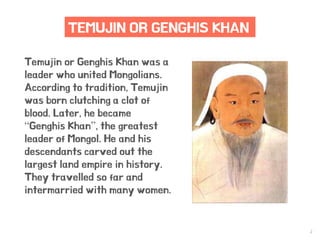
Temujin or Genghis Khan was a
leader who united Mongolians.
According to tradition, Temujin
was born clutching a clot of
blood. Later, he became
“Genghis Khan”, the greatest
leader of Mongol. He and his
descendants carved out the
largest land empire in history.
They travelled so far and
intermarried with many women.
3
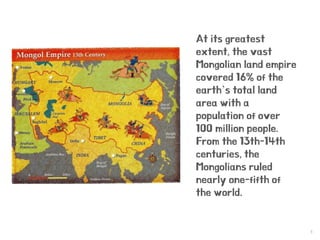
At its greatest
extent, the vast
Mongolian land empire
covered 16% of the
earth’s total land
area with a
population of over
100 million people.
From the 13th-14th
centuries, the
Mongolians ruled
nearly one-fifth of
the world.
4
The Mongols were champions in
battle, undefeated by anyone. They
forced their fellow Asians, including
the Chinese, Turks, Russians,
Persians, and Indians, to surrender
to them.
In East Asia, where they started,
the Mongols massacred more than 18
million people in Mongolia, Korea, and
China. In the Russian capital of Kiev,
they massacred 50,000 city
inhabitants.
5
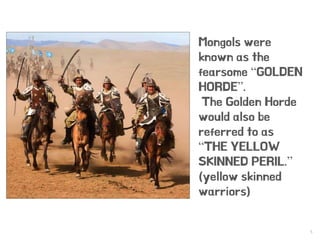
Mongols were
known as the
fearsome “GOLDEN
HORDE”.
The Golden Horde
would also be
referred to as
“THE YELLOW
SKINNED PERIL.”
(yellow skinned
warriors)
6
In 1258, they captured Baghdad and destroyed the
center of the Muslim Caliphates.
In 1274, they tried to invade Japan but failed only due
to a miraculous typhoon. Hence, the Japanese refer to a
typhoon as “divine wind”.
Then, the Mongols nearly wiped out the population of
Western Europe without going there. To escape from
the yellow peril, terrified Asian refugees fled in ships
that sailed to Western Europe. But the ships carried
sick rats, which spread bubonic plague in the West. This
was the catastrophic “Black Plague” of medieval Europe.
7
MONGOL EMPIRES
Mongolian conquerors founded
khanates or new empires in Russia,
India and China. The most famous
Mongol rulers were the successors of
Genghis khan - Batu Khan ,
Tamerlane , Kublai Khan , and Akbar
the Great.
8
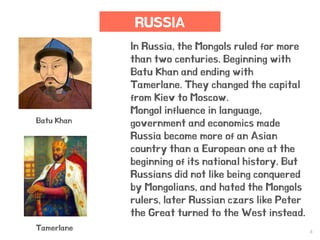
RUSSIA
In Russia, the Mongols ruled for more
than two centuries. Beginning with
Batu Khan and ending with
Tamerlane. They changed the capital
from Kiev to Moscow.
Mongol influence in language,
government and economics made
Russia become more of an Asian
country than a European one at the
beginning of its national history. But
Russians did not like being conquered
by Mongolians, and hated the Mongols
rulers, later Russian czars like Peter
the Great turned to the West instead.
Batu Khan
Tamerlane
9
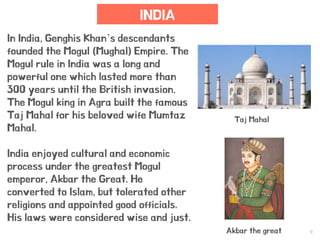
INDIA
In India, Genghis Khan’s descendants
founded the Mogul (Mughal) Empire. The
Mogul rule in India was a long and
powerful one which lasted more than
300 years until the British invasion.
The Mogul king in Agra built the famous
Taj Mahal for his beloved wife Mumtaz
Mahal.
India enjoyed cultural and economic
process under the greatest Mogul
emperor, Akbar the Great. He
converted to Islam, but tolerated other
religions and appointed good officials.
His laws were considered wise and just.
Akbar the great
Taj Mahal
10
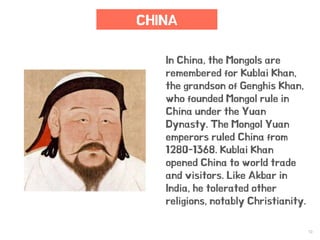
CHINA
In China, the Mongols are
remembered for Kublai Khan,
the grandson of Genghis Khan,
who founded Mongol rule in
China under the Yuan
Dynasty. The Mongol Yuan
emperors ruled China from
1280-1368. Kublai Khan
opened China to world trade
and visitors. Like Akbar in
India, he tolerated other
religions, notably Christianity.
11
A CHRISTIAN MOTHER OF FOUR MONGOL RULERS
Princess of the Kerait Christian tribe married
Genghis Khan’s son and heir, Tolui. Her name was
Sorkaktani.
Sorkaktani’s four sons (including Kublai Khan)
inherited the Mongol Empire and became the
rulers in Russia, Baghdad, and China.
Mongol women stayed in the background so we
cannot know Sorkakstani had influence on her
husband or sons. But according to biographers,
she exposed them to some Christian principles,
like the knowledge of one God and the toleration
of different religious practices.
12
THE MONGOL LEGACY TO THE WORLD
= most feared conquering nation in the world history.
= defeated other Asians
= terrified the European kingdoms and spread bubonic
plague , catastrophic "Black Plague”.
= acquired the culture of their vanquished nations
= Genghis Khan and his numerous descendants
= the ferocity of their yellow hordes
= their toleration and assimilations of other cultures and
religions
13
MYSTERY OF THEIR DISAPPEARANCE
By the 14th century, the Mongols simply faded
away. As far as empires go, the Mongolian
Empire was short, lasting only a century and
a half. Their disappearance is one of
history’s mysteries, because they were
undefeated in battle. Perhaps it was illness,
perhaps they got homesick for the easy life of
the steppes or perhaps there was nothing
more to conquer. Until today, the location of
Genghis Khan’s grave is unknown, which is
symbolic of how the Mongols disappeared.
14
THANK
YOU

Ancient Civilizations: The Mongols

  • 1.
    0 THE MONGOLS The LargestLand Empire In History Made by YUNJIN & VICKY G.11 SOCIAL PRESENTATION
  • 2.
    1 THE MONGOLIANS The Mongoliansor Mongols started as barbarian tribes in EAST ASIA. Their ancestors were simple nomads who roamed in the grass steppes of Mongolia. But they became powerful due to their HORSE RIDING SKILL and GREAT COURAGE. Various Mongol tribes competed for the scarce resources in the barren steppes of Mongolia.
  • 3.
    2 TEMUJIN OR GENGHISKHAN Temujin or Genghis Khan was a leader who united Mongolians. According to tradition, Temujin was born clutching a clot of blood. Later, he became “Genghis Khan”, the greatest leader of Mongol. He and his descendants carved out the largest land empire in history. They travelled so far and intermarried with many women.
  • 4.
    3 At its greatest extent,the vast Mongolian land empire covered 16% of the earth’s total land area with a population of over 100 million people. From the 13th-14th centuries, the Mongolians ruled nearly one-fifth of the world.
  • 5.
    4 The Mongols werechampions in battle, undefeated by anyone. They forced their fellow Asians, including the Chinese, Turks, Russians, Persians, and Indians, to surrender to them. In East Asia, where they started, the Mongols massacred more than 18 million people in Mongolia, Korea, and China. In the Russian capital of Kiev, they massacred 50,000 city inhabitants.
  • 6.
    5 Mongols were known asthe fearsome “GOLDEN HORDE”. The Golden Horde would also be referred to as “THE YELLOW SKINNED PERIL.” (yellow skinned warriors)
  • 7.
    6 In 1258, theycaptured Baghdad and destroyed the center of the Muslim Caliphates. In 1274, they tried to invade Japan but failed only due to a miraculous typhoon. Hence, the Japanese refer to a typhoon as “divine wind”. Then, the Mongols nearly wiped out the population of Western Europe without going there. To escape from the yellow peril, terrified Asian refugees fled in ships that sailed to Western Europe. But the ships carried sick rats, which spread bubonic plague in the West. This was the catastrophic “Black Plague” of medieval Europe.
  • 8.
    7 MONGOL EMPIRES Mongolian conquerorsfounded khanates or new empires in Russia, India and China. The most famous Mongol rulers were the successors of Genghis khan - Batu Khan , Tamerlane , Kublai Khan , and Akbar the Great.
  • 9.
    8 RUSSIA In Russia, theMongols ruled for more than two centuries. Beginning with Batu Khan and ending with Tamerlane. They changed the capital from Kiev to Moscow. Mongol influence in language, government and economics made Russia become more of an Asian country than a European one at the beginning of its national history. But Russians did not like being conquered by Mongolians, and hated the Mongols rulers, later Russian czars like Peter the Great turned to the West instead. Batu Khan Tamerlane
  • 10.
    9 INDIA In India, GenghisKhan’s descendants founded the Mogul (Mughal) Empire. The Mogul rule in India was a long and powerful one which lasted more than 300 years until the British invasion. The Mogul king in Agra built the famous Taj Mahal for his beloved wife Mumtaz Mahal. India enjoyed cultural and economic process under the greatest Mogul emperor, Akbar the Great. He converted to Islam, but tolerated other religions and appointed good officials. His laws were considered wise and just. Akbar the great Taj Mahal
  • 11.
    10 CHINA In China, theMongols are remembered for Kublai Khan, the grandson of Genghis Khan, who founded Mongol rule in China under the Yuan Dynasty. The Mongol Yuan emperors ruled China from 1280-1368. Kublai Khan opened China to world trade and visitors. Like Akbar in India, he tolerated other religions, notably Christianity.
  • 12.
    11 A CHRISTIAN MOTHEROF FOUR MONGOL RULERS Princess of the Kerait Christian tribe married Genghis Khan’s son and heir, Tolui. Her name was Sorkaktani. Sorkaktani’s four sons (including Kublai Khan) inherited the Mongol Empire and became the rulers in Russia, Baghdad, and China. Mongol women stayed in the background so we cannot know Sorkakstani had influence on her husband or sons. But according to biographers, she exposed them to some Christian principles, like the knowledge of one God and the toleration of different religious practices.
  • 13.
    12 THE MONGOL LEGACYTO THE WORLD = most feared conquering nation in the world history. = defeated other Asians = terrified the European kingdoms and spread bubonic plague , catastrophic "Black Plague”. = acquired the culture of their vanquished nations = Genghis Khan and his numerous descendants = the ferocity of their yellow hordes = their toleration and assimilations of other cultures and religions
  • 14.
    13 MYSTERY OF THEIRDISAPPEARANCE By the 14th century, the Mongols simply faded away. As far as empires go, the Mongolian Empire was short, lasting only a century and a half. Their disappearance is one of history’s mysteries, because they were undefeated in battle. Perhaps it was illness, perhaps they got homesick for the easy life of the steppes or perhaps there was nothing more to conquer. Until today, the location of Genghis Khan’s grave is unknown, which is symbolic of how the Mongols disappeared.
  • 15.