THE ADDITION
RULES FOR
PROBABILITY
PROBABILITY AND
COUNTING RULES
Example
At a large political gathering,
you might wish to
know, for a person selected
at random, the probability
that the person is a female
or is a Republican.
There are 3 possibilities:
1. The person is a female.
2. The person is a
Republican.
3. The person is both a
female and a Republican.
Another example
In the same gathering, there
are Republicans,
Democrats, and
Independents. If a person
is selected at random, what
is the probability that the
person is a Democrat or an
Independent?
There are 2 possibilities:
1. The person is a Democrat.
2. The person is an
Independent.
Comparing examples
Case 1: The person selected
can be a female and a
Republican at the same
time.
Case 2: The person selected
cannot be both a Democrat
and an Independent at the
same time.
Solution
Case 1: The events are not
mutually exclusive.
Case 2: The two events are
said to be mutually
exclusive.
Mutually and
Not Mutually
Exclusive
Events
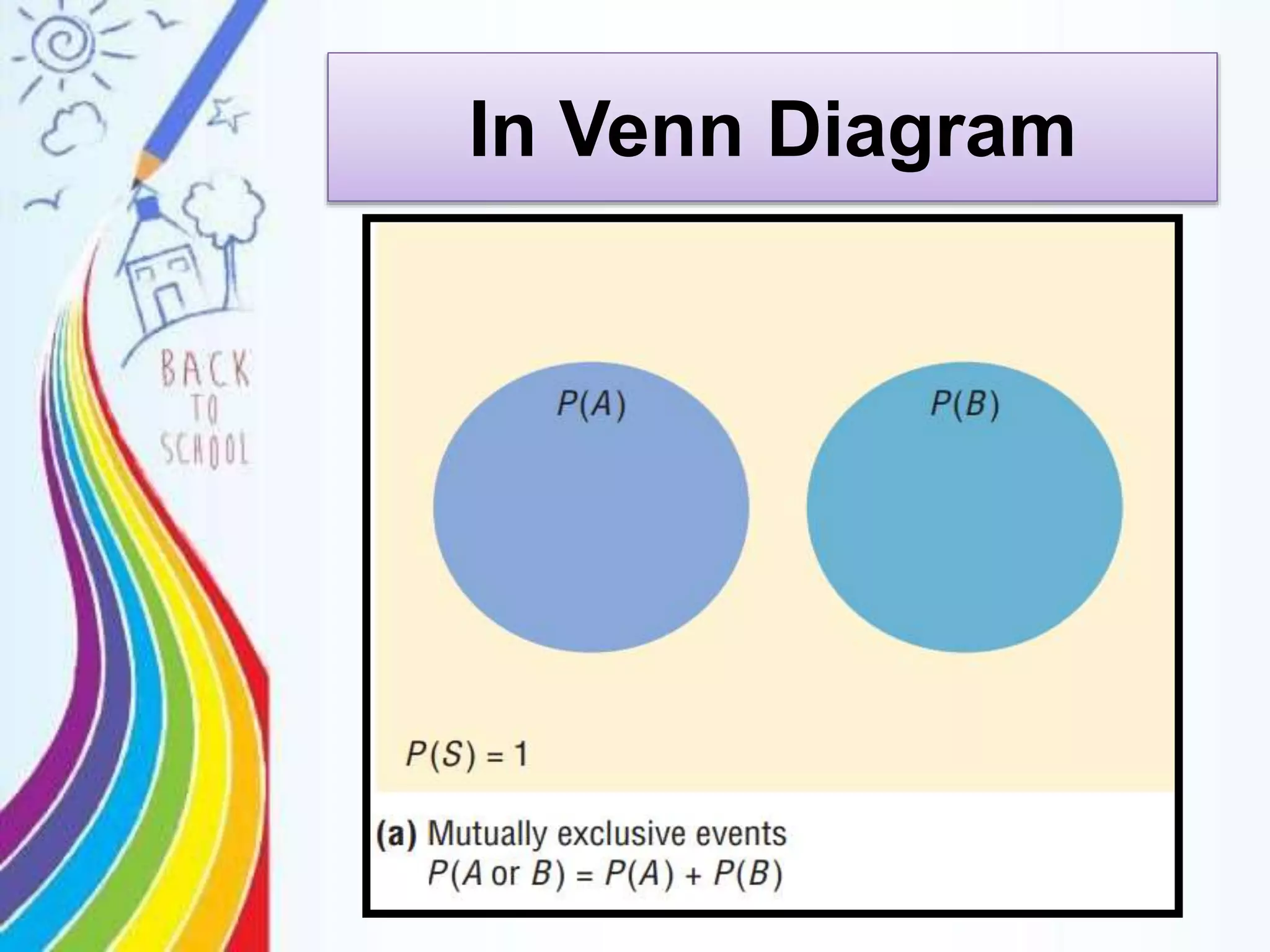
Mutually Exclusive Events
 Two events are mutually
exclusive events if they
cannot occur at the same
time (i.e., they have no
outcomes in common).
In Venn Diagram
 Two events are not
mutually exclusive events
if they can occur at the
same time (i.e., they have
outcomes in common).
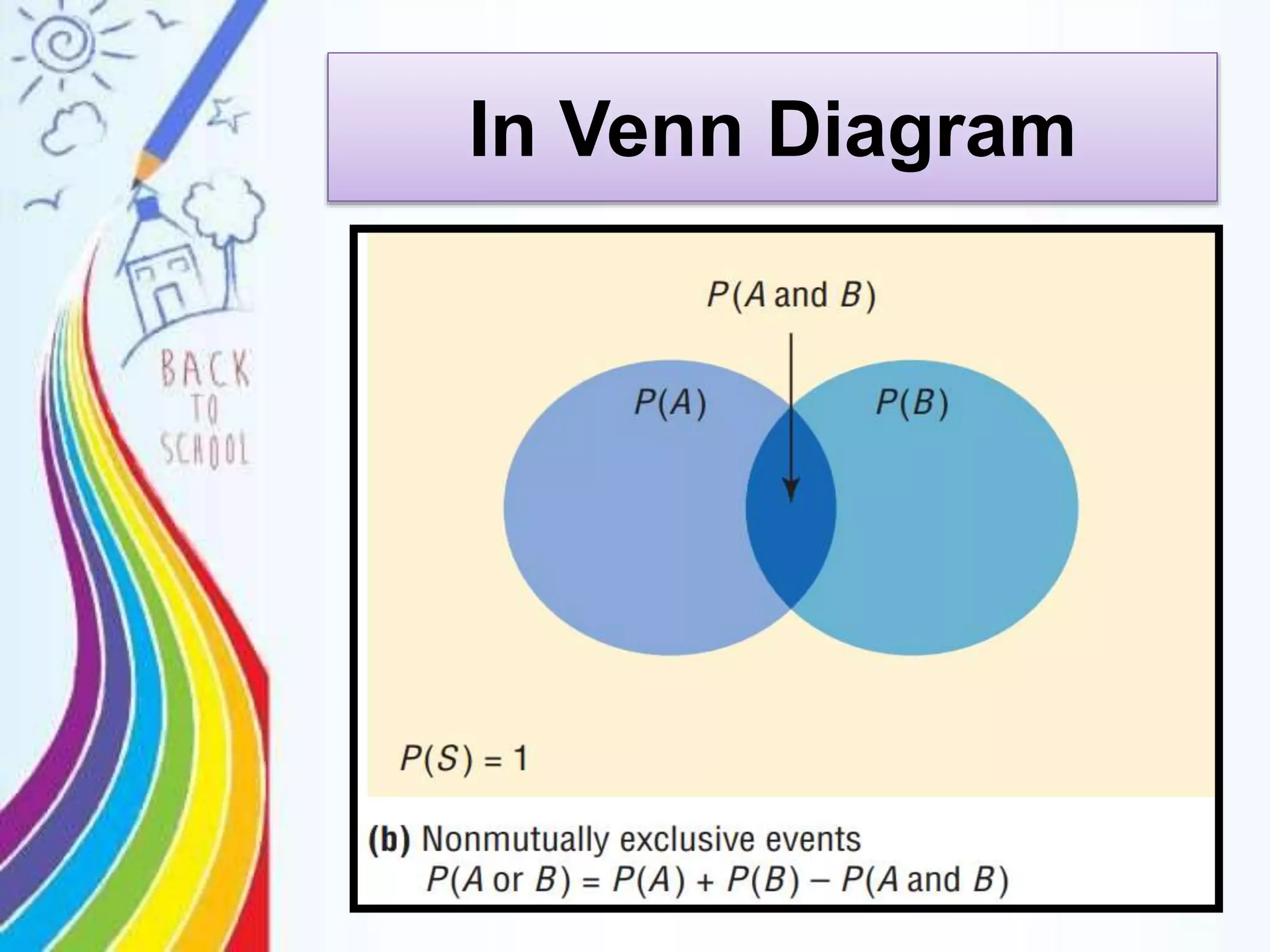
Not Mutually Exclusive
Events
In Venn Diagram
Example: Rolling a Die
Determine which events are
mutually exclusive and
which are not, when a single
die is rolled.
a. Getting an odd number and
getting an even number
Example: Rolling a Die
Determine which events are
mutually exclusive and
which are not, when a
single die is rolled.
b. Getting a 3 and getting an
odd number
Example: Rolling a Die
Determine which events are
mutually exclusive and
which are not, when a
single die is rolled.
c. Getting an odd number and
getting a number less than
4
Example: Rolling a Die
Determine which events are
mutually exclusive and
which are not, when a
single die is rolled.
d. Getting a number greater
than 4 and getting a number
less than 4
Determine which events are
mutually exclusive and
which are not, when a
single card is drawn from a
deck.
a. Getting a 7 and getting a
jack
Example: Drawing a Card
Determine which events are
mutually exclusive and
which are not, when a
single card is drawn from a
deck.
b. Getting a club and getting
a king
Example: Drawing a Card
Determine which events are
mutually exclusive and
which are not, when a
single card is drawn from a
deck.
c. Getting a face card and
getting an ace
Example: Drawing a Card
Determine which events are
mutually exclusive and
which are not, when a
single card is drawn from a
deck.
d. Getting a face card and
getting a spade
Example: Drawing a Card
Addition
Rules for
Probability
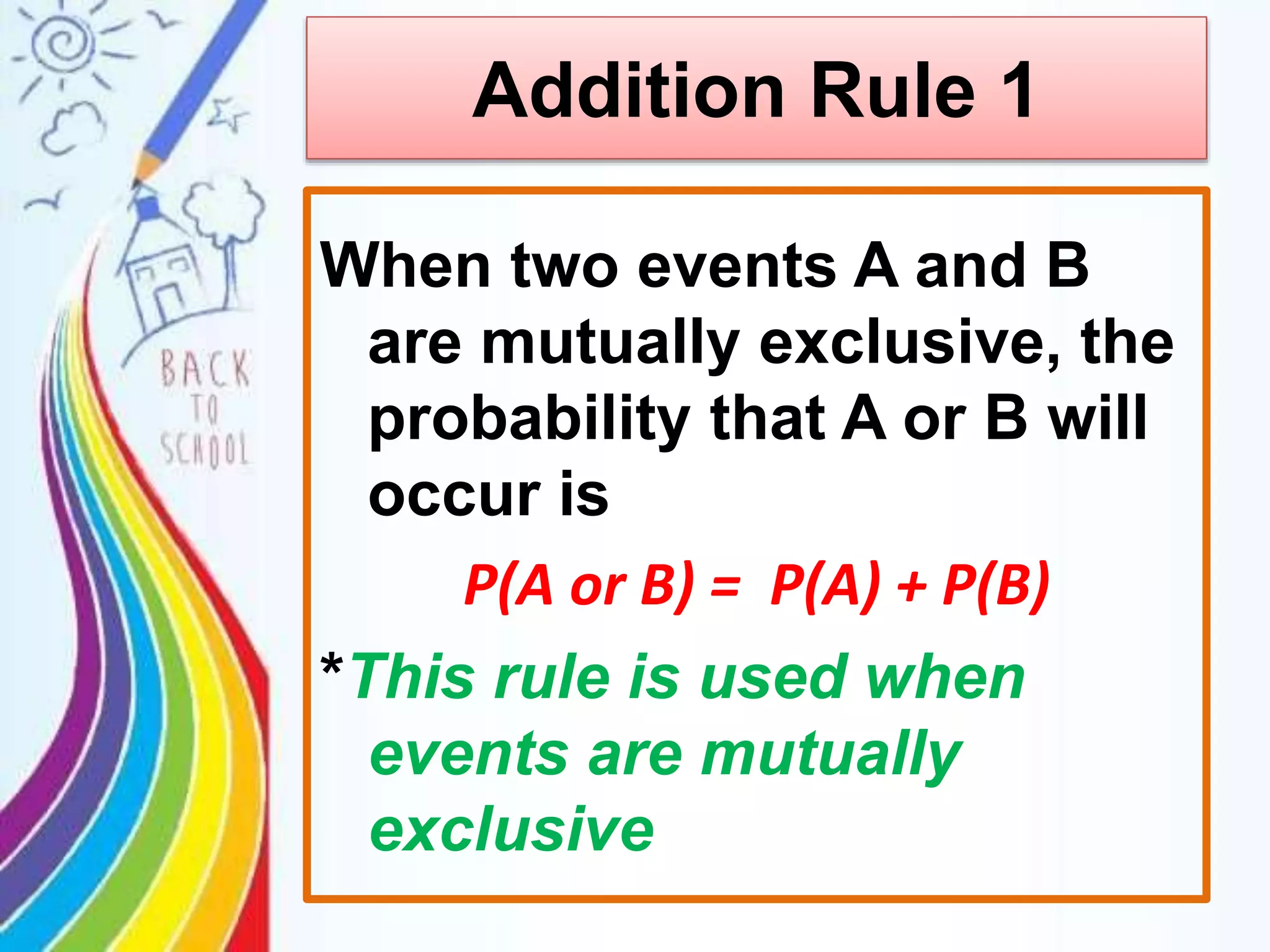
Addition Rule 1
When two events A and B
are mutually exclusive, the
probability that A or B will
occur is
P(A or B) = P(A) + P(B)
*This rule is used when
events are mutually
exclusive
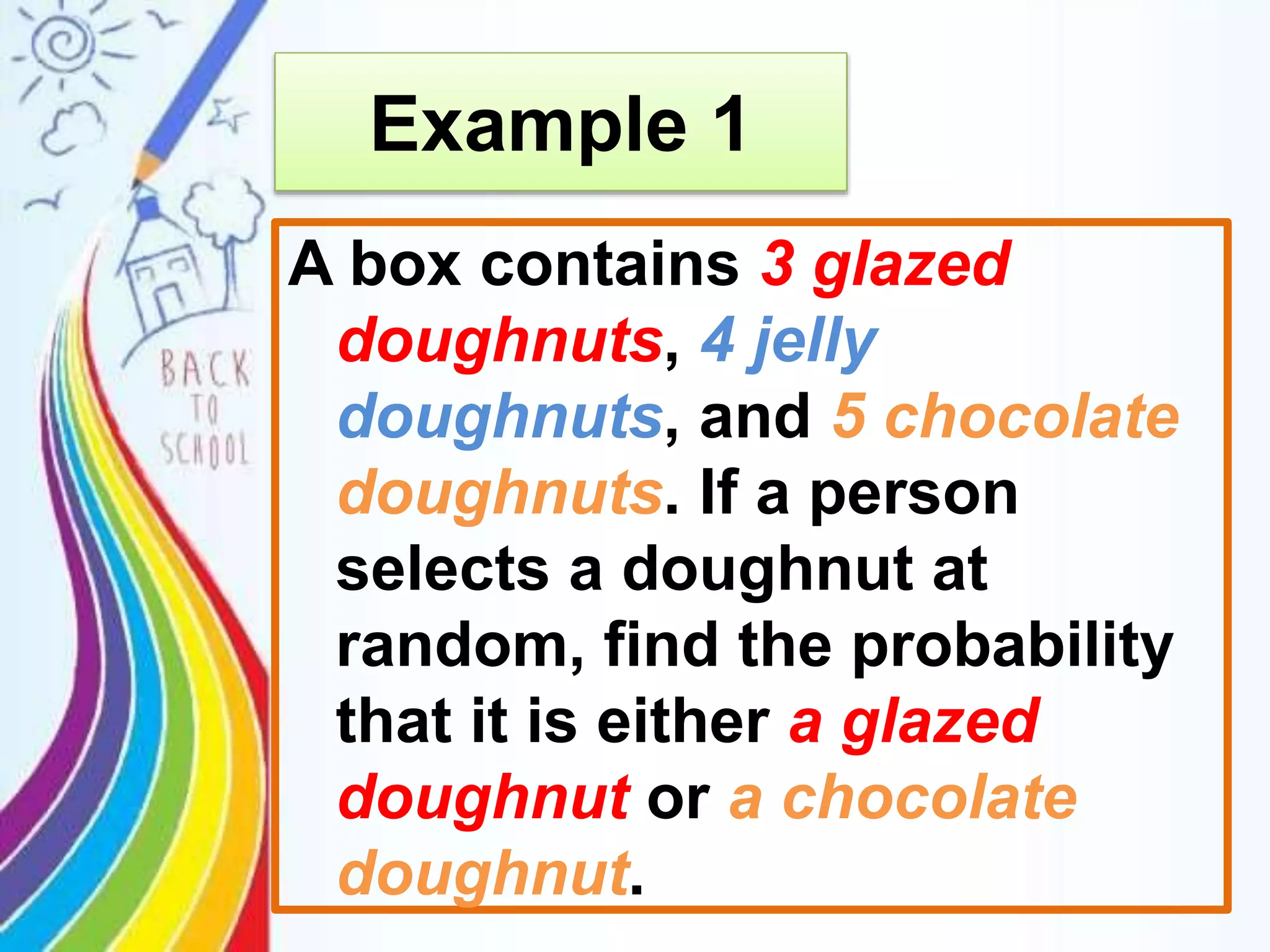
A box contains 3 glazed
doughnuts, 4 jelly
doughnuts, and 5 chocolate
doughnuts. If a person
selects a doughnut at
random, find the probability
that it is either a glazed
doughnut or a chocolate
doughnut.
Example 1
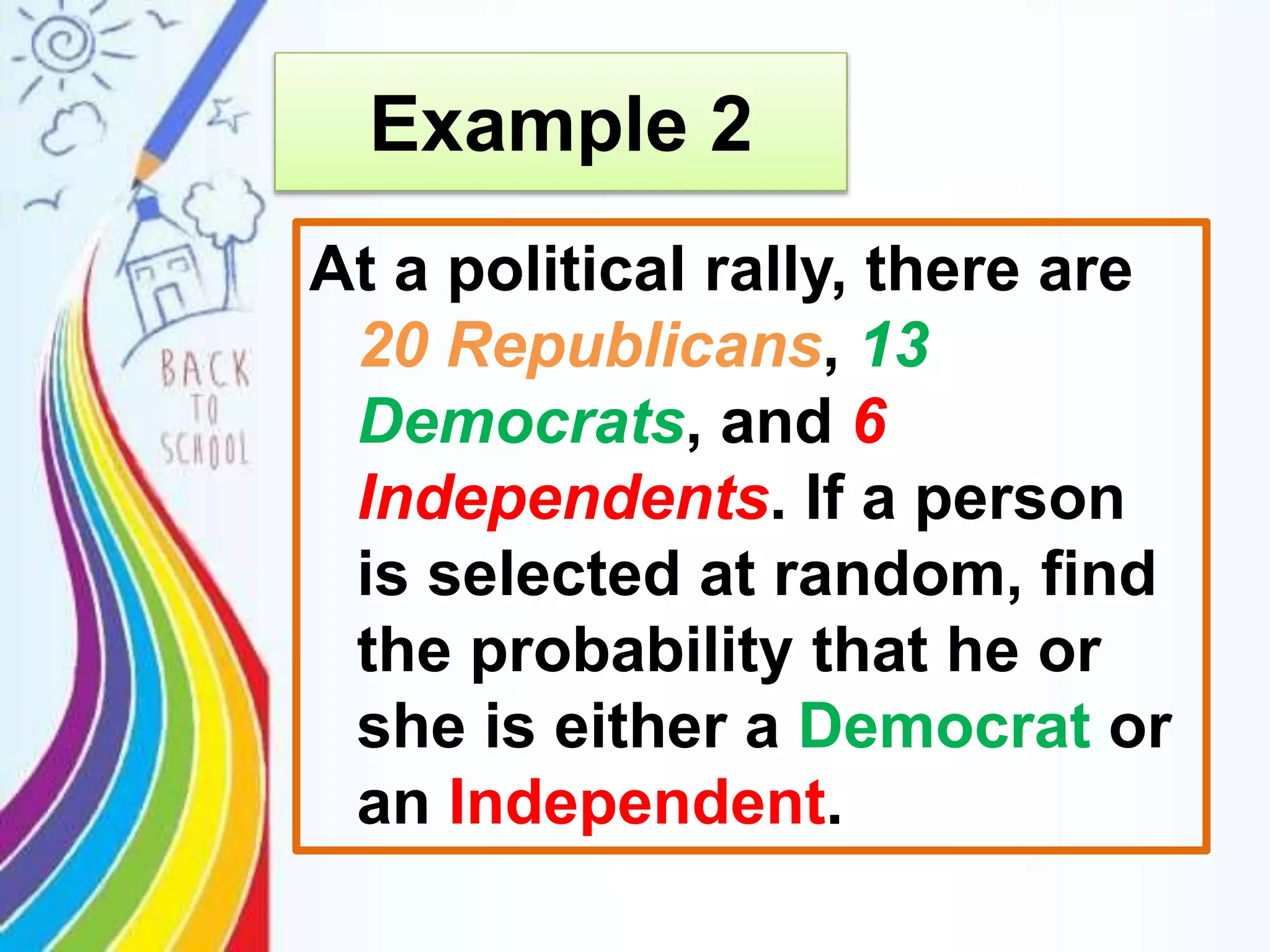
At a political rally, there are
20 Republicans, 13
Democrats, and 6
Independents. If a person
is selected at random, find
the probability that he or
she is either a Democrat or
an Independent.
Example 2
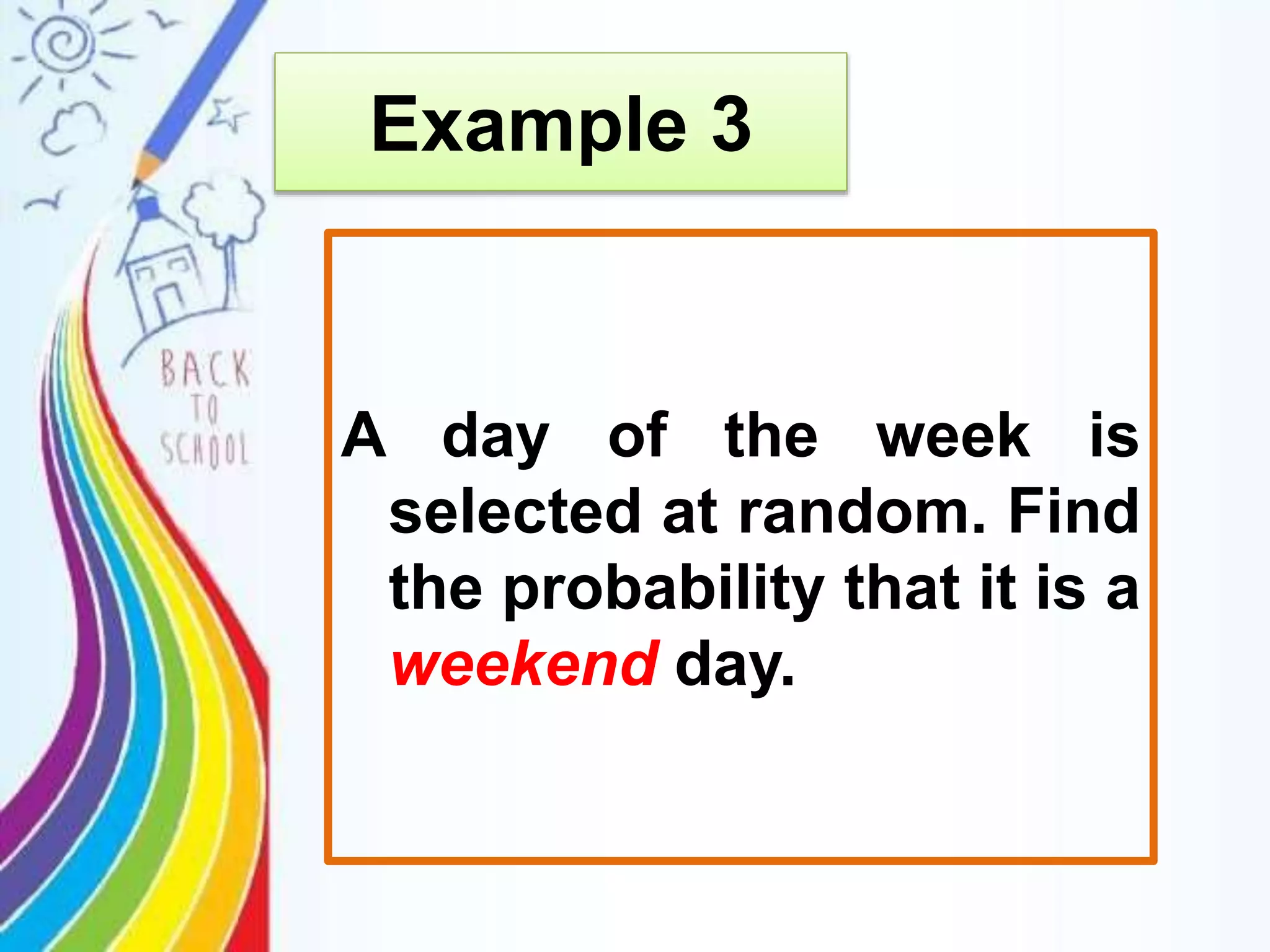
A day of the week is
selected at random. Find
the probability that it is a
weekend day.
Example 3
A single card is drawn at
random from an ordinary
deck of cards. Find the
probability that it is either
an ace or a black card.
Example 4
Addition Rule 2
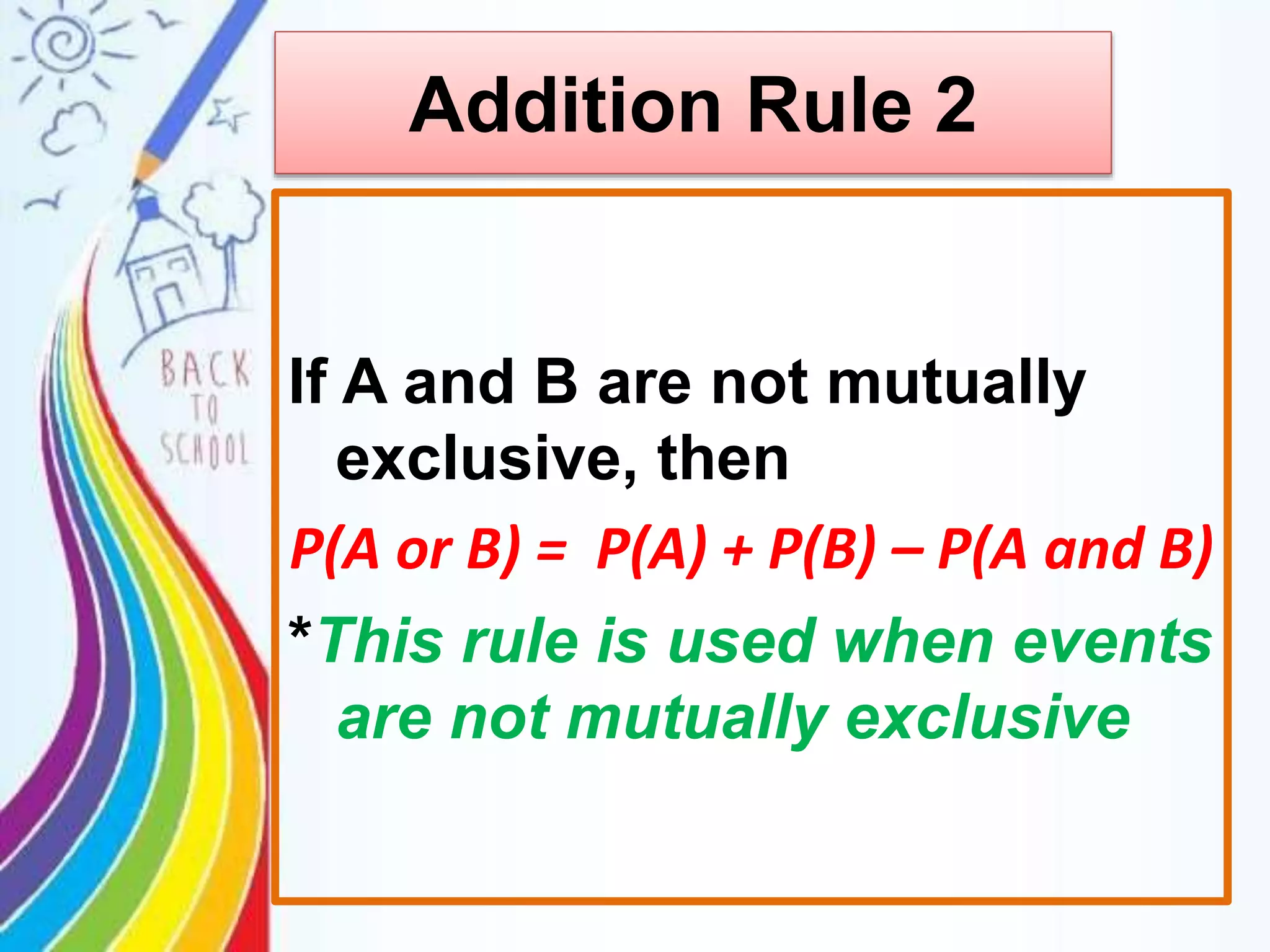
If A and B are not mutually
exclusive, then
P(A or B) = P(A) + P(B) – P(A and B)
*This rule is used when events
are not mutually exclusive
In a hospital unit there are 8
nurses and 5 physicians; 7
nurses and 3 physicians
are females. If a staff
person is selected, find the
probability that the subject
is a nurse or a male.
Example 1
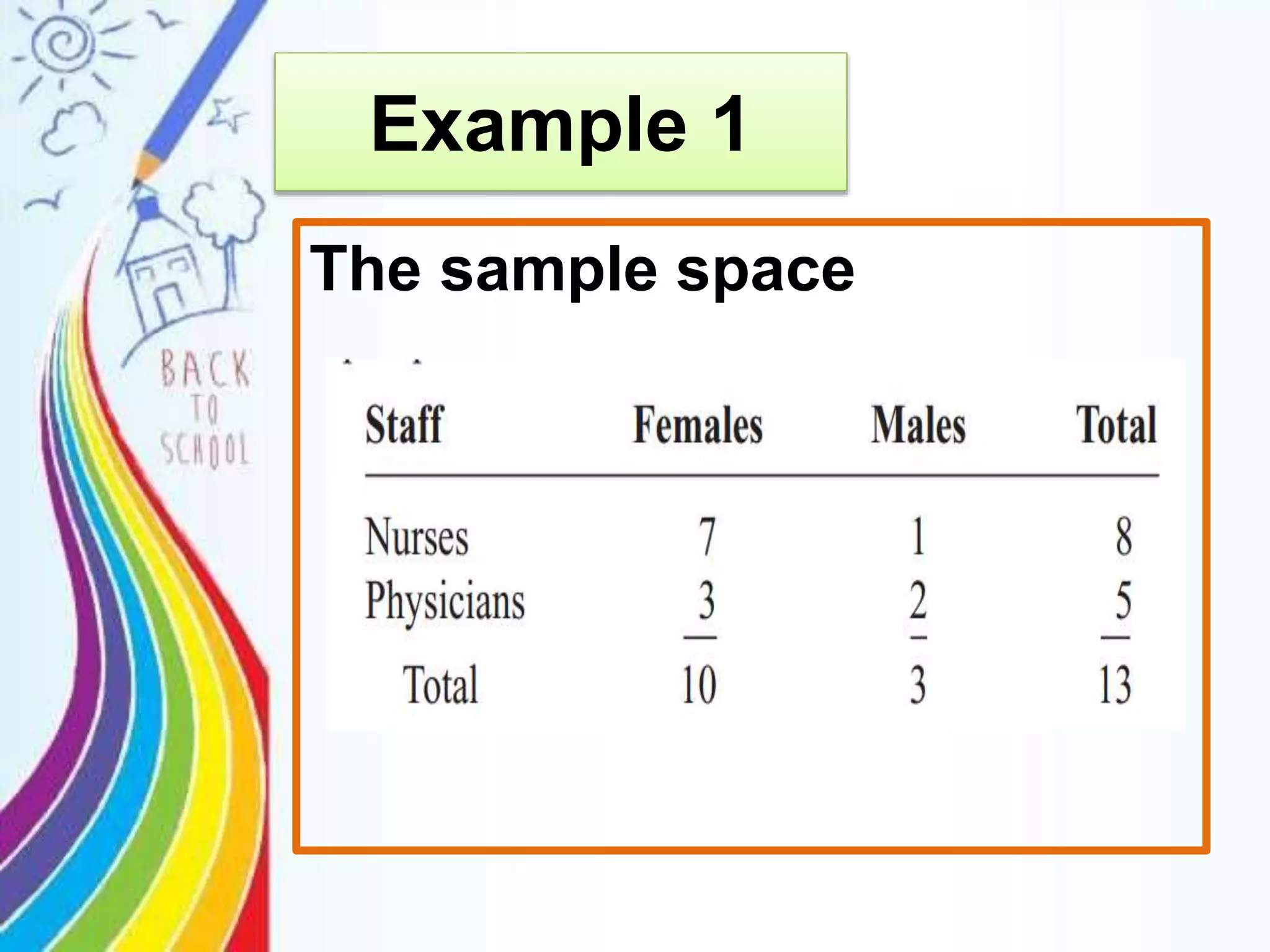
The sample space
Example 1
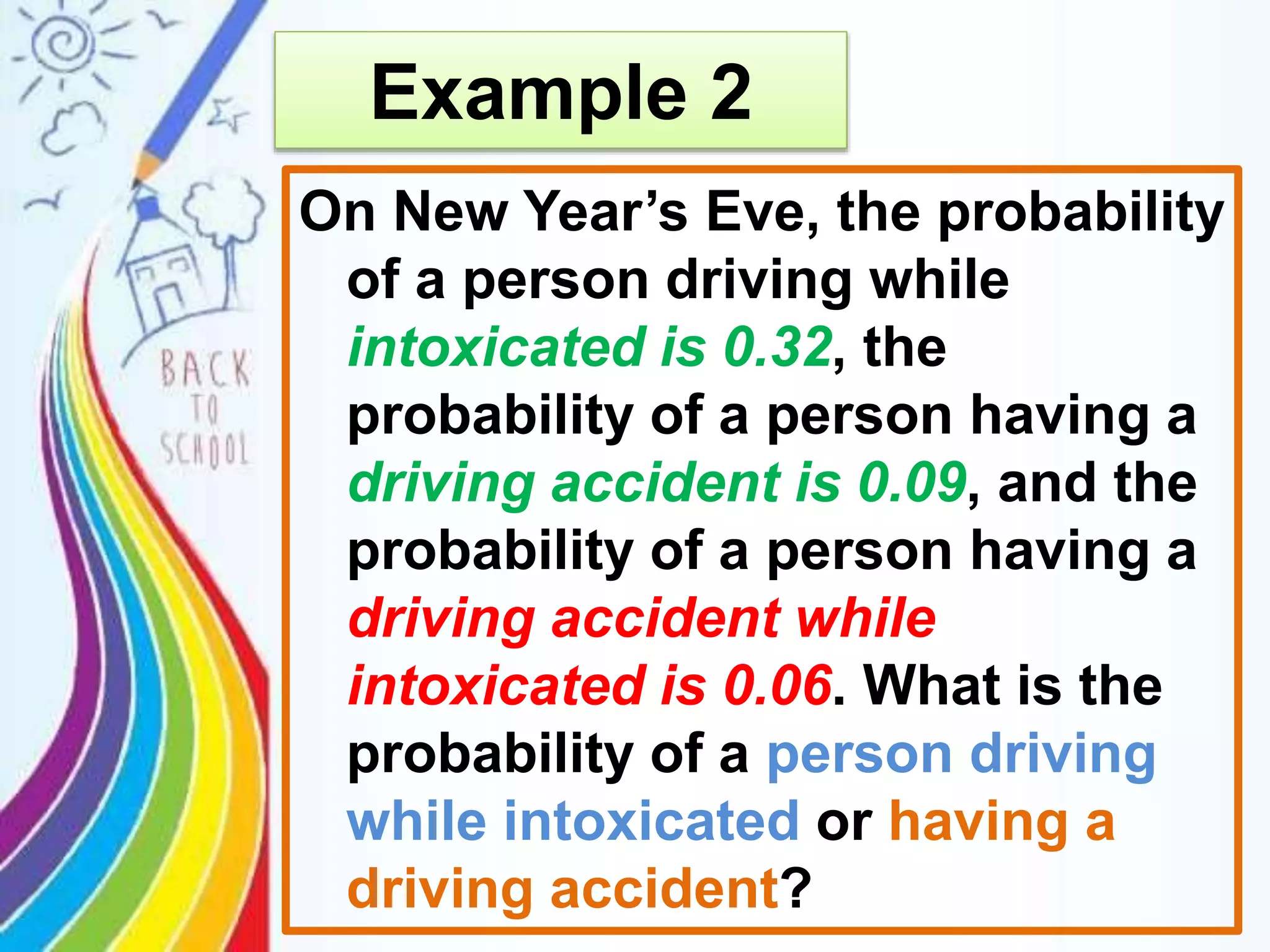
On New Year’s Eve, the probability
of a person driving while
intoxicated is 0.32, the
probability of a person having a
driving accident is 0.09, and the
probability of a person having a
driving accident while
intoxicated is 0.06. What is the
probability of a person driving
while intoxicated or having a
driving accident?
Example 2
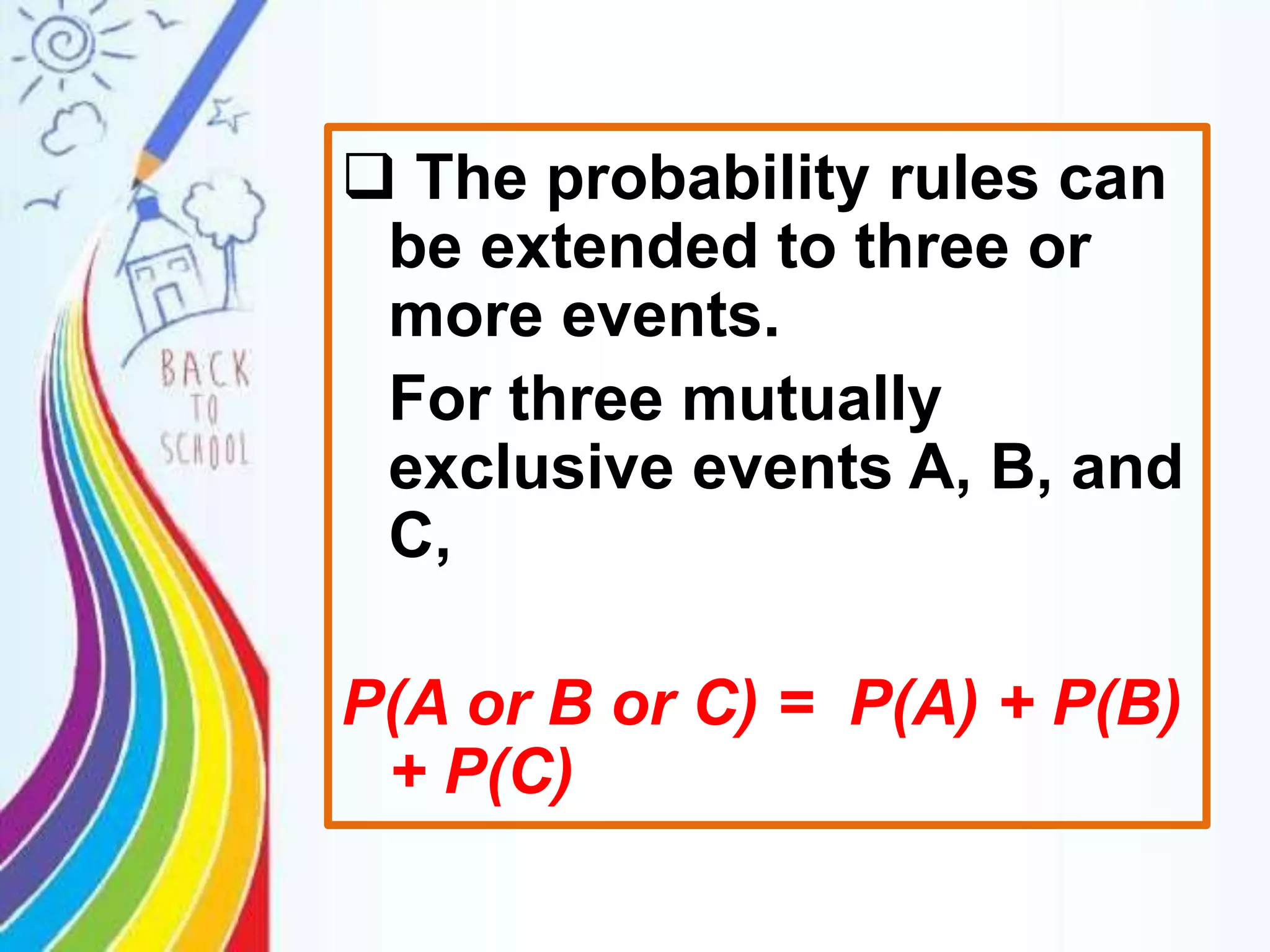
 The probability rules can
be extended to three or
more events.
For three mutually
exclusive events A, B, and
C,
P(A or B or C) = P(A) + P(B)
+ P(C)
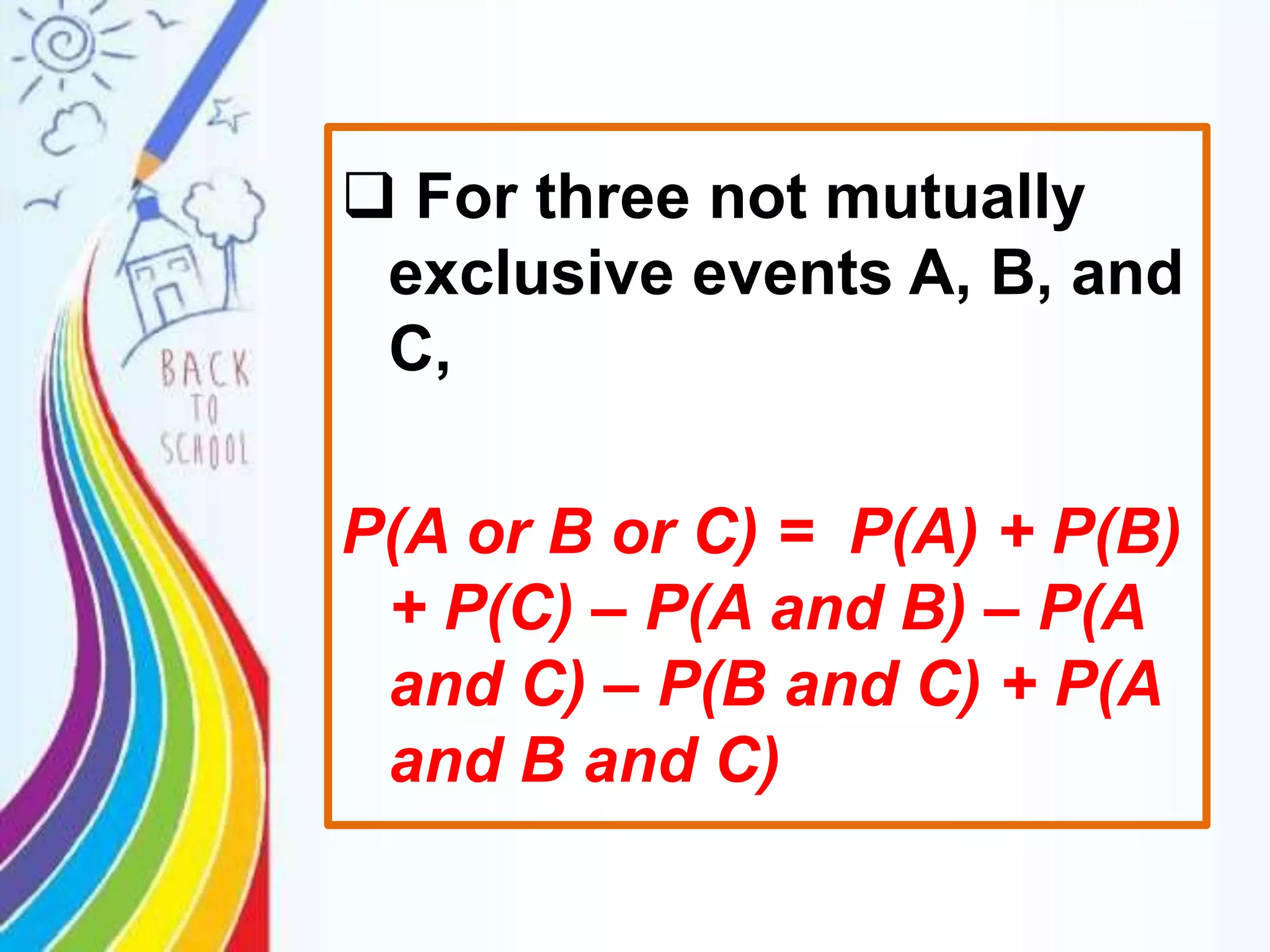
 For three not mutually
exclusive events A, B, and
C,
P(A or B or C) = P(A) + P(B)
+ P(C) – P(A and B) – P(A
and C) – P(B and C) + P(A
and B and C)
The Rules for
Probability
Quiz
1. Define mutually exclusive
events, and give an
example of two events
that are mutually
exclusive.
(2 pts)
Direction
Write Mutually Exclusive or
Not Mutually Exclusive
events. (8 pts)
2. a.) Get an even number,
and get a number less
than 3.
2. b.) Get a prime number
(2, 3, 5), and get an odd
number.
2. c.) Get a number greater
than 3, and get a number
less than 3.
2. d.) Getting a face card
and 10.
2. e) Getting a diamond
card or a jack.
2. f) Getting an ace card or
king.
2. g) Getting club and
heart.
Solving
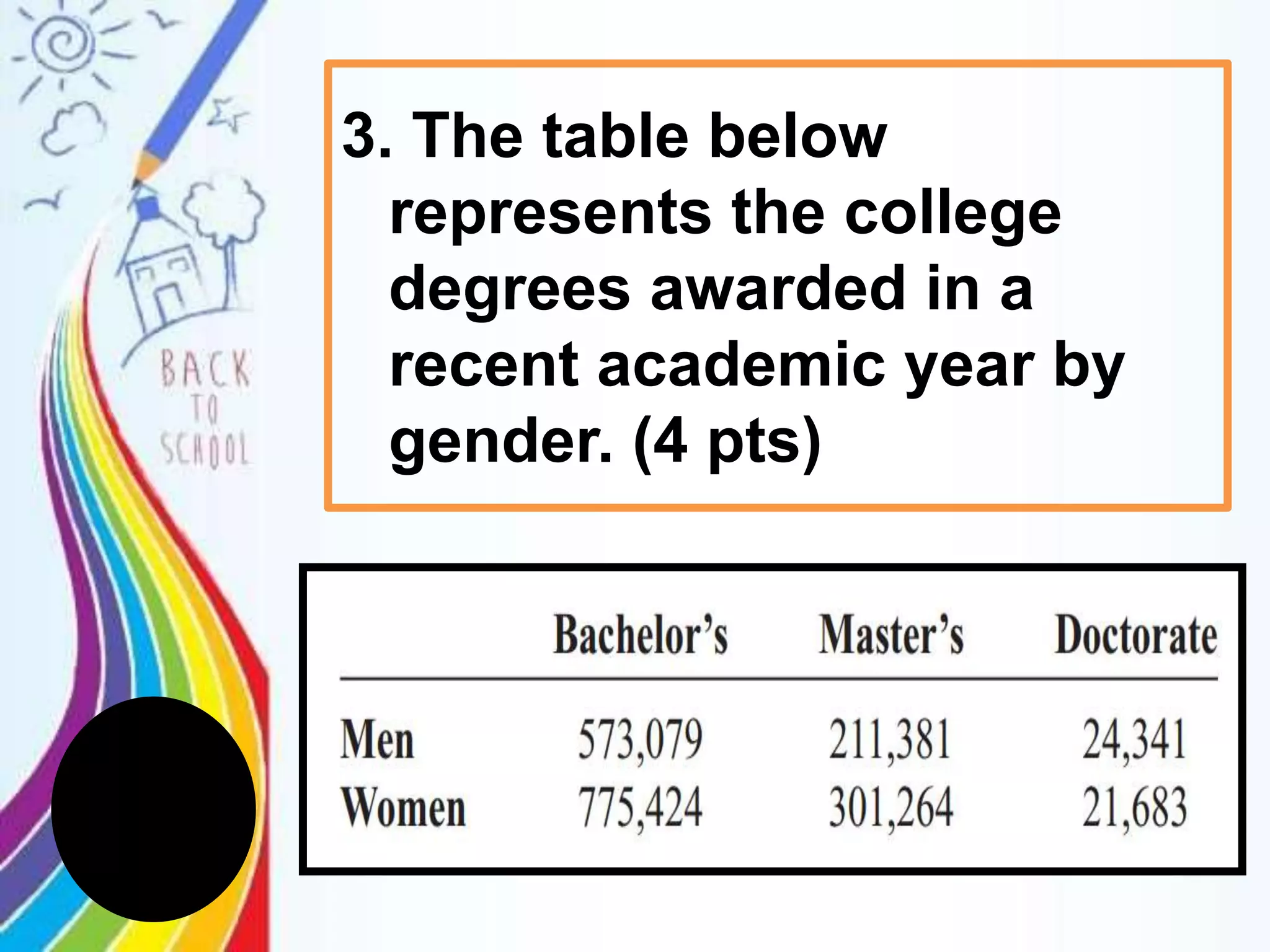
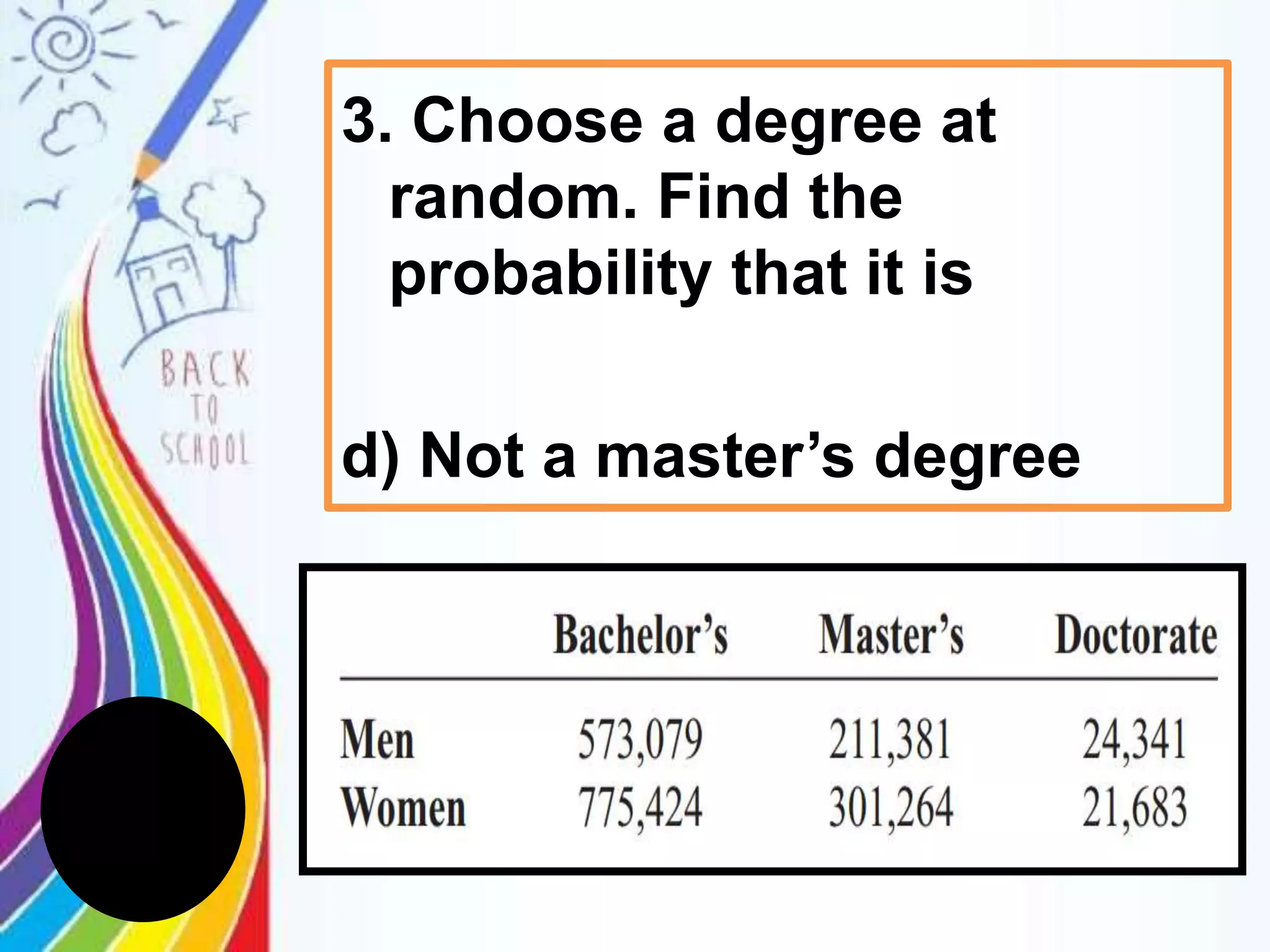
3. The table below
represents the college
degrees awarded in a
recent academic year by
gender. (4 pts)
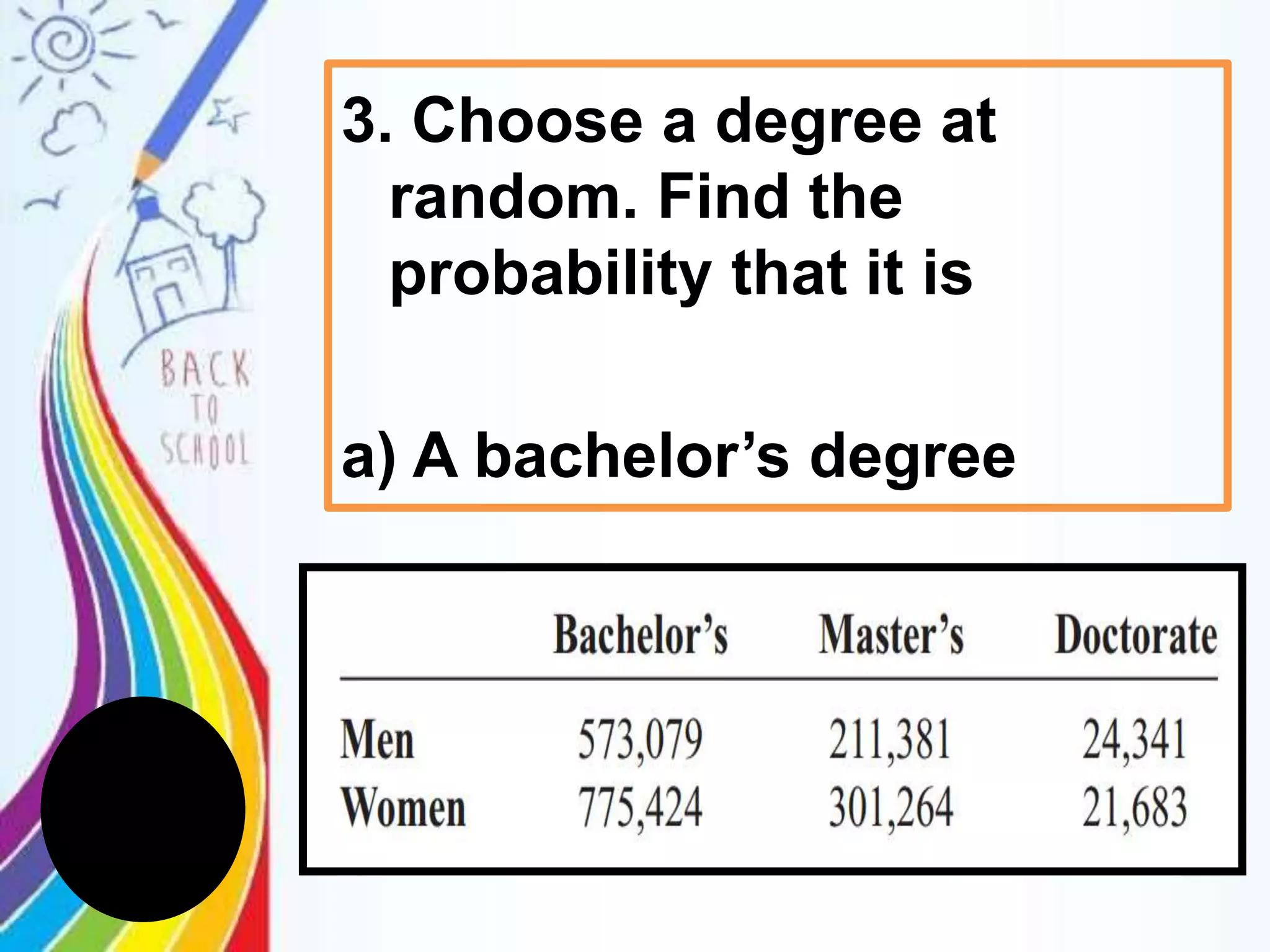
3. Choose a degree at
random. Find the
probability that it is
a) A bachelor’s degree
3. Choose a degree at
random. Find the
probability that it is
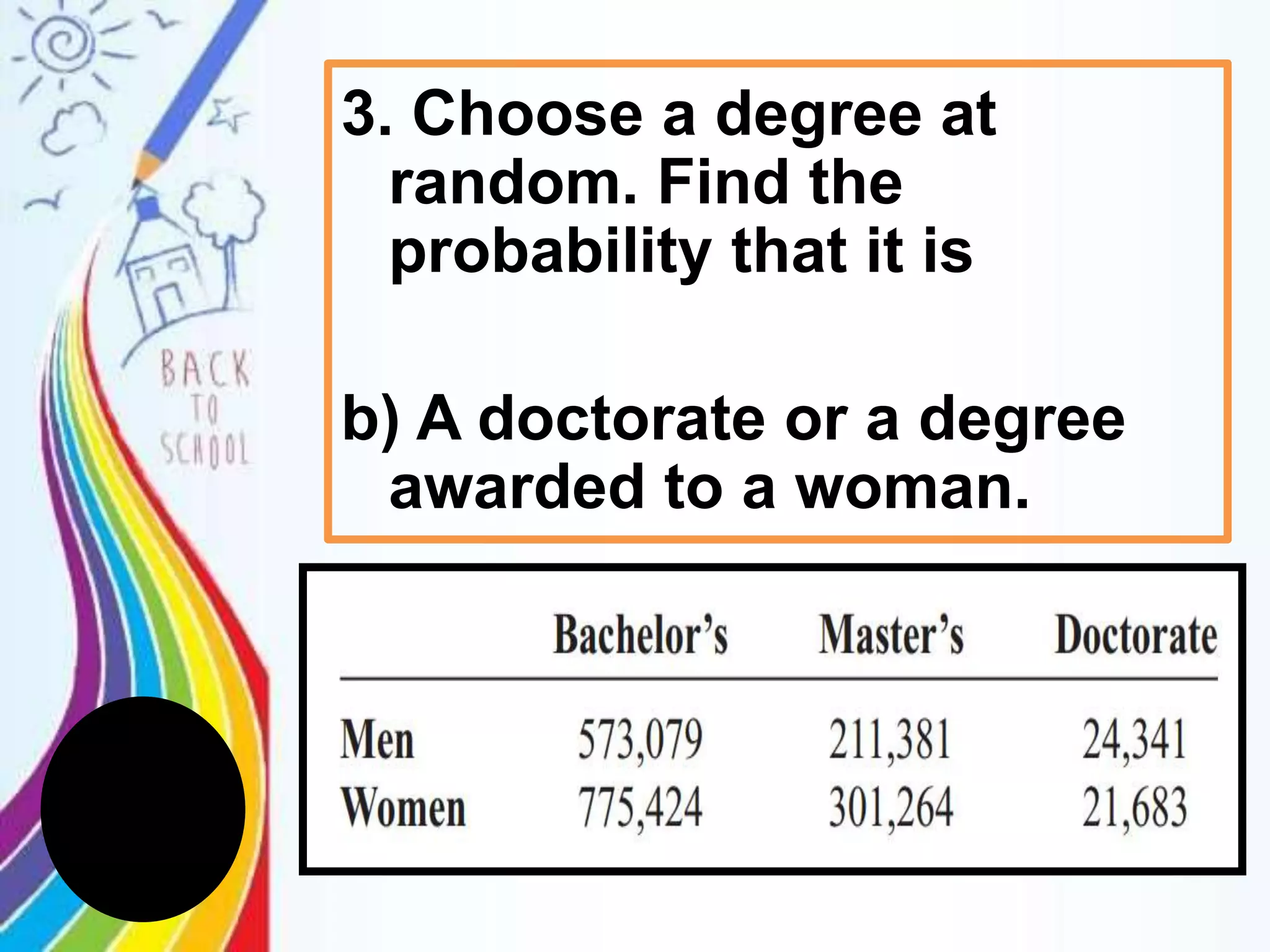
b) A doctorate or a degree
awarded to a woman.
3. Choose a degree at
random. Find the
probability that it is
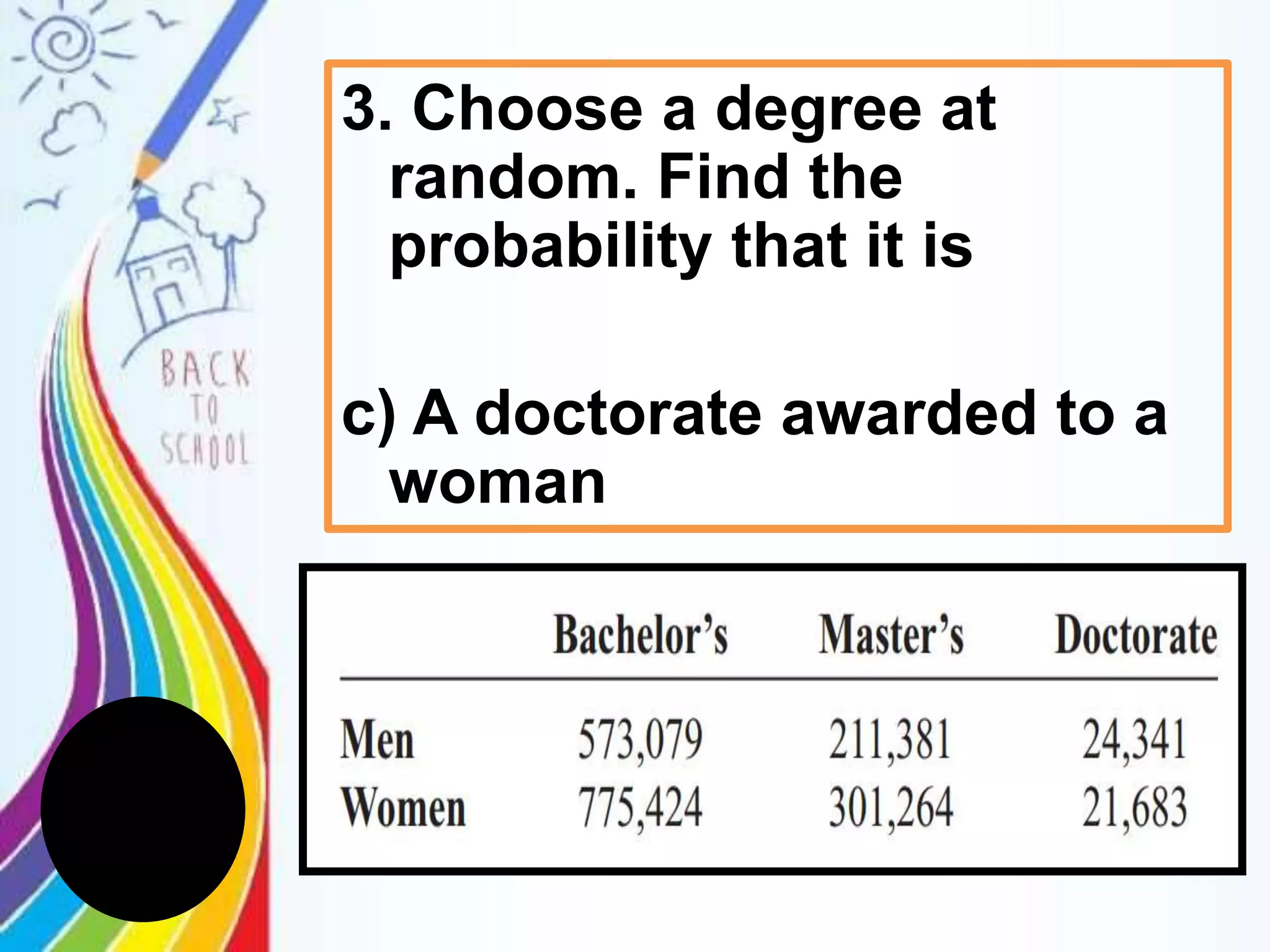
c) A doctorate awarded to a
woman
3. Choose a degree at
random. Find the
probability that it is
d) Not a master’s degree
4. A single card is drawn
from a deck. Find the
probability of selecting the
following. (3pts)
a) A 4 or a diamond
b) A club or a diamond
c) A jack or a black card
5. In a statistics class there
are 18 juniors and 10
seniors; 6 of the seniors
are females, and 12 of the
juniors are males. If a
student is selected at
random, find the
probability of selecting the
following. (3pts)
a) A junior or a female
5. In a statistics class there
are 18 juniors and 10
seniors; 6 of the seniors
are females, and 12 of the
juniors are males. If a
student is selected at
random, find the
probability of selecting the
following. (3pts)
b) A senior or a female
5. In a statistics class there
are 18 juniors and 10
seniors; 6 of the seniors
are females, and 12 of the
juniors are males. If a
student is selected at
random, find the
probability of selecting the
following. (3pts)
c) A senior or a junior
6. At a used-book sale, 100
books are adult books and
160 are children’s books. Of
the adult books, 70 are
nonfiction while 60 of the
children’s books are
nonfiction. (3 pts)
a) A fiction
6. At a used-book sale, 100
books are adult books and
160 are children’s books. Of
the adult books, 70 are
nonfiction while 60 of the
children’s books are
nonfiction. (3 pts)
b) Not a children’s nonfiction
book
6. At a used-book sale, 100
books are adult books and
160 are children’s books. Of
the adult books, 70 are
nonfiction while 60 of the
children’s books are
nonfiction. (3pts)
c) An adult book or a
children’s nonfiction book
7. If one card is drawn from
an ordinary deck of cards,
find the probability of
getting the following. (5pts)
a) A king or a queen or a jack
7. If one card is drawn from
an ordinary deck of cards,
find the probability of
getting the following. (5pts)
b) A club or a heart or a
spade
7. If one card is drawn from
an ordinary deck of cards,
find the probability of
getting the following. (5pts)
c) A king or a queen or a
diamond
7. If one card is drawn from
an ordinary deck of cards,
find the probability of
getting the following. (5pts)
d) An ace or a diamond or a
heart
7. If one card is drawn from
an ordinary deck of cards,
find the probability of
getting the following. (5pts)
e) A 9 or a 10 or a spade or a
heart
8. A recent study of 200 nurses
found that of 125 female
nurses, 56 bachelor’s
degrees; and 75 male nurses,
34 had bachelor’s degrees.
If a nurse is selected at
random, find the probability
that the nurse is (2 pts)
a) A female nurse with a
bachelor’s degree
8. A recent study of 200 nurses
found that of 125 female
nurses, 56 bachelor’s
degrees; and 75 male nurses,
34 had bachelor’s degrees.
If a nurse is selected at
random, find the probability
that the nurse is (2 pts)
b) A male nurse
THE ADDITION RULES FOR PROBABILITY.pptx

THE ADDITION RULES FOR PROBABILITY.pptx

  • 1.
  • 2.
    Example At a largepolitical gathering, you might wish to know, for a person selected at random, the probability that the person is a female or is a Republican.
  • 3.
    There are 3possibilities: 1. The person is a female. 2. The person is a Republican. 3. The person is both a female and a Republican.
  • 4.
    Another example In thesame gathering, there are Republicans, Democrats, and Independents. If a person is selected at random, what is the probability that the person is a Democrat or an Independent?
  • 5.
    There are 2possibilities: 1. The person is a Democrat. 2. The person is an Independent.
  • 6.
    Comparing examples Case 1:The person selected can be a female and a Republican at the same time. Case 2: The person selected cannot be both a Democrat and an Independent at the same time.
  • 7.
    Solution Case 1: Theevents are not mutually exclusive. Case 2: The two events are said to be mutually exclusive.
  • 8.
  • 9.
    Mutually Exclusive Events Two events are mutually exclusive events if they cannot occur at the same time (i.e., they have no outcomes in common).
  • 10.
  • 11.
     Two eventsare not mutually exclusive events if they can occur at the same time (i.e., they have outcomes in common). Not Mutually Exclusive Events
  • 12.
  • 13.
    Example: Rolling aDie Determine which events are mutually exclusive and which are not, when a single die is rolled. a. Getting an odd number and getting an even number
  • 14.
    Example: Rolling aDie Determine which events are mutually exclusive and which are not, when a single die is rolled. b. Getting a 3 and getting an odd number
  • 15.
    Example: Rolling aDie Determine which events are mutually exclusive and which are not, when a single die is rolled. c. Getting an odd number and getting a number less than 4
  • 16.
    Example: Rolling aDie Determine which events are mutually exclusive and which are not, when a single die is rolled. d. Getting a number greater than 4 and getting a number less than 4
  • 17.
    Determine which eventsare mutually exclusive and which are not, when a single card is drawn from a deck. a. Getting a 7 and getting a jack Example: Drawing a Card
  • 18.
    Determine which eventsare mutually exclusive and which are not, when a single card is drawn from a deck. b. Getting a club and getting a king Example: Drawing a Card
  • 19.
    Determine which eventsare mutually exclusive and which are not, when a single card is drawn from a deck. c. Getting a face card and getting an ace Example: Drawing a Card
  • 20.
    Determine which eventsare mutually exclusive and which are not, when a single card is drawn from a deck. d. Getting a face card and getting a spade Example: Drawing a Card
  • 21.
  • 22.
    Addition Rule 1 Whentwo events A and B are mutually exclusive, the probability that A or B will occur is P(A or B) = P(A) + P(B) *This rule is used when events are mutually exclusive
  • 23.
    A box contains3 glazed doughnuts, 4 jelly doughnuts, and 5 chocolate doughnuts. If a person selects a doughnut at random, find the probability that it is either a glazed doughnut or a chocolate doughnut. Example 1
  • 24.
    At a politicalrally, there are 20 Republicans, 13 Democrats, and 6 Independents. If a person is selected at random, find the probability that he or she is either a Democrat or an Independent. Example 2
  • 25.
    A day ofthe week is selected at random. Find the probability that it is a weekend day. Example 3
  • 26.
    A single cardis drawn at random from an ordinary deck of cards. Find the probability that it is either an ace or a black card. Example 4
  • 27.
    Addition Rule 2 IfA and B are not mutually exclusive, then P(A or B) = P(A) + P(B) – P(A and B) *This rule is used when events are not mutually exclusive
  • 28.
    In a hospitalunit there are 8 nurses and 5 physicians; 7 nurses and 3 physicians are females. If a staff person is selected, find the probability that the subject is a nurse or a male. Example 1
  • 29.
  • 30.
    On New Year’sEve, the probability of a person driving while intoxicated is 0.32, the probability of a person having a driving accident is 0.09, and the probability of a person having a driving accident while intoxicated is 0.06. What is the probability of a person driving while intoxicated or having a driving accident? Example 2
  • 31.
     The probabilityrules can be extended to three or more events. For three mutually exclusive events A, B, and C, P(A or B or C) = P(A) + P(B) + P(C)
  • 32.
     For threenot mutually exclusive events A, B, and C, P(A or B or C) = P(A) + P(B) + P(C) – P(A and B) – P(A and C) – P(B and C) + P(A and B and C)
  • 33.
  • 34.
    1. Define mutuallyexclusive events, and give an example of two events that are mutually exclusive. (2 pts)
  • 35.
    Direction Write Mutually Exclusiveor Not Mutually Exclusive events. (8 pts)
  • 36.
    2. a.) Getan even number, and get a number less than 3.
  • 37.
    2. b.) Geta prime number (2, 3, 5), and get an odd number.
  • 38.
    2. c.) Geta number greater than 3, and get a number less than 3.
  • 39.
    2. d.) Gettinga face card and 10.
  • 40.
    2. e) Gettinga diamond card or a jack.
  • 41.
    2. f) Gettingan ace card or king.
  • 42.
    2. g) Gettingclub and heart.
  • 43.
  • 44.
    3. The tablebelow represents the college degrees awarded in a recent academic year by gender. (4 pts)
  • 45.
    3. Choose adegree at random. Find the probability that it is a) A bachelor’s degree
  • 46.
    3. Choose adegree at random. Find the probability that it is b) A doctorate or a degree awarded to a woman.
  • 47.
    3. Choose adegree at random. Find the probability that it is c) A doctorate awarded to a woman
  • 48.
    3. Choose adegree at random. Find the probability that it is d) Not a master’s degree
  • 49.
    4. A singlecard is drawn from a deck. Find the probability of selecting the following. (3pts) a) A 4 or a diamond b) A club or a diamond c) A jack or a black card
  • 50.
    5. In astatistics class there are 18 juniors and 10 seniors; 6 of the seniors are females, and 12 of the juniors are males. If a student is selected at random, find the probability of selecting the following. (3pts) a) A junior or a female
  • 51.
    5. In astatistics class there are 18 juniors and 10 seniors; 6 of the seniors are females, and 12 of the juniors are males. If a student is selected at random, find the probability of selecting the following. (3pts) b) A senior or a female
  • 52.
    5. In astatistics class there are 18 juniors and 10 seniors; 6 of the seniors are females, and 12 of the juniors are males. If a student is selected at random, find the probability of selecting the following. (3pts) c) A senior or a junior
  • 53.
    6. At aused-book sale, 100 books are adult books and 160 are children’s books. Of the adult books, 70 are nonfiction while 60 of the children’s books are nonfiction. (3 pts) a) A fiction
  • 54.
    6. At aused-book sale, 100 books are adult books and 160 are children’s books. Of the adult books, 70 are nonfiction while 60 of the children’s books are nonfiction. (3 pts) b) Not a children’s nonfiction book
  • 55.
    6. At aused-book sale, 100 books are adult books and 160 are children’s books. Of the adult books, 70 are nonfiction while 60 of the children’s books are nonfiction. (3pts) c) An adult book or a children’s nonfiction book
  • 56.
    7. If onecard is drawn from an ordinary deck of cards, find the probability of getting the following. (5pts) a) A king or a queen or a jack
  • 57.
    7. If onecard is drawn from an ordinary deck of cards, find the probability of getting the following. (5pts) b) A club or a heart or a spade
  • 58.
    7. If onecard is drawn from an ordinary deck of cards, find the probability of getting the following. (5pts) c) A king or a queen or a diamond
  • 59.
    7. If onecard is drawn from an ordinary deck of cards, find the probability of getting the following. (5pts) d) An ace or a diamond or a heart
  • 60.
    7. If onecard is drawn from an ordinary deck of cards, find the probability of getting the following. (5pts) e) A 9 or a 10 or a spade or a heart
  • 61.
    8. A recentstudy of 200 nurses found that of 125 female nurses, 56 bachelor’s degrees; and 75 male nurses, 34 had bachelor’s degrees. If a nurse is selected at random, find the probability that the nurse is (2 pts) a) A female nurse with a bachelor’s degree
  • 62.
    8. A recentstudy of 200 nurses found that of 125 female nurses, 56 bachelor’s degrees; and 75 male nurses, 34 had bachelor’s degrees. If a nurse is selected at random, find the probability that the nurse is (2 pts) b) A male nurse

Editor's Notes

  • #3 There are three possibilities.
  • #7 The difference between the two examples is that in the first case.
  • #8 Now, we will discuss the mutually and not mutually exclusive events:
  • #10 What do we mean mutually exclusive events
  • #12 What is not mutually exclusive events: