Probability Concepts
Venkata Sai Krishna M
Applications
• Insurance Companies
• Medical Research
• Risk Calculation
• Product Management
Venkata Sai Krishna M
Basic Terminology in Probability
• Event
• Possible outcomes of doing an activity
• Experiment
• The activity that produces an event
• Mutuality of the events
• Exclusive: Independent events
• Inclusive: Dependent events
• Probability of occurance
Venkata Sai Krishna M
Check!!!!
• Collectively exhaustive list:
• Coin: (Head, Head); (Head, Tail); (Tail, Head); (Tail, Tail)
• Dice: (1,1); (1,2);…… (6,6)
• Probability of Occurrence in Dice:
• Rolling of x = P(x) =
= (Count of event occurances) / All Possible combinations
• Mutually Exclusive: From the Deck of cards
• Heart and Queen
• Ace and Even number
Venkata Sai Krishna M
Types of Probability
• Classical Approach
• Relative Frequency Approach
• Subjective Approach
Venkata Sai Krishna M
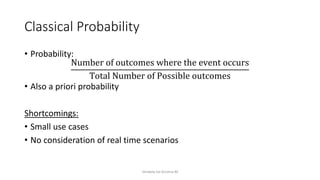
Classical Probability
• Probability:
Number of outcomes where the event occurs
Total Number of Possible outcomes
• Also a priori probability
Shortcomings:
• Small use cases
• No consideration of real time scenarios
Venkata Sai Krishna M
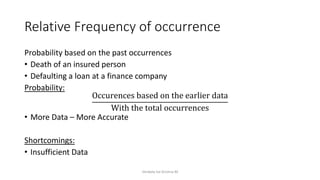
Relative Frequency of occurrence
Probability based on the past occurrences
• Death of an insured person
• Defaulting a loan at a finance company
Probability:
Occurences based on the earlier data
With the total occurrences
• More Data – More Accurate
Shortcomings:
• Insufficient Data
Venkata Sai Krishna M
Subjective Probabilities
• Subjective assessments, either from the previous occurrences or from
the extracted knowledge
• Classic Eg: Board Exam Results
Venkata Sai Krishna M
Probability Rules
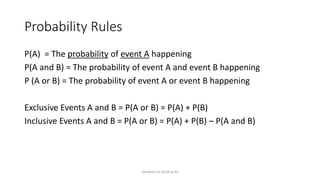
P(A) = The probability of event A happening
P(A and B) = The probability of event A and event B happening
P (A or B) = The probability of event A or event B happening
Exclusive Events A and B = P(A or B) = P(A) + P(B)
Inclusive Events A and B = P(A or B) = P(A) + P(B) – P(A and B)
Venkata Sai Krishna M
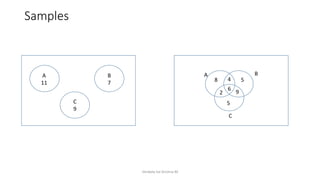
Samples
Venkata Sai Krishna M
A
11
B
7
C
9
A B
C
8 5
5
4
2 9
6
Probabilities under conditions of statistical
independence
• Marginal
• Joint
• Conditional
Venkata Sai Krishna M
Marginal Probabilities of Independent Events
Simple Probability of distribution of all possible outcomes
Venkata Sai Krishna M
Joint Probabilities of Independent Events
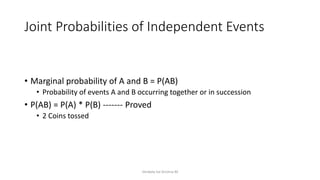
• Marginal probability of A and B = P(AB)
• Probability of events A and B occurring together or in succession
• P(AB) = P(A) * P(B) ------- Proved
• 2 Coins tossed
Venkata Sai Krishna M
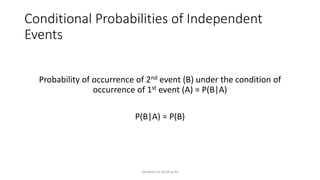
Conditional Probabilities of Independent
Events
Probability of occurrence of 2nd event (B) under the condition of
occurrence of 1st event (A) = P(B|A)
P(B|A) = P(B)
Venkata Sai Krishna M
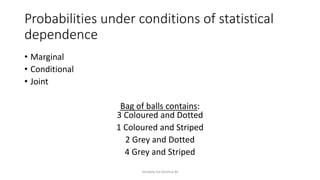
Probabilities under conditions of statistical
dependence
• Marginal
• Conditional
• Joint
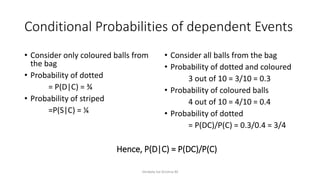
Bag of balls contains:
3 Coloured and Dotted
1 Coloured and Striped
2 Grey and Dotted
4 Grey and Striped
Venkata Sai Krishna M
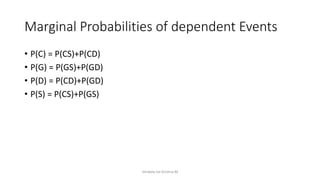
Marginal Probabilities of dependent Events
• P(C) = P(CS)+P(CD)
• P(G) = P(GS)+P(GD)
• P(D) = P(CD)+P(GD)
• P(S) = P(CS)+P(GS)
Venkata Sai Krishna M
Conditional Probabilities of dependent Events
• Consider only coloured balls from
the bag
• Probability of dotted
= P(D|C) = ¾
• Probability of striped
=P(S|C) = ¼
• Consider all balls from the bag
• Probability of dotted and coloured
3 out of 10 = 3/10 = 0.3
• Probability of coloured balls
4 out of 10 = 4/10 = 0.4
• Probability of dotted
= P(DC)/P(C) = 0.3/0.4 = 3/4
Venkata Sai Krishna M
Hence, P(D|C) = P(DC)/P(C)
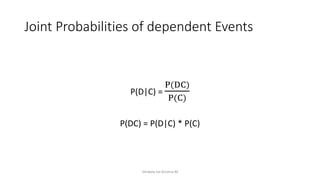
Joint Probabilities of dependent Events
P(D|C) =
P(DC)
P(C)
P(DC) = P(D|C) * P(C)
Venkata Sai Krishna M
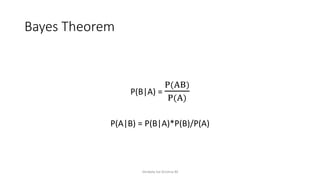
Bayes Theorem
Venkata Sai Krishna M
P(B|A) =
P(AB)
P(A)
P(A|B) = P(B|A)*P(B)/P(A)
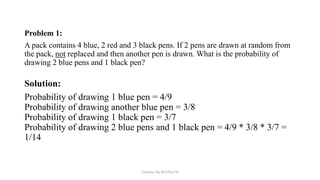
Problem 1:
A pack contains 4 blue, 2 red and 3 black pens. If 2 pens are drawn at random from
the pack, not replaced and then another pen is drawn. What is the probability of
drawing 2 blue pens and 1 black pen?
Solution:
Probability of drawing 1 blue pen = 4/9
Probability of drawing another blue pen = 3/8
Probability of drawing 1 black pen = 3/7
Probability of drawing 2 blue pens and 1 black pen = 4/9 * 3/8 * 3/7 =
1/14
Venkata Sai Krishna M
Problem 2:
What is the probability of drawing a king and a queen consecutively from a deck of
52 cards, without replacement.?
Solution:
• Probability of drawing a king = 4/52 = 1/13
• After drawing one card, the number of cards are 51.
• Probability of drawing a queen = 4/51.
• Now, the probability of drawing a king and queen consecutively is
1/13 * 4/51 = 4/663
Venkata Sai Krishna M
Problem 3:
What is the probability of the occurrence of a number that is odd or less than 5
when a fair die is rolled?
Solution:
• Let the event of the occurrence of a number that is odd be ‘A’ and the event of
the occurrence of a number that is less than 5 be ‘B’. We need to find P(A or B).
• P(A) = 3/6 (odd numbers = 1,3 and 5)
• P(B) = 4/6 (numbers less than 5 = 1,2,3 and 4)
• P(A and B) = 2/6 (numbers that are both odd and less than 5 = 1 and 3)
• Now, P(A or B) = P(A) + P(B) – P(A or B)
• = 3/6 + 4/6 – 2/6
• P(A or B) = 5/6.
Venkata Sai Krishna M
Problem 4:
In a class, 40% of the students study math and science. 60% of the students study
math. What is the probability of a student studying science given he/she is already
studying math?
Solution:
• P(M and S) = 0.40
• P(M) = 0.60
• P(S|M) = P(M and S)/P(S) = 0.40/0.60 = 2/3 = 0.67
Venkata Sai Krishna M
Problem 5:
When two dice are rolled, find the probability of getting a greater number on the
first die than the one on the second, given that the sum should equal 8.
Solution:
• Let the event of getting a greater number on the first die be G.
• There are 5 ways to get a sum of 8 when two dice are rolled = {(2,6),(3,5),(4,4),
(5,3),(6,2)}.
• And there are two ways where the number on the first die is greater than the one on the
second given that the sum should equal 8, G = {(5,3), (6,2)}.
• Therefore, P(Sum equals 8) = 5/36 and P(G) = 2/36.
• Now, P(G|sum equals 8) = P(G and sum equals 8)/P(sum equals 8)
• = (2/36)/(5/36)
• = 2/5
Venkata Sai Krishna M
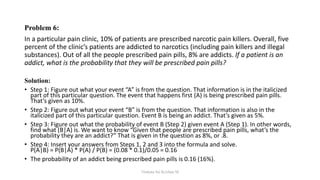
Problem 6:
In a particular pain clinic, 10% of patients are prescribed narcotic pain killers. Overall, five
percent of the clinic’s patients are addicted to narcotics (including pain killers and illegal
substances). Out of all the people prescribed pain pills, 8% are addicts. If a patient is an
addict, what is the probability that they will be prescribed pain pills?
Solution:
• Step 1: Figure out what your event “A” is from the question. That information is in the italicized
part of this particular question. The event that happens first (A) is being prescribed pain pills.
That’s given as 10%.
• Step 2: Figure out what your event “B” is from the question. That information is also in the
italicized part of this particular question. Event B is being an addict. That’s given as 5%.
• Step 3: Figure out what the probability of event B (Step 2) given event A (Step 1). In other words,
find what (B|A) is. We want to know “Given that people are prescribed pain pills, what’s the
probability they are an addict?” That is given in the question as 8%, or .8.
• Step 4: Insert your answers from Steps 1, 2 and 3 into the formula and solve.
P(A|B) = P(B|A) * P(A) / P(B) = (0.08 * 0.1)/0.05 = 0.16
• The probability of an addict being prescribed pain pills is 0.16 (16%).
Venkata Sai Krishna M

Probability concepts

  • 1.
  • 2.
    Applications • Insurance Companies •Medical Research • Risk Calculation • Product Management Venkata Sai Krishna M
  • 3.
    Basic Terminology inProbability • Event • Possible outcomes of doing an activity • Experiment • The activity that produces an event • Mutuality of the events • Exclusive: Independent events • Inclusive: Dependent events • Probability of occurance Venkata Sai Krishna M
  • 4.
    Check!!!! • Collectively exhaustivelist: • Coin: (Head, Head); (Head, Tail); (Tail, Head); (Tail, Tail) • Dice: (1,1); (1,2);…… (6,6) • Probability of Occurrence in Dice: • Rolling of x = P(x) = = (Count of event occurances) / All Possible combinations • Mutually Exclusive: From the Deck of cards • Heart and Queen • Ace and Even number Venkata Sai Krishna M
  • 5.
    Types of Probability •Classical Approach • Relative Frequency Approach • Subjective Approach Venkata Sai Krishna M
  • 6.
    Classical Probability • Probability: Numberof outcomes where the event occurs Total Number of Possible outcomes • Also a priori probability Shortcomings: • Small use cases • No consideration of real time scenarios Venkata Sai Krishna M
  • 7.
    Relative Frequency ofoccurrence Probability based on the past occurrences • Death of an insured person • Defaulting a loan at a finance company Probability: Occurences based on the earlier data With the total occurrences • More Data – More Accurate Shortcomings: • Insufficient Data Venkata Sai Krishna M
  • 8.
    Subjective Probabilities • Subjectiveassessments, either from the previous occurrences or from the extracted knowledge • Classic Eg: Board Exam Results Venkata Sai Krishna M
  • 9.
    Probability Rules P(A) =The probability of event A happening P(A and B) = The probability of event A and event B happening P (A or B) = The probability of event A or event B happening Exclusive Events A and B = P(A or B) = P(A) + P(B) Inclusive Events A and B = P(A or B) = P(A) + P(B) – P(A and B) Venkata Sai Krishna M
  • 10.
    Samples Venkata Sai KrishnaM A 11 B 7 C 9 A B C 8 5 5 4 2 9 6
  • 11.
    Probabilities under conditionsof statistical independence • Marginal • Joint • Conditional Venkata Sai Krishna M
  • 12.
    Marginal Probabilities ofIndependent Events Simple Probability of distribution of all possible outcomes Venkata Sai Krishna M
  • 13.
    Joint Probabilities ofIndependent Events • Marginal probability of A and B = P(AB) • Probability of events A and B occurring together or in succession • P(AB) = P(A) * P(B) ------- Proved • 2 Coins tossed Venkata Sai Krishna M
  • 14.
    Conditional Probabilities ofIndependent Events Probability of occurrence of 2nd event (B) under the condition of occurrence of 1st event (A) = P(B|A) P(B|A) = P(B) Venkata Sai Krishna M
  • 15.
    Probabilities under conditionsof statistical dependence • Marginal • Conditional • Joint Bag of balls contains: 3 Coloured and Dotted 1 Coloured and Striped 2 Grey and Dotted 4 Grey and Striped Venkata Sai Krishna M
  • 16.
    Marginal Probabilities ofdependent Events • P(C) = P(CS)+P(CD) • P(G) = P(GS)+P(GD) • P(D) = P(CD)+P(GD) • P(S) = P(CS)+P(GS) Venkata Sai Krishna M
  • 17.
    Conditional Probabilities ofdependent Events • Consider only coloured balls from the bag • Probability of dotted = P(D|C) = ¾ • Probability of striped =P(S|C) = ¼ • Consider all balls from the bag • Probability of dotted and coloured 3 out of 10 = 3/10 = 0.3 • Probability of coloured balls 4 out of 10 = 4/10 = 0.4 • Probability of dotted = P(DC)/P(C) = 0.3/0.4 = 3/4 Venkata Sai Krishna M Hence, P(D|C) = P(DC)/P(C)
  • 18.
    Joint Probabilities ofdependent Events P(D|C) = P(DC) P(C) P(DC) = P(D|C) * P(C) Venkata Sai Krishna M
  • 19.
    Bayes Theorem Venkata SaiKrishna M P(B|A) = P(AB) P(A) P(A|B) = P(B|A)*P(B)/P(A)
  • 20.
    Problem 1: A packcontains 4 blue, 2 red and 3 black pens. If 2 pens are drawn at random from the pack, not replaced and then another pen is drawn. What is the probability of drawing 2 blue pens and 1 black pen? Solution: Probability of drawing 1 blue pen = 4/9 Probability of drawing another blue pen = 3/8 Probability of drawing 1 black pen = 3/7 Probability of drawing 2 blue pens and 1 black pen = 4/9 * 3/8 * 3/7 = 1/14 Venkata Sai Krishna M
  • 21.
    Problem 2: What isthe probability of drawing a king and a queen consecutively from a deck of 52 cards, without replacement.? Solution: • Probability of drawing a king = 4/52 = 1/13 • After drawing one card, the number of cards are 51. • Probability of drawing a queen = 4/51. • Now, the probability of drawing a king and queen consecutively is 1/13 * 4/51 = 4/663 Venkata Sai Krishna M
  • 22.
    Problem 3: What isthe probability of the occurrence of a number that is odd or less than 5 when a fair die is rolled? Solution: • Let the event of the occurrence of a number that is odd be ‘A’ and the event of the occurrence of a number that is less than 5 be ‘B’. We need to find P(A or B). • P(A) = 3/6 (odd numbers = 1,3 and 5) • P(B) = 4/6 (numbers less than 5 = 1,2,3 and 4) • P(A and B) = 2/6 (numbers that are both odd and less than 5 = 1 and 3) • Now, P(A or B) = P(A) + P(B) – P(A or B) • = 3/6 + 4/6 – 2/6 • P(A or B) = 5/6. Venkata Sai Krishna M
  • 23.
    Problem 4: In aclass, 40% of the students study math and science. 60% of the students study math. What is the probability of a student studying science given he/she is already studying math? Solution: • P(M and S) = 0.40 • P(M) = 0.60 • P(S|M) = P(M and S)/P(S) = 0.40/0.60 = 2/3 = 0.67 Venkata Sai Krishna M
  • 24.
    Problem 5: When twodice are rolled, find the probability of getting a greater number on the first die than the one on the second, given that the sum should equal 8. Solution: • Let the event of getting a greater number on the first die be G. • There are 5 ways to get a sum of 8 when two dice are rolled = {(2,6),(3,5),(4,4), (5,3),(6,2)}. • And there are two ways where the number on the first die is greater than the one on the second given that the sum should equal 8, G = {(5,3), (6,2)}. • Therefore, P(Sum equals 8) = 5/36 and P(G) = 2/36. • Now, P(G|sum equals 8) = P(G and sum equals 8)/P(sum equals 8) • = (2/36)/(5/36) • = 2/5 Venkata Sai Krishna M
  • 25.
    Problem 6: In aparticular pain clinic, 10% of patients are prescribed narcotic pain killers. Overall, five percent of the clinic’s patients are addicted to narcotics (including pain killers and illegal substances). Out of all the people prescribed pain pills, 8% are addicts. If a patient is an addict, what is the probability that they will be prescribed pain pills? Solution: • Step 1: Figure out what your event “A” is from the question. That information is in the italicized part of this particular question. The event that happens first (A) is being prescribed pain pills. That’s given as 10%. • Step 2: Figure out what your event “B” is from the question. That information is also in the italicized part of this particular question. Event B is being an addict. That’s given as 5%. • Step 3: Figure out what the probability of event B (Step 2) given event A (Step 1). In other words, find what (B|A) is. We want to know “Given that people are prescribed pain pills, what’s the probability they are an addict?” That is given in the question as 8%, or .8. • Step 4: Insert your answers from Steps 1, 2 and 3 into the formula and solve. P(A|B) = P(B|A) * P(A) / P(B) = (0.08 * 0.1)/0.05 = 0.16 • The probability of an addict being prescribed pain pills is 0.16 (16%). Venkata Sai Krishna M