Diversity of Learners
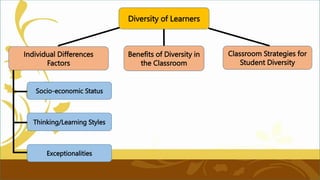
Individual Differences
Factors
Socio-economic Status
Thinking/Learning Styles
Exceptionalities
Classroom Strategies for
Student Diversity
Benefits of Diversity in
the Classroom
Teachers need to integrate various
educational ideas, perspectives, and
theories in planning instruction for all
types of students.
Ball (2000), pointed out that the
enormous complexities of today’s
world require a new vision for
schooling that responds to the needs
of the global and multicultural society
in which we live.
The classrooms are becoming more
complex and diverse (Shim 2011).
Teachers therefore play a significant
role in helping the students become
cosmopolitan members of society.
Understanding the learners is the first
thing that teachers should do before
planning and implementing of
instruction.
Factors that bring about Student Diversity
1. Socio-economic Status
2. Thinking/Learning Styles
Multiple Intelligences
Brain Hemispheres
3. Exceptionalities
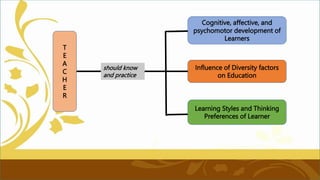
T
E
A
C
H
E
R
Cognitive, affective, and
psychomotor development of
Learners
Influence of Diversity factors
on Education
Learning Styles and Thinking
Preferences of Learner
should know
and practice
Cognitive, affective, and psychomotor
development of Learners
-Psychology provides us with studies,
theories, and principles about the
development and nature of every learner.
Influence of Diversity factors on
Education
-Students are responding to culturally
diverse individuals. Students are
becoming diverse. They have different
interests and issues too.
Influence of Diversity factors on
Education
-It is also important for teachers to instill
a global perspectives among students
exposing them to the histories,
languages, religious traditions, and
cultures of countries and other places.
Learning Styles and Thinking Preferences
of Learner
-Howard Gardner’s Multiple Intelligence
Theory (1981)
Benefits of Diversity in
the Classroom
1. Student’s self-awareness is enhanced
by Diversity
Exposing students to others with diverse
backgrounds and experiences also serves
to help students focus on their awareness
of themselves.
2. Student Diversity contributes to
Cognitive Development
The opportunity to gain access to the
perspectives of peers and to learn from other
students, rather than the instructor only, may
be especially important for promoting
learner’s cognitive development.
3. Student Diversity prepares learners for
their role as responsible members of
society
4. Student Diversity can promote
harmony
When student diversity is integrated into
the classroom teaching and learning
process, it can become a vehicle for
promoting harmonious race relations.
Classroom Strategies for
Student Diversity
1. Encourage learners to share their
personal history and experiences.
2. Integrate learning experiences and
activities which promote student’s
multicultural and cross-cultural
awareness.
3. Aside from highlighting diversity,
identify patterns of unity that
transcend group differences.
4. Communicate high expectations to
students from all subgroups.
5. Use varied instructional methods to
accommodate student diversity in
learning styles.
6. Vary the examples you use to illustrate
concepts in order to provide multiple
contexts that are relevant to students
from diverse backgrounds.
7. Adapt to students’ diverse backgrounds
and learning styles by allowing them
personal choice and decision-making
opportunities concerning what they will
learn and how they will learn it.
8. Diversify your methods of assessing
and evaluating student learning.
9. Purposely, form small-discussion
groups of students from diverse
backgrounds.
Prepared by:
Group 8-BSED 1-A
Jomar L. Pore
Maricar Gerez

Diversity of Learners.pptx

  • 1.
  • 2.
    Diversity of Learners IndividualDifferences Factors Socio-economic Status Thinking/Learning Styles Exceptionalities Classroom Strategies for Student Diversity Benefits of Diversity in the Classroom
  • 3.
    Teachers need tointegrate various educational ideas, perspectives, and theories in planning instruction for all types of students.
  • 4.
    Ball (2000), pointedout that the enormous complexities of today’s world require a new vision for schooling that responds to the needs of the global and multicultural society in which we live.
  • 5.
    The classrooms arebecoming more complex and diverse (Shim 2011). Teachers therefore play a significant role in helping the students become cosmopolitan members of society.
  • 6.
    Understanding the learnersis the first thing that teachers should do before planning and implementing of instruction.
  • 7.
    Factors that bringabout Student Diversity 1. Socio-economic Status 2. Thinking/Learning Styles Multiple Intelligences Brain Hemispheres 3. Exceptionalities
  • 8.
    T E A C H E R Cognitive, affective, and psychomotordevelopment of Learners Influence of Diversity factors on Education Learning Styles and Thinking Preferences of Learner should know and practice
  • 9.
    Cognitive, affective, andpsychomotor development of Learners -Psychology provides us with studies, theories, and principles about the development and nature of every learner.
  • 10.
    Influence of Diversityfactors on Education -Students are responding to culturally diverse individuals. Students are becoming diverse. They have different interests and issues too.
  • 11.
    Influence of Diversityfactors on Education -It is also important for teachers to instill a global perspectives among students exposing them to the histories, languages, religious traditions, and cultures of countries and other places.
  • 12.
    Learning Styles andThinking Preferences of Learner -Howard Gardner’s Multiple Intelligence Theory (1981)
  • 13.
    Benefits of Diversityin the Classroom
  • 14.
    1. Student’s self-awarenessis enhanced by Diversity Exposing students to others with diverse backgrounds and experiences also serves to help students focus on their awareness of themselves.
  • 15.
    2. Student Diversitycontributes to Cognitive Development The opportunity to gain access to the perspectives of peers and to learn from other students, rather than the instructor only, may be especially important for promoting learner’s cognitive development.
  • 16.
    3. Student Diversityprepares learners for their role as responsible members of society
  • 17.
    4. Student Diversitycan promote harmony When student diversity is integrated into the classroom teaching and learning process, it can become a vehicle for promoting harmonious race relations.
  • 18.
  • 19.
    1. Encourage learnersto share their personal history and experiences. 2. Integrate learning experiences and activities which promote student’s multicultural and cross-cultural awareness.
  • 20.
    3. Aside fromhighlighting diversity, identify patterns of unity that transcend group differences. 4. Communicate high expectations to students from all subgroups.
  • 21.
    5. Use variedinstructional methods to accommodate student diversity in learning styles. 6. Vary the examples you use to illustrate concepts in order to provide multiple contexts that are relevant to students from diverse backgrounds.
  • 22.
    7. Adapt tostudents’ diverse backgrounds and learning styles by allowing them personal choice and decision-making opportunities concerning what they will learn and how they will learn it.
  • 23.
    8. Diversify yourmethods of assessing and evaluating student learning. 9. Purposely, form small-discussion groups of students from diverse backgrounds.
  • 24.
    Prepared by: Group 8-BSED1-A Jomar L. Pore Maricar Gerez

Editor's Notes

  • #5 There is a need to prepare teachers who possess high level of knowledge and skills that include high level of cultural literacy that allows them to understand the nature and needs of every learner. ● the teacher must be train to have a broader knowledge and skills on how to deal to the differeces of the students and how to deal with them. Cultural Literacy-means that you as a teacher knows the differences of your learners and know how to deal with it.
  • #6 Cosmopolitan- showing an interest in different cultures, ideas, and etc. > that the students must know about many different cultures of the world. ●the teacher here must teach the student to be worldy or to be knowledgable in culture.
  • #7 Understanding the nature of the learners empowers every teachers to respond to the needs, learning styles, interests, and personality of the learners. ● in knowing who are your students, is helpful in planning effective instruction and in implementing learning activities.
  • #8 Socio-economic status- learners come from different family level: from high, average, and low income families Thinking/Learning styles- some of your learners learn better through seeing, hearing, and etc. ●multiple intelligences-- it is the word smart, music smart, self smart, people smart Who can inumerate the 9 multiple intellgences? Including the existential. I think it is already discussed by the past group. each individual possess one or more intelligence. Understanding these learning styles and thinking processes is essential Exceptionalities- some may have difficulties in seeing, hearing, and etc. ● includes learners with special needs, related to cignitive abilities, behavioral, social functioning, physical and sensory impairments, emitional distubance and giftedness.
  • #9 These are the things that teachers should know and practice to understand better your learners.
  • #10 Teachers should know developmental tasks and characteristics in order to understand each individual learner’s need, motivation, and interests. This task is also helpful in handling student’s behaviors and in managing classroom tasks. Cognitive--relating to, or involving conscious mental/intellectual ctivities (such as thinking, understanding, learning, and remembering)
  • #11 Diverse in terms of language, culture, socio-economic condition, learner styles religion, ability, etc.
  • #12 Teachers therefore need to understand all these diversity factors in order to teach students effectively. Instill--gradually cause someone to have (an attitude, feeling, etc.) ●This means that the teacher must expose students gradually about the global perspective, For the students to fully understand and accept
  • #13 This theory means that each individual possess one or more intelligence. Understanding these learning styles and thinking processes is essential in designing appropriate learning experiences, selecting learner-centered strategies, designing effective assessment tools, and etc.. Teacher’s and learner’s thinking/learning styles should match with each other.
  • #16 According to Supreme Court Justice William J. Brennan, “ The classroom is the marketplace of ideas”
  • #17 Suzanne Morse stresses one competency that has strong implications for instructional strategies that capitalize on diversity, and that, “The capacity ti imagine situations or problems from all perspectives and to appreciate all aspects of diversity