

Chapter 4: Probability
Probability
• Probability is the chance of an event
occurring.
• A probability experiment is a chance
process that leads to well-defined results
called outcomes.
• An outcome is the result of a single trial of
a probability experiment.
• A sample space is the set of all possible
outcomes of a probability experiment.
Example
• Find the sample space for tossing two coins.

• Find the sample space for tossing a coin and
rolling a die.
Example
• Use a tree diagram to determine the
outcomes of an experiment of tossing three
coins.
• An event is a set of outcomes. An event can
be one outcome or more than one outcome.
• An event with one outcome is called a simple
event.
• An event with more than one outcome is
called a compound event.
Example
• The event of drawing a card and getting a
queen of hearts is a _____________ event.

• The event of drawing a card and getting a
spade is a ____________ event
• Classical probability uses sample
spaces to determine the numerical
probability that an event will happen.
• Classical probability assumes that all
outcomes in the sample space are equally
likely to occur.
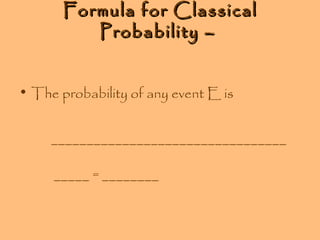
Formula for Classical
Probability –
• The probability of any event E is
_________________________________
_____ = ________
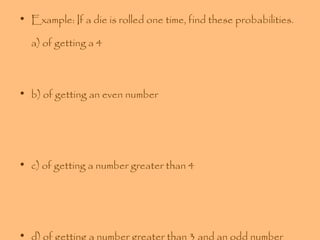
• Example: If a die is rolled one time, find these probabilities.
a) of getting a 4

• b) of getting an even number

• c) of getting a number greater than 4

• d) of getting a number greater than 3 and an odd number
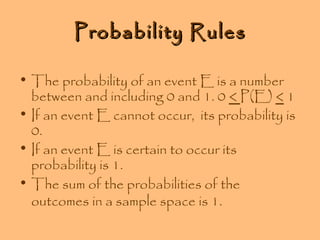
Probability Rules
• The probability of an event E is a number
between and including 0 and 1. 0 < P(E) < 1
• If an event E cannot occur, its probability is
0.
• If an event E is certain to occur its
probability is 1.
• The sum of the probabilities of the
outcomes in a sample space is 1.
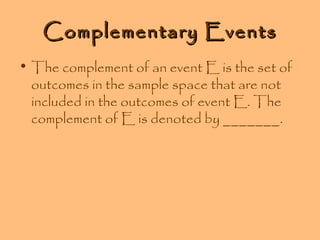
Complementary Events
• The complement of an event E is the set of
outcomes in the sample space that are not
included in the outcomes of event E. The
complement of E is denoted by _______.
Example
• Find the complement of each event.
• Flipping two coins and getting at least one
head

• Selecting a day of the week that has two
syllables.
Example
• Find the complement of each event.

– Rolling a die and getting a number greater than 4

– Drawing a card and getting a face card
Rule for Complementary
Events
• _______________
•
•
•

or

__________________ or
_______________
Examples
• An urn contains three red marbles, eight white
marbles and 3 green marbles. Find the probability
of selecting a marble that is not green.

• Two dice are tossed. Find the probability of not
getting doubles.
Classical vs. Empirical
Probability

• The difference between classical and
empirical probability is that classical
probability assumes that certain outcomes
are equally likely while empirical probability
relies on actual observation to determine the
likelihood of outcomes.
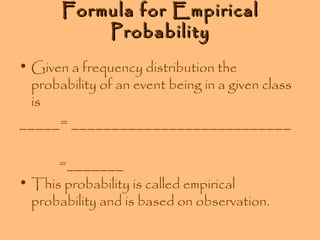
Formula for Empirical
Probability
• Given a frequency distribution the
probability of an event being in a given class
is
_____= ___________________________
=_______
• This probability is called empirical
probability and is based on observation.
Example:

• The director of the Readlot College Health Center
wishes to open an eye clinic. To justify the expense
of such a clinic, the director reports the probability
that a student selected at random from the college
roster needs corrective lenses. He took a random
sample of 500 students to compute this probability
and found that 375 of them need corrective lenses.
What is the probability that a Readlot College
student selected at random needs corrective lenses?
Example
• The Right to Health Lobby wants to make a claim
about the number of erroneous reports issued by a
medical lab in one low-cost health center. Suppose
they find in a random sample of 100 reports, 40
erroneous lab reports. What’s the probability that
a report issued by this health center is erroneous?
Law of Large Numbers
• As the number of trials increases the
empirical probability will approach the
theoretical probability.
Subjective Probability
• Subjective probability uses a probability
value based on an educated guess or
estimate, employing opinions and inexact
information.
Example
• Example: Classify each statement as an example
of classical probability, empirical probability, or
subjective probability.

• The probability that a person will watch the
6:00 news.
• The probability of winning at a chuck-a-luck
game is 5/36.
Example
• An instructor states that the probability of
passing the class, assuming that you pass the
first test is 85%.

• The probability that a bus will be in an
accident on a specific run is about 6%.
• The probability of getting a royal flush when
five cards are selected at random is
1/649,740.

• The probability that a student will get a C
or better in a statistics course is about 70%
• The probability that a new fast-food
restaurant will be a success in Chicago is
35%.

• The probability that interest rates will rise in
the next 6 months is 0.50.
The Addition Rule for
Probability

• Two events are mutually exclusive if they
cannot occur at the same time (i.e. they have
no outcomes in common).
Example: Mutual
Exclusiveness

• Determine whether these events are mutually
exclusive:
• Roll a die and get an even number, and get a
number less than 3
• Roll a die: Get a number greater than 3, and
get a number less than 3
Example: Mutual
Exclusiveness

• Select a student in your college: The
student is a sophomore, and the student is
a business major.

• Select a registered voter: The voter is a
Republican and the voter is a Democrat.
Addition Rule 1.
• When two events A and B are mutually
exclusive, the probability that A or B will
occur is
•
______________________________
Example:
• An automobile dealer has 10 Fords, 7
Buicks, and 5 Plymouths on her used car lot.
If a person purchases a used car, find the
probability that it is a Ford or a Buick?
Example:
• One card is randomly selected from a
standard 52-card deck. Find the probability
that the selected card is an ace or a king.
Example:
• An automobile dealership has found that 37
percent of its new car sales have been dealer
financed, 45 percent have been financed by
another institution, and 18 percent have been cash
sales. Find the probability that the next purchase
of a new car at this dealership will be either a cash
sale or dealer financed.
Addition Rule 2
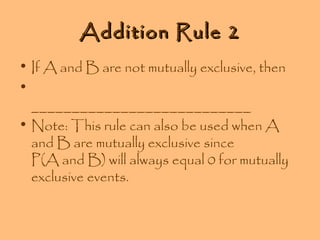
• If A and B are not mutually exclusive, then
•
___________________________
• Note: This rule can also be used when A
and B are mutually exclusive since
P(A and B) will always equal 0 for mutually
exclusive events.
Example
• The probability that a student owns a car is
0.65, and the probability that a student owns
a computer is 0.82. The probability that a
student owns both is 0.55.
• What is the probability that a given student
owns a car or a computer?
Example:

• The probability that a student owns a car is 0.65,
and the probability that a student owns a computer
is 0.82. The probability that a student owns both
is 0.55.

• What is the probability that a given student
owns neither a car nor a computer?
Example
• A single card is drawn from a deck. Find the
probability of selecting
• a four or a diamond
Example
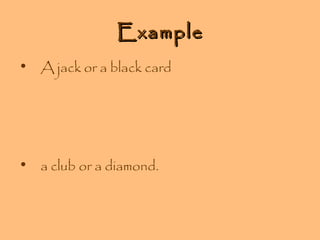
• A jack or a black card

• a club or a diamond.
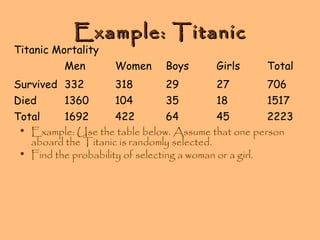
Example: Titanic

Titanic Mortality
Men

Women

Boys

Girls

Total

Survived 332

318

29

27

706

Died

104

35

18

1517

1360

Total
1692
422
64
45
2223
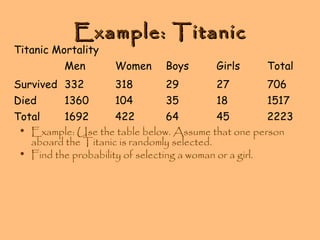
• Example: Use the table below. Assume that one person
aboard the Titanic is randomly selected.
• Find the probability of selecting a woman or a girl.
Example: Titanic

Titanic Mortality
Men

Women

Boys

Girls

Total

Survived 332

318

29

27

706

Died

104

35

18

1517

1360

Total
1692
422
64
45
2223
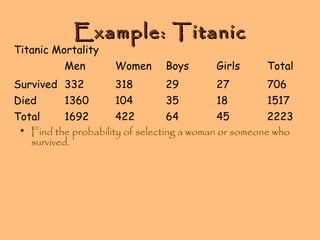
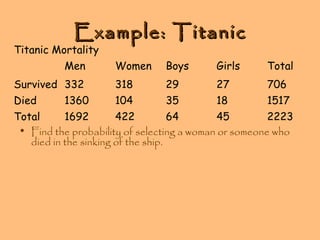
• Find the probability of selecting a woman or someone who
survived.
Example: Titanic

Titanic Mortality
Men

Women

Boys

Girls

Total

Survived 332

318

29

27

706

Died

104

35

18

1517

1360

Total
1692
422
64
45
2223
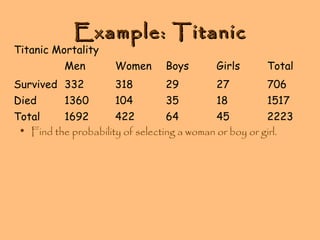
• Find the probability of selecting a woman or boy or girl.
Example: Titanic

Titanic Mortality
Men

Women

Boys

Girls

Total

Survived 332

318

29

27

706

Died

104

35

18

1517

1360

Total
1692
422
64
45
2223
• Find the probability of selecting a woman or someone who
died in the sinking of the ship.
Example: Titanic

Titanic Mortality
Men

Women

Boys

Girls

Total

Survived 332

318

29

27

706

Died

104

35

18

1517

1360

Total
1692
422
64
45
2223
• Example: Use the table below. Assume that one person
aboard the Titanic is randomly selected.
• Find the probability of selecting a woman or a girl.
Example

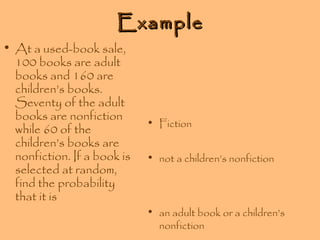
• At a used-book sale,
100 books are adult
books and 160 are
children’s books.
Seventy of the adult
books are nonfiction
while 60 of the
children’s books are
nonfiction. If a book is
selected at random,
find the probability
that it is

• Fiction
• not a children’s nonfiction

• an adult book or a children’s
nonfiction
4-4 The Multiplication Rules
and Conditional Probability

• Two events A and B are independent
events if the fact that A occurs does not
affect the probability of B occurring.
• Flipping a coin and getting heads
• Flipping a coin a second time and getting
heads
• Speeding while driving to class
• Getting a traffic ticket while driving to class
• Finding that your car will not start
• Finding that your kitchen light will not work
Multiplication Rule 1
• When two events are independent the
probability of both occurring is
________________________
Example:
• Find the probability of flipping a coin and
getting tails and rolling a die and getting a 6.
Example:
• One card is selected from a deck of 52
cards and replaced and then another card is
selected. Find the probability of selecting a
queen and then selecting a heart.
• Example: If 18% of all Americans are
underweight, find the probability that if three
Americans are selected at random, all will be
underweight.
• The Multiplication Rule 1 can be extended
to three or more independent events by using
the formula
• ______________________________
Example:
• The Gallup Poll reported that 52% of Americans
used a seat belt the last time they got into a car. If
four people are selected at random, find the
probability that they all used a seat belt the last
time they got into a car.
• When the outcome or occurrence of the first
event affects the outcome or occurrence of
the second event in such a way that the
probability is changed, the events are said to
be dependent events.
Conditional Probability
• The conditional probability of an event
B in relationship to an event A is the
probability that event B occurs after event
A has already occurred. The notation for
conditional probability is P(B|A).
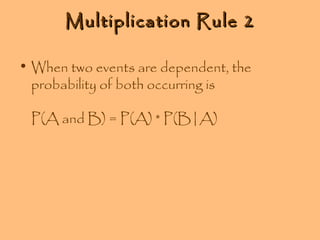
Multiplication Rule 2
• When two events are dependent, the
probability of both occurring is
P(A and B) = P(A) * P(B|A)
Example:
• If two cards are selected from a standard
deck of 52 cards without replacement, find
these probabilities.
• Both are spades
Example:
• If two cards are selected from a standard
deck of 52 cards without replacement, find
these probabilities.
• Both are kings
Example:
• If two cards are selected from a standard
deck of 52 cards without replacement, find
these probabilities.
• Both are the same suit
Example
• A flashlight has six batteries, two of which
are defective. If two are selected at random
without replacement, find the probability that
both are defective.
Example
• In a class containing twelve men and two
women, 2 students are selected at random to
given an impromptu speech. Find the
probability that both are men.
Example:
• An automobile manufacturer has three factories, A, B, and
C. They produce 50%, 30%, and 20%, respectively of a
specific model of car. Thirty percent of the cars produced
in factory A are white, 40% of those produced in factory B
are white, and 25% of those produced in factory C are
white. If an automobile produced by the company is selected
at random, find the probability that it is white.
Conditional Probability
• Conditional Probability – Derived from
formula for dependent events
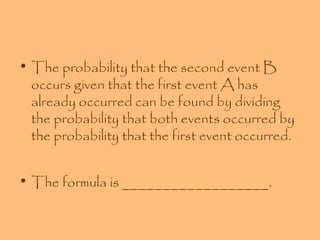
• The probability that the second event B
occurs given that the first event A has
already occurred can be found by dividing
the probability that both events occurred by
the probability that the first event occurred.
• The formula is __________________.
Example:
• At a small college, the probability that a
student takes physics and sociology is
0.092. The probability that a student takes
sociology is 0.73. Find the probability that
the student is taking physics, given that he or
she is taking sociology.
Example
• A circuit to run a model railroad has eight
switches. Two are defective. If a person
selects two switches at random and tests
them, find the probability that the second
one is defective, given that the first one is
defective.
Example
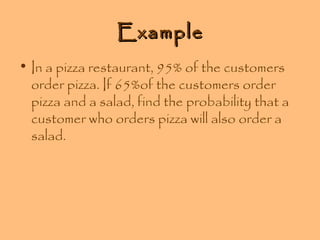
• In a pizza restaurant, 95% of the customers
order pizza. If 65%of the customers order
pizza and a salad, find the probability that a
customer who orders pizza will also order a
salad.
Example
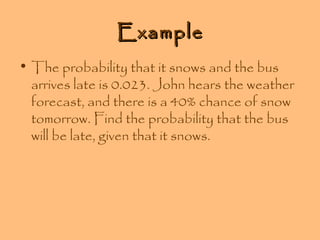
• The probability that it snows and the bus
arrives late is 0.023. John hears the weather
forecast, and there is a 40% chance of snow
tomorrow. Find the probability that the bus
will be late, given that it snows.
Example
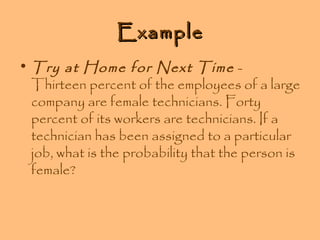
• Try at Home for Next Time Thirteen percent of the employees of a large
company are female technicians. Forty
percent of its workers are technicians. If a
technician has been assigned to a particular
job, what is the probability that the person is
female?
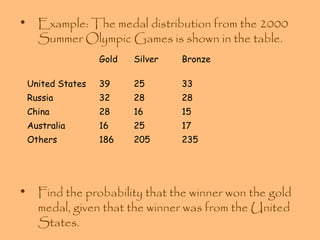
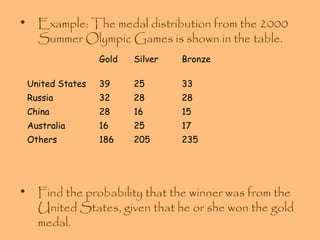
• Example: The medal distribution from the 2000
Summer Olympic Games is shown in the table.
Gold

Silver

Bronze

United States

39

25

33

Russia

32

28

28

China

28

16

15

Australia

16

25

17

Others

186

205

235

• Find the probability that the winner won the gold
medal, given that the winner was from the United
States.
• Example: The medal distribution from the 2000
Summer Olympic Games is shown in the table.
Gold

Silver

Bronze

United States

39

25

33

Russia

32

28

28

China

28

16

15

Australia

16

25

17

Others

186

205

235

• Find the probability that the winner was from the
United States, given that he or she won the gold
medal.
Example:

• Traffic entering an intersection can continue
straight ahead or turn right. Eighty percent of the
traffic flow is straight ahead. If a car continues
straight, the probability of a collision is 0.0004; if a
car turns right, the probability of a collision is
0.0036. Find the probability that a car entering the
intersection will have a collision.
Example:
• In situations where it is critical that a system function
properly, additional backup systems are usually provided.
Suppose a switch is used to activate a component in a
satellite. If the switch fails, then a second switch takes over
and activates the component. If each switch has a
probability of 0.002 of failing, what is the probability that
the component will be activated?
Example
• A vaccine has a 90% probability of being effective in
preventing a certain disease. The probability of
getting the disease if a person is not vaccinated is 50%.
In a certain geographic region, 25% of the people get
vaccinated. If a person is selected at random, find the
probability that he or she will contract the disease.
At Least One
• The complement of at least one is zero of
the same type.
Example:
• A game is played by drawing four cards from
an ordinary deck and replacing each card
after it is drawn. Find the probability of
winning if at least one ace is drawn.
Example
• A coin is tossed five times. Find the
probability of getting at least one tail.
Example
• It has been found that 40% of all people over the
age of 85 suffer from Alzheimer’s disease. If three
people over 85 are selected at random, find the
probability that at least one person does not suffer
from Alzheimer’s disease.
Example:
• Among a class of 25 students, find the
probability that at least two of them have the
same birthday.
Example:
• In a lab there are eight technicians. Three
are male and five are female. If three
technicians are selected, find the probability
that at least one is female.
Example:
• On a surprise quiz consisting of five truefalse questions, an unprepared student
guesses each answer. Find the probability
that he gets at least one correct.
Example:
• A medication is 75% effective against a
bacterial infection. Find the probability that
if 12 people take the medications, at least
one person’s infection will not improve.
Fundamental Counting Rule
• In a sequence of n events in which the first
one has k possibilities and the second has k2
possibilities and the third has k3 possiblities
and so fourth, the total number of
possibilities of the sequence would be
k1* k2 * k3. . . .
Example
• There are eight different statistics books, 6
different geometry books and 3 different
trigonometry books. A student must select
one book of each type. How many different
ways can this be done?
Example:
• A college bookstore offers a personal computer
system consisting of a computer, a monitor, and a
printer. A student has a choice of two computers,
three monitors, and two printers, all of which are
compatible. In how many ways can a computer
system be bundled?
• Factorial Formulas – For any counting
number, n,
•
n! = _________________
•

0! = _________________
Factorial Rule
• The arrangement of n objects is ________.
(This is a special case of the permutation
rule, where all n objects are being arranged.)
Example:
• You are hosting a dinner party for eight
people. In preparing the seating
arrangement, you would like to know the
number of different ways in which the guest
can be arranged.
Example:
• Five students are to give presentations in
class on a particular day. In how many ways
can the presentations be made?
Permutation
• A permutation is an arrangement of n
objects selected r at a time in a specific
order.
Example
• How many ordered seating arrangements
can be made for eight people in five chairs?
• The board of directors of a local college has
12 members. Three officers—president, vicepresident and treasurer—must be elected
from the members. How many different
possible slates of officers are there?
Combination
• A selection of distinct objects without
regard to order is called a combination.
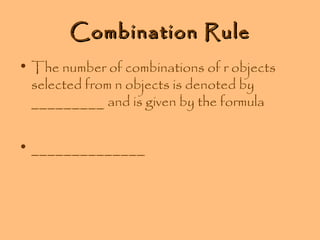
Combination Rule
• The number of combinations of r objects
selected from n objects is denoted by
_________ and is given by the formula
• ______________
Example:
• How many different 5-card poker hands can
be dealt from a standard deck of 52 cards?
Example:
• A professor grades homework by randomly
choosing 5 out of 12 homework problems to
grade. How many different groups of
problems can he possibly grade?
Example:
• A sales representative must visit four cities:
Omaha, Dallas, Wichita, and Oklahoma
City. There are air connections between
each of the cities. In how many orders can he
visit the cities?
Example
• A pizza shop offers a combination pizza
consisting of a choice of any three of the
four ingredients: pepperoni (P), mushrooms
(M), sausage (S), and anchovies (A).
Determine the number of possible
combination pizzas.
Example
• A professor grades homework by randomly
choosing 5 out of 12 homework problems to
grade. How many different groups of
problems can he possibly grade?
Example:
• There are three nursing positions to be filled at
Lilly Hospital. Position one is the day nursing
supervisor; position two is the night nursing
supervisor; and position three is the nursing
coordinator position. There are 15 candidates
qualified for all three of the positions. In how many
ways can the positions be filled by the applicants?
Example:
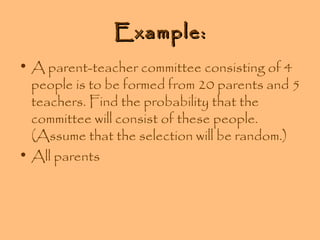
• A parent-teacher committee consisting of 4
people is to be formed from 20 parents and 5
teachers. Find the probability that the
committee will consist of these people.
(Assume that the selection will be random.)
• All teachers
Example:
• A parent-teacher committee consisting of 4
people is to be formed from 20 parents and 5
teachers. Find the probability that the
committee will consist of these people.
(Assume that the selection will be random.)
• 2 teachers and 2 parents
Example:
• A parent-teacher committee consisting of 4
people is to be formed from 20 parents and 5
teachers. Find the probability that the
committee will consist of these people.
(Assume that the selection will be random.)
• All parents
Example:
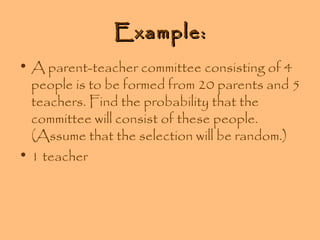
• A parent-teacher committee consisting of 4
people is to be formed from 20 parents and 5
teachers. Find the probability that the
committee will consist of these people.
(Assume that the selection will be random.)
• 1 teacher
Example:
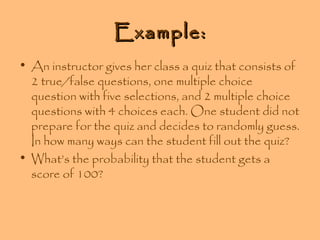
• An instructor gives her class a quiz that consists of
2 true/false questions, one multiple choice
question with five selections, and 2 multiple choice
questions with 4 choices each. One student did not
prepare for the quiz and decides to randomly guess.
In how many ways can the student fill out the quiz?
• What’s the probability that the student gets a
score of 100?
Example:
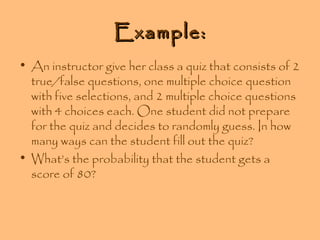
• An instructor give her class a quiz that consists of 2
true/false questions, one multiple choice question
with five selections, and 2 multiple choice questions
with 4 choices each. One student did not prepare
for the quiz and decides to randomly guess. In how
many ways can the student fill out the quiz?
• What’s the probability that the student gets a
score of 80?
Example:
• An insurance sales representative selects three
policies to review. The group of policies she can
select from contains 8 life policies, 5 automobile
polices, and 2 homeowner’s policies. Find the
probability of selecting:
• All life policies
Example:
• An insurance sales representative selects three
policies to review. The group of policies she can
select from contains 8 life policies, 5 automobile
polices, and 2 homeowner’s policies. Find the
probability of selecting:
• Both homeowner’s policies
Example:
• An insurance sales representative selects three
policies to review. The group of policies she can
select from contains 8 life policies, 5 automobile
polices, and 2 homeowner’s policies. Find the
probability of selecting:
• All automobile policies
Example:
• An insurance sales representative selects three
policies to review. The group of policies she can
select from contains 8 life policies, 5 automobile
polices, and 2 homeowner’s policies. Find the
probability of selecting:
• 1 of each policy.

Chapter 4- probability

  • 1.
  • 2.
    Probability • Probability isthe chance of an event occurring. • A probability experiment is a chance process that leads to well-defined results called outcomes. • An outcome is the result of a single trial of a probability experiment.
  • 3.
    • A samplespace is the set of all possible outcomes of a probability experiment.
  • 4.
    Example • Find thesample space for tossing two coins. • Find the sample space for tossing a coin and rolling a die.
  • 5.
    Example • Use atree diagram to determine the outcomes of an experiment of tossing three coins.
  • 6.
    • An eventis a set of outcomes. An event can be one outcome or more than one outcome. • An event with one outcome is called a simple event. • An event with more than one outcome is called a compound event.
  • 7.
    Example • The eventof drawing a card and getting a queen of hearts is a _____________ event. • The event of drawing a card and getting a spade is a ____________ event
  • 8.
    • Classical probabilityuses sample spaces to determine the numerical probability that an event will happen. • Classical probability assumes that all outcomes in the sample space are equally likely to occur.
  • 9.
    Formula for Classical Probability– • The probability of any event E is _________________________________ _____ = ________
  • 10.
    • Example: Ifa die is rolled one time, find these probabilities. a) of getting a 4 • b) of getting an even number • c) of getting a number greater than 4 • d) of getting a number greater than 3 and an odd number
  • 11.
    Probability Rules • Theprobability of an event E is a number between and including 0 and 1. 0 < P(E) < 1 • If an event E cannot occur, its probability is 0. • If an event E is certain to occur its probability is 1. • The sum of the probabilities of the outcomes in a sample space is 1.
  • 12.
    Complementary Events • Thecomplement of an event E is the set of outcomes in the sample space that are not included in the outcomes of event E. The complement of E is denoted by _______.
  • 13.
    Example • Find thecomplement of each event. • Flipping two coins and getting at least one head • Selecting a day of the week that has two syllables.
  • 14.
    Example • Find thecomplement of each event. – Rolling a die and getting a number greater than 4 – Drawing a card and getting a face card
  • 15.
    Rule for Complementary Events •_______________ • • • or __________________ or _______________
  • 16.
    Examples • An urncontains three red marbles, eight white marbles and 3 green marbles. Find the probability of selecting a marble that is not green. • Two dice are tossed. Find the probability of not getting doubles.
  • 17.
    Classical vs. Empirical Probability •The difference between classical and empirical probability is that classical probability assumes that certain outcomes are equally likely while empirical probability relies on actual observation to determine the likelihood of outcomes.
  • 18.
    Formula for Empirical Probability •Given a frequency distribution the probability of an event being in a given class is _____= ___________________________ =_______ • This probability is called empirical probability and is based on observation.
  • 19.
    Example: • The directorof the Readlot College Health Center wishes to open an eye clinic. To justify the expense of such a clinic, the director reports the probability that a student selected at random from the college roster needs corrective lenses. He took a random sample of 500 students to compute this probability and found that 375 of them need corrective lenses. What is the probability that a Readlot College student selected at random needs corrective lenses?
  • 20.
    Example • The Rightto Health Lobby wants to make a claim about the number of erroneous reports issued by a medical lab in one low-cost health center. Suppose they find in a random sample of 100 reports, 40 erroneous lab reports. What’s the probability that a report issued by this health center is erroneous?
  • 21.
    Law of LargeNumbers • As the number of trials increases the empirical probability will approach the theoretical probability.
  • 22.
    Subjective Probability • Subjectiveprobability uses a probability value based on an educated guess or estimate, employing opinions and inexact information.
  • 23.
    Example • Example: Classifyeach statement as an example of classical probability, empirical probability, or subjective probability. • The probability that a person will watch the 6:00 news. • The probability of winning at a chuck-a-luck game is 5/36.
  • 24.
    Example • An instructorstates that the probability of passing the class, assuming that you pass the first test is 85%. • The probability that a bus will be in an accident on a specific run is about 6%.
  • 25.
    • The probabilityof getting a royal flush when five cards are selected at random is 1/649,740. • The probability that a student will get a C or better in a statistics course is about 70%
  • 26.
    • The probabilitythat a new fast-food restaurant will be a success in Chicago is 35%. • The probability that interest rates will rise in the next 6 months is 0.50.
  • 27.
    The Addition Rulefor Probability • Two events are mutually exclusive if they cannot occur at the same time (i.e. they have no outcomes in common).
  • 28.
    Example: Mutual Exclusiveness • Determinewhether these events are mutually exclusive: • Roll a die and get an even number, and get a number less than 3 • Roll a die: Get a number greater than 3, and get a number less than 3
  • 29.
    Example: Mutual Exclusiveness • Selecta student in your college: The student is a sophomore, and the student is a business major. • Select a registered voter: The voter is a Republican and the voter is a Democrat.
  • 30.
    Addition Rule 1. •When two events A and B are mutually exclusive, the probability that A or B will occur is • ______________________________
  • 31.
    Example: • An automobiledealer has 10 Fords, 7 Buicks, and 5 Plymouths on her used car lot. If a person purchases a used car, find the probability that it is a Ford or a Buick?
  • 32.
    Example: • One cardis randomly selected from a standard 52-card deck. Find the probability that the selected card is an ace or a king.
  • 33.
    Example: • An automobiledealership has found that 37 percent of its new car sales have been dealer financed, 45 percent have been financed by another institution, and 18 percent have been cash sales. Find the probability that the next purchase of a new car at this dealership will be either a cash sale or dealer financed.
  • 34.
    Addition Rule 2 •If A and B are not mutually exclusive, then • ___________________________ • Note: This rule can also be used when A and B are mutually exclusive since P(A and B) will always equal 0 for mutually exclusive events.
  • 35.
    Example • The probabilitythat a student owns a car is 0.65, and the probability that a student owns a computer is 0.82. The probability that a student owns both is 0.55. • What is the probability that a given student owns a car or a computer?
  • 36.
    Example: • The probabilitythat a student owns a car is 0.65, and the probability that a student owns a computer is 0.82. The probability that a student owns both is 0.55. • What is the probability that a given student owns neither a car nor a computer?
  • 37.
    Example • A singlecard is drawn from a deck. Find the probability of selecting • a four or a diamond
  • 38.
    Example • A jackor a black card • a club or a diamond.
  • 39.
    Example: Titanic Titanic Mortality Men Women Boys Girls Total Survived332 318 29 27 706 Died 104 35 18 1517 1360 Total 1692 422 64 45 2223 • Example: Use the table below. Assume that one person aboard the Titanic is randomly selected. • Find the probability of selecting a woman or a girl.
  • 40.
    Example: Titanic Titanic Mortality Men Women Boys Girls Total Survived332 318 29 27 706 Died 104 35 18 1517 1360 Total 1692 422 64 45 2223 • Find the probability of selecting a woman or someone who survived.
  • 41.
    Example: Titanic Titanic Mortality Men Women Boys Girls Total Survived332 318 29 27 706 Died 104 35 18 1517 1360 Total 1692 422 64 45 2223 • Find the probability of selecting a woman or boy or girl.
  • 42.
    Example: Titanic Titanic Mortality Men Women Boys Girls Total Survived332 318 29 27 706 Died 104 35 18 1517 1360 Total 1692 422 64 45 2223 • Find the probability of selecting a woman or someone who died in the sinking of the ship.
  • 43.
    Example: Titanic Titanic Mortality Men Women Boys Girls Total Survived332 318 29 27 706 Died 104 35 18 1517 1360 Total 1692 422 64 45 2223 • Example: Use the table below. Assume that one person aboard the Titanic is randomly selected. • Find the probability of selecting a woman or a girl.
  • 44.
    Example • At aused-book sale, 100 books are adult books and 160 are children’s books. Seventy of the adult books are nonfiction while 60 of the children’s books are nonfiction. If a book is selected at random, find the probability that it is • Fiction • not a children’s nonfiction • an adult book or a children’s nonfiction
  • 45.
    4-4 The MultiplicationRules and Conditional Probability • Two events A and B are independent events if the fact that A occurs does not affect the probability of B occurring.
  • 46.
    • Flipping acoin and getting heads • Flipping a coin a second time and getting heads • Speeding while driving to class • Getting a traffic ticket while driving to class • Finding that your car will not start • Finding that your kitchen light will not work
  • 47.
    Multiplication Rule 1 •When two events are independent the probability of both occurring is ________________________
  • 48.
    Example: • Find theprobability of flipping a coin and getting tails and rolling a die and getting a 6.
  • 49.
    Example: • One cardis selected from a deck of 52 cards and replaced and then another card is selected. Find the probability of selecting a queen and then selecting a heart.
  • 50.
    • Example: If18% of all Americans are underweight, find the probability that if three Americans are selected at random, all will be underweight.
  • 51.
    • The MultiplicationRule 1 can be extended to three or more independent events by using the formula • ______________________________
  • 52.
    Example: • The GallupPoll reported that 52% of Americans used a seat belt the last time they got into a car. If four people are selected at random, find the probability that they all used a seat belt the last time they got into a car.
  • 53.
    • When theoutcome or occurrence of the first event affects the outcome or occurrence of the second event in such a way that the probability is changed, the events are said to be dependent events.
  • 54.
    Conditional Probability • Theconditional probability of an event B in relationship to an event A is the probability that event B occurs after event A has already occurred. The notation for conditional probability is P(B|A).
  • 55.
    Multiplication Rule 2 •When two events are dependent, the probability of both occurring is P(A and B) = P(A) * P(B|A)
  • 56.
    Example: • If twocards are selected from a standard deck of 52 cards without replacement, find these probabilities. • Both are spades
  • 57.
    Example: • If twocards are selected from a standard deck of 52 cards without replacement, find these probabilities. • Both are kings
  • 58.
    Example: • If twocards are selected from a standard deck of 52 cards without replacement, find these probabilities. • Both are the same suit
  • 59.
    Example • A flashlighthas six batteries, two of which are defective. If two are selected at random without replacement, find the probability that both are defective.
  • 60.
    Example • In aclass containing twelve men and two women, 2 students are selected at random to given an impromptu speech. Find the probability that both are men.
  • 61.
    Example: • An automobilemanufacturer has three factories, A, B, and C. They produce 50%, 30%, and 20%, respectively of a specific model of car. Thirty percent of the cars produced in factory A are white, 40% of those produced in factory B are white, and 25% of those produced in factory C are white. If an automobile produced by the company is selected at random, find the probability that it is white.
  • 62.
    Conditional Probability • ConditionalProbability – Derived from formula for dependent events
  • 63.
    • The probabilitythat the second event B occurs given that the first event A has already occurred can be found by dividing the probability that both events occurred by the probability that the first event occurred. • The formula is __________________.
  • 64.
    Example: • At asmall college, the probability that a student takes physics and sociology is 0.092. The probability that a student takes sociology is 0.73. Find the probability that the student is taking physics, given that he or she is taking sociology.
  • 65.
    Example • A circuitto run a model railroad has eight switches. Two are defective. If a person selects two switches at random and tests them, find the probability that the second one is defective, given that the first one is defective.
  • 66.
    Example • In apizza restaurant, 95% of the customers order pizza. If 65%of the customers order pizza and a salad, find the probability that a customer who orders pizza will also order a salad.
  • 67.
    Example • The probabilitythat it snows and the bus arrives late is 0.023. John hears the weather forecast, and there is a 40% chance of snow tomorrow. Find the probability that the bus will be late, given that it snows.
  • 68.
    Example • Try atHome for Next Time Thirteen percent of the employees of a large company are female technicians. Forty percent of its workers are technicians. If a technician has been assigned to a particular job, what is the probability that the person is female?
  • 69.
    • Example: Themedal distribution from the 2000 Summer Olympic Games is shown in the table. Gold Silver Bronze United States 39 25 33 Russia 32 28 28 China 28 16 15 Australia 16 25 17 Others 186 205 235 • Find the probability that the winner won the gold medal, given that the winner was from the United States.
  • 70.
    • Example: Themedal distribution from the 2000 Summer Olympic Games is shown in the table. Gold Silver Bronze United States 39 25 33 Russia 32 28 28 China 28 16 15 Australia 16 25 17 Others 186 205 235 • Find the probability that the winner was from the United States, given that he or she won the gold medal.
  • 71.
    Example: • Traffic enteringan intersection can continue straight ahead or turn right. Eighty percent of the traffic flow is straight ahead. If a car continues straight, the probability of a collision is 0.0004; if a car turns right, the probability of a collision is 0.0036. Find the probability that a car entering the intersection will have a collision.
  • 72.
    Example: • In situationswhere it is critical that a system function properly, additional backup systems are usually provided. Suppose a switch is used to activate a component in a satellite. If the switch fails, then a second switch takes over and activates the component. If each switch has a probability of 0.002 of failing, what is the probability that the component will be activated?
  • 73.
    Example • A vaccinehas a 90% probability of being effective in preventing a certain disease. The probability of getting the disease if a person is not vaccinated is 50%. In a certain geographic region, 25% of the people get vaccinated. If a person is selected at random, find the probability that he or she will contract the disease.
  • 74.
    At Least One •The complement of at least one is zero of the same type.
  • 75.
    Example: • A gameis played by drawing four cards from an ordinary deck and replacing each card after it is drawn. Find the probability of winning if at least one ace is drawn.
  • 76.
    Example • A coinis tossed five times. Find the probability of getting at least one tail.
  • 77.
    Example • It hasbeen found that 40% of all people over the age of 85 suffer from Alzheimer’s disease. If three people over 85 are selected at random, find the probability that at least one person does not suffer from Alzheimer’s disease.
  • 78.
    Example: • Among aclass of 25 students, find the probability that at least two of them have the same birthday.
  • 79.
    Example: • In alab there are eight technicians. Three are male and five are female. If three technicians are selected, find the probability that at least one is female.
  • 80.
    Example: • On asurprise quiz consisting of five truefalse questions, an unprepared student guesses each answer. Find the probability that he gets at least one correct.
  • 81.
    Example: • A medicationis 75% effective against a bacterial infection. Find the probability that if 12 people take the medications, at least one person’s infection will not improve.
  • 82.
    Fundamental Counting Rule •In a sequence of n events in which the first one has k possibilities and the second has k2 possibilities and the third has k3 possiblities and so fourth, the total number of possibilities of the sequence would be k1* k2 * k3. . . .
  • 83.
    Example • There areeight different statistics books, 6 different geometry books and 3 different trigonometry books. A student must select one book of each type. How many different ways can this be done?
  • 84.
    Example: • A collegebookstore offers a personal computer system consisting of a computer, a monitor, and a printer. A student has a choice of two computers, three monitors, and two printers, all of which are compatible. In how many ways can a computer system be bundled?
  • 85.
    • Factorial Formulas– For any counting number, n, • n! = _________________ • 0! = _________________
  • 86.
    Factorial Rule • Thearrangement of n objects is ________. (This is a special case of the permutation rule, where all n objects are being arranged.)
  • 87.
    Example: • You arehosting a dinner party for eight people. In preparing the seating arrangement, you would like to know the number of different ways in which the guest can be arranged.
  • 88.
    Example: • Five studentsare to give presentations in class on a particular day. In how many ways can the presentations be made?
  • 89.
    Permutation • A permutationis an arrangement of n objects selected r at a time in a specific order.
  • 90.
    Example • How manyordered seating arrangements can be made for eight people in five chairs?
  • 91.
    • The boardof directors of a local college has 12 members. Three officers—president, vicepresident and treasurer—must be elected from the members. How many different possible slates of officers are there?
  • 92.
    Combination • A selectionof distinct objects without regard to order is called a combination.
  • 93.
    Combination Rule • Thenumber of combinations of r objects selected from n objects is denoted by _________ and is given by the formula • ______________
  • 94.
    Example: • How manydifferent 5-card poker hands can be dealt from a standard deck of 52 cards?
  • 95.
    Example: • A professorgrades homework by randomly choosing 5 out of 12 homework problems to grade. How many different groups of problems can he possibly grade?
  • 96.
    Example: • A salesrepresentative must visit four cities: Omaha, Dallas, Wichita, and Oklahoma City. There are air connections between each of the cities. In how many orders can he visit the cities?
  • 97.
    Example • A pizzashop offers a combination pizza consisting of a choice of any three of the four ingredients: pepperoni (P), mushrooms (M), sausage (S), and anchovies (A). Determine the number of possible combination pizzas.
  • 98.
    Example • A professorgrades homework by randomly choosing 5 out of 12 homework problems to grade. How many different groups of problems can he possibly grade?
  • 99.
    Example: • There arethree nursing positions to be filled at Lilly Hospital. Position one is the day nursing supervisor; position two is the night nursing supervisor; and position three is the nursing coordinator position. There are 15 candidates qualified for all three of the positions. In how many ways can the positions be filled by the applicants?
  • 100.
    Example: • A parent-teachercommittee consisting of 4 people is to be formed from 20 parents and 5 teachers. Find the probability that the committee will consist of these people. (Assume that the selection will be random.) • All teachers
  • 101.
    Example: • A parent-teachercommittee consisting of 4 people is to be formed from 20 parents and 5 teachers. Find the probability that the committee will consist of these people. (Assume that the selection will be random.) • 2 teachers and 2 parents
  • 102.
    Example: • A parent-teachercommittee consisting of 4 people is to be formed from 20 parents and 5 teachers. Find the probability that the committee will consist of these people. (Assume that the selection will be random.) • All parents
  • 103.
    Example: • A parent-teachercommittee consisting of 4 people is to be formed from 20 parents and 5 teachers. Find the probability that the committee will consist of these people. (Assume that the selection will be random.) • 1 teacher
  • 104.
    Example: • An instructorgives her class a quiz that consists of 2 true/false questions, one multiple choice question with five selections, and 2 multiple choice questions with 4 choices each. One student did not prepare for the quiz and decides to randomly guess. In how many ways can the student fill out the quiz? • What’s the probability that the student gets a score of 100?
  • 105.
    Example: • An instructorgive her class a quiz that consists of 2 true/false questions, one multiple choice question with five selections, and 2 multiple choice questions with 4 choices each. One student did not prepare for the quiz and decides to randomly guess. In how many ways can the student fill out the quiz? • What’s the probability that the student gets a score of 80?
  • 106.
    Example: • An insurancesales representative selects three policies to review. The group of policies she can select from contains 8 life policies, 5 automobile polices, and 2 homeowner’s policies. Find the probability of selecting: • All life policies
  • 107.
    Example: • An insurancesales representative selects three policies to review. The group of policies she can select from contains 8 life policies, 5 automobile polices, and 2 homeowner’s policies. Find the probability of selecting: • Both homeowner’s policies
  • 108.
    Example: • An insurancesales representative selects three policies to review. The group of policies she can select from contains 8 life policies, 5 automobile polices, and 2 homeowner’s policies. Find the probability of selecting: • All automobile policies
  • 109.
    Example: • An insurancesales representative selects three policies to review. The group of policies she can select from contains 8 life policies, 5 automobile polices, and 2 homeowner’s policies. Find the probability of selecting: • 1 of each policy.