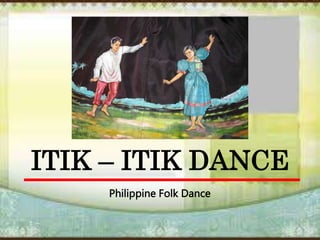
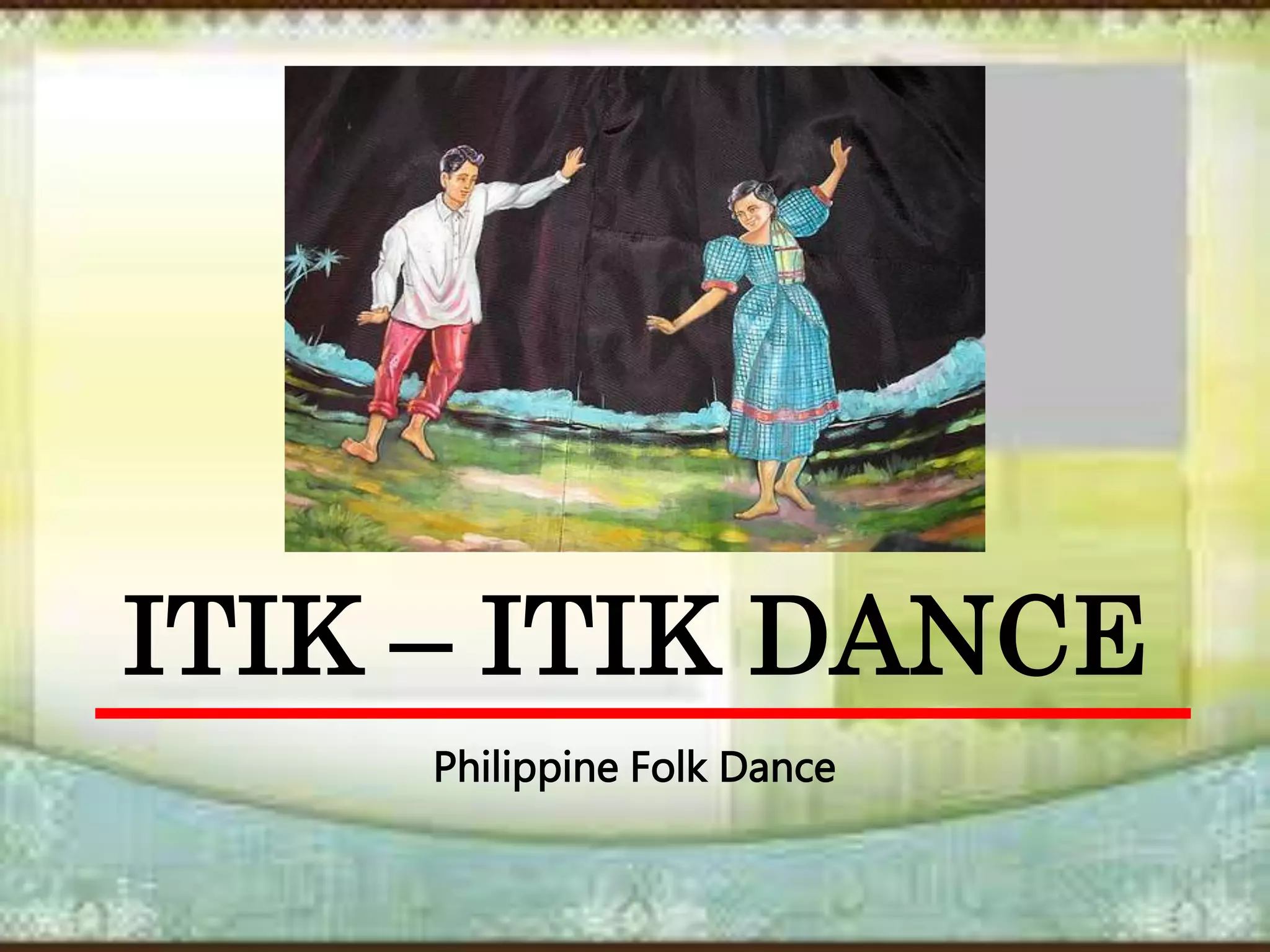
ITIK – ITIK DANCE
Philippine Folk Dance
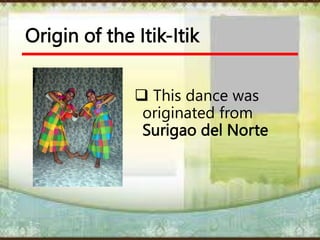
Origin of the Itik-Itik
 This dance was
originated from
Surigao del Norte
Origin of the Itik-Itik
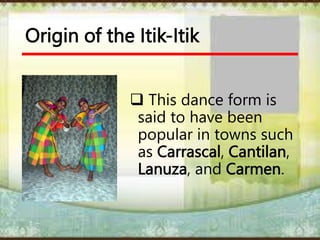
 This dance form is
said to have been
popular in towns such
as Carrascal, Cantilan,
Lanuza, and Carmen.
Origin of the Itik-Itik
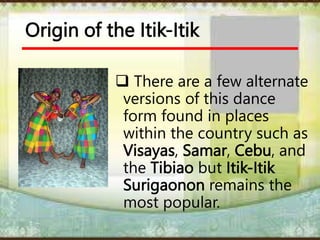
 There are a few alternate
versions of this dance
form found in places
within the country such as
Visayas, Samar, Cebu, and
the Tibiao but Itik-Itik
Surigaonon remains the
most popular.
What is Itik-Itik?
 Itik-Itik is a Philippines folk dance
form created by imitating the
“movements of a duck” such as
wading, flying, and short steps and
splashing water on their backs like
the ducks do.
Story of Itik-Itik
 According to story, this dance was
first created by a young Filipina
maiden-dancer of Surigao del Norte
named Kanang who was considered
to be best dancer in the Surigao
province.
Story of Itik-Itik
 Due to her dancing prowess,
Kanang was asked to perform the
Sibay – another important Filipino
dance performed during baptism
ceremony.
Story of Itik-Itik
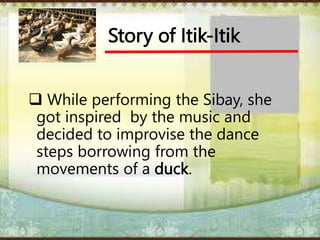
 While performing the Sibay, she
got inspired by the music and
decided to improvise the dance
steps borrowing from the
movements of a duck.
Story of Itik-Itik
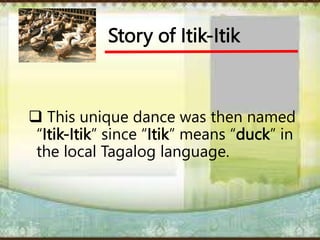
 This unique dance was then named
“Itik-Itik” since “Itik” means “duck” in
the local Tagalog language.
Costumes
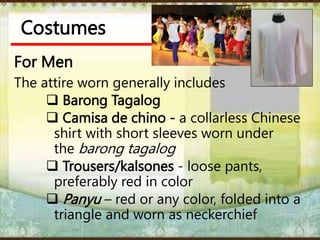
For Men
The attire worn generally includes
 Barong Tagalog
 Camisa de chino - a collarless Chinese
shirt with short sleeves worn under
the barong tagalog
 Trousers/kalsones - loose pants,
preferably red in color
 Panyu – red or any color, folded into a
triangle and worn as neckerchief
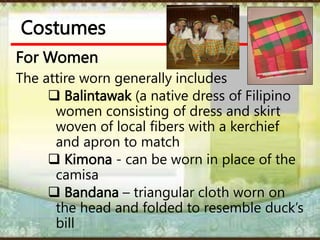
Costumes
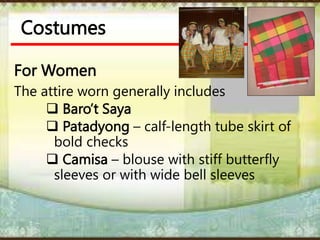
For Women
The attire worn generally includes
 Baro’t Saya
 Patadyong – calf-length tube skirt of
bold checks
 Camisa – blouse with stiff butterfly
sleeves or with wide bell sleeves
Costumes
For Women
The attire worn generally includes
 Balintawak (a native dress of Filipino
women consisting of dress and skirt
woven of local fibers with a kerchief
and apron to match
 Kimona - can be worn in place of the
camisa
 Bandana – triangular cloth worn on
the head and folded to resemble duck’s
bill
Basic Steps of Itik-Itik
1. Step to your left and raise your
left arm up in a flowing motion.
2. Step to your right and raise your
right arm up in a flowing motion.
3. Step forward and bring your
hands into your chest, bending
your elbows and making sure to
point your hands inward.
Basic Steps of Itik-Itik
4. Step in a circle as you sway your
arms to the right, then to the left.
5. Raise your arm and step hop to the
left.
6. Raise your arm and step hop to the
right.
7. Sway to the right, then to the left
8. Repeat all steps.

ITIK – ITIK DANCE.pptx

  • 1.
    ITIK – ITIKDANCE Philippine Folk Dance
  • 2.
    Origin of theItik-Itik  This dance was originated from Surigao del Norte
  • 3.
    Origin of theItik-Itik  This dance form is said to have been popular in towns such as Carrascal, Cantilan, Lanuza, and Carmen.
  • 4.
    Origin of theItik-Itik  There are a few alternate versions of this dance form found in places within the country such as Visayas, Samar, Cebu, and the Tibiao but Itik-Itik Surigaonon remains the most popular.
  • 5.
    What is Itik-Itik? Itik-Itik is a Philippines folk dance form created by imitating the “movements of a duck” such as wading, flying, and short steps and splashing water on their backs like the ducks do.
  • 6.
    Story of Itik-Itik According to story, this dance was first created by a young Filipina maiden-dancer of Surigao del Norte named Kanang who was considered to be best dancer in the Surigao province.
  • 7.
    Story of Itik-Itik Due to her dancing prowess, Kanang was asked to perform the Sibay – another important Filipino dance performed during baptism ceremony.
  • 8.
    Story of Itik-Itik While performing the Sibay, she got inspired by the music and decided to improvise the dance steps borrowing from the movements of a duck.
  • 9.
    Story of Itik-Itik This unique dance was then named “Itik-Itik” since “Itik” means “duck” in the local Tagalog language.
  • 10.
    Costumes For Men The attireworn generally includes  Barong Tagalog  Camisa de chino - a collarless Chinese shirt with short sleeves worn under the barong tagalog  Trousers/kalsones - loose pants, preferably red in color  Panyu – red or any color, folded into a triangle and worn as neckerchief
  • 11.
    Costumes For Women The attireworn generally includes  Baro’t Saya  Patadyong – calf-length tube skirt of bold checks  Camisa – blouse with stiff butterfly sleeves or with wide bell sleeves
  • 12.
    Costumes For Women The attireworn generally includes  Balintawak (a native dress of Filipino women consisting of dress and skirt woven of local fibers with a kerchief and apron to match  Kimona - can be worn in place of the camisa  Bandana – triangular cloth worn on the head and folded to resemble duck’s bill
  • 13.
    Basic Steps ofItik-Itik 1. Step to your left and raise your left arm up in a flowing motion. 2. Step to your right and raise your right arm up in a flowing motion. 3. Step forward and bring your hands into your chest, bending your elbows and making sure to point your hands inward.
  • 14.
    Basic Steps ofItik-Itik 4. Step in a circle as you sway your arms to the right, then to the left. 5. Raise your arm and step hop to the left. 6. Raise your arm and step hop to the right. 7. Sway to the right, then to the left 8. Repeat all steps.