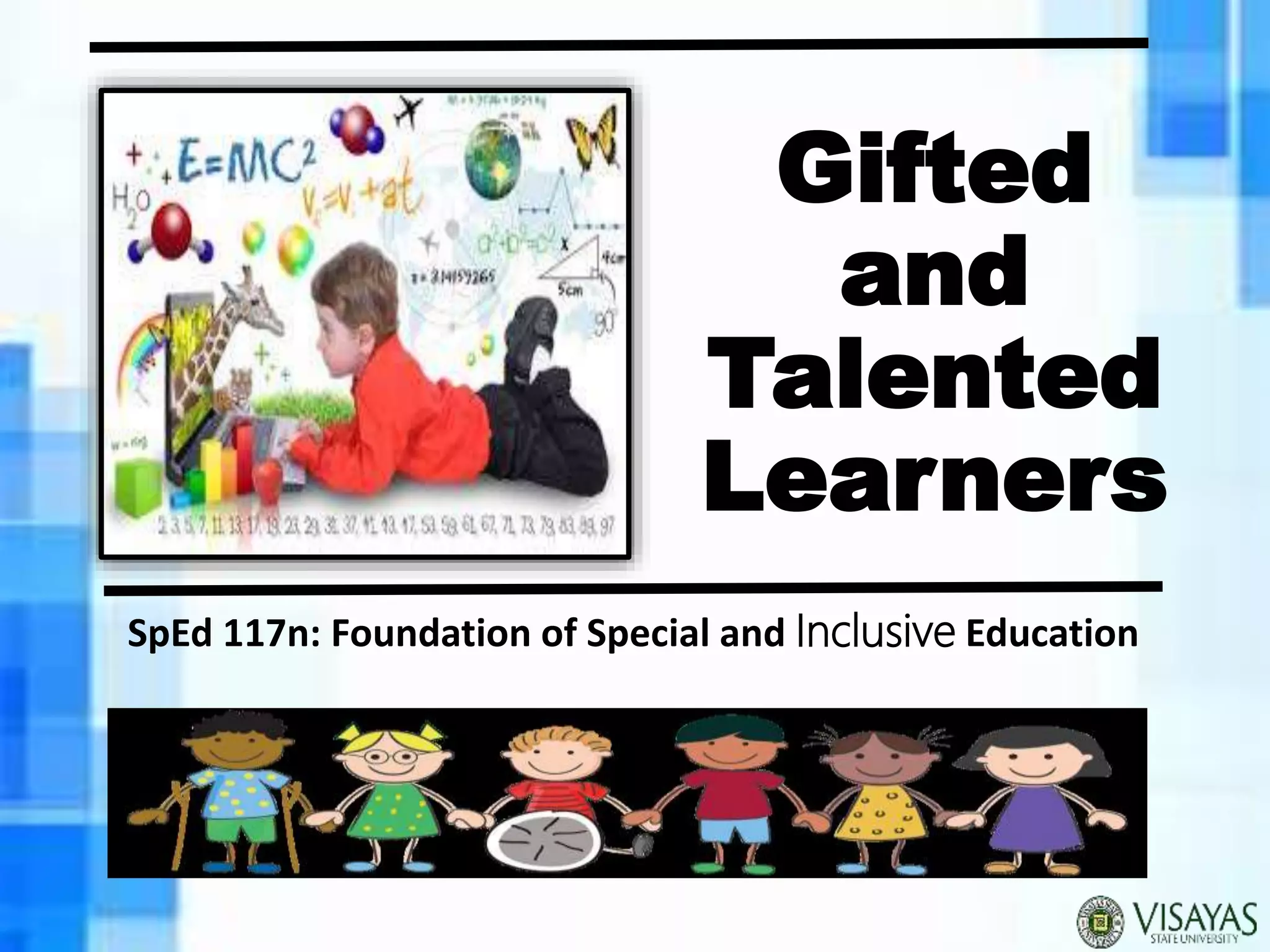
Gifted
and
Talented
Learners
SpEd 117n: Foundation of Special and Inclusive Education
 These are learners between the ages
of four and twenty-one whose abilities,
talents, and potential for
accomplishment are so exceptional or
developmentally advanced that they
require special provisions to meet their
educational programing needs.
Gifted
and Talented
Learners
 Gifted Learners
Those learners who have
extraordinary intellectual ability and
creativity
 Talented Learners
Those learners who have exceptional
skills and ability in a specific area such as
art, music, science, and language
Who are Gifted
and Talented
Learners?
Characteristics
 According to Mc Alpine & Reid (1996),
the characteristics of gifted and
talented students can be studied in
various sections:
Characteristics
1. Learning Characteristics
2. Self- Determination Characteristics
3. Creative Thinking Characteristics
4. Social Leadership Characteristics
5. Motivational Characteristics
Learning
Characteristics
Learner…
 displays logical and analytical thinking
 is quick to see patterns and
relationships
 masters information quickly
Learner…
 is sceptical of authoritarian
pronouncements
 questions arbitrary decisions
 pushes teachers and adults for
explanations
Self-Determination
Characteristics
Creative thinking
Characteristics
Learner…
 produces original ideas
 displays intellectual playfulness,
imagination, and fantasy
 creates original texts or invents things
Social Leadership
Characteristics
Learner…
 takes the initiative in social situations
 is popular with peers
 communicates well with others
Motivational
Characteristics
Learner…
 strives for high standards of personal
achievement
 is self – directed
 is highly self - motivated and sets
personal goals
Classroom Strategies
The subject or class teacher may
need to be aware of the school policy
and practice for gifted and talented
learners;
 refer to subject policy guidance on
working with gifted and talented
learners
 liaise with subject coordinators where
necessary
Classroom Strategies
 use a variety of forms of differentiation
in their teaching
 plan for the use of higher order
learning skills in their teaching
 consider and plan for different learning
styles
 set high expectations for the gifted and
talented learners
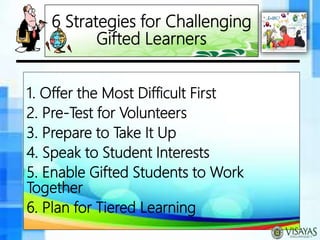
6 Strategies for Challenging
Gifted Learners
1. Offer the Most Difficult First
2. Pre-Test for Volunteers
3. Prepare to Take It Up
4. Speak to Student Interests
5. Enable Gifted Students to Work
Together
6. Plan for Tiered Learning
Serving Gifted Learners
Gifted learners typically finished work
early than regular students which caused
them to be bored. The dilemma came out
that there is a mismatched on the
academic needs and system of
instructional program
Here are the Do’s and Don'ts's for
teachers who serve gifted students
Serving Gifted Learners
Don’t…
 Use these students, whether formally
identified as gifted or not, as teacher
assistants.
 Expect the gifted student to be well
behaved.
 Give them more work because they
finish early.
Serving Gifted Learners
Don’t…
 Isolate them to work independently
without oversight.
 Expect a gifted child to be gifted in
every subject area.
Serving Gifted Learners
Do…
 Figure out in what area(s) students are
gifted.
 Ensure that task demands and
assessments are content rich.
 Find other gifted students and create
opportunities for them to work
together.
Serving Gifted Learners
Do…
 Learn about this special diverse
population of learners.
 Implement research-based curriculum
units.
Six Principles for Teaching
Gifted
1. Focus on unique pattern of strengths.
2. Group students by interests or abilities
at least part of the time
3. Encourage students to move as far
and as fast in the basic skills as
possible
Six Principles for Teaching
Gifted
4. Enrich individual interests
5. Offer mediation, counseling, mentoring
and facilitation
6. . Provide the tools for life-long learning
Activities to Try in Your
Gifted and Talented
Classroom
1. Explore Space
2. Virtual Archaeology
3. Write A Novel
4. Learn To Code
5. Work On Wall Street
Miralles, Victor A.
Pore, Jomar L
Moldes, Cristy
Gayas, Shiela Mae
Gerez, Maricar

Gifted and Talented Learners

  • 1.
    Gifted and Talented Learners SpEd 117n: Foundationof Special and Inclusive Education
  • 2.
     These arelearners between the ages of four and twenty-one whose abilities, talents, and potential for accomplishment are so exceptional or developmentally advanced that they require special provisions to meet their educational programing needs. Gifted and Talented Learners
  • 3.
     Gifted Learners Thoselearners who have extraordinary intellectual ability and creativity  Talented Learners Those learners who have exceptional skills and ability in a specific area such as art, music, science, and language Who are Gifted and Talented Learners?
  • 4.
    Characteristics  According toMc Alpine & Reid (1996), the characteristics of gifted and talented students can be studied in various sections:
  • 5.
    Characteristics 1. Learning Characteristics 2.Self- Determination Characteristics 3. Creative Thinking Characteristics 4. Social Leadership Characteristics 5. Motivational Characteristics
  • 6.
    Learning Characteristics Learner…  displays logicaland analytical thinking  is quick to see patterns and relationships  masters information quickly
  • 7.
    Learner…  is scepticalof authoritarian pronouncements  questions arbitrary decisions  pushes teachers and adults for explanations Self-Determination Characteristics
  • 8.
    Creative thinking Characteristics Learner…  producesoriginal ideas  displays intellectual playfulness, imagination, and fantasy  creates original texts or invents things
  • 9.
    Social Leadership Characteristics Learner…  takesthe initiative in social situations  is popular with peers  communicates well with others
  • 10.
    Motivational Characteristics Learner…  strives forhigh standards of personal achievement  is self – directed  is highly self - motivated and sets personal goals
  • 11.
    Classroom Strategies The subjector class teacher may need to be aware of the school policy and practice for gifted and talented learners;  refer to subject policy guidance on working with gifted and talented learners  liaise with subject coordinators where necessary
  • 12.
    Classroom Strategies  usea variety of forms of differentiation in their teaching  plan for the use of higher order learning skills in their teaching  consider and plan for different learning styles  set high expectations for the gifted and talented learners
  • 13.
    6 Strategies forChallenging Gifted Learners 1. Offer the Most Difficult First 2. Pre-Test for Volunteers 3. Prepare to Take It Up 4. Speak to Student Interests 5. Enable Gifted Students to Work Together 6. Plan for Tiered Learning
  • 14.
    Serving Gifted Learners Giftedlearners typically finished work early than regular students which caused them to be bored. The dilemma came out that there is a mismatched on the academic needs and system of instructional program Here are the Do’s and Don'ts's for teachers who serve gifted students
  • 15.
    Serving Gifted Learners Don’t… Use these students, whether formally identified as gifted or not, as teacher assistants.  Expect the gifted student to be well behaved.  Give them more work because they finish early.
  • 16.
    Serving Gifted Learners Don’t… Isolate them to work independently without oversight.  Expect a gifted child to be gifted in every subject area.
  • 17.
    Serving Gifted Learners Do… Figure out in what area(s) students are gifted.  Ensure that task demands and assessments are content rich.  Find other gifted students and create opportunities for them to work together.
  • 18.
    Serving Gifted Learners Do… Learn about this special diverse population of learners.  Implement research-based curriculum units.
  • 19.
    Six Principles forTeaching Gifted 1. Focus on unique pattern of strengths. 2. Group students by interests or abilities at least part of the time 3. Encourage students to move as far and as fast in the basic skills as possible
  • 20.
    Six Principles forTeaching Gifted 4. Enrich individual interests 5. Offer mediation, counseling, mentoring and facilitation 6. . Provide the tools for life-long learning
  • 21.
    Activities to Tryin Your Gifted and Talented Classroom 1. Explore Space 2. Virtual Archaeology 3. Write A Novel 4. Learn To Code 5. Work On Wall Street
  • 22.
    Miralles, Victor A. Pore,Jomar L Moldes, Cristy Gayas, Shiela Mae Gerez, Maricar

Editor's Notes

  • #12 the subject or class teacher may need to be aware of the school policy and practice for Gifted and Talented pupils
  • #13 the subject or class teacher may need to be aware of the school policy and practice for Gifted and Talented pupils