Text Analysis of Teacher Texts
Doing Text Analysis of Teacher Feedback
PAGES 122-124
The benefits of teacher feedback on student essays have been
widely debated, with some questioning its value.
Frequently the criticismof teacher feedback arises from the
belief that teacher comments are vague andconfusing to
students.
Clearly any study of the effectiveness of teacher comments
depends on the ability to categorize the type of feedback
that teachers give students andto assess the effect of such
feedback on the development of students’ writing.
One study that attempts to do this is Ferris (1997). In
this study, Ferris examined over 1,600 marginal and end
comments written by teachers on 110 drafts of student
essays written by 47 advanced L2 students.
She then analyzed the length of the written feedback,
the type of comments made, the use of hedges, and
whether or not the comments were text specific. In
reference to the type of comments teachers wrote, she
developed the following categories.
1. Ask for information/question
Did you work out this problem with your roommates?
2. Make a request/question
Can you provide a thesis statement here—What did you learn from this?
3. Make a request/statement
This paragraph might be better earlier in the essay.
4. Make a request/imperative
Mention what Zinsser says about parental pressure.
5. Give information/question
Most states do allow a waiting period before an adoption is final—Do you feel that
all such laws are wrong?
6. Give information/statement
Lowa law favors parental rights. Michigan and California consider the best interests
of the child.
7. Make a positive comment/statement or exclamation
A nice start to your essay! You’ve done an impressive job of finding facts and quotes
to support your argument.
8.Make a grammar/mechanics comment/question/statement or imperative Past or
present tense?
a. Your verb tenses are confusing me in this paragraph.
b. Don’t forget to spell-check! (p. 321)
• Ferris then assessed the impact of these comments on student
revisions.
• She developed a subjective rating scale based on the degree to
which students utilized the comments to revise their essays by
making no attempt, a minimal attempt, or a substantive attempt
to address the comment.
• analyzed the changes students made to determine whether or not
they improved the paper, had mixed effects, or negligible or
negative effects on the essay.
• she found that the changes students made in response to
teachers’ comments tended to improve the students’ papers
and that marginal requests for information, requests
(regardless of their grammatical form), and summary
comments on grammar led to the most substantive changes.
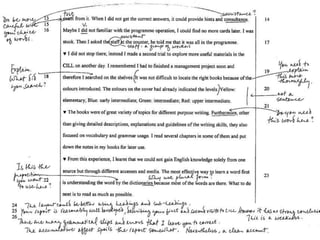
An Investigation into the Effectiveness of Teacher
Feedback on Student Writing
Liz Hamp-Lyonsand JuliaChen
The Hong Kong PolytechnicUniversity
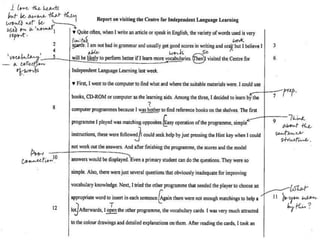
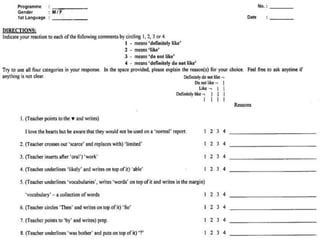
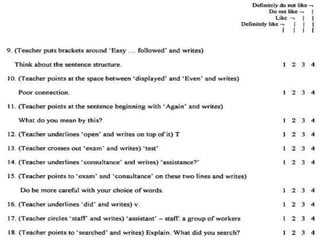
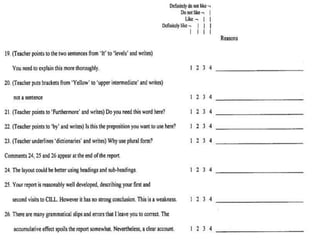
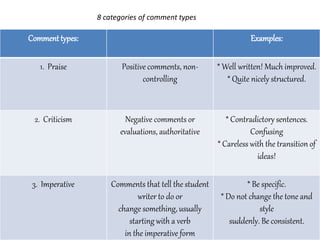
8 categories of comment types
Comment types: Examples:
1. Praise Positive comments, non-
controlling
* Well written! Much improved.
* Quite nicely structured.
2. Criticism Negative comments or
evaluations, authoritative
* Contradictory sentences.
Confusing
* Careless with the transition of
ideas!
3. Imperative Comments that tell the student
writer to do or
change something, usually
starting with a verb
in the imperative form
* Be specific.
* Do not change the tone and
style
suddenly. Be consistent.
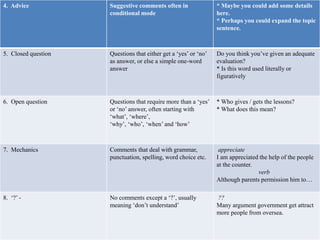
4. Advice Suggestive comments often in
conditional mode
* Maybe you could add some details
here.
* Perhaps you could expand the topic
sentence.
5. Closed question Questions that either get a ‘yes’ or ‘no’
as answer, or else a simple one-word
answer
Do you think you’ve given an adequate
evaluation?
* Is this word used literally or
figuratively
6. Open question Questions that require more than a ‘yes’
or ‘no’ answer, often starting with
‘what’, ‘where’,
‘why’, ‘who’, ‘when’ and ‘how’
* Who gives / gets the lessons?
* What does this mean?
7. Mechanics Comments that deal with grammar,
punctuation, spelling, word choice etc.
appreciate
I am appreciated the help of the people
at the counter.
verb
Although parents permission him to…
8. ‘?’ - No comments except a ‘?’, usually
meaning ‘don’t understand’
??
Many argument government get attract
more people from oversea.
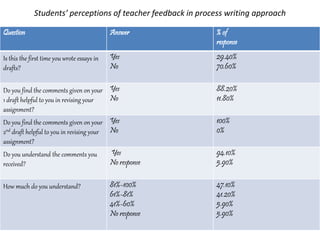
Students’ perceptions of teacher feedback in process writing approach
Question Answer % of
response
Is this the first time you wrote essays in
drafts?
Yes
No
29.40%
70.60%
Do you find the comments given on your
1 draft helpful to you in revising your
assignment?
Yes
No
88.20%
11.80%
Do you find the comments given on your
2nd draft helpful to you in revising your
assignment?
Yes
No
100%
0%
Do you understand the comments you
received?
Yes
No response
94.10%
5.90%
How much do you understand? 81%-100%
61%-81%
41%-60%
No response
47.10%
41.20%
5.90%
5.90%
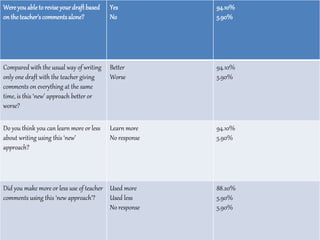
Wereyou able to revise yourdraft based
on theteacher’scommentsalone?
Yes
No
94.10%
5.90%
Compared with the usual way of writing
only one draft with the teacher giving
comments on everything at the same
time, is this ‘new’ approach better or
worse?
Better
Worse
94.10%
5.90%
Do you think you can learn more or less
about writing using this ‘new’
approach?
Learn more
No response
94.10%
5.90%
Did you make more or less use of teacher
comments using this ‘new approach’?
Used more
Used less
No response
88.20%
5.90%
5.90%
THANK YOU

Text analysis of teacher texts

  • 1.
    Text Analysis ofTeacher Texts Doing Text Analysis of Teacher Feedback PAGES 122-124
  • 2.
    The benefits ofteacher feedback on student essays have been widely debated, with some questioning its value. Frequently the criticismof teacher feedback arises from the belief that teacher comments are vague andconfusing to students. Clearly any study of the effectiveness of teacher comments depends on the ability to categorize the type of feedback that teachers give students andto assess the effect of such feedback on the development of students’ writing.
  • 3.
    One study thatattempts to do this is Ferris (1997). In this study, Ferris examined over 1,600 marginal and end comments written by teachers on 110 drafts of student essays written by 47 advanced L2 students. She then analyzed the length of the written feedback, the type of comments made, the use of hedges, and whether or not the comments were text specific. In reference to the type of comments teachers wrote, she developed the following categories.
  • 4.
    1. Ask forinformation/question Did you work out this problem with your roommates? 2. Make a request/question Can you provide a thesis statement here—What did you learn from this? 3. Make a request/statement This paragraph might be better earlier in the essay. 4. Make a request/imperative Mention what Zinsser says about parental pressure. 5. Give information/question Most states do allow a waiting period before an adoption is final—Do you feel that all such laws are wrong?
  • 5.
    6. Give information/statement Lowalaw favors parental rights. Michigan and California consider the best interests of the child. 7. Make a positive comment/statement or exclamation A nice start to your essay! You’ve done an impressive job of finding facts and quotes to support your argument. 8.Make a grammar/mechanics comment/question/statement or imperative Past or present tense? a. Your verb tenses are confusing me in this paragraph. b. Don’t forget to spell-check! (p. 321)
  • 6.
    • Ferris thenassessed the impact of these comments on student revisions. • She developed a subjective rating scale based on the degree to which students utilized the comments to revise their essays by making no attempt, a minimal attempt, or a substantive attempt to address the comment. • analyzed the changes students made to determine whether or not they improved the paper, had mixed effects, or negligible or negative effects on the essay.
  • 7.
    • she foundthat the changes students made in response to teachers’ comments tended to improve the students’ papers and that marginal requests for information, requests (regardless of their grammatical form), and summary comments on grammar led to the most substantive changes.
  • 8.
    An Investigation intothe Effectiveness of Teacher Feedback on Student Writing Liz Hamp-Lyonsand JuliaChen The Hong Kong PolytechnicUniversity
  • 14.
    8 categories ofcomment types Comment types: Examples: 1. Praise Positive comments, non- controlling * Well written! Much improved. * Quite nicely structured. 2. Criticism Negative comments or evaluations, authoritative * Contradictory sentences. Confusing * Careless with the transition of ideas! 3. Imperative Comments that tell the student writer to do or change something, usually starting with a verb in the imperative form * Be specific. * Do not change the tone and style suddenly. Be consistent.
  • 15.
    4. Advice Suggestivecomments often in conditional mode * Maybe you could add some details here. * Perhaps you could expand the topic sentence. 5. Closed question Questions that either get a ‘yes’ or ‘no’ as answer, or else a simple one-word answer Do you think you’ve given an adequate evaluation? * Is this word used literally or figuratively 6. Open question Questions that require more than a ‘yes’ or ‘no’ answer, often starting with ‘what’, ‘where’, ‘why’, ‘who’, ‘when’ and ‘how’ * Who gives / gets the lessons? * What does this mean? 7. Mechanics Comments that deal with grammar, punctuation, spelling, word choice etc. appreciate I am appreciated the help of the people at the counter. verb Although parents permission him to… 8. ‘?’ - No comments except a ‘?’, usually meaning ‘don’t understand’ ?? Many argument government get attract more people from oversea.
  • 16.
    Students’ perceptions ofteacher feedback in process writing approach Question Answer % of response Is this the first time you wrote essays in drafts? Yes No 29.40% 70.60% Do you find the comments given on your 1 draft helpful to you in revising your assignment? Yes No 88.20% 11.80% Do you find the comments given on your 2nd draft helpful to you in revising your assignment? Yes No 100% 0% Do you understand the comments you received? Yes No response 94.10% 5.90% How much do you understand? 81%-100% 61%-81% 41%-60% No response 47.10% 41.20% 5.90% 5.90%
  • 17.
    Wereyou able torevise yourdraft based on theteacher’scommentsalone? Yes No 94.10% 5.90% Compared with the usual way of writing only one draft with the teacher giving comments on everything at the same time, is this ‘new’ approach better or worse? Better Worse 94.10% 5.90% Do you think you can learn more or less about writing using this ‘new’ approach? Learn more No response 94.10% 5.90% Did you make more or less use of teacher comments using this ‘new approach’? Used more Used less No response 88.20% 5.90% 5.90%
  • 18.