1
MAIN VERBS AND MODAL AUXILIARIES: CAN AND MAY
Introduction
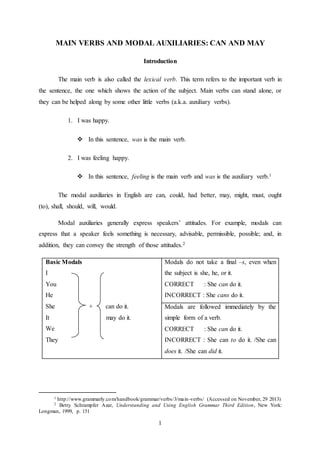
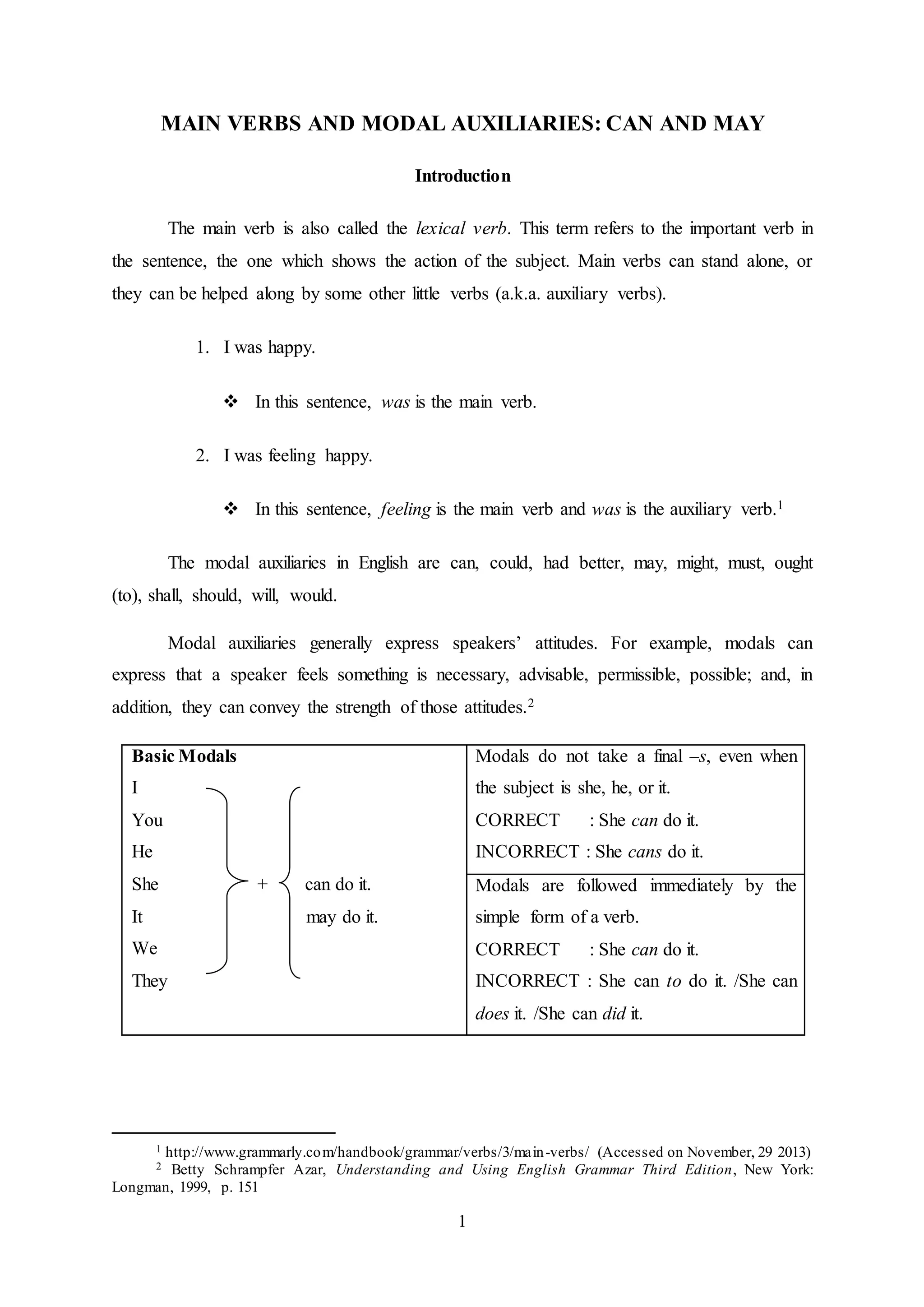
The main verb is also called the lexical verb. This term refers to the important verb in
the sentence, the one which shows the action of the subject. Main verbs can stand alone, or
they can be helped along by some other little verbs (a.k.a. auxiliary verbs).
1. I was happy.
 In this sentence, was is the main verb.
2. I was feeling happy.
 In this sentence, feeling is the main verb and was is the auxiliary verb.1
The modal auxiliaries in English are can, could, had better, may, might, must, ought
(to), shall, should, will, would.
Modal auxiliaries generally express speakers’ attitudes. For example, modals can
express that a speaker feels something is necessary, advisable, permissible, possible; and, in
addition, they can convey the strength of those attitudes.2
Basic Modals
I
You
He
She + can do it.
It may do it.
We
They
Modals do not take a final –s, even when
the subject is she, he, or it.
CORRECT : She can do it.
INCORRECT : She cans do it.
Modals are followed immediately by the
simple form of a verb.
CORRECT : She can do it.
INCORRECT : She can to do it. /She can
does it. /She can did it.
1 http://www.grammarly.com/handbook/grammar/verbs/3/main-verbs/ (Accessed on November, 29 2013)
2 Betty Schrampfer Azar, Understanding and Using English Grammar Third Edition, New York:
Longman, 1999, p. 151
2
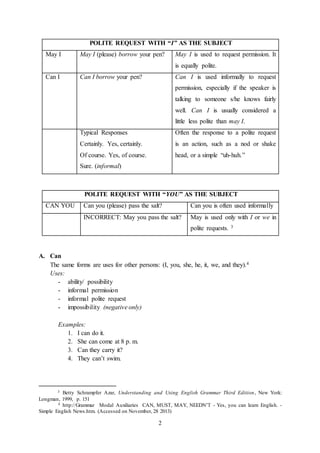
POLITE REQUEST WITH “I” AS THE SUBJECT
May I May I (please) borrow your pen? May I is used to request permission. It
is equally polite.
Can I Can I borrow your pen? Can I is used informally to request
permission, especially if the speaker is
talking to someone s/he knows fairly
well. Can I is usually considered a
little less polite than may I.
Typical Responses
Certainly. Yes, certainly.
Of course. Yes, of course.
Sure. (informal)
Often the response to a polite request
is an action, such as a nod or shake
head, or a simple “uh-huh.”
POLITE REQUEST WITH “YOU” AS THE SUBJECT
CAN YOU Can you (please) pass the salt? Can you is often used informally
INCORRECT: May you pass the salt? May is used only with I or we in
polite requests. 3
A. Can
The same forms are uses for other persons: (I, you, she, he, it, we, and they).4
Uses:
- ability/ possibility
- informal permission
- informal polite request
- impossibility (negative only)
Examples:
1. I can do it.
2. She can come at 8 p. m.
3. Can they carry it?
4. They can’t swim.
3 Betty Schrampfer Azar, Understanding and Using English Grammar Third Edition, New York:
Longman, 1999, p. 151
4 http://Grammar Modal Auxiliaries CAN, MUST, MAY, NEEDN’T - Yes, you can learn English. -
Simple English News.htm. (Accessed on November, 28 2013)
3
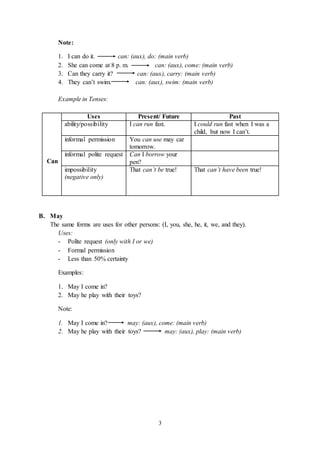
Note:
1. I can do it. can: (aux), do: (main verb)
2. She can come at 8 p. m. can: (aux), come: (main verb)
3. Can they carry it? can: (aux), carry: (main verb)
4. They can’t swim. can: (aux), swim: (main verb)
Example in Tenses:
Can
Uses Present/ Future Past
ability/possibility I can run fast. I could run fast when I was a
child, but now I can’t.
informal permission You can use may car
tomorrow.
informal polite request Can I borrow your
pen?
impossibility
(negative only)
That can’t be true! That can’t have been true!
B. May
The same forms are uses for other persons: (I, you, she, he, it, we, and they).
Uses:
- Polite request (only with I or we)
- Formal permission
- Less than 50% certainty
Examples:
1. May I come in?
2. May he play with their toys?
Note:
1. May I come in? may: (aux), come: (main verb)
2. May he play with their toys? may: (aux), play: (main verb)
4
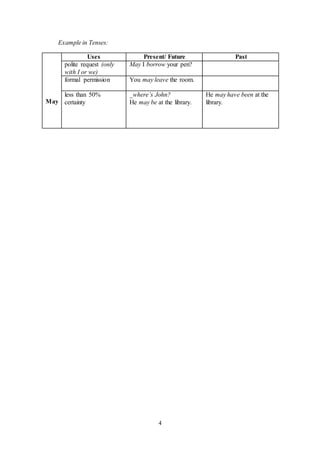
Example in Tenses:
May
Uses Present/ Future Past
polite request (only
with I or we)
May I borrow your pen?
formal permission You may leave the room.
less than 50%
certainty
_where’s John?
He may be at the library.
He may have been at the
library.
5
REFERENCES
http://www.grammarly.com/handbook/grammar/verbs/3/main-verbs/ (Accessed on November, 29
2013)
Azar, B. S. Understanding and Using English Grammar Third Edition, New York: Longman, 1999
http://Grammar Modal Auxiliaries CAN, MUST, MAY, NEEDN’T - Yes, you can learn English. -
Simple English News.htm. (Accessed on November, 28 2013)

Modal auxiliaries

  • 1.
    1 MAIN VERBS ANDMODAL AUXILIARIES: CAN AND MAY Introduction The main verb is also called the lexical verb. This term refers to the important verb in the sentence, the one which shows the action of the subject. Main verbs can stand alone, or they can be helped along by some other little verbs (a.k.a. auxiliary verbs). 1. I was happy.  In this sentence, was is the main verb. 2. I was feeling happy.  In this sentence, feeling is the main verb and was is the auxiliary verb.1 The modal auxiliaries in English are can, could, had better, may, might, must, ought (to), shall, should, will, would. Modal auxiliaries generally express speakers’ attitudes. For example, modals can express that a speaker feels something is necessary, advisable, permissible, possible; and, in addition, they can convey the strength of those attitudes.2 Basic Modals I You He She + can do it. It may do it. We They Modals do not take a final –s, even when the subject is she, he, or it. CORRECT : She can do it. INCORRECT : She cans do it. Modals are followed immediately by the simple form of a verb. CORRECT : She can do it. INCORRECT : She can to do it. /She can does it. /She can did it. 1 http://www.grammarly.com/handbook/grammar/verbs/3/main-verbs/ (Accessed on November, 29 2013) 2 Betty Schrampfer Azar, Understanding and Using English Grammar Third Edition, New York: Longman, 1999, p. 151
  • 2.
    2 POLITE REQUEST WITH“I” AS THE SUBJECT May I May I (please) borrow your pen? May I is used to request permission. It is equally polite. Can I Can I borrow your pen? Can I is used informally to request permission, especially if the speaker is talking to someone s/he knows fairly well. Can I is usually considered a little less polite than may I. Typical Responses Certainly. Yes, certainly. Of course. Yes, of course. Sure. (informal) Often the response to a polite request is an action, such as a nod or shake head, or a simple “uh-huh.” POLITE REQUEST WITH “YOU” AS THE SUBJECT CAN YOU Can you (please) pass the salt? Can you is often used informally INCORRECT: May you pass the salt? May is used only with I or we in polite requests. 3 A. Can The same forms are uses for other persons: (I, you, she, he, it, we, and they).4 Uses: - ability/ possibility - informal permission - informal polite request - impossibility (negative only) Examples: 1. I can do it. 2. She can come at 8 p. m. 3. Can they carry it? 4. They can’t swim. 3 Betty Schrampfer Azar, Understanding and Using English Grammar Third Edition, New York: Longman, 1999, p. 151 4 http://Grammar Modal Auxiliaries CAN, MUST, MAY, NEEDN’T - Yes, you can learn English. - Simple English News.htm. (Accessed on November, 28 2013)
  • 3.
    3 Note: 1. I cando it. can: (aux), do: (main verb) 2. She can come at 8 p. m. can: (aux), come: (main verb) 3. Can they carry it? can: (aux), carry: (main verb) 4. They can’t swim. can: (aux), swim: (main verb) Example in Tenses: Can Uses Present/ Future Past ability/possibility I can run fast. I could run fast when I was a child, but now I can’t. informal permission You can use may car tomorrow. informal polite request Can I borrow your pen? impossibility (negative only) That can’t be true! That can’t have been true! B. May The same forms are uses for other persons: (I, you, she, he, it, we, and they). Uses: - Polite request (only with I or we) - Formal permission - Less than 50% certainty Examples: 1. May I come in? 2. May he play with their toys? Note: 1. May I come in? may: (aux), come: (main verb) 2. May he play with their toys? may: (aux), play: (main verb)
  • 4.
    4 Example in Tenses: May UsesPresent/ Future Past polite request (only with I or we) May I borrow your pen? formal permission You may leave the room. less than 50% certainty _where’s John? He may be at the library. He may have been at the library.
  • 5.
    5 REFERENCES http://www.grammarly.com/handbook/grammar/verbs/3/main-verbs/ (Accessed onNovember, 29 2013) Azar, B. S. Understanding and Using English Grammar Third Edition, New York: Longman, 1999 http://Grammar Modal Auxiliaries CAN, MUST, MAY, NEEDN’T - Yes, you can learn English. - Simple English News.htm. (Accessed on November, 28 2013)