1.0 Skill Planet confidential Page 1
Guidelines to Prepare Better Multiple-Choice Test
Items/MCQs/Questions
Before we start preparing multiple choice items/questions, we need to
understand the following. What is a multiple choice item or question?
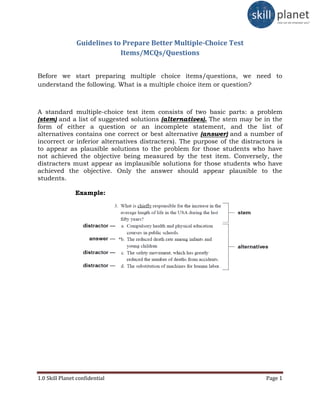
A standard multiple-choice test item consists of two basic parts: a problem
(stem) and a list of suggested solutions (alternatives). The stem may be in the
form of either a question or an incomplete statement, and the list of
alternatives contains one correct or best alternative (answer) and a number of
incorrect or inferior alternatives distracters). The purpose of the distractors is
to appear as plausible solutions to the problem for those students who have
not achieved the objective being measured by the test item. Conversely, the
distracters must appear as implausible solutions for those students who have
achieved the objective. Only the answer should appear plausible to the
students.
Example:
1.0 Skill Planet confidential Page 2
Constructing an Effective Stem
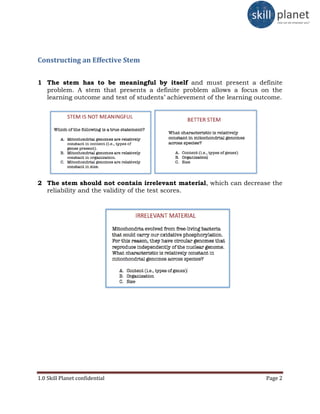
1 The stem has to be meaningful by itself and must present a definite
problem. A stem that presents a definite problem allows a focus on the
learning outcome and test of students’ achievement of the learning outcome.
2 The stem should not contain irrelevant material, which can decrease the
reliability and the validity of the test scores.
1.0 Skill Planet confidential Page 3
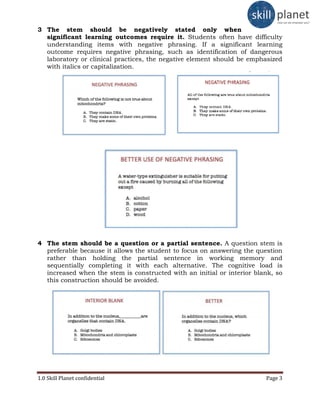
3 The stem should be negatively stated only when
significant learning outcomes require it. Students often have difficulty
understanding items with negative phrasing. If a significant learning
outcome requires negative phrasing, such as identification of dangerous
laboratory or clinical practices, the negative element should be emphasized
with italics or capitalization.
4 The stem should be a question or a partial sentence. A question stem is
preferable because it allows the student to focus on answering the question
rather than holding the partial sentence in working memory and
sequentially completing it with each alternative. The cognitive load is
increased when the stem is constructed with an initial or interior blank, so
this construction should be avoided.
1.0 Skill Planet confidential Page 4
5 Avoid vague qualitative modifiers such as many, large, much, small, old,
and important.
6 Avoid complex or awkward word arrangements. Also, avoid use of negatives
in the stem as this may add unnecessary comprehension difficulties. Avoid
trick statements with some minor misleading word or spelling anomaly. An
experienced exam taker may profit from his detection of such a ploy, despite
a lack of knowledge in the subject matter.
7 Avoid the exact wording of a source material. This places too much
emphasis on simple memory and barely tests cognitive acquisition at the
knowledge level.
8 Avoid specific determiners or giveaway qualifiers. Students quickly learn
that strongly worded statements are more likely to be false than true, for
example, statements with "never" "no" "all" or "always." Moderately worded
statements are more likely to be true than false. Statements with "many"
"often" "sometimes" "generally" "frequently" or "some" should be avoided.
9 With true or false questions, avoid a grossly disproportionate number of
either true or false statements. It may be best to have slightly more false
since examinees guessing at a true or false statement are more likely to
choose true, although many test experts insist that all patterns should be
avoided.
10 Each item stem should be as short as possible; otherwise you risk testing
more for reading and comprehension skills.
Constructing Effective Alternatives
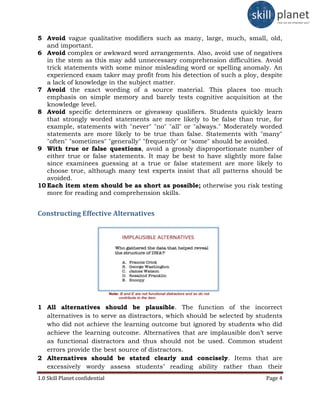
1 All alternatives should be plausible. The function of the incorrect
alternatives is to serve as distractors, which should be selected by students
who did not achieve the learning outcome but ignored by students who did
achieve the learning outcome. Alternatives that are implausible don’t serve
as functional distractors and thus should not be used. Common student
errors provide the best source of distractors.
2 Alternatives should be stated clearly and concisely. Items that are
excessively wordy assess students’ reading ability rather than their
1.0 Skill Planet confidential Page 5
attainment of the learning objective. Wordy must be avoided
until there is the requirement of testing the reading skills.
3 Alternatives should be mutually exclusive. Alternatives with overlapping
content may be considered “trick” items by test takers, excessive use of
which can erode trust and respect for the testing process.
1.0 Skill Planet confidential Page 6
4 Alternatives should be homogenous in content. Alternatives
that are heterogeneous in content can provide clues to student about the
correct answer.
5 Alternatives should be free from clues about which response is correct.
Sophisticated test takers are alert to inadvertent clues to the correct
answer, such differences in grammar, length, formatting, and language
choice in the alternatives. It’s therefore important that alternatives
 have grammar consistent with the stem.
 are parallel in form.
 are similar in length.
 use similar language (e.g., all unlike textbook language or all like
textbook language).
6 The alternatives “all of the above” and “none of the above” should not
be used. When “all of the above” is used as an answer, test takers who can
identify more than one alternative as correct can select the correct answer
even if unsure about other alternative(s). When “none of the above” is used
as an alternative, test takers who can eliminate a single option can thereby
eliminate a second option. In either case, students can use partial
knowledge to arrive at a correct answer.
1.0 Skill Planet confidential Page 7
Some basic rules to be followed
1 Use Plausible Distractors (wrong-response options)
2 Use a Question Format
3 Emphasize Higher-Level Thinking
4 Lay out the items in a clear and consistent manner.
5 Keep Option Lengths Similar
6 Balance the placement of the correct answer
7 Use proper grammar, punctuation, and spelling.
8 Avoid clues to the correct answer
9 Avoid negative questions
10 Use only one correct option (or be sure the best option is clearly the best
option)
11 Give clear instructions
12 Use only a single, clearly-defined problem and include the main idea in
the question
13 Avoid the alternatives “all of the above” and “none of the above” (in
general).
14 Avoid using unnecessarily difficult vocabulary.
Tips for incorrect answer options (distractors):
 Statements based on common student errors and misconceptions often
make strong distractors.
 True statements that do not answer the question often make good
distractors.
 Absolute statements (e.g. ‘never’, ‘always’, ‘all’) are best avoided as
students will rule them out.
 Keep the distractors sufficiently different to the key (correct) response in
substance, and not just clever or subtle wording.
 Ensure that the alternatives are independent and mutually exclusive.
 Avoid absurd, jokey and idiosyncratic distractors – they are easily
spotted.
 Make each distractor grammatically similar to the correct response, as
well as consistent with the stem.
Writing the correct response
 Correct responses don’t necessarily have to be absolute truths – students
can be asked to select the best answer or the one ‘which is most likely’.
1.0 Skill Planet confidential Page 8
 Avoid giving a clue by having the correct response
noticeably different in terms of either:
I. length
II. grammar/syntax being more highly qualified than the distractors
III. being the only one to match the stem in the number of factors
required.
Other pointers about alternatives
 Avoid using the alternative ‘all the above’ and use ‘none of the above’
with caution. ‘
I. “All of the above” makes it possible to answer the question on
the basis of partial information – if there is only one correct
answer, and a student notes that two alternatives are correct,
‘All the above’ must be the answer. Similarly, a student can
detect ‘All the above’ as a wrong answer if he/she recognises
another alternative as incorrect.
II. ‘None of the above’—when used as the right answer in a
correct answer type item—tends to me sure nothing more than
the ability to detect wrong answers (with no guarantee that a
student knows a correct response to the question).
 In terms of arranging the responses: present them in a logical (e.g.
numerical) order if one exists
Avoid giving clues to the answers of other test questions either in the
alternatives provided or in the stem.

Guidelines to Prepare MCQs

  • 1.
    1.0 Skill Planetconfidential Page 1 Guidelines to Prepare Better Multiple-Choice Test Items/MCQs/Questions Before we start preparing multiple choice items/questions, we need to understand the following. What is a multiple choice item or question? A standard multiple-choice test item consists of two basic parts: a problem (stem) and a list of suggested solutions (alternatives). The stem may be in the form of either a question or an incomplete statement, and the list of alternatives contains one correct or best alternative (answer) and a number of incorrect or inferior alternatives distracters). The purpose of the distractors is to appear as plausible solutions to the problem for those students who have not achieved the objective being measured by the test item. Conversely, the distracters must appear as implausible solutions for those students who have achieved the objective. Only the answer should appear plausible to the students. Example:
  • 2.
    1.0 Skill Planetconfidential Page 2 Constructing an Effective Stem 1 The stem has to be meaningful by itself and must present a definite problem. A stem that presents a definite problem allows a focus on the learning outcome and test of students’ achievement of the learning outcome. 2 The stem should not contain irrelevant material, which can decrease the reliability and the validity of the test scores.
  • 3.
    1.0 Skill Planetconfidential Page 3 3 The stem should be negatively stated only when significant learning outcomes require it. Students often have difficulty understanding items with negative phrasing. If a significant learning outcome requires negative phrasing, such as identification of dangerous laboratory or clinical practices, the negative element should be emphasized with italics or capitalization. 4 The stem should be a question or a partial sentence. A question stem is preferable because it allows the student to focus on answering the question rather than holding the partial sentence in working memory and sequentially completing it with each alternative. The cognitive load is increased when the stem is constructed with an initial or interior blank, so this construction should be avoided.
  • 4.
    1.0 Skill Planetconfidential Page 4 5 Avoid vague qualitative modifiers such as many, large, much, small, old, and important. 6 Avoid complex or awkward word arrangements. Also, avoid use of negatives in the stem as this may add unnecessary comprehension difficulties. Avoid trick statements with some minor misleading word or spelling anomaly. An experienced exam taker may profit from his detection of such a ploy, despite a lack of knowledge in the subject matter. 7 Avoid the exact wording of a source material. This places too much emphasis on simple memory and barely tests cognitive acquisition at the knowledge level. 8 Avoid specific determiners or giveaway qualifiers. Students quickly learn that strongly worded statements are more likely to be false than true, for example, statements with "never" "no" "all" or "always." Moderately worded statements are more likely to be true than false. Statements with "many" "often" "sometimes" "generally" "frequently" or "some" should be avoided. 9 With true or false questions, avoid a grossly disproportionate number of either true or false statements. It may be best to have slightly more false since examinees guessing at a true or false statement are more likely to choose true, although many test experts insist that all patterns should be avoided. 10 Each item stem should be as short as possible; otherwise you risk testing more for reading and comprehension skills. Constructing Effective Alternatives 1 All alternatives should be plausible. The function of the incorrect alternatives is to serve as distractors, which should be selected by students who did not achieve the learning outcome but ignored by students who did achieve the learning outcome. Alternatives that are implausible don’t serve as functional distractors and thus should not be used. Common student errors provide the best source of distractors. 2 Alternatives should be stated clearly and concisely. Items that are excessively wordy assess students’ reading ability rather than their
  • 5.
    1.0 Skill Planetconfidential Page 5 attainment of the learning objective. Wordy must be avoided until there is the requirement of testing the reading skills. 3 Alternatives should be mutually exclusive. Alternatives with overlapping content may be considered “trick” items by test takers, excessive use of which can erode trust and respect for the testing process.
  • 6.
    1.0 Skill Planetconfidential Page 6 4 Alternatives should be homogenous in content. Alternatives that are heterogeneous in content can provide clues to student about the correct answer. 5 Alternatives should be free from clues about which response is correct. Sophisticated test takers are alert to inadvertent clues to the correct answer, such differences in grammar, length, formatting, and language choice in the alternatives. It’s therefore important that alternatives  have grammar consistent with the stem.  are parallel in form.  are similar in length.  use similar language (e.g., all unlike textbook language or all like textbook language). 6 The alternatives “all of the above” and “none of the above” should not be used. When “all of the above” is used as an answer, test takers who can identify more than one alternative as correct can select the correct answer even if unsure about other alternative(s). When “none of the above” is used as an alternative, test takers who can eliminate a single option can thereby eliminate a second option. In either case, students can use partial knowledge to arrive at a correct answer.
  • 7.
    1.0 Skill Planetconfidential Page 7 Some basic rules to be followed 1 Use Plausible Distractors (wrong-response options) 2 Use a Question Format 3 Emphasize Higher-Level Thinking 4 Lay out the items in a clear and consistent manner. 5 Keep Option Lengths Similar 6 Balance the placement of the correct answer 7 Use proper grammar, punctuation, and spelling. 8 Avoid clues to the correct answer 9 Avoid negative questions 10 Use only one correct option (or be sure the best option is clearly the best option) 11 Give clear instructions 12 Use only a single, clearly-defined problem and include the main idea in the question 13 Avoid the alternatives “all of the above” and “none of the above” (in general). 14 Avoid using unnecessarily difficult vocabulary. Tips for incorrect answer options (distractors):  Statements based on common student errors and misconceptions often make strong distractors.  True statements that do not answer the question often make good distractors.  Absolute statements (e.g. ‘never’, ‘always’, ‘all’) are best avoided as students will rule them out.  Keep the distractors sufficiently different to the key (correct) response in substance, and not just clever or subtle wording.  Ensure that the alternatives are independent and mutually exclusive.  Avoid absurd, jokey and idiosyncratic distractors – they are easily spotted.  Make each distractor grammatically similar to the correct response, as well as consistent with the stem. Writing the correct response  Correct responses don’t necessarily have to be absolute truths – students can be asked to select the best answer or the one ‘which is most likely’.
  • 8.
    1.0 Skill Planetconfidential Page 8  Avoid giving a clue by having the correct response noticeably different in terms of either: I. length II. grammar/syntax being more highly qualified than the distractors III. being the only one to match the stem in the number of factors required. Other pointers about alternatives  Avoid using the alternative ‘all the above’ and use ‘none of the above’ with caution. ‘ I. “All of the above” makes it possible to answer the question on the basis of partial information – if there is only one correct answer, and a student notes that two alternatives are correct, ‘All the above’ must be the answer. Similarly, a student can detect ‘All the above’ as a wrong answer if he/she recognises another alternative as incorrect. II. ‘None of the above’—when used as the right answer in a correct answer type item—tends to me sure nothing more than the ability to detect wrong answers (with no guarantee that a student knows a correct response to the question).  In terms of arranging the responses: present them in a logical (e.g. numerical) order if one exists Avoid giving clues to the answers of other test questions either in the alternatives provided or in the stem.