
Responding to Student WritingElizabeth NesiusWriting Center Coordinator
This presentation can be found at www.slideshare.net/enesius
Elements of the AssignmentWill the students be able to revise the essay?Are they demonstrating writing skills, knowledge or understanding of material, or both?Is this an early, middle, or capstone assignment?Is it an in-class or take-home essay?How long is the essay?
Focusing Responses You don’t have to address everything!Putting down your penSometimes you have to let yourself read and enjoy it!Fight the urge to correct every mistake—Inhibits learningTakes more timeStudents will be overwhelmed or discouraged by too many comments
Focused Responses IHelpful when multiple writing assignments given during a semesterTell the students purpose of assignment (the learning outcomes) in advance and focus grading on this purposeE.g. a compare-contrast essayPurpose to think critically about 2 items and learn essay structureResponse focuses on points of comparison, balance, and organizationRespond to other elements in future assignments
Focused Responses IIHelpful for longer papers or papers with multiple problemsDrafting importantFocus on “higher order” problems firstOrganizationThesis statementMeeting basic requirements of assignmentAddress other concerns in future draftsSupport and contentSave grammar for final draft if possible
The Question of RevisionNot revisedLimit comments—point out one or two examples of errorsStudents need a purpose to read commentsRevisedFocus on the major issuesTry to choose no more than 3 types of problemsPoint out a few examples, but leave the rest for students to find
Writing FocusResponse focus will be more on writing elements than contentAssignments address current writing lessons Assessment should focus on those elementsRemind students of the connections between lessonsWriting skills are cumulativeMake sure students are clear on what content elements will be addressed
Content FocusResponse focus will be on what students must show they knowCan simply use check marks to check off required elementsOrganization and mechanics secondaryIf not graded for writing elements, no need to mark themStudents confused/frustrated by things marked that don’t contribute to grade
Content Focus ExceptionsJournalsUsually graded for contentRepeated assignment (supplemental goal often to improve writing)Marking some mechanics can be helpful as they can be applied to future entriesReadability ImpededReturn to student (unmarked) and request rewriteHolds students accountable for proofreadingNot for use with students who are severely lacking skills
Early/Mid-Semester AssignmentScaffoldingFirst/Early assignments should have more comments than later assignmentsIt’s ok to rewrite/rephrase a little in the beginningLater, suggest changes, but don’t give exampleLater still, note where changes need to be made, but don’t give change suggestionInform students of expectation that comments be applied to future assignments
End-of-Semester AssignmentNot intended for revisionNo need for in-text comments: Put down the pen!Give grade (on last page or back) and list of (a few) strengths and weaknessesCould use rubric alone
In-Class EssaysNot intended for revisionIf given during semester, comments can be applied to future writingMark a few errorsMain focus should be on summary at the end
Use of ShorthandCreate shorthand you are comfortable withGive students a “key” for shorthand and encourage them to use itOn first essay (at least) devote class time to questions about instructor commentsSaves time and frustration later (for student and instructor!)Encourages students to approach instructor with questions
Summarizing CommentsGives students a clear, concise assessment of writingKeeps students from being overwhelmedImproves student performance on rewrites and future assignmentsEncourages students to think for themselves
Next StepsSets up expectations of students for the futureLays out expectations in a clear and understandable wayKeeps things simpleLimit Next Steps to 3 or 4: Gives students focus and reassurance
Explaining Your SystemExplain where students can expect to find certain types of commentsExplain function of commentsExplain your shorthand (and give them a reference guide)Walk them through using a rubric—and have them assess their own writing!
Importance of PraiseWriting scares students: 4 out of 5 students are not “proficient” writers—and most know itFeedback has a profound and lasting effect on studentsIt is not about reassuring or “false praise.” It is important always to find something good about an essay
PraiseSome suggestions for essays with “nothing good” about themTopic choiceLevel of effortAccomplishment in relation to difficulty of taskImprovement relative to previous writingAccomplishment or improvement in one particular areaPraise of student behavior in class (e.g. “Based on your insight in class discussion, I know you can offer more information about this topic.”)Improvement from prewriting to final draft
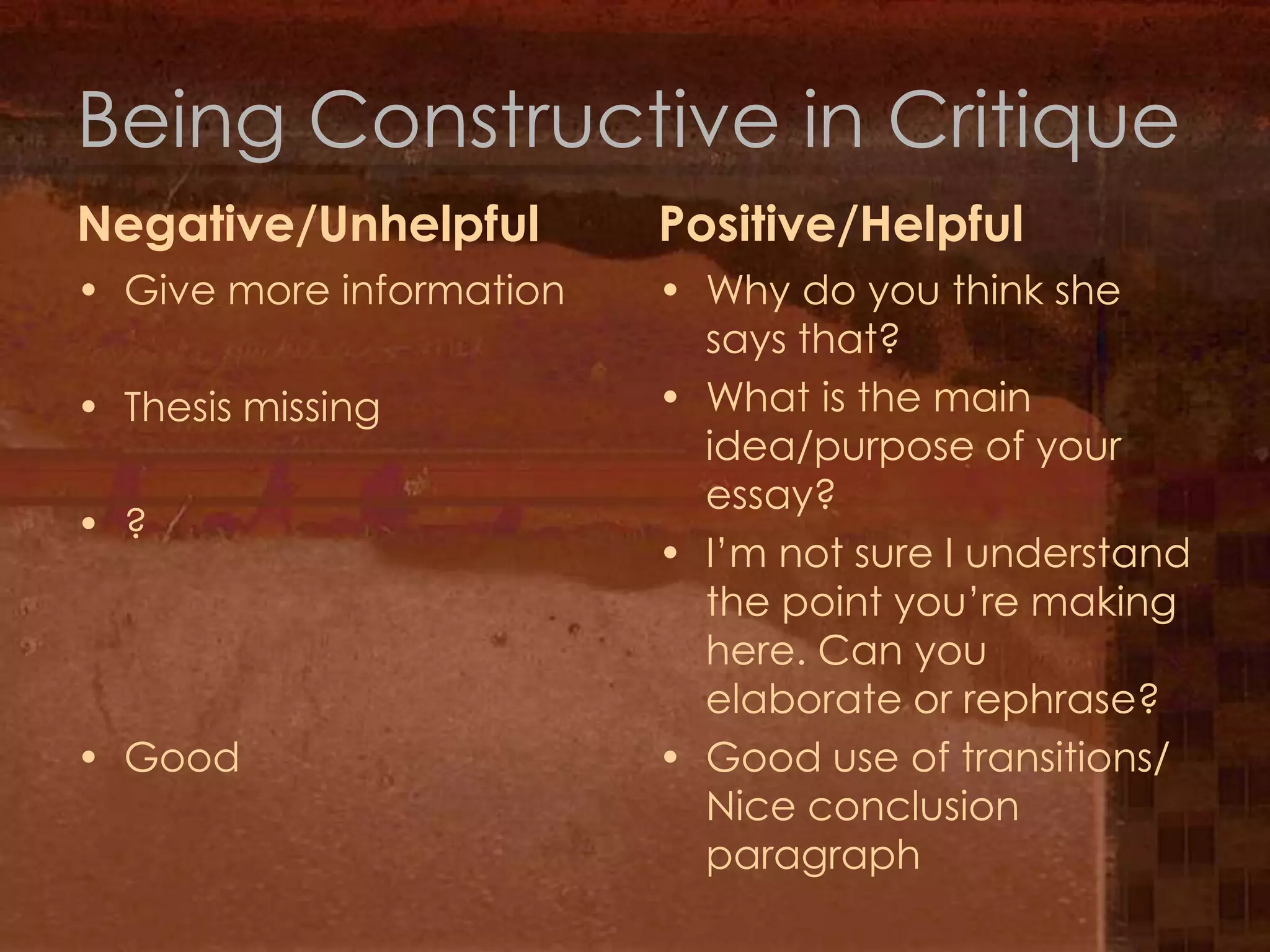
Being Constructive in CritiqueShow you are engaged in your students’ writing, that it interests youMake comments specific to what you readMake note of a detail that is new to you, interesting, or relatableAsk questions (rather than stating needed changes) to encourage thought
Being Constructive in CritiqueNegative/UnhelpfulPositive/HelpfulGive more informationThesis missing?GoodWhy do you think she says that?What is the main idea/purpose of your essay?I’m not sure I understand the point you’re making here. Can you elaborate or rephrase?Good use of transitions/ Nice conclusion paragraph
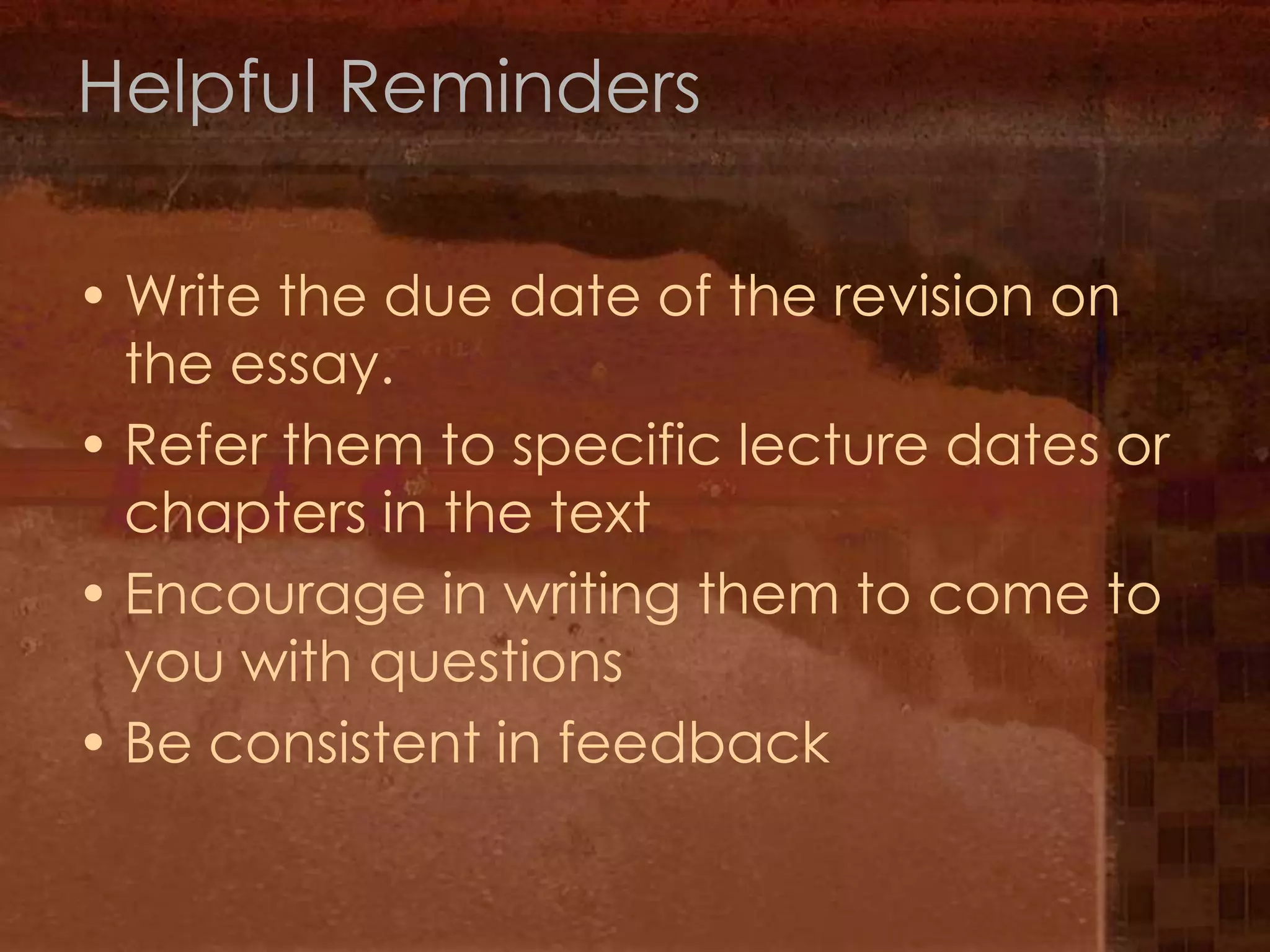
Helpful RemindersWrite the due date of the revision on the essay.Refer them to specific lecture dates or chapters in the textEncourage in writing them to come to you with questionsBe consistent in feedback
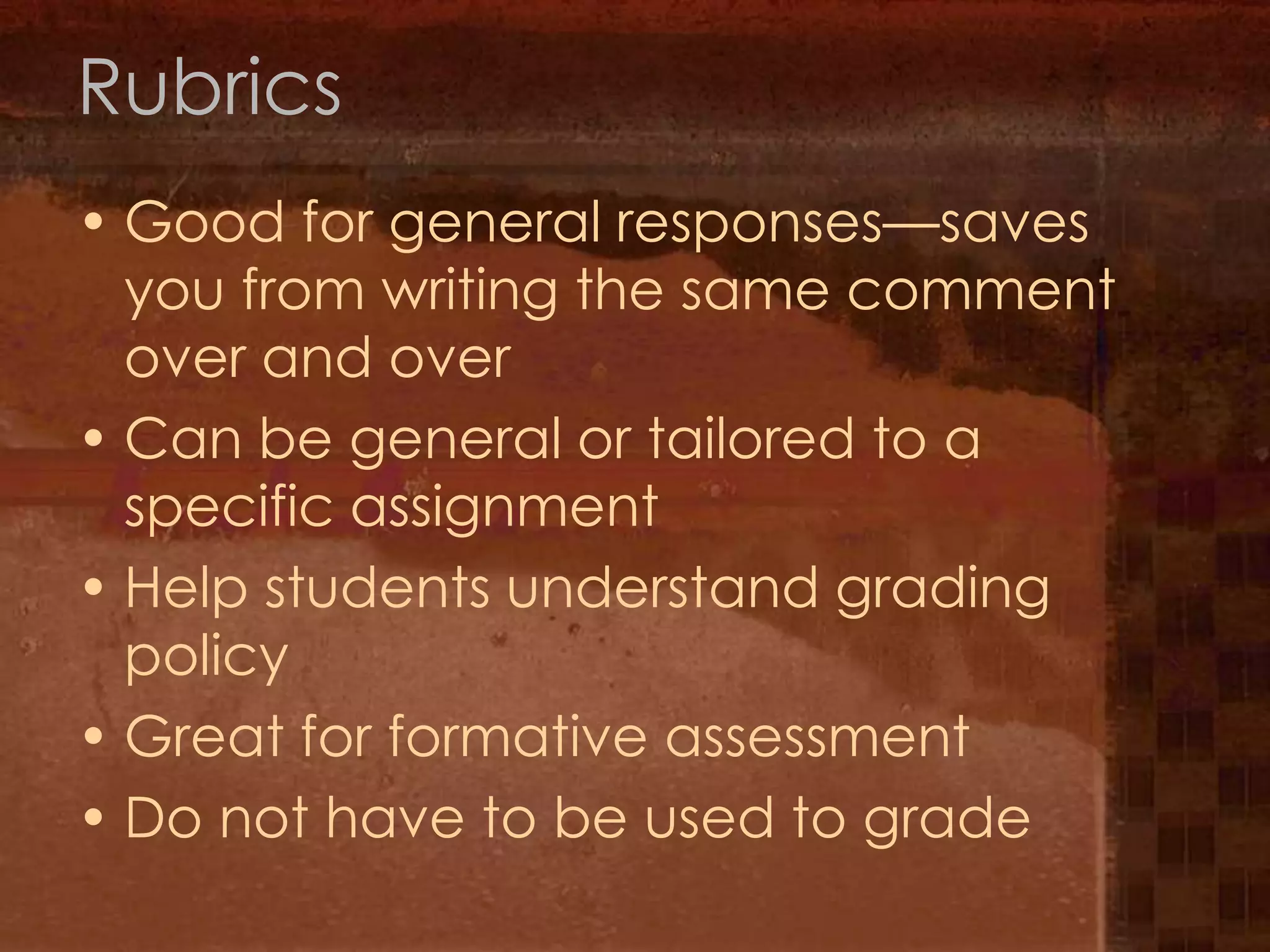
RubricsGood for general responses—saves you from writing the same comment over and overCan be general or tailored to a specific assignmentHelp students understand grading policyGreat for formative assessmentDo not have to be used to grade
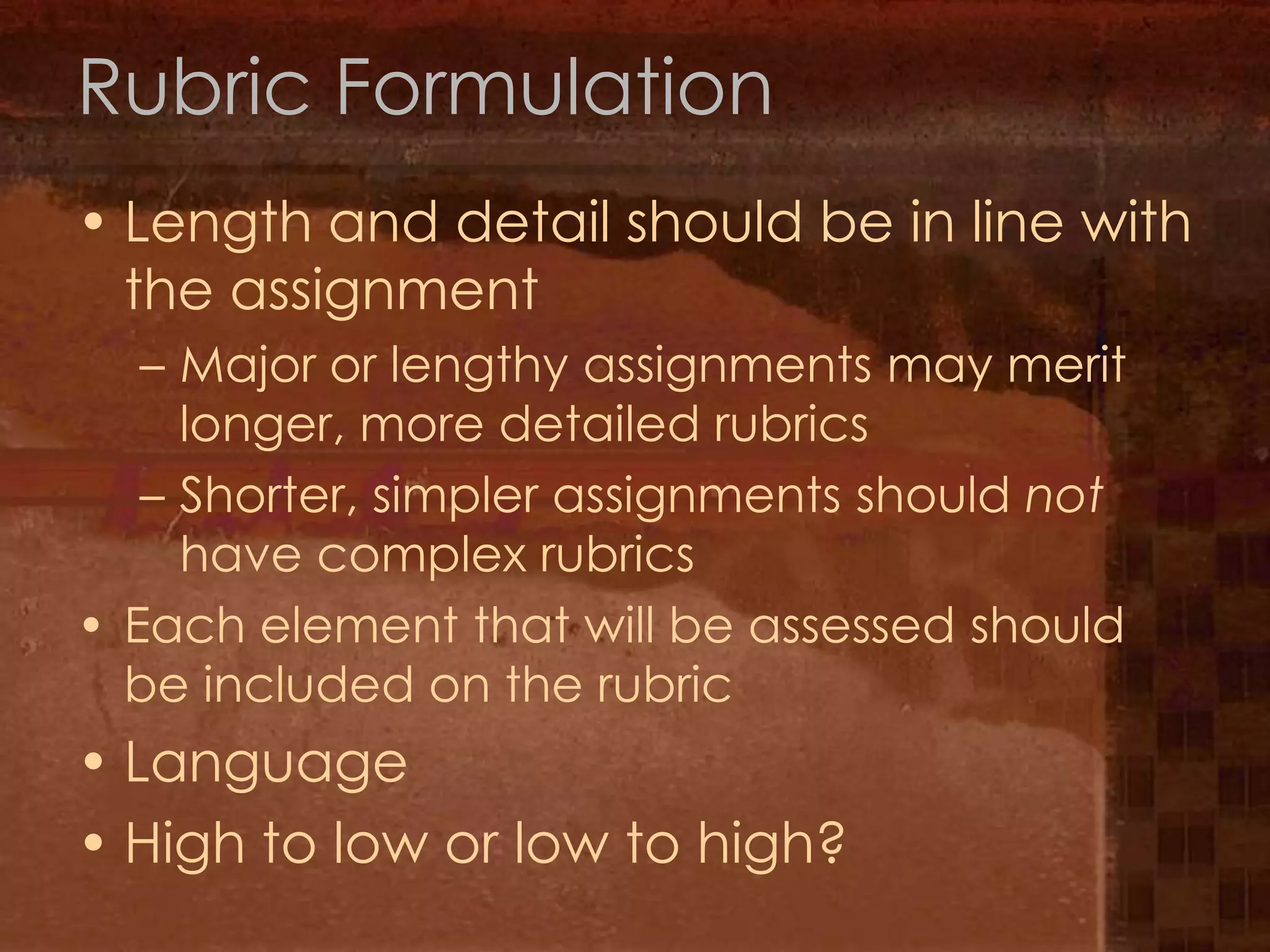
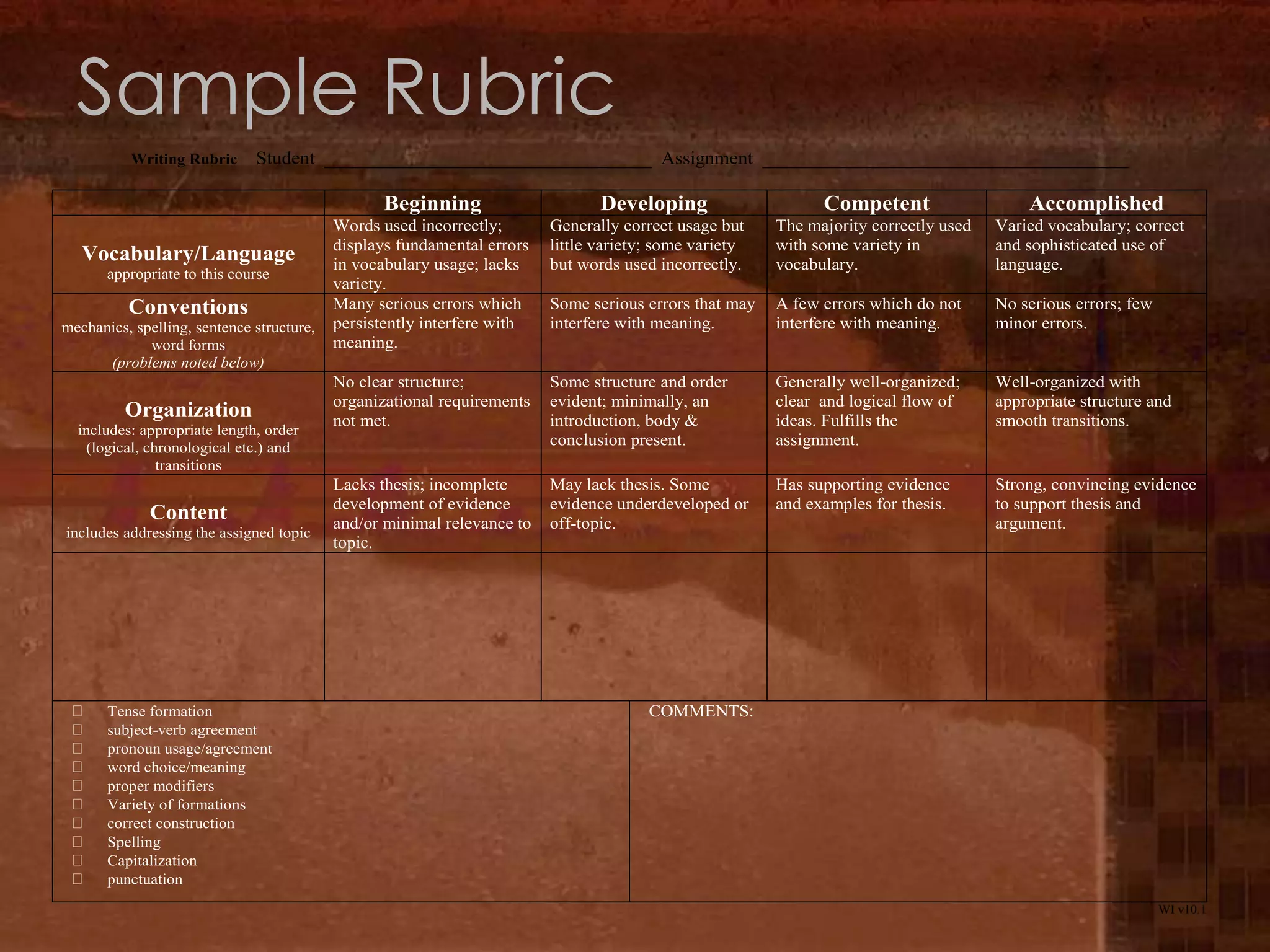
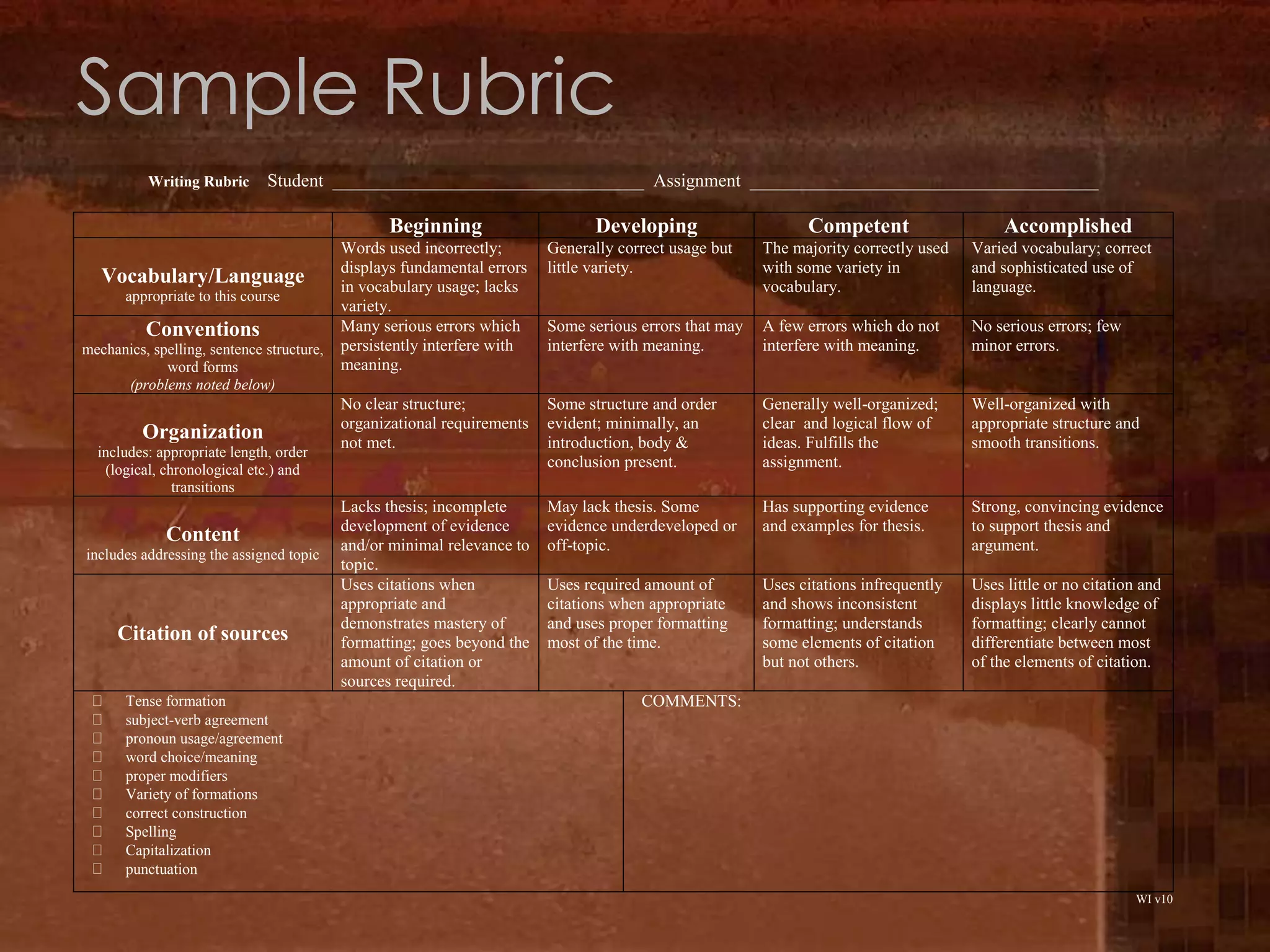
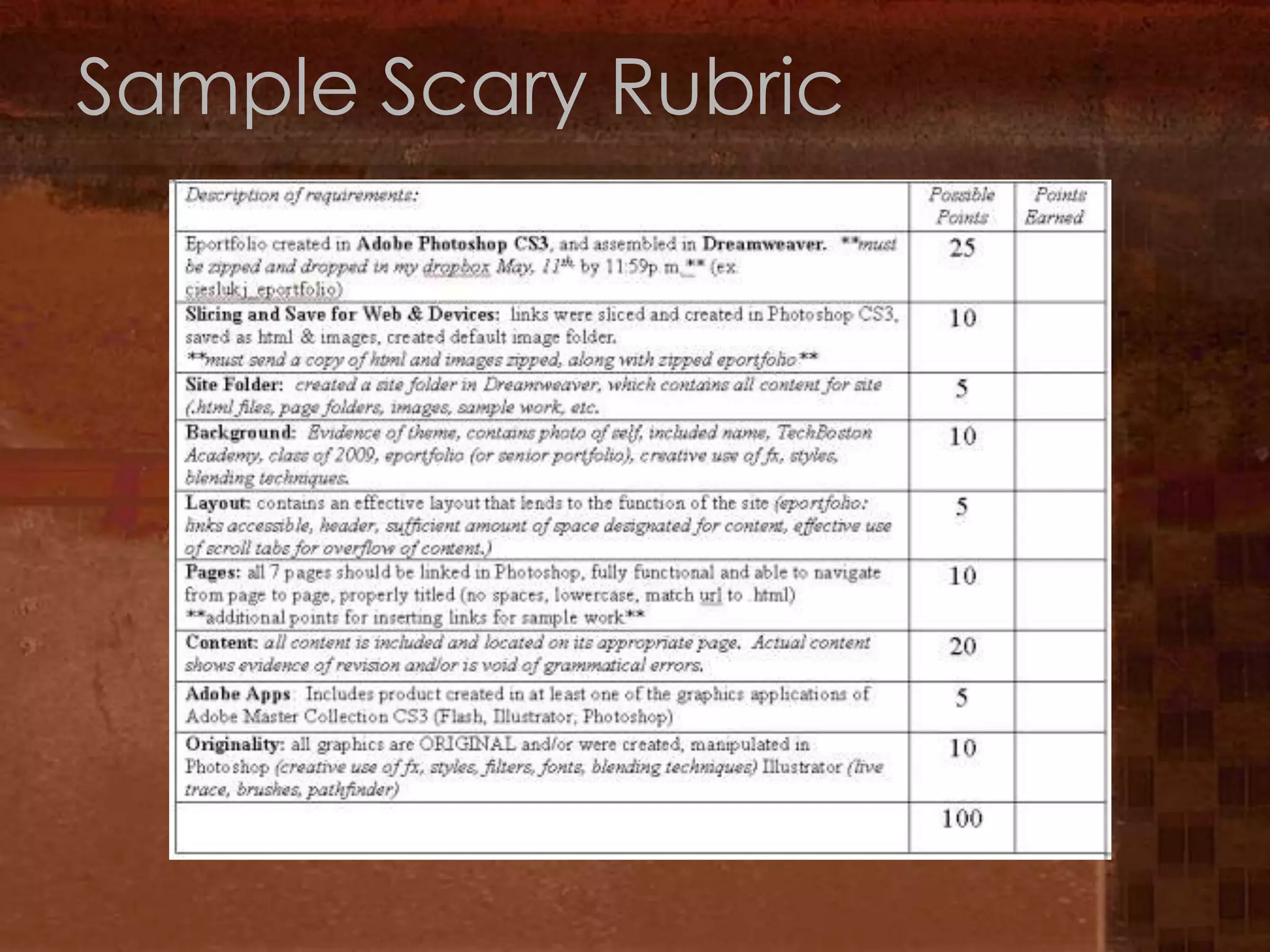
Rubric FormulationLength and detail should be in line with the assignmentMajor or lengthy assignments may merit longer, more detailed rubricsShorter, simpler assignments should not have complex rubrics Each element that will be assessed should be included on the rubricLanguageHigh to low or low to high?
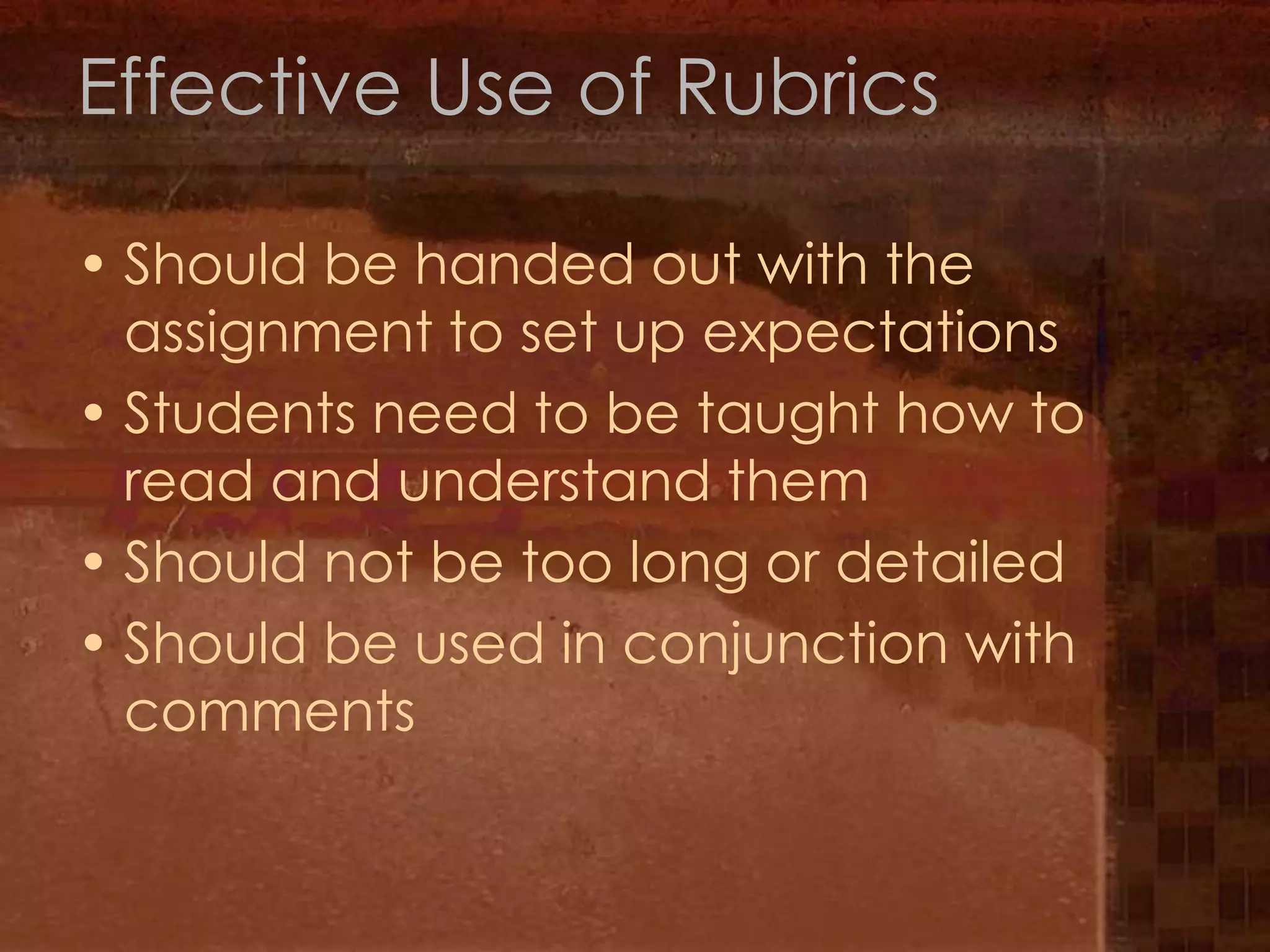
Effective Use of RubricsShould be handed out with the assignment to set up expectationsStudents need to be taught how to read and understand themShould not be too long or detailedShould be used in conjunction with comments
Sample Rubric
Sample Rubric
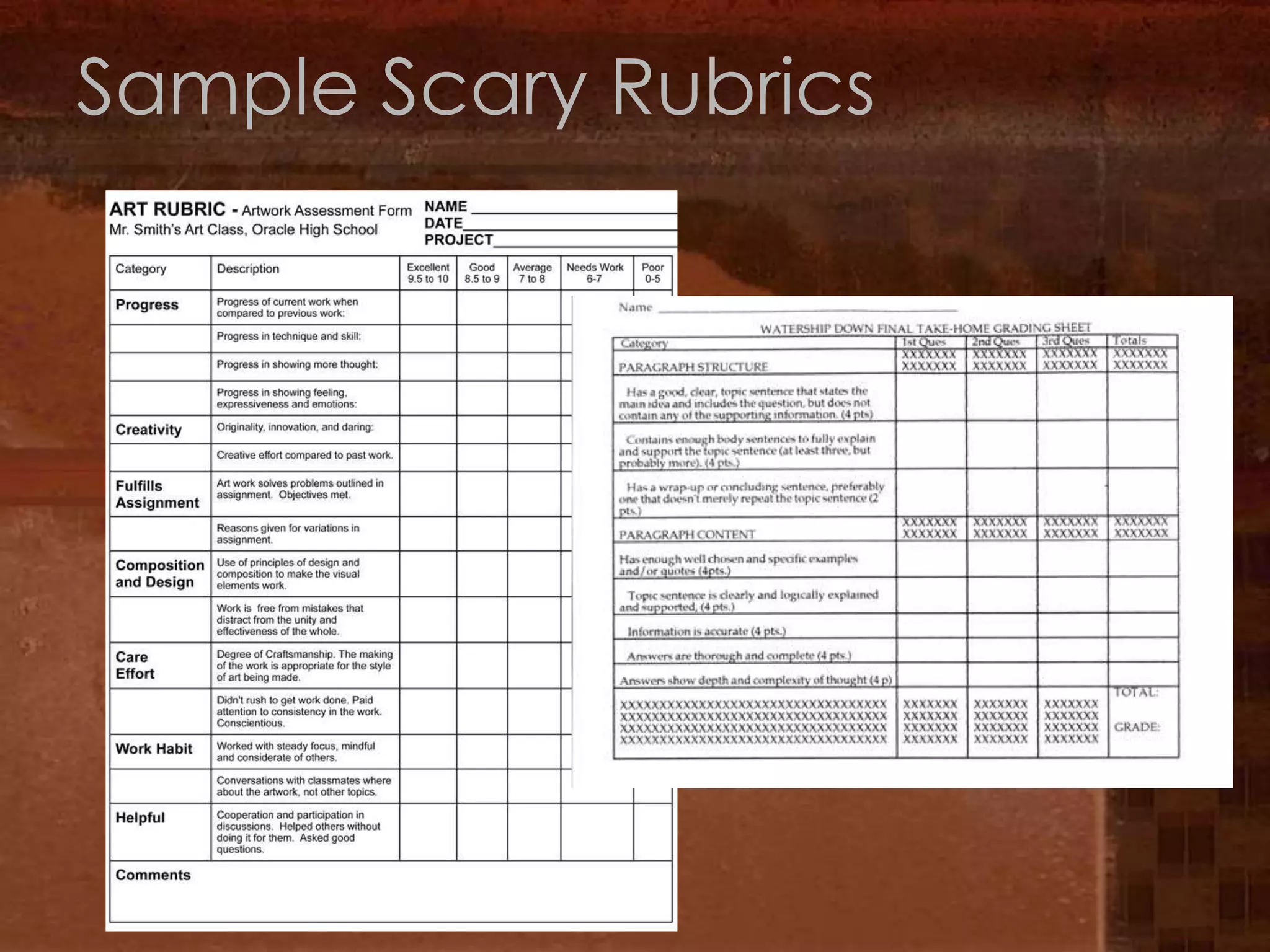
Sample Scary Rubric
Sample Scary Rubrics
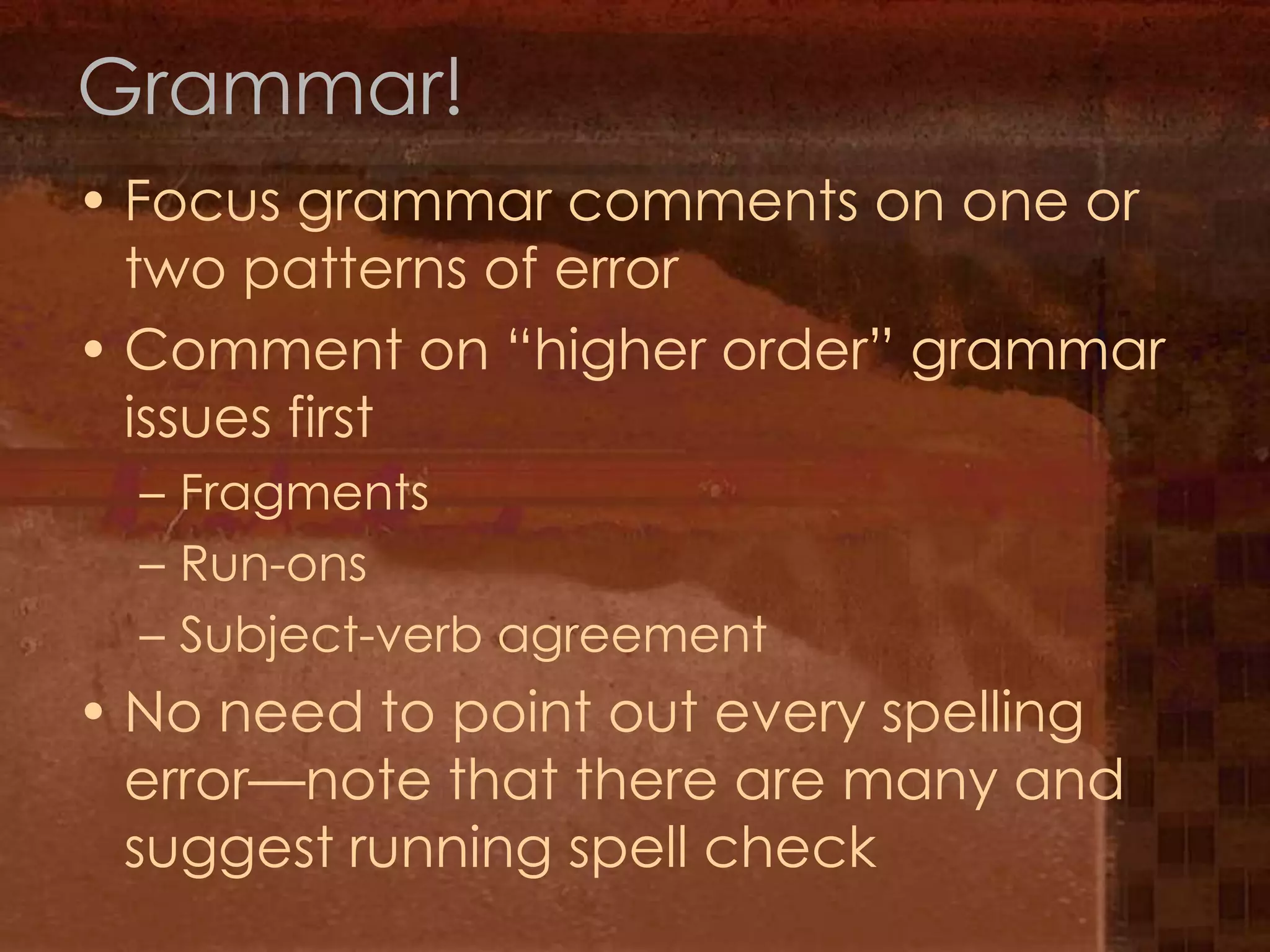
Grammar!Focus grammar comments on one or two patterns of errorComment on “higher order” grammar issues firstFragmentsRun-onsSubject-verb agreementNo need to point out every spelling error—note that there are many and suggest running spell check
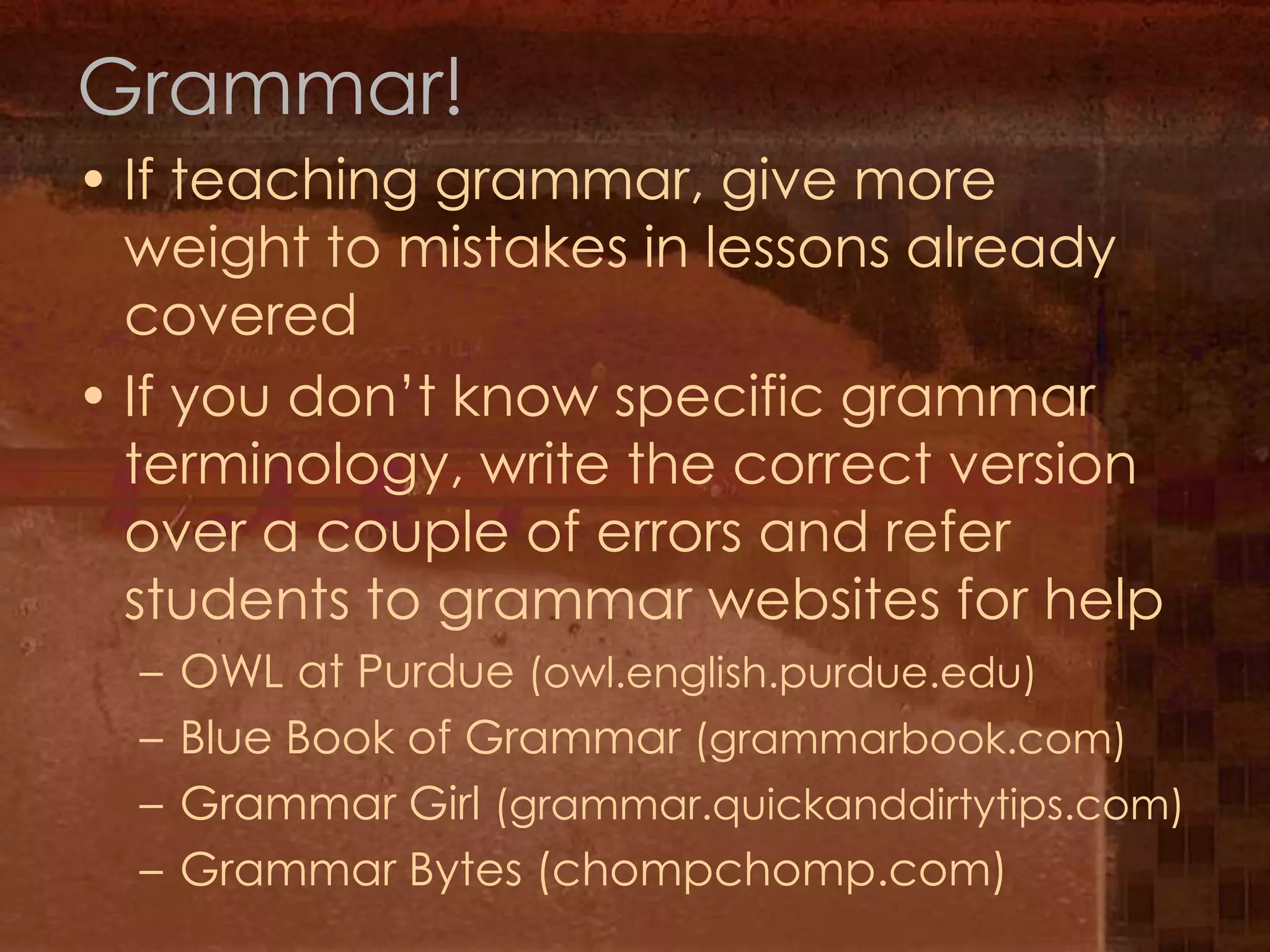
Grammar!If teaching grammar, give more weight to mistakes in lessons already coveredIf you don’t know specific grammar terminology, write the correct version over a couple of errors and refer students to grammar websites for helpOWL at Purdue (owl.english.purdue.edu)Blue Book of Grammar (grammarbook.com)Grammar Girl (grammar.quickanddirtytips.com)Grammar Bytes (chompchomp.com)
Myths about CommentingRed pens Are not scary Lots of ink in any color is scaryPraise sandwichStudents will recognize itOnce they see the pattern, they doubt your sincerity
Thank you!Elizabeth Nesiusenesius@pccc.edu973-684-6160

Responding to student writing

  • 1.
    Responding to StudentWritingElizabeth NesiusWriting Center Coordinator
  • 2.
    This presentation canbe found at www.slideshare.net/enesius
  • 3.
    Elements of theAssignmentWill the students be able to revise the essay?Are they demonstrating writing skills, knowledge or understanding of material, or both?Is this an early, middle, or capstone assignment?Is it an in-class or take-home essay?How long is the essay?
  • 4.
    Focusing Responses Youdon’t have to address everything!Putting down your penSometimes you have to let yourself read and enjoy it!Fight the urge to correct every mistake—Inhibits learningTakes more timeStudents will be overwhelmed or discouraged by too many comments
  • 5.
    Focused Responses IHelpfulwhen multiple writing assignments given during a semesterTell the students purpose of assignment (the learning outcomes) in advance and focus grading on this purposeE.g. a compare-contrast essayPurpose to think critically about 2 items and learn essay structureResponse focuses on points of comparison, balance, and organizationRespond to other elements in future assignments
  • 6.
    Focused Responses IIHelpfulfor longer papers or papers with multiple problemsDrafting importantFocus on “higher order” problems firstOrganizationThesis statementMeeting basic requirements of assignmentAddress other concerns in future draftsSupport and contentSave grammar for final draft if possible
  • 7.
    The Question ofRevisionNot revisedLimit comments—point out one or two examples of errorsStudents need a purpose to read commentsRevisedFocus on the major issuesTry to choose no more than 3 types of problemsPoint out a few examples, but leave the rest for students to find
  • 8.
    Writing FocusResponse focuswill be more on writing elements than contentAssignments address current writing lessons Assessment should focus on those elementsRemind students of the connections between lessonsWriting skills are cumulativeMake sure students are clear on what content elements will be addressed
  • 9.
    Content FocusResponse focuswill be on what students must show they knowCan simply use check marks to check off required elementsOrganization and mechanics secondaryIf not graded for writing elements, no need to mark themStudents confused/frustrated by things marked that don’t contribute to grade
  • 10.
    Content Focus ExceptionsJournalsUsuallygraded for contentRepeated assignment (supplemental goal often to improve writing)Marking some mechanics can be helpful as they can be applied to future entriesReadability ImpededReturn to student (unmarked) and request rewriteHolds students accountable for proofreadingNot for use with students who are severely lacking skills
  • 11.
    Early/Mid-Semester AssignmentScaffoldingFirst/Early assignmentsshould have more comments than later assignmentsIt’s ok to rewrite/rephrase a little in the beginningLater, suggest changes, but don’t give exampleLater still, note where changes need to be made, but don’t give change suggestionInform students of expectation that comments be applied to future assignments
  • 12.
    End-of-Semester AssignmentNot intendedfor revisionNo need for in-text comments: Put down the pen!Give grade (on last page or back) and list of (a few) strengths and weaknessesCould use rubric alone
  • 13.
    In-Class EssaysNot intendedfor revisionIf given during semester, comments can be applied to future writingMark a few errorsMain focus should be on summary at the end
  • 14.
    Use of ShorthandCreateshorthand you are comfortable withGive students a “key” for shorthand and encourage them to use itOn first essay (at least) devote class time to questions about instructor commentsSaves time and frustration later (for student and instructor!)Encourages students to approach instructor with questions
  • 15.
    Summarizing CommentsGives studentsa clear, concise assessment of writingKeeps students from being overwhelmedImproves student performance on rewrites and future assignmentsEncourages students to think for themselves
  • 16.
    Next StepsSets upexpectations of students for the futureLays out expectations in a clear and understandable wayKeeps things simpleLimit Next Steps to 3 or 4: Gives students focus and reassurance
  • 17.
    Explaining Your SystemExplainwhere students can expect to find certain types of commentsExplain function of commentsExplain your shorthand (and give them a reference guide)Walk them through using a rubric—and have them assess their own writing!
  • 18.
    Importance of PraiseWritingscares students: 4 out of 5 students are not “proficient” writers—and most know itFeedback has a profound and lasting effect on studentsIt is not about reassuring or “false praise.” It is important always to find something good about an essay
  • 19.
    PraiseSome suggestions foressays with “nothing good” about themTopic choiceLevel of effortAccomplishment in relation to difficulty of taskImprovement relative to previous writingAccomplishment or improvement in one particular areaPraise of student behavior in class (e.g. “Based on your insight in class discussion, I know you can offer more information about this topic.”)Improvement from prewriting to final draft
  • 20.
    Being Constructive inCritiqueShow you are engaged in your students’ writing, that it interests youMake comments specific to what you readMake note of a detail that is new to you, interesting, or relatableAsk questions (rather than stating needed changes) to encourage thought
  • 21.
    Being Constructive inCritiqueNegative/UnhelpfulPositive/HelpfulGive more informationThesis missing?GoodWhy do you think she says that?What is the main idea/purpose of your essay?I’m not sure I understand the point you’re making here. Can you elaborate or rephrase?Good use of transitions/ Nice conclusion paragraph
  • 22.
    Helpful RemindersWrite thedue date of the revision on the essay.Refer them to specific lecture dates or chapters in the textEncourage in writing them to come to you with questionsBe consistent in feedback
  • 23.
    RubricsGood for generalresponses—saves you from writing the same comment over and overCan be general or tailored to a specific assignmentHelp students understand grading policyGreat for formative assessmentDo not have to be used to grade
  • 24.
    Rubric FormulationLength anddetail should be in line with the assignmentMajor or lengthy assignments may merit longer, more detailed rubricsShorter, simpler assignments should not have complex rubrics Each element that will be assessed should be included on the rubricLanguageHigh to low or low to high?
  • 25.
    Effective Use ofRubricsShould be handed out with the assignment to set up expectationsStudents need to be taught how to read and understand themShould not be too long or detailedShould be used in conjunction with comments
  • 26.
  • 27.
  • 28.
  • 29.
  • 30.
    Grammar!Focus grammar commentson one or two patterns of errorComment on “higher order” grammar issues firstFragmentsRun-onsSubject-verb agreementNo need to point out every spelling error—note that there are many and suggest running spell check
  • 31.
    Grammar!If teaching grammar,give more weight to mistakes in lessons already coveredIf you don’t know specific grammar terminology, write the correct version over a couple of errors and refer students to grammar websites for helpOWL at Purdue (owl.english.purdue.edu)Blue Book of Grammar (grammarbook.com)Grammar Girl (grammar.quickanddirtytips.com)Grammar Bytes (chompchomp.com)
  • 32.
    Myths about CommentingRedpens Are not scary Lots of ink in any color is scaryPraise sandwichStudents will recognize itOnce they see the pattern, they doubt your sincerity
  • 33.