By
Dr Salihi Abdulmalik
National Orthopaedic Hospital Dala-Kano
14th March, 2021
 INTRODUCTION
 RELEVANT SURGICAL ANATOMY
 CLASSIFICATION
 EVALUATION OF PATIENT WITH NERVE INJURY
 PRINCIPLE OF REPAIR
 OUTCOME
 CURRENT/FUTURE TRENDS
 CONCLUSSION
 REFERENCES
 A nerve is an enclosed cable-like bundle of
axons
 Can be categorized as either afferent,
efferent or mixed nerve
 Myelinated and unmyelinated
 Nerve injuries are fairly common
 Affects 5% of patients following trauma
 Trauma
◦ Mechanical
 Laceration
 Compression
 Crush injury
◦ Chemical
◦ Thermal
◦ Traction
 Radiation
 Infection; leprosy
 malignancy
 Ischemia
 Seddon
 Sunderland
 Neurapraxia
◦ Minor contussion or compression
◦ Impulse transmission physiologically interrupted
◦ No anatomical damage
◦ Complete recovery within few days to weeks
 Axonotemesis
◦ Breakdown of axon
◦ Neural tube is intact
◦ Wallerian degeneration occur
◦ Spontaneous recovery can be expected
 Neurotmesis
◦ Nerve trunk division
◦ Wallerian degeneration
◦ Scarring prevents regeneration
◦ Spontaneous recovery not possible
 Presentation
◦ Emergency; multiply injured, #s/dislocations,
vascular injuries
◦ Elective
 Multidisciplinary
 History
◦ Nerve involve
◦ Level
◦ Cause
◦ Degree of injury
 Numbness
 Paresthesia
 Muscles weakness
 PMH; DM and
double crush
phenomenon
 Smoking
 Deformities
 Muscles wasting
 Skin dryness
 Atrophic nail
changes
 Sensory impairment
 Power
 Low/high lesion
 Claw hand
 Hypothenar and
interosseous
wasting
 Sensory loss ring
and little finger
 PAD/DAB
 Froment’s sign
 Ulnar paradox
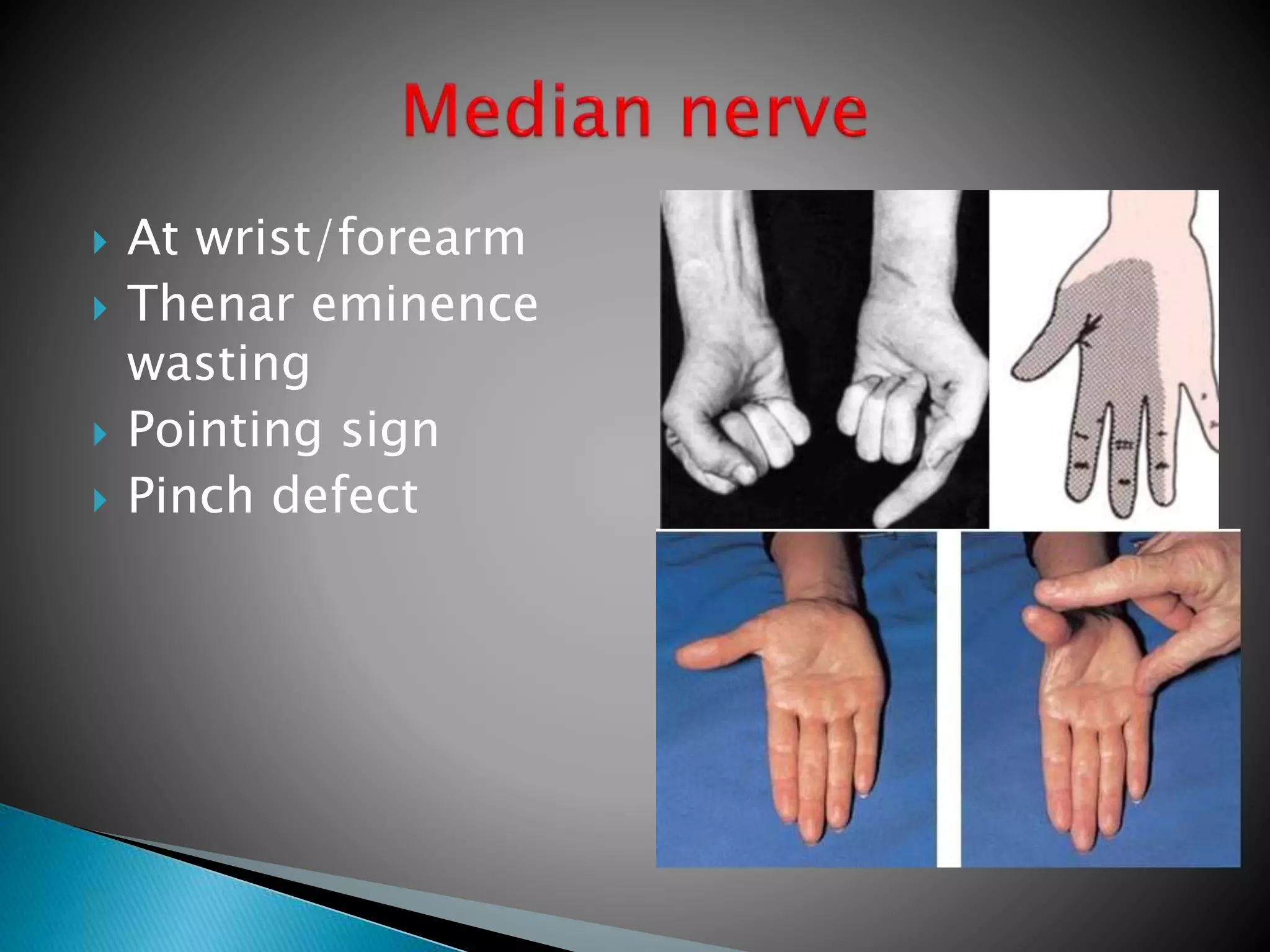
 At wrist/forearm
 Thenar eminence
wasting
 Pointing sign
 Pinch defect
 Low lesion - #s/dislocation around the elbow
 High – humeral #/tourniquet
 Very high – shoulder trauma/surgery, crutch
palsy, Saturday night palsy
 Low lesion
◦ Can not extend MCPJ
◦ wrist extension is
preserved; ECRL
supplied proximal to
elbow
 Axillary nerve
◦ Can not maintain abduction
◦ Regimental badge sign
 Sciatic nerve
◦ Foot drop
◦ Trophic ulcer
 X ray
 EMG
 Nerve conduction velocity
 MRI
 CT
 Nerve seen to be divided
 Injury suggests nerve is divided or severely
damaged
 Recovery inappropriately delayed and the
diagnosis is in doubt
 Repair
◦ Primary
 Not retracted much
 No fibrosis
 Relative rotation undisturbed
◦ Delayed
 Left with no recovery
 Missed/delay presentation
 Failed primary repair
 Nerve graft
 Nerve transfer
 Tendon transfer
 Intra-op
◦ Expertise
◦ Patience
◦ Adequate lighting
◦ Surgeon should be relaxed
◦ Vascular injuries, unstable fractures, contaminated
soft tissues and tendon divisions should be dealt
with before the nerve lesion
◦ Dissection from normal to abnormal, long incision
◦ Neuroma excision, debridement
◦ Sling sutures
◦ Tensionless repair: rerouting of nerves flexion of
joints
◦ Operating loops
◦ Nerve stimulation
◦ Bipolar diathermy
◦ No shame in referral !!
 Post op
◦ POP at least 6 wks
◦ Protect parts at risk of injury
◦ Early physiotherapy
◦ Dynamic splinting
 Early repair
 ADVANTAGES
 Early return to fxn
 Better fuscicular visualization
 Better realignment
 Decreased tension on suture line
 DISADVANTAGES
 Not all injuries amenable to repair
 No advantage in fxnal outcome
 Potential for suture line dehiscence due to
delayed necrosis
 Epineurium more friable
 Delayed repair
 Indicated in major trauma or contamination
 Adv
 Epineural hypertrophy
 Demarcation of injured nerve elements
 Disadv
 Stump retraction
 Neuroma debridement
 The graft is no substitute to nerve loss
 It is a guiding rail, yet better than any
alloplastic material
 Double coaptation required
 Autograft is superior
 Source
 -sural
 -saphenous
 -posterior auricular
 Alternatives to nerve graft
 -alloplastic nerve conduit
 -venous grafts
 Nil tension
 Positioning/splints/Immobilization for 7-14
days
 Gradual mobilization
 3wk- 3mon range of motion exercises
 3-6mon strengthen exercises
 6mon-1yr Sensory re-education
 General: anesthetic, wound infxn
 Insensate limb
 Failure of repair
 Collateral injury to surrounding structures
 Volkmanns ischemia
 Tension at the site of repair/ dehiscence
 Pain due to neuroma
 Infection
 Though not life threatening, morbidity could
be far reaching. A good knowledge of the
peripheral nerve injuries is essential
 Where expertise is lacking referral should be
done after the initial treatment of associated
injuries
Thank you
for
listening

Peripheral nerve injuries

  • 1.
    By Dr Salihi Abdulmalik NationalOrthopaedic Hospital Dala-Kano 14th March, 2021
  • 2.
     INTRODUCTION  RELEVANTSURGICAL ANATOMY  CLASSIFICATION  EVALUATION OF PATIENT WITH NERVE INJURY  PRINCIPLE OF REPAIR  OUTCOME  CURRENT/FUTURE TRENDS  CONCLUSSION  REFERENCES
  • 3.
     A nerveis an enclosed cable-like bundle of axons  Can be categorized as either afferent, efferent or mixed nerve
  • 4.
     Myelinated andunmyelinated  Nerve injuries are fairly common  Affects 5% of patients following trauma
  • 7.
     Trauma ◦ Mechanical Laceration  Compression  Crush injury ◦ Chemical ◦ Thermal ◦ Traction  Radiation  Infection; leprosy  malignancy  Ischemia
  • 8.
  • 9.
     Neurapraxia ◦ Minorcontussion or compression ◦ Impulse transmission physiologically interrupted ◦ No anatomical damage ◦ Complete recovery within few days to weeks
  • 10.
     Axonotemesis ◦ Breakdownof axon ◦ Neural tube is intact ◦ Wallerian degeneration occur ◦ Spontaneous recovery can be expected
  • 11.
     Neurotmesis ◦ Nervetrunk division ◦ Wallerian degeneration ◦ Scarring prevents regeneration ◦ Spontaneous recovery not possible
  • 13.
     Presentation ◦ Emergency;multiply injured, #s/dislocations, vascular injuries ◦ Elective
  • 14.
     Multidisciplinary  History ◦Nerve involve ◦ Level ◦ Cause ◦ Degree of injury
  • 15.
     Numbness  Paresthesia Muscles weakness  PMH; DM and double crush phenomenon  Smoking  Deformities  Muscles wasting  Skin dryness  Atrophic nail changes  Sensory impairment  Power
  • 16.
     Low/high lesion Claw hand  Hypothenar and interosseous wasting  Sensory loss ring and little finger  PAD/DAB  Froment’s sign  Ulnar paradox
  • 17.
     At wrist/forearm Thenar eminence wasting  Pointing sign  Pinch defect
  • 18.
     Low lesion- #s/dislocation around the elbow  High – humeral #/tourniquet  Very high – shoulder trauma/surgery, crutch palsy, Saturday night palsy
  • 19.
     Low lesion ◦Can not extend MCPJ ◦ wrist extension is preserved; ECRL supplied proximal to elbow
  • 20.
     Axillary nerve ◦Can not maintain abduction ◦ Regimental badge sign  Sciatic nerve ◦ Foot drop ◦ Trophic ulcer
  • 21.
     X ray EMG  Nerve conduction velocity  MRI  CT
  • 22.
     Nerve seento be divided  Injury suggests nerve is divided or severely damaged  Recovery inappropriately delayed and the diagnosis is in doubt
  • 23.
     Repair ◦ Primary Not retracted much  No fibrosis  Relative rotation undisturbed ◦ Delayed  Left with no recovery  Missed/delay presentation  Failed primary repair  Nerve graft  Nerve transfer  Tendon transfer
  • 24.
     Intra-op ◦ Expertise ◦Patience ◦ Adequate lighting ◦ Surgeon should be relaxed ◦ Vascular injuries, unstable fractures, contaminated soft tissues and tendon divisions should be dealt with before the nerve lesion ◦ Dissection from normal to abnormal, long incision
  • 25.
    ◦ Neuroma excision,debridement ◦ Sling sutures ◦ Tensionless repair: rerouting of nerves flexion of joints ◦ Operating loops ◦ Nerve stimulation ◦ Bipolar diathermy ◦ No shame in referral !!
  • 26.
     Post op ◦POP at least 6 wks ◦ Protect parts at risk of injury ◦ Early physiotherapy ◦ Dynamic splinting
  • 27.
     Early repair ADVANTAGES  Early return to fxn  Better fuscicular visualization  Better realignment  Decreased tension on suture line
  • 28.
     DISADVANTAGES  Notall injuries amenable to repair  No advantage in fxnal outcome  Potential for suture line dehiscence due to delayed necrosis  Epineurium more friable
  • 29.
     Delayed repair Indicated in major trauma or contamination  Adv  Epineural hypertrophy  Demarcation of injured nerve elements  Disadv  Stump retraction  Neuroma debridement
  • 30.
     The graftis no substitute to nerve loss  It is a guiding rail, yet better than any alloplastic material  Double coaptation required  Autograft is superior
  • 31.
     Source  -sural -saphenous  -posterior auricular  Alternatives to nerve graft  -alloplastic nerve conduit  -venous grafts
  • 32.
     Nil tension Positioning/splints/Immobilization for 7-14 days  Gradual mobilization  3wk- 3mon range of motion exercises  3-6mon strengthen exercises  6mon-1yr Sensory re-education
  • 33.
     General: anesthetic,wound infxn  Insensate limb  Failure of repair  Collateral injury to surrounding structures  Volkmanns ischemia  Tension at the site of repair/ dehiscence  Pain due to neuroma  Infection
  • 34.
     Though notlife threatening, morbidity could be far reaching. A good knowledge of the peripheral nerve injuries is essential  Where expertise is lacking referral should be done after the initial treatment of associated injuries
  • 35.