Introduction to Anthropology Prepared by:  Arnel O. Rivera MAT-SS
What is Anthropology? Anthropology  comes from the Greek word  anthropos  for “man, human” and  logos  for “study”. It seeks to answer an enormous variety of questions about humans. They are interested in discovering  when, where and why  humans appeared on earth, how and why they have changed since then, and how and why modern human populations vary in certain physical features. Anthropologists are also interested in how and why societies in the past and present have varied in their customary ideas and practices.
Anthropology's basic concerns are… What defines  Homo sapiens ? Who are the ancestors of modern  Homo sapiens ? What are humans' physical traits? How do humans behave? Why are there variations and differences among different groups of humans? How has the evolutionary past of  Homo sapiens  influenced its social organization and culture?”
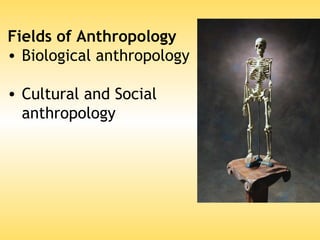
Fields of Anthropology Biological anthropology Cultural and Social anthropology
Biological Anthropology
Biological anthropology or Physical anthropology, focuses on the study of human populations using an evolutionary framework.  Biological anthropologists have theorized about how the globe has become populated with humans as well as tried to explain geographical human variation and race.  Many biological anthropologists studying modern human populations identify their field as human ecology - itself linked to sociobiology.
Branches of Biological Anthropology Human paleontology  – this set includes questions about the emergence of humans and their later emergence Human variation  – this set includes questions about how and why contemporary human populations vary biologically.
Human Evolution
Evolution  is the change in the inherited traits of a population of organisms through successive generations. After a population splits into smaller groups, these groups evolve independently and may eventually diversify into new species.
Mutation and sexual reproduction produces variation Natural (and cultural) selection is involved in who leaves offspring and how many Each generation is genetically different than the previous generation Over time, the species becomes different.  Human Evolution
Cultural and Social Anthropology
Cultural Anthropology It seeks to study how populations or societies vary in their cultural features. It also deals with man’s behavior and with the ways human beings carry out the activities of daily living. The diversity of human behavior is seen in : food habits, ways food is cooked, habits of dress and ornaments and relations with in-laws. Cultural anthropology has the following subdivisions:  Ethnology, Anthropological Linguistics  &  Archeology
Ethnography It seeks to understand how and why people today and in the recent past differ in their customary ways of thinking and acting. It is the study of culture, and is often based on ethnography. can refer to both a methodology and a product of research, namely a monograph or book.
Ethnography is a grounded, inductive method, that heavily relies on participant-observation. It is grounded on the study of kinship and social organization.
Archaeology
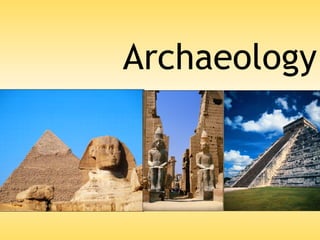
Archeology  deals with ancient cultures and past phases of modern civilization based on documents, stone carvings, relics etc. It seeks to reconstruct the daily life and customs of peoples who lived in the past but also to trace cultural changes and to offer possible explanations of those changes.
Archaeology is the study of human material culture, including both artifacts (older pieces of human culture) carefully gathered  in  museum pieces and modern garbage.
Archaeology: A preserve body on  Pompei from the eruption of Mount Vesuvius
Linguistic Anthropology
Linguistic anthropology seeks to understand the processes of human communications, verbal and non-verbal, variation in language across time and space, the social uses of language, and the relationship between language and culture.  It is the branch of anthropology that brings linguistic methods to bear on anthropological problems, linking the analysis of linguistic forms and processes to the interpretation of sociocultural processes.
Linguistic anthropologists often draw on related fields including sociolinguistics, pragmatics, cognitive linguistics, semiotics, discourse analysis, and narrative analysis.
Branches of Linguistic Anthropology Historical linguistics  – is the study of how languages change over time and how they may be related. Structural/Descriptive linguistics  – is the study of how contemporary languages differ, especially in their construction. Socio – linguistics  – the study of how language is used in social context.
To download this file, go to: http://www.slideshare.net/ArnelSSI Thank Y  u!

Into to anthropology

  • 1.
    Introduction to AnthropologyPrepared by: Arnel O. Rivera MAT-SS
  • 2.
    What is Anthropology?Anthropology comes from the Greek word anthropos for “man, human” and logos for “study”. It seeks to answer an enormous variety of questions about humans. They are interested in discovering when, where and why humans appeared on earth, how and why they have changed since then, and how and why modern human populations vary in certain physical features. Anthropologists are also interested in how and why societies in the past and present have varied in their customary ideas and practices.
  • 3.
    Anthropology's basic concernsare… What defines Homo sapiens ? Who are the ancestors of modern Homo sapiens ? What are humans' physical traits? How do humans behave? Why are there variations and differences among different groups of humans? How has the evolutionary past of Homo sapiens influenced its social organization and culture?”
  • 4.
    Fields of AnthropologyBiological anthropology Cultural and Social anthropology
  • 5.
  • 6.
    Biological anthropology orPhysical anthropology, focuses on the study of human populations using an evolutionary framework. Biological anthropologists have theorized about how the globe has become populated with humans as well as tried to explain geographical human variation and race. Many biological anthropologists studying modern human populations identify their field as human ecology - itself linked to sociobiology.
  • 7.
    Branches of BiologicalAnthropology Human paleontology – this set includes questions about the emergence of humans and their later emergence Human variation – this set includes questions about how and why contemporary human populations vary biologically.
  • 8.
  • 9.
    Evolution isthe change in the inherited traits of a population of organisms through successive generations. After a population splits into smaller groups, these groups evolve independently and may eventually diversify into new species.
  • 10.
    Mutation and sexualreproduction produces variation Natural (and cultural) selection is involved in who leaves offspring and how many Each generation is genetically different than the previous generation Over time, the species becomes different. Human Evolution
  • 11.
    Cultural and SocialAnthropology
  • 12.
    Cultural Anthropology Itseeks to study how populations or societies vary in their cultural features. It also deals with man’s behavior and with the ways human beings carry out the activities of daily living. The diversity of human behavior is seen in : food habits, ways food is cooked, habits of dress and ornaments and relations with in-laws. Cultural anthropology has the following subdivisions: Ethnology, Anthropological Linguistics & Archeology
  • 13.
    Ethnography It seeksto understand how and why people today and in the recent past differ in their customary ways of thinking and acting. It is the study of culture, and is often based on ethnography. can refer to both a methodology and a product of research, namely a monograph or book.
  • 14.
    Ethnography is agrounded, inductive method, that heavily relies on participant-observation. It is grounded on the study of kinship and social organization.
  • 15.
  • 16.
    Archeology dealswith ancient cultures and past phases of modern civilization based on documents, stone carvings, relics etc. It seeks to reconstruct the daily life and customs of peoples who lived in the past but also to trace cultural changes and to offer possible explanations of those changes.
  • 17.
    Archaeology is thestudy of human material culture, including both artifacts (older pieces of human culture) carefully gathered in museum pieces and modern garbage.
  • 18.
    Archaeology: A preservebody on Pompei from the eruption of Mount Vesuvius
  • 19.
  • 20.
    Linguistic anthropology seeksto understand the processes of human communications, verbal and non-verbal, variation in language across time and space, the social uses of language, and the relationship between language and culture. It is the branch of anthropology that brings linguistic methods to bear on anthropological problems, linking the analysis of linguistic forms and processes to the interpretation of sociocultural processes.
  • 21.
    Linguistic anthropologists oftendraw on related fields including sociolinguistics, pragmatics, cognitive linguistics, semiotics, discourse analysis, and narrative analysis.
  • 22.
    Branches of LinguisticAnthropology Historical linguistics – is the study of how languages change over time and how they may be related. Structural/Descriptive linguistics – is the study of how contemporary languages differ, especially in their construction. Socio – linguistics – the study of how language is used in social context.
  • 23.
    To download thisfile, go to: http://www.slideshare.net/ArnelSSI Thank Y u!