
This document provides guidance on writing effective multiple choice questions. It discusses the advantages and disadvantages of multiple choice questions, guidelines for constructing item stems and alternatives, and examples of questions at different cognitive levels. The intended learning outcomes are to explain the strengths and weaknesses of multiple choice exams, evaluate existing multiple choice items, and create effective multiple choice items that measure various learning levels. Participants are engaged in revision activities to practice applying the guidelines.
Writing Effective
Multiple-Choice Questions
Julie Sievers, Center for Teaching Excellence
2.
Sources
Burton,S. J., Sudweeks, R. R., Merrill, P. F., & Wood,
B. (1991). How to prepare better multiple-choice test
items: Guidelines for university faculty. Brigham
Young University Testing Services and The
Department of Instructional Science.
Zimarro, D. (2010). Writing good multiple-choice
exams. University of Texas at Austin Center for
Teaching and Learning.
3.
Goals
After learningabout question design, you should be able to:
Explain the strengths and weaknesses of multiple-choice exams
Identify learning objectives that can be assessed by multiple-choice
items and those that should be assessed by other means
Evaluate existing multiple-choice items using accepted criteria
and improve poorly written items
Create multiple-choice items that accurately measure learning
objectives and that assess various levels of learning
Use exam results for feedback and to evaluate instructional
effectiveness
4.
Meet your table
Who are we?
Name
Department
One question you have
about multiple-choice test
design (use note cards)
5.
Advantages
Learningoutcomes from simple to complex can be
measured.
Highly structured and clear tasks are provided.
A broad sample of achievement can be measured.
Incorrect alternatives provide diagnostic
information.
Scores are less influenced by guessing than true-false
items.
Scores are more reliable than subjectively scored
items (e.g., essays).
6.
More Advantages
Scoring is easy, objective, and reliable.
Item analysis can reveal how difficult each item was
and how well it discriminated between the strong
and weaker students in the class.
Performance can be compared from class to class
and year to year.
Exam can cover a lot of material very efficiently
(about one item per minute of testing time).
Items can be written so that students must
discriminate among options that vary in degree of
correctness.
7.
Disadvantages
Constructinggood items is time consuming.
It is frequently difficult to find plausible distractors.
This item is ineffective for measuring some types of
problem solving and the ability to organize and
express ideas.
Real-world problem solving differs – a different
process is involved in proposing a solution versus
selecting a solution from a set of alternatives.
Scores can be influenced by reading ability.
8.
More Disadvantages
Items provide little information about individual thought
processes; it is difficult to determine why individual
students selected incorrect responses.
Items are often focus on testing factual information and
fail to test higher levels of cognitive thinking.
Sometimes there is more than one defensible “correct”
answer.
They place a high degree of dependence on the
student’s reading ability and the instructor’s writing
ability.
May encourage guessing.
9.
A Design Process
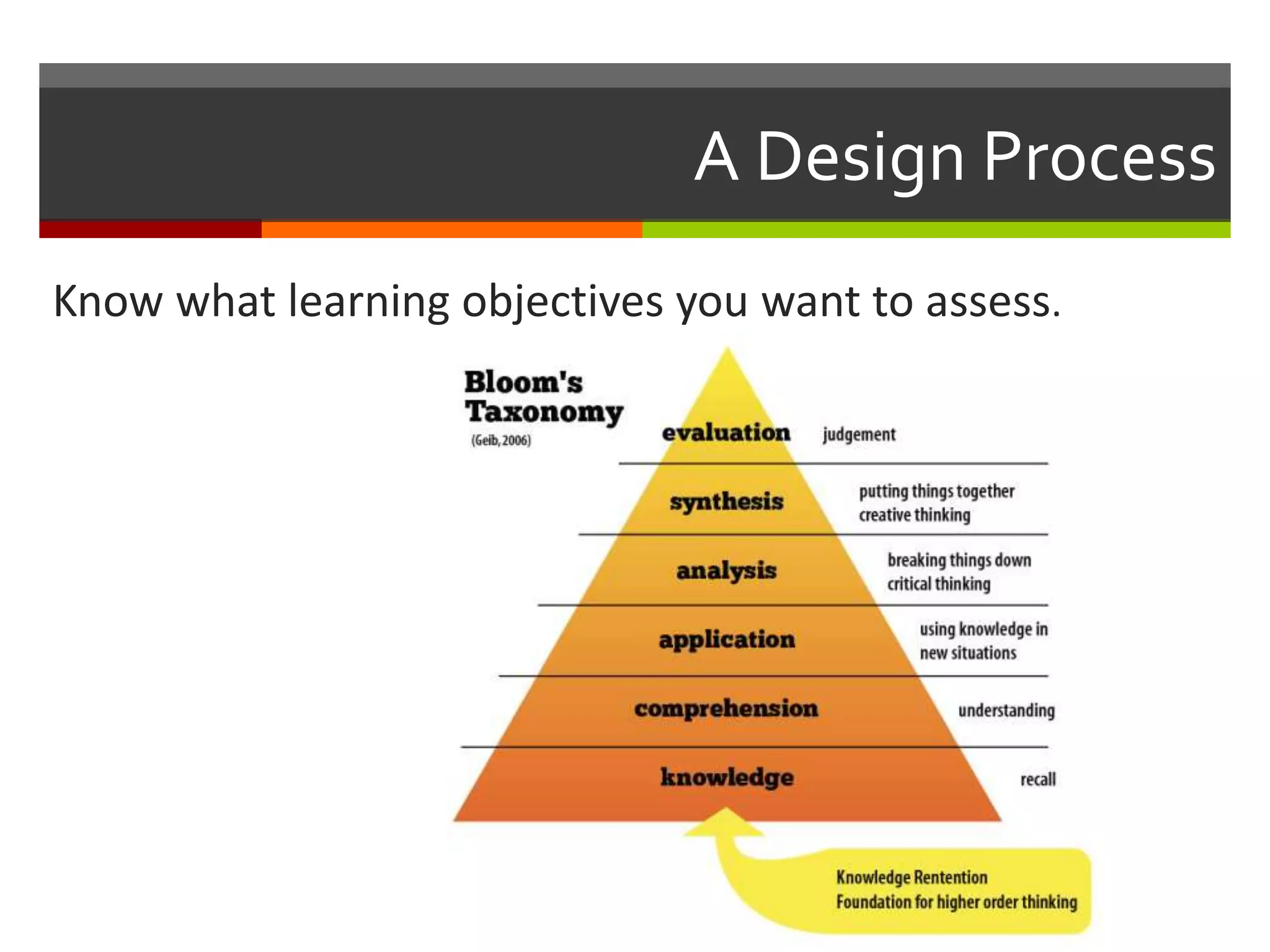
Know what learning objectives you want to assess.
10.
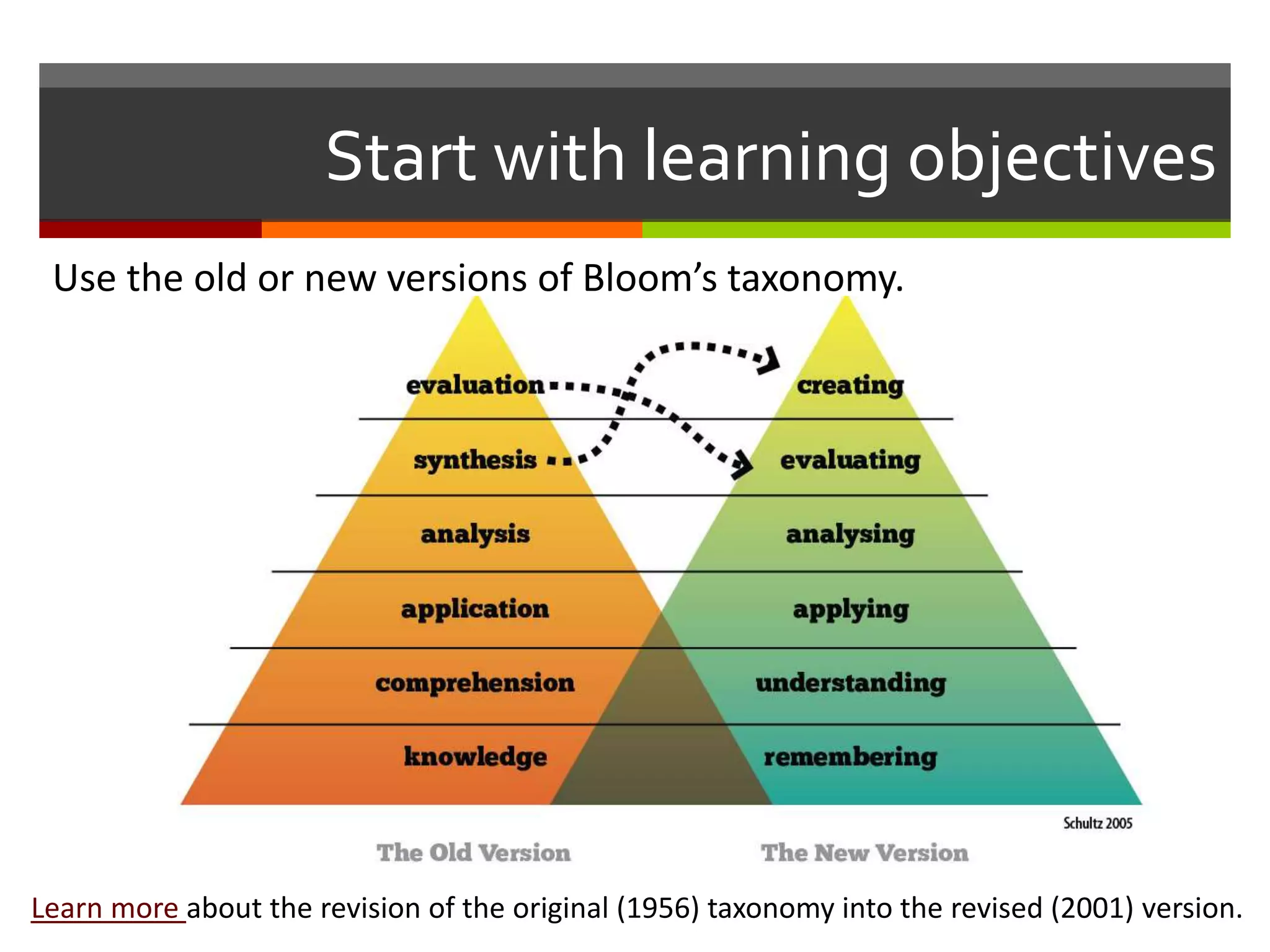
Start with learningobjectives
Use the old or new versions of Bloom’s taxonomy.
Learn more about the revision of the original (1956) taxonomy into the revised (2001) version.
11.
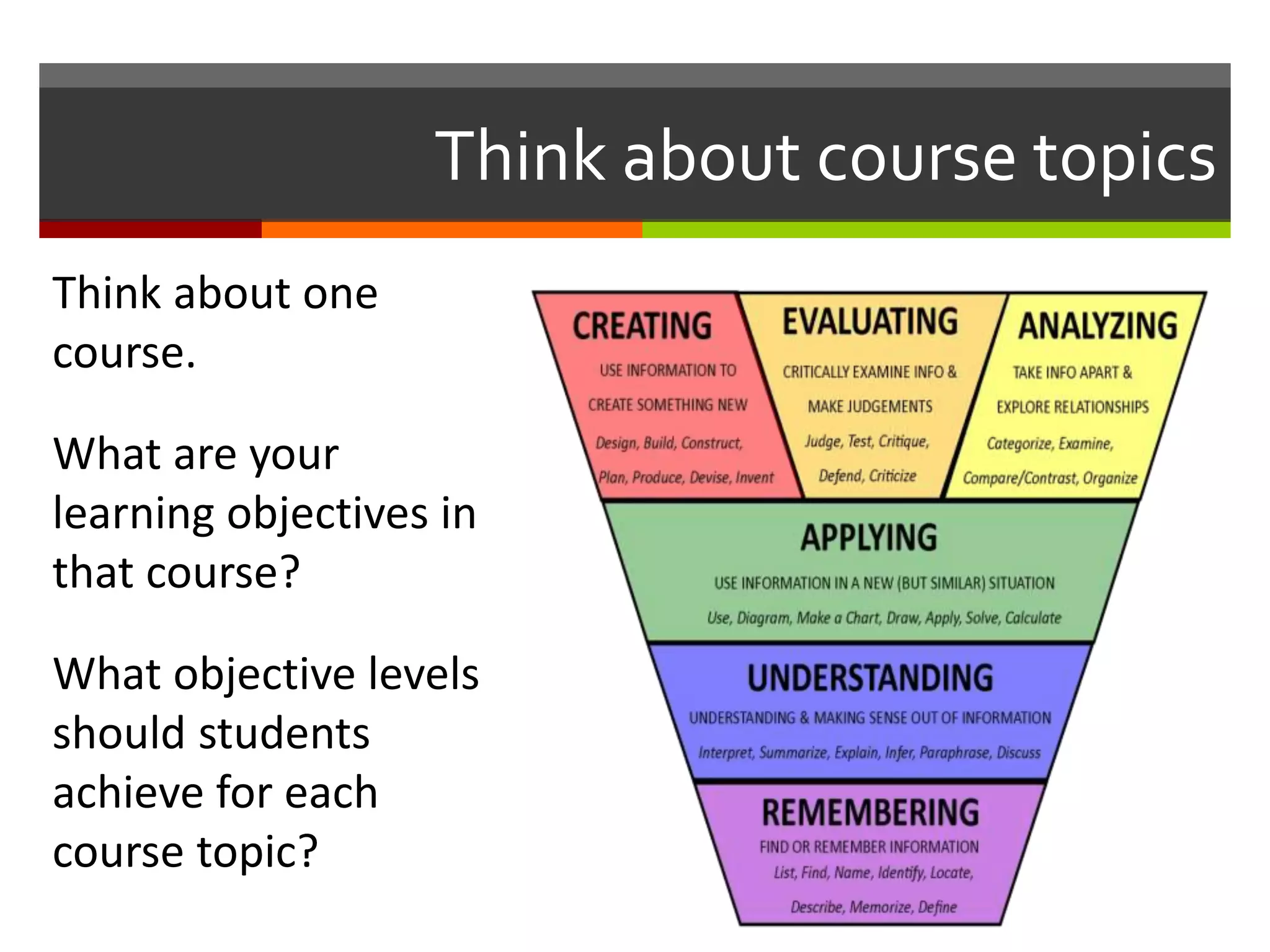
Think about coursetopics
Think about one
course.
What are your
learning objectives in
that course?
What objective levels
should students
achieve for each
course topic?
12.
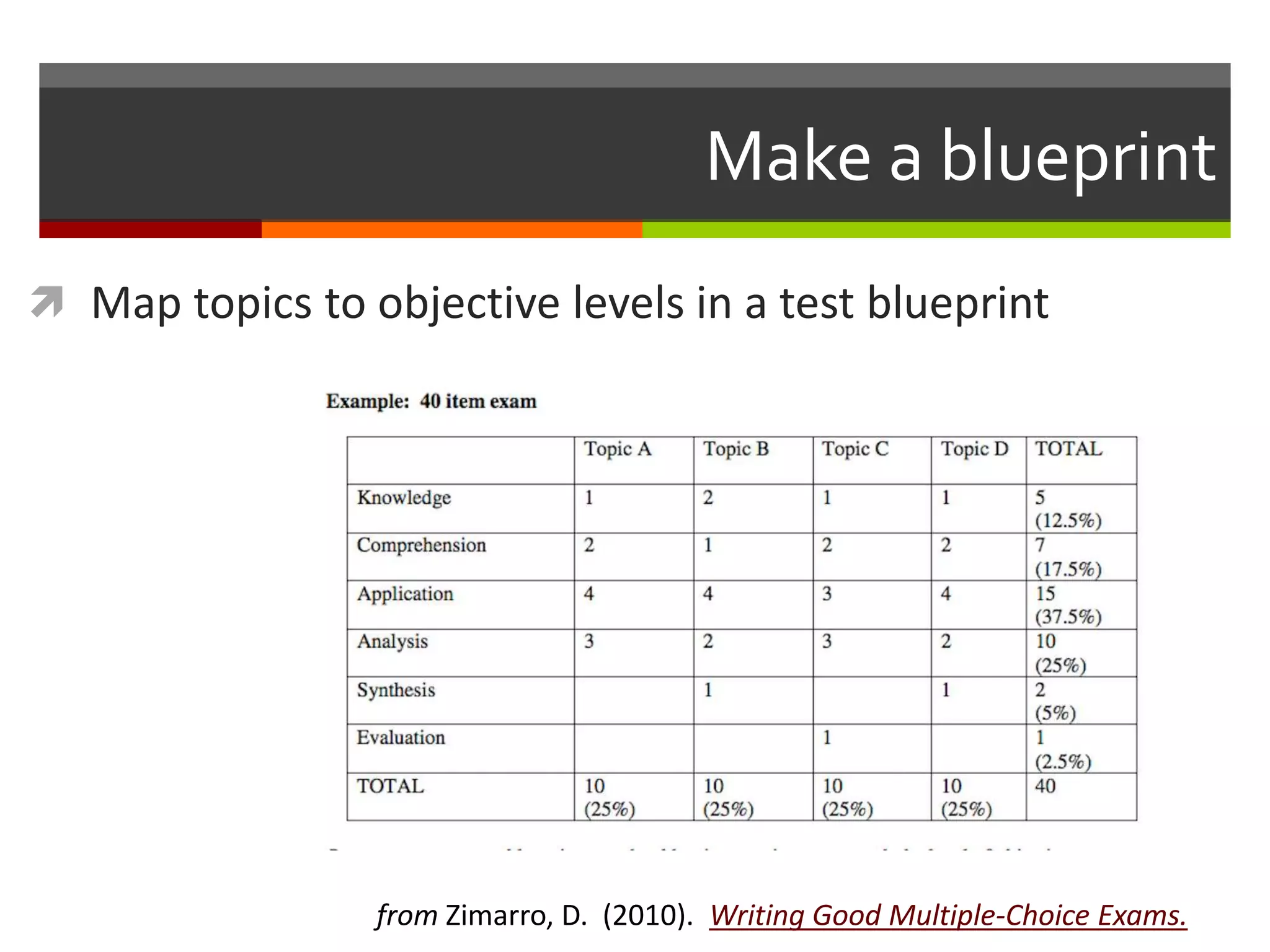
Make a blueprint
Map topics to objective levels in a test blueprint
from Zimarro, D. (2010). Writing Good Multiple-Choice Exams.
13.
For example
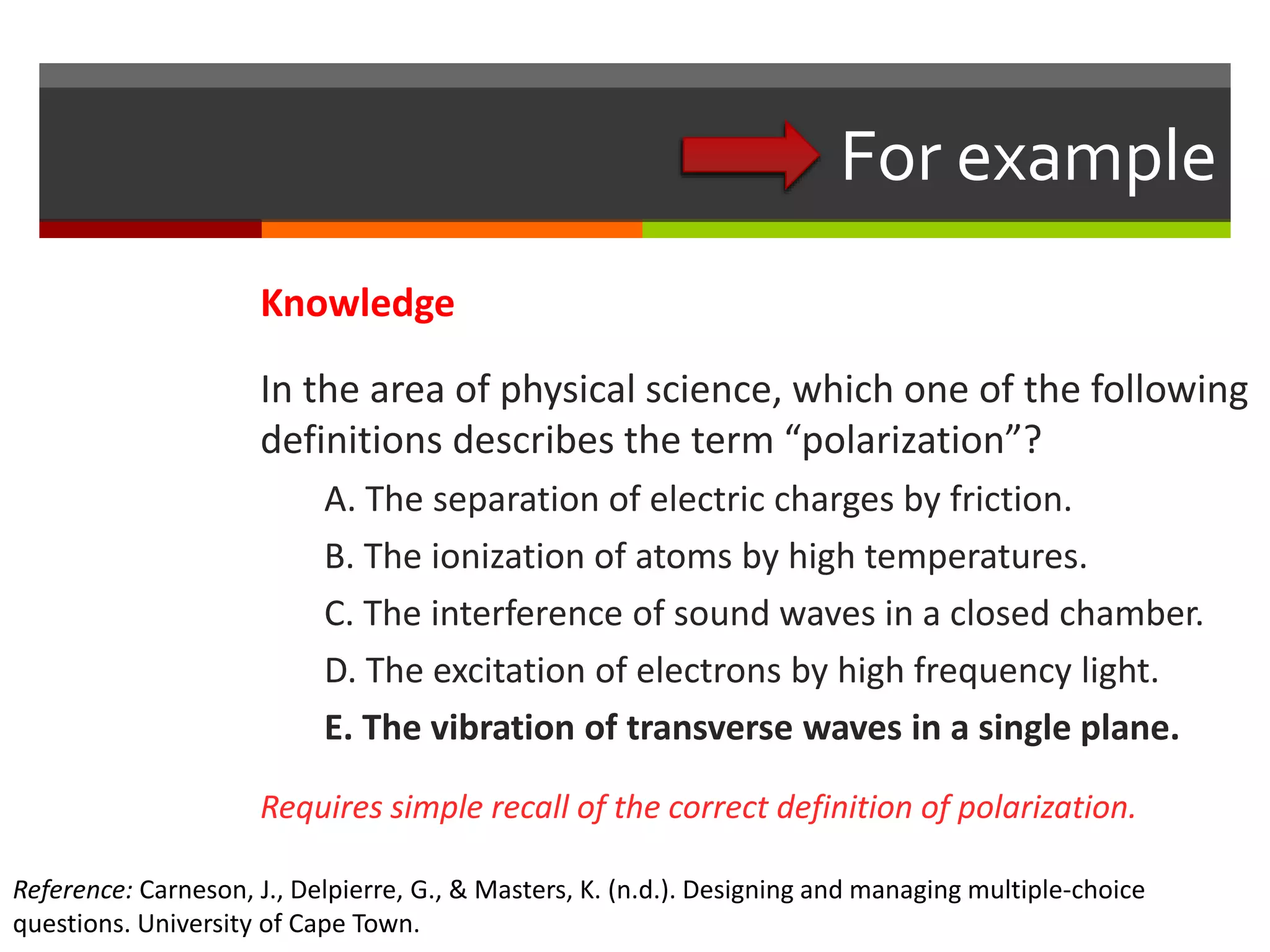
Knowledge
In the area of physical science, which one of the following
definitions describes the term “polarization”?
A. The separation of electric charges by friction.
B. The ionization of atoms by high temperatures.
C. The interference of sound waves in a closed chamber.
D. The excitation of electrons by high frequency light.
E. The vibration of transverse waves in a single plane.
Requires simple recall of the correct definition of polarization.
Reference: Carneson, J., Delpierre, G., & Masters, K. (n.d.). Designing and managing multiple-choice
questions. University of Cape Town.
14.
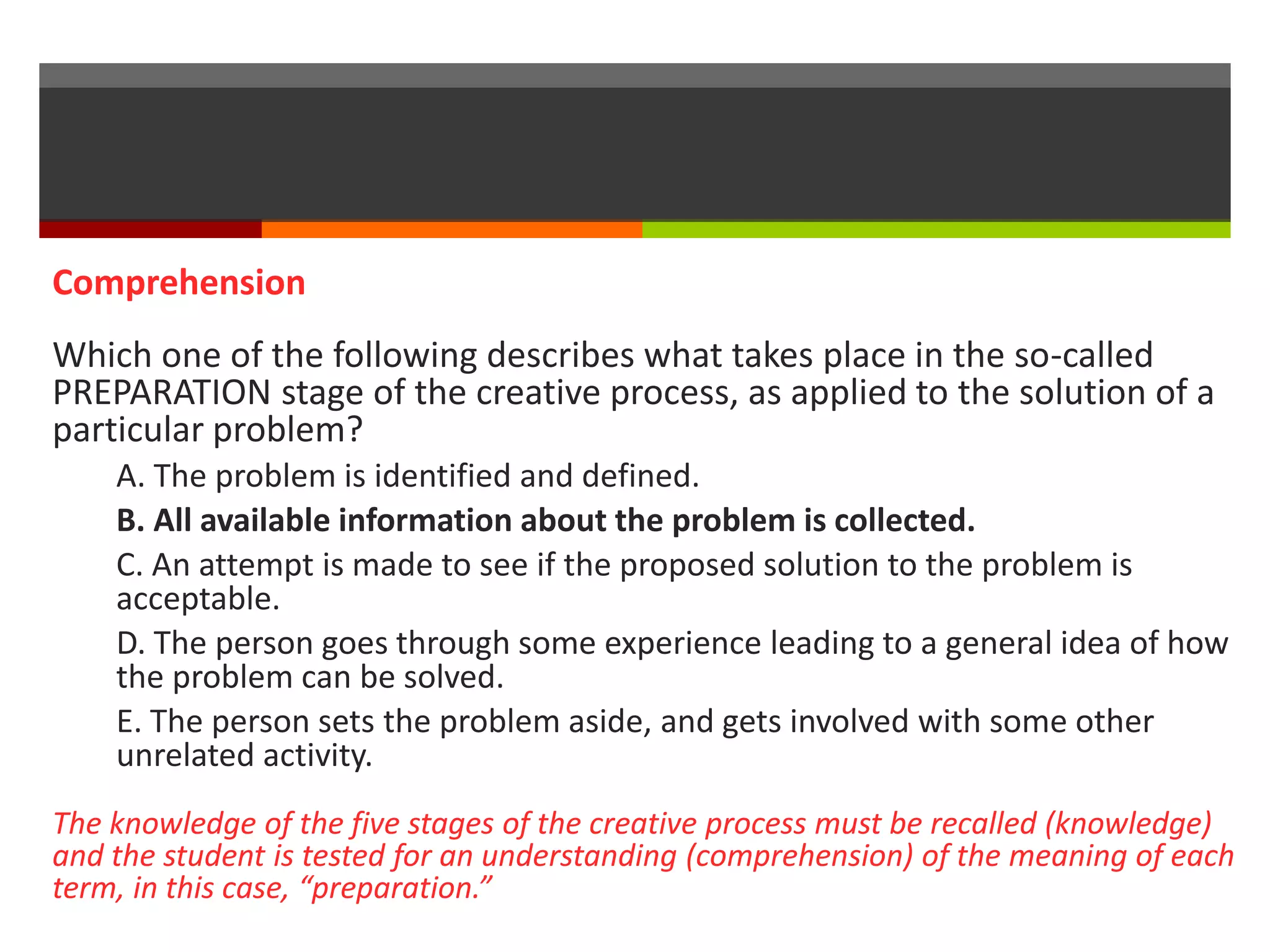
Comprehension
Which oneof the following describes what takes place in the so-called
PREPARATION stage of the creative process, as applied to the solution of a
particular problem?
A. The problem is identified and defined.
B. All available information about the problem is collected.
C. An attempt is made to see if the proposed solution to the problem is
acceptable.
D. The person goes through some experience leading to a general idea of how
the problem can be solved.
E. The person sets the problem aside, and gets involved with some other
unrelated activity.
The knowledge of the five stages of the creative process must be recalled (knowledge)
and the student is tested for an understanding (comprehension) of the meaning of each
term, in this case, “preparation.”
15.
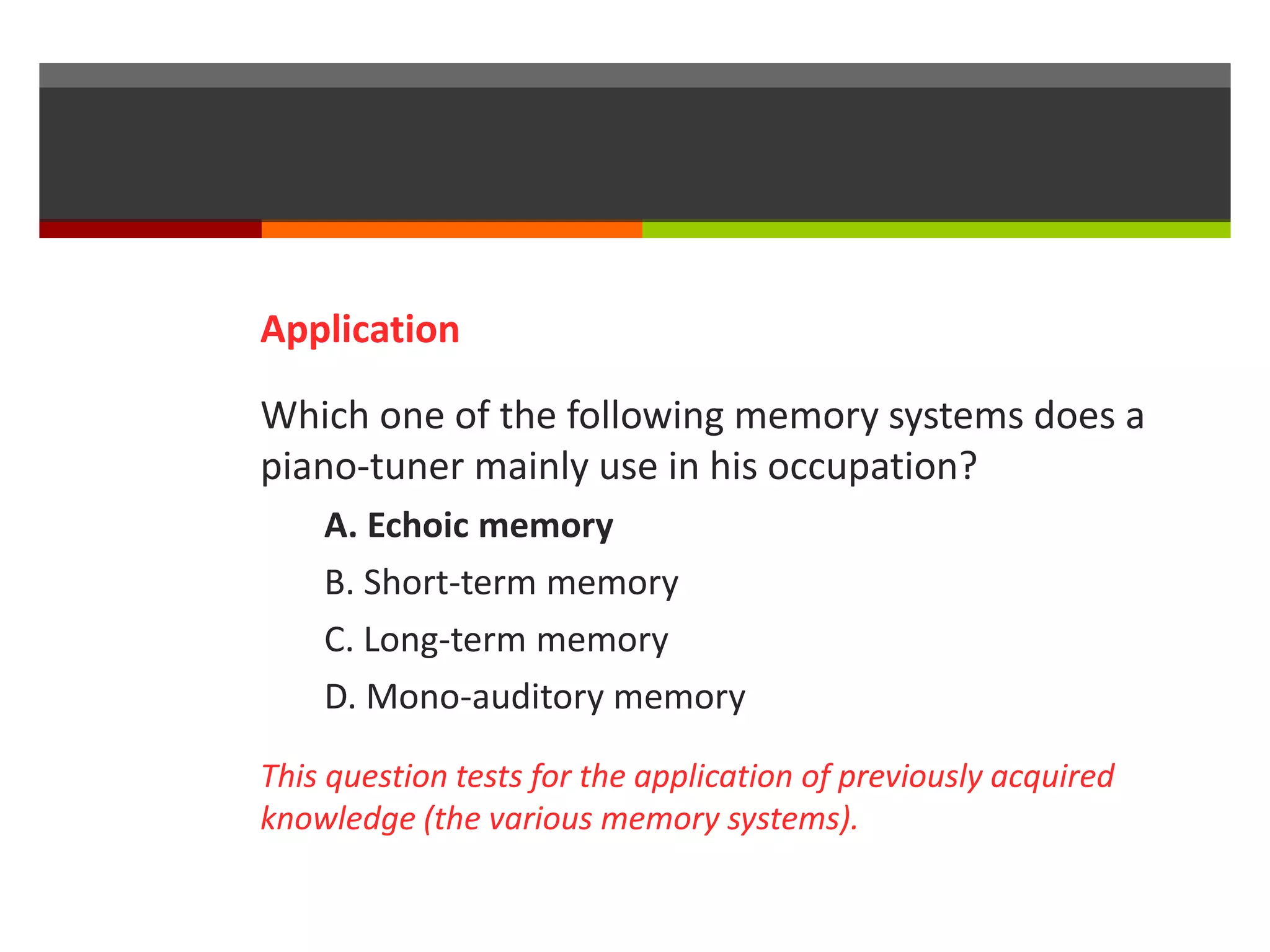
Application
Which oneof the following memory systems does a
piano-tuner mainly use in his occupation?
A. Echoic memory
B. Short-term memory
C. Long-term memory
D. Mono-auditory memory
This question tests for the application of previously acquired
knowledge (the various memory systems).
16.
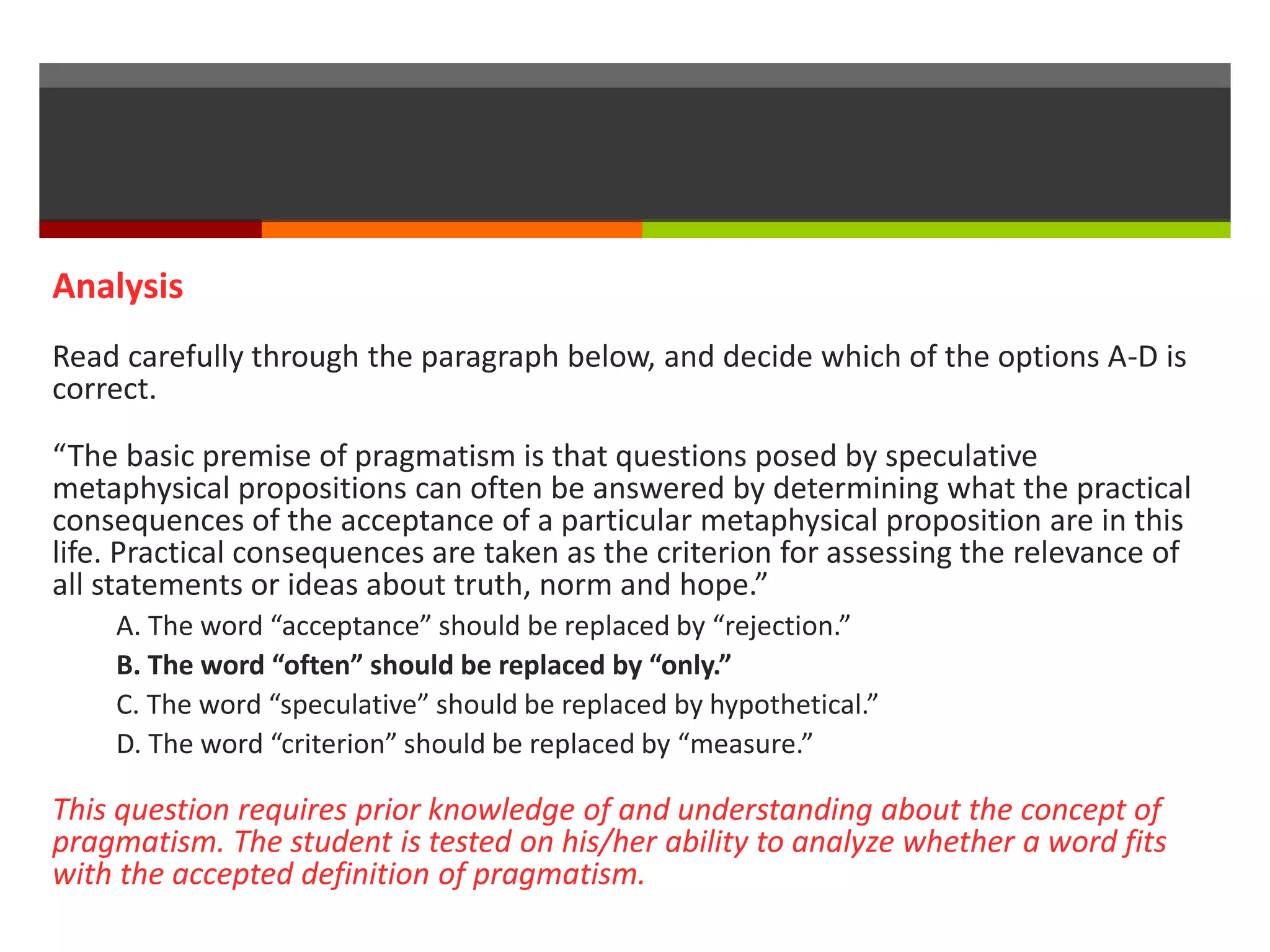
Analysis
Read carefullythrough the paragraph below, and decide which of the options A-D is
correct.
“The basic premise of pragmatism is that questions posed by speculative
metaphysical propositions can often be answered by determining what the practical
consequences of the acceptance of a particular metaphysical proposition are in this
life. Practical consequences are taken as the criterion for assessing the relevance of
all statements or ideas about truth, norm and hope.”
A. The word “acceptance” should be replaced by “rejection.”
B. The word “often” should be replaced by “only.”
C. The word “speculative” should be replaced by hypothetical.”
D. The word “criterion” should be replaced by “measure.”
This question requires prior knowledge of and understanding about the concept of
pragmatism. The student is tested on his/her ability to analyze whether a word fits
with the accepted definition of pragmatism.
17.
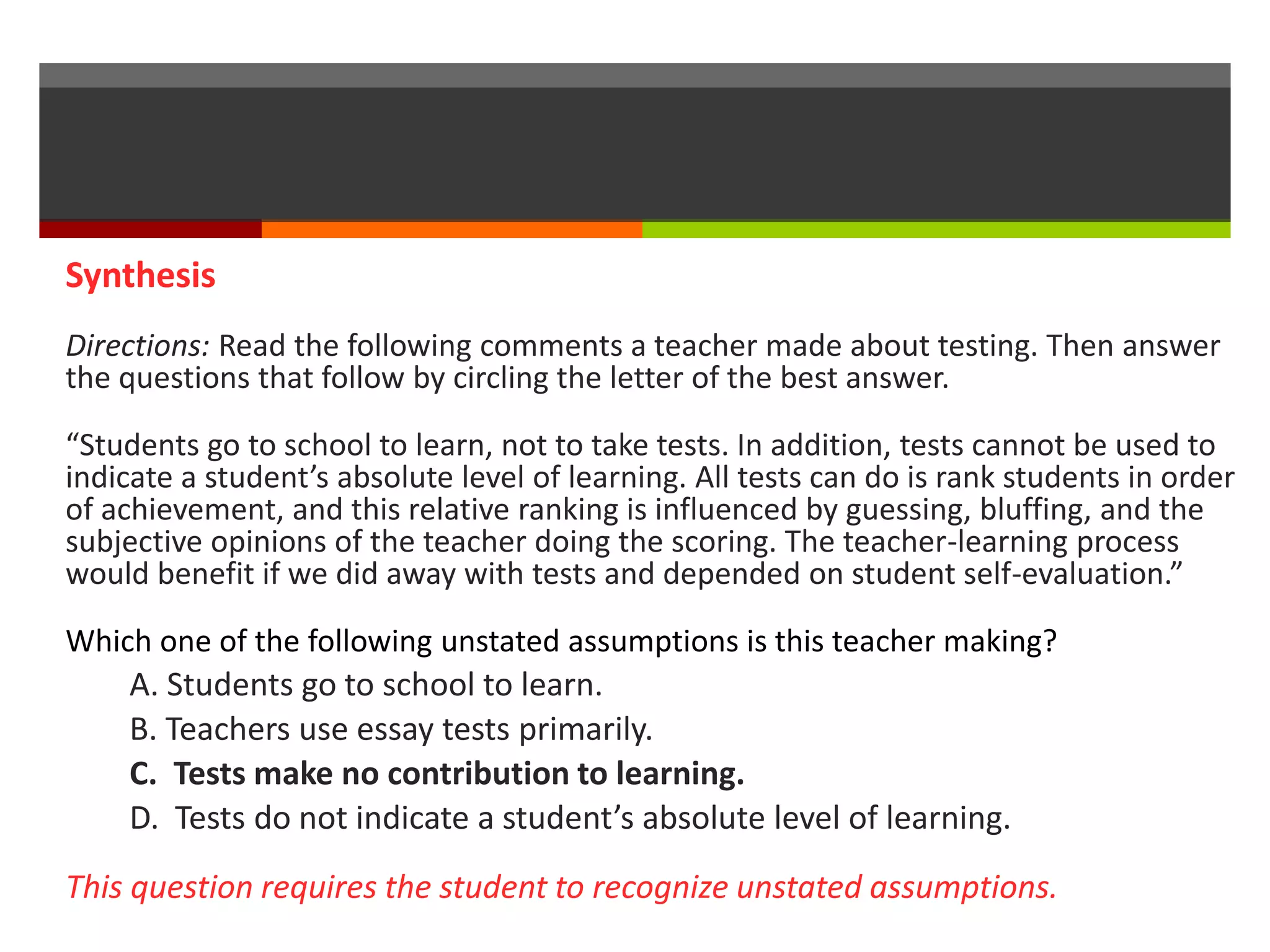
Synthesis
Directions: Readthe following comments a teacher made about testing. Then answer
the questions that follow by circling the letter of the best answer.
“Students go to school to learn, not to take tests. In addition, tests cannot be used to
indicate a student’s absolute level of learning. All tests can do is rank students in order
of achievement, and this relative ranking is influenced by guessing, bluffing, and the
subjective opinions of the teacher doing the scoring. The teacher-learning process
would benefit if we did away with tests and depended on student self-evaluation.”
Which one of the following unstated assumptions is this teacher making?
A. Students go to school to learn.
B. Teachers use essay tests primarily.
C. Tests make no contribution to learning.
D. Tests do not indicate a student’s absolute level of learning.
This question requires the student to recognize unstated assumptions.
18.
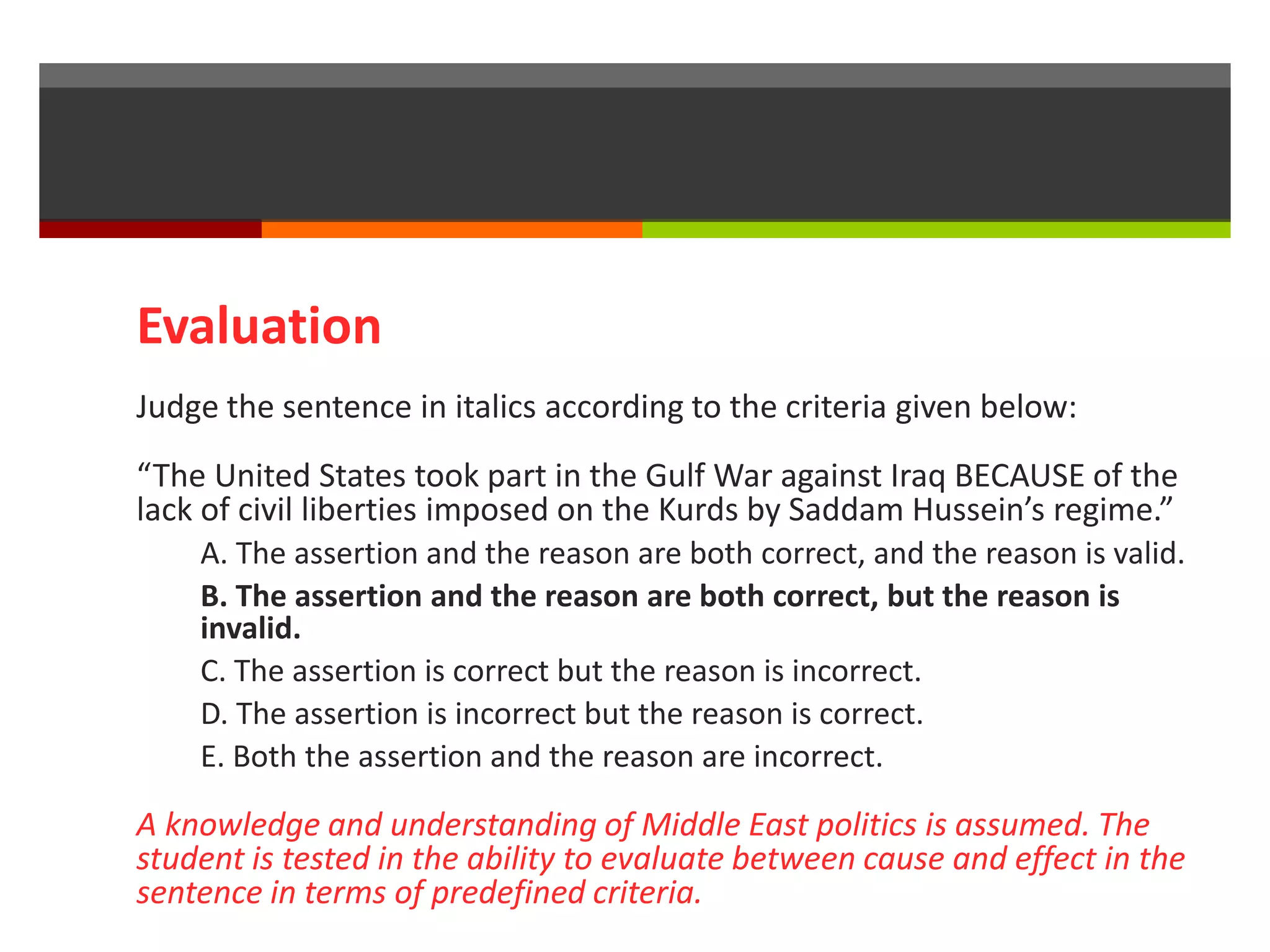
Evaluation
Judge thesentence in italics according to the criteria given below:
“The United States took part in the Gulf War against Iraq BECAUSE of the
lack of civil liberties imposed on the Kurds by Saddam Hussein’s regime.”
A. The assertion and the reason are both correct, and the reason is valid.
B. The assertion and the reason are both correct, but the reason is
invalid.
C. The assertion is correct but the reason is incorrect.
D. The assertion is incorrect but the reason is correct.
E. Both the assertion and the reason are incorrect.
A knowledge and understanding of Middle East politics is assumed. The
student is tested in the ability to evaluate between cause and effect in the
sentence in terms of predefined criteria.
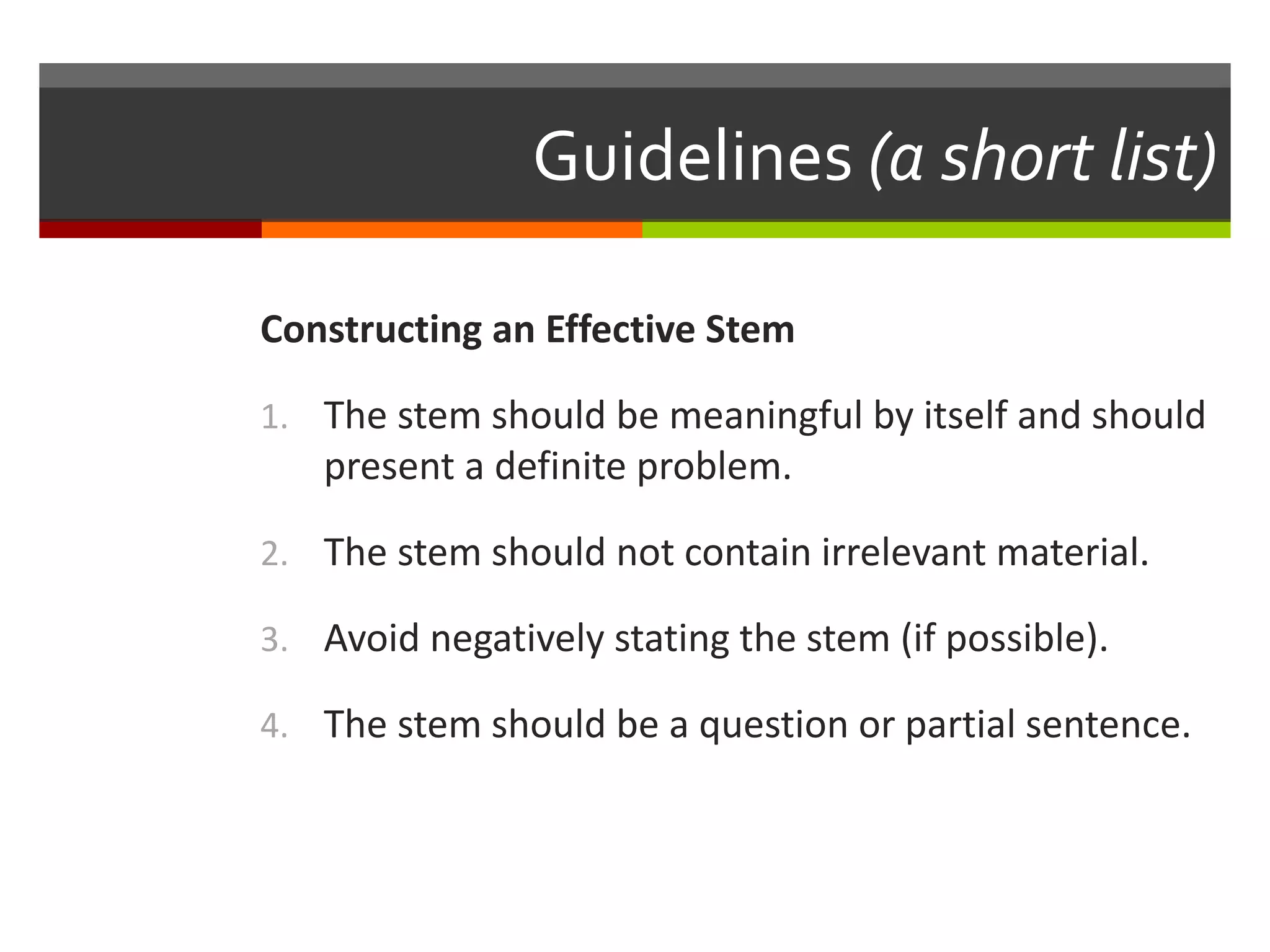
Guidelines (a shortlist)
Constructing an Effective Stem
1. The stem should be meaningful by itself and should
present a definite problem.
2. The stem should not contain irrelevant material.
3. Avoid negatively stating the stem (if possible).
4. The stem should be a question or partial sentence.
21.
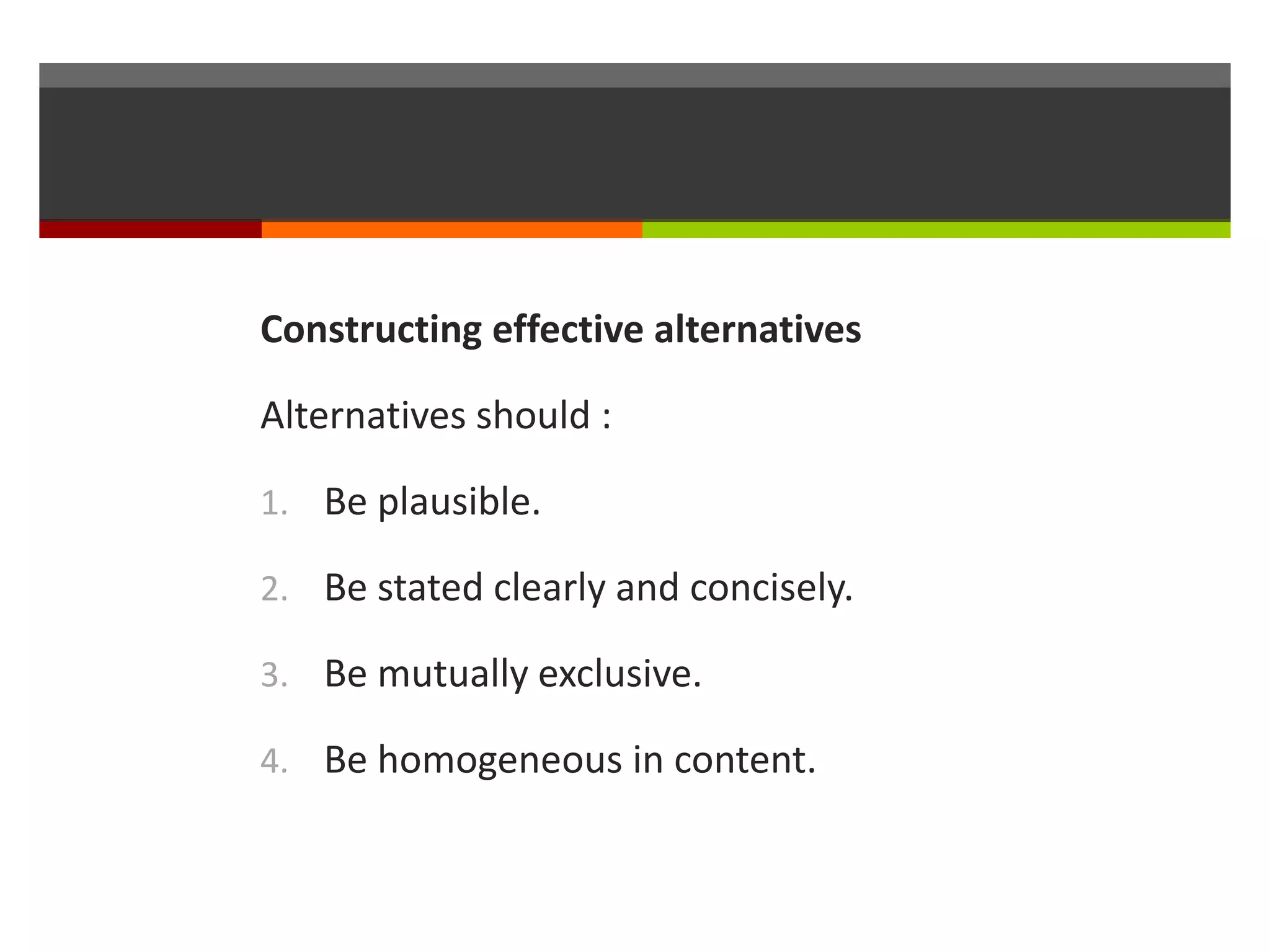
Constructing effective alternatives
Alternatives should :
1. Be plausible.
2. Be stated clearly and concisely.
3. Be mutually exclusive.
4. Be homogeneous in content.
22.
5. Be freefrom clues about the correct response
6. Not include “all of the above” or “none of the
above”
7. Be presented in a logical order (alphabetical or
numerical)
8. Vary in number among items, as long as all
alternatives are plausible.
23.
Revision activity #1
At tables:
Work on choosing the best
question from Zimarro’s
samples.
Why is one better than the
other?
24.
Revision activity #2
At tables:
Work on revising Duquesne
questions
How did you go about revising
it?
25.
Further reading
Readon!
The CTE at St. Edward’s University has provided a blog
post with links about a variety of topics related to
multiple-choice test design:
http://think.stedwards.edu/cte/blog/post/writing-effective-
multiple-choice-tests