What is
assessment?
Are we
really
teaching,
what
we’re
teaching?
Guidelines for
Constructing
Effective Test
Items
-KimverlyTorres
Guidelines for
Constructing Multiple
Choice Items
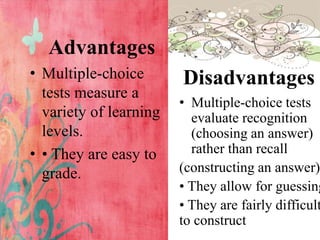
Advantages
• Multiple-choice
tests measure a
variety of learning
levels.
• • They are easy to
grade.
Disadvantages
• Multiple-choice tests
evaluate recognition
(choosing an answer)
rather than recall
(constructing an answer)
• They allow for guessing
• They are fairly difficult
to construct
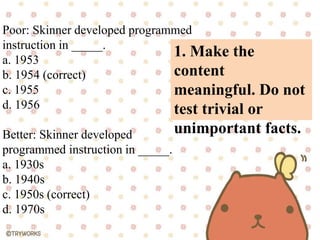
1. Make the
content
meaningful. Do not
test trivial or
unimportant facts.
Poor: Skinner developed programmed
instruction in _____.
a. 1953
b. 1954 (correct)
c. 1955
d. 1956
Better: Skinner developed
programmed instruction in _____.
a. 1930s
b. 1940s
c. 1950s (correct)
d. 1970s
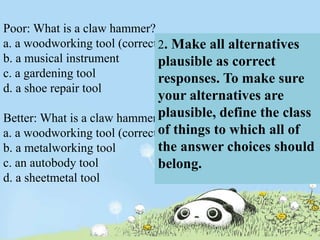
Poor: What is a claw hammer?
a. a woodworking tool (correct)
b. a musical instrument
c. a gardening tool
d. a shoe repair tool
Better: What is a claw hammer?
a. a woodworking tool (correct)
b. a metalworking tool
c. an autobody tool
d. a sheetmetal tool
2. Make all alternatives
plausible as correct
responses. To make sure
your alternatives are
plausible, define the class
of things to which all of
the answer choices should
belong.
3. Reduce the length of the alternatives by moving as many
words as possible to the stem. The rationale is that
additional words in the alternatives have to be read four or
five times, in the stem only once.
Poor: The mean is _____.
a. a measure of the average (correct)
b. a measure of the midpoint
c. a measure of the most popular score
d. a measure of the dispersion scores.
Better: The mean is a measure of the _____.
a. average (correct)
b. midpoint
c. most popular score
d. dispersion of scores
4. Do not make the correct answer stand out as a
result of its phrasing or length.
Poor: A narrow strip of land bordered on both sides of water is called an
_____.
a. isthmus (correct)
b. peninsula
c. bayou
d. continent
Better: A narrow strip of land bordered on both sides by water is called
a(n) _____.
a. isthmus (correct)
b. peninsula
c. bayou
d. continent
(Note: Do you see why
a would be the best
guess given the
phrasing?)
5. Avoid the exact wording of a
source material. This places too
much emphasis on simple
memory and barely tests
cognitive acquisition at the
knowledge level.
In the Mediterranean region, cattle raising is
handicapped by:
a. A hot climate
b. Lack of demand for beef
c. A lack of sufficient productive pasturage
d. High labor costs
The correct choice, "C," may be obvious from its
length and explicitness alone.
6. The length, explicitness, or degree of
technicality of alternatives should not vary
with correctness.
Guidelines for
Constructing
True/False Items
Advantages
• True/false items are fairly easy to
write
• They are very easy to grade
Disadvantages
• True/false items can only test for
factual information
• They allow for a high probability
(50%) of guessing the correct
answer
• They limit assessments to lower
levels of learning (knowledge and
1. Be certain that the
statement is entirely true
or entirely false.
2. Convey only one
thought or idea in a
true/false statement
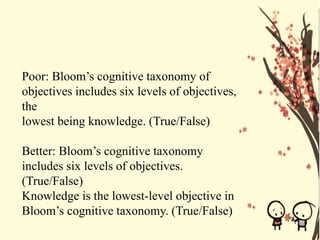
Poor: Bloom’s cognitive taxonomy of
objectives includes six levels of objectives,
the
lowest being knowledge. (True/False)
Better: Bloom’s cognitive taxonomy
includes six levels of objectives.
(True/False)
Knowledge is the lowest-level objective in
Bloom’s cognitive taxonomy. (True/False)
3. Require learners to write
a short explanation of why
false answers are incorrect.
4. Beware of detectable answer
patterns. Students can pick out
patterns such as (TTTTFFFF)
which might be designed to
make scoring easier.
5. Beware of words denoting
indefinite degree. The use of
words like “more,” “less,”
“important,” “unimportant,”
“large,” “small,” “recent,” “old,”
“tall,” “great,” and so on, can
easily lead to ambiguity.
Guidelines for
Constructing
Matching Items
Advantages
• A large amount of material can be
condensed to fit in less space
• Students have substantially fewer
chances for guessing correct
associations than
on multiple-choice and true/false tests
Disadvantage
• Matching tests cannot effectively test
higher order intellectual skills
1. Limit the number of
items to a maximum of
six or seven. It becomes
very confusing for
learners to try to match
a greater amount.
2. Provide directions. Students
should not have to ask, for
example, whether options may
be used more than once.
4. Limit the length of the items to a word,
phrase, or brief sentence. In general, make
the items as short as possible.
5. Provide one or two extra items
(distractors) in the second column.
Their inclusion reduces the probability
of correct guessing. This also eliminates

the situation that may occur in equal-
sized lists, where if one match is
incorrect, a second match must also be
incorrect.
6. Keep the question to one page
and on the same page. Arrange
items so that students will not
have to turn pages back and
forth as they respond.
Guidelines for
Constructing SHORT-
ANSWER, FILL IN
THE BLANK,
COMPLETION Items
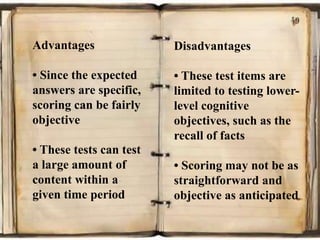
Advantages
• Since the expected
answers are specific,
scoring can be fairly
objective
• These tests can test
a large amount of
content within a
given time period
Disadvantages
• These test items are
limited to testing lower-
level cognitive
objectives, such as the
recall of facts
• Scoring may not be as
straightforward and
objective as anticipated
2. Prepare a scoring
key that contains all
acceptable answers
for each item.
3. Beware of open
questions that invite
unexpected but
reasonable answers.
Poor: The first president of the United
States was _____. (two words)
(Note: The desired answer is George
Washington, but students may write “from
Virginia”, “a general”, and other creative
expressions.)
Better: Give the first and last name of the
first president of the United States: _____.
Guidelines for
Constructing Essay
Items
1. Inform students of the
grading criteria and
conditions.
2. Do not give students a choice
of essays; have all respond to the
same questions.
3. Allow sufficient time to
answer to give the students
to outline first.
KimTorres
III-BSE
Thank You!

http://tamannakalim.wordpress.com/2013/10/2
2/guideline-for-constructing-effective-test-
items/
http://webs.rtc.edu/ii/Teaching%20Resources/G
uidelinesforWritingTest.htm
Check out this sites ♥

Guidelines for Constructing Effective Test Items

  • 1.
  • 2.
  • 3.
  • 4.
  • 5.
    Advantages • Multiple-choice tests measurea variety of learning levels. • • They are easy to grade. Disadvantages • Multiple-choice tests evaluate recognition (choosing an answer) rather than recall (constructing an answer) • They allow for guessing • They are fairly difficult to construct
  • 6.
    1. Make the content meaningful.Do not test trivial or unimportant facts. Poor: Skinner developed programmed instruction in _____. a. 1953 b. 1954 (correct) c. 1955 d. 1956 Better: Skinner developed programmed instruction in _____. a. 1930s b. 1940s c. 1950s (correct) d. 1970s
  • 7.
    Poor: What isa claw hammer? a. a woodworking tool (correct) b. a musical instrument c. a gardening tool d. a shoe repair tool Better: What is a claw hammer? a. a woodworking tool (correct) b. a metalworking tool c. an autobody tool d. a sheetmetal tool 2. Make all alternatives plausible as correct responses. To make sure your alternatives are plausible, define the class of things to which all of the answer choices should belong.
  • 8.
    3. Reduce thelength of the alternatives by moving as many words as possible to the stem. The rationale is that additional words in the alternatives have to be read four or five times, in the stem only once. Poor: The mean is _____. a. a measure of the average (correct) b. a measure of the midpoint c. a measure of the most popular score d. a measure of the dispersion scores. Better: The mean is a measure of the _____. a. average (correct) b. midpoint c. most popular score d. dispersion of scores
  • 9.
    4. Do notmake the correct answer stand out as a result of its phrasing or length. Poor: A narrow strip of land bordered on both sides of water is called an _____. a. isthmus (correct) b. peninsula c. bayou d. continent Better: A narrow strip of land bordered on both sides by water is called a(n) _____. a. isthmus (correct) b. peninsula c. bayou d. continent
  • 10.
    (Note: Do yousee why a would be the best guess given the phrasing?)
  • 11.
    5. Avoid theexact wording of a source material. This places too much emphasis on simple memory and barely tests cognitive acquisition at the knowledge level.
  • 12.
    In the Mediterraneanregion, cattle raising is handicapped by: a. A hot climate b. Lack of demand for beef c. A lack of sufficient productive pasturage d. High labor costs The correct choice, "C," may be obvious from its length and explicitness alone. 6. The length, explicitness, or degree of technicality of alternatives should not vary with correctness.
  • 13.
  • 14.
    Advantages • True/false itemsare fairly easy to write • They are very easy to grade Disadvantages • True/false items can only test for factual information • They allow for a high probability (50%) of guessing the correct answer • They limit assessments to lower levels of learning (knowledge and
  • 15.
    1. Be certainthat the statement is entirely true or entirely false.
  • 16.
    2. Convey onlyone thought or idea in a true/false statement
  • 17.
    Poor: Bloom’s cognitivetaxonomy of objectives includes six levels of objectives, the lowest being knowledge. (True/False) Better: Bloom’s cognitive taxonomy includes six levels of objectives. (True/False) Knowledge is the lowest-level objective in Bloom’s cognitive taxonomy. (True/False)
  • 18.
    3. Require learnersto write a short explanation of why false answers are incorrect.
  • 19.
    4. Beware ofdetectable answer patterns. Students can pick out patterns such as (TTTTFFFF) which might be designed to make scoring easier.
  • 20.
    5. Beware ofwords denoting indefinite degree. The use of words like “more,” “less,” “important,” “unimportant,” “large,” “small,” “recent,” “old,” “tall,” “great,” and so on, can easily lead to ambiguity.
  • 21.
  • 22.
    Advantages • A largeamount of material can be condensed to fit in less space • Students have substantially fewer chances for guessing correct associations than on multiple-choice and true/false tests Disadvantage • Matching tests cannot effectively test higher order intellectual skills
  • 23.
    1. Limit thenumber of items to a maximum of six or seven. It becomes very confusing for learners to try to match a greater amount.
  • 24.
    2. Provide directions.Students should not have to ask, for example, whether options may be used more than once.
  • 25.
    4. Limit thelength of the items to a word, phrase, or brief sentence. In general, make the items as short as possible.
  • 26.
    5. Provide oneor two extra items (distractors) in the second column. Their inclusion reduces the probability of correct guessing. This also eliminates the situation that may occur in equal- sized lists, where if one match is incorrect, a second match must also be incorrect.
  • 27.
    6. Keep thequestion to one page and on the same page. Arrange items so that students will not have to turn pages back and forth as they respond.
  • 28.
    Guidelines for Constructing SHORT- ANSWER,FILL IN THE BLANK, COMPLETION Items
  • 29.
    Advantages • Since theexpected answers are specific, scoring can be fairly objective • These tests can test a large amount of content within a given time period Disadvantages • These test items are limited to testing lower- level cognitive objectives, such as the recall of facts • Scoring may not be as straightforward and objective as anticipated
  • 31.
    2. Prepare ascoring key that contains all acceptable answers for each item.
  • 32.
    3. Beware ofopen questions that invite unexpected but reasonable answers.
  • 33.
    Poor: The firstpresident of the United States was _____. (two words) (Note: The desired answer is George Washington, but students may write “from Virginia”, “a general”, and other creative expressions.) Better: Give the first and last name of the first president of the United States: _____.
  • 34.
  • 35.
    1. Inform studentsof the grading criteria and conditions.
  • 36.
    2. Do notgive students a choice of essays; have all respond to the same questions.
  • 37.
    3. Allow sufficienttime to answer to give the students to outline first.
  • 38.
  • 39.