International Research Journal of Engineering and Technology (IRJET) e-ISSN: 2395-0056
Volume: 07 Issue: 01 | Jan 2020 www.irjet.net p-ISSN: 2395-0072
© 2020, IRJET | Impact Factor value: 7.34 | ISO 9001:2008 Certified Journal | Page 1471
Efficient Face Detection from Video Sequences using KNN and PCA
Shankavi. K
M.Tech student, UVCE, Karnataka, India
---------------------------------------------------------------------***----------------------------------------------------------------------------
Abstract - Security is a big challenge in today’s human society. Normallysecurityis providedthroughCCTVCamerawhichrequires
human supervision but many time security failures occurs due to human error mainly, as a result it is needed to make automatic
detection of human faces from the video is necessary. For this purpose many algorithm are implemented but most of those
algorithm are for static data and also the algorithm is not suitable for real application purpose. In this project the new algorithm
for face detection from real video sequences is proposed which is implementedusingKNN neuralnetworkandPCA. The PCAisused
for feature extraction and the use of neural network made this system for real time application. The system performance is
measured in terms of accuracy.
1. INTRODUCTION
Image Processing is tool or an algorithm to process an image in order to compress image, enhance image or to extract some
useful information from the image. There are two methods for the image processing. A compete face recognition system
includes two patterns i.e. face detection and face recognition. The biolo gical characteristics of the face have overall structural
similarity and individual local differences. Therefore, it is necessary to extract the structural features of the face through the
face detection process, and to separate the face from the background pattern and face recognition of the separated faces.
1.1 Face recognition techniques
1.1.1 Template-based method :- This method gives main focus on the use of template. In this method, the whole templateof
face is matched with the known individuals whole images are stored in the database.
1.1.2 Feature-invariant based method:- This method aims to find the structural features that exist even when pose or
lightening conditions vary and then use these features to locate faces which provide great advantages in various areas.
1.1.3 Knowledge-based method: - These methods are the rule-based methods where the main purpose is to encode the
knowledge of human faces such as skin color, shape etc. This method basically relies on the human brain knowledge which is
encoded in some form of rules to find the facial features.
1.1.4 Appearance-based method:- Any extracted characteristics from the image referred to as feature. Despite of relyingon
the human brain knowledge, this method gives main focus on the set of training images. It is a basically template matching
method. In this technique, pattern database is learnt from a set of training images.
1.1.5 Model-based method:- This method basically combines a model of a shape variation with the model of appearance
variation i.e. variation in shape of features of face images and the variation in face appearance.
1.1.6 Geometric- based method:- This method is different from the other method that basically takes relative position and
sizes of face into consideration and tries to solve the face recognition problem. This method can also work noisy images and
low-resolution. This method aims at the extraction of the geometric features.
1.2 1.2 Various Classifiers used for face recognition
Classifiers are the important part of face recognition system. The firststepintheface recognitionistoproperlypre-processthe
image and then extract the facial features.
1.2.1 Hidden Markov Model:- These model can be easily used to encode the face features. These are the set of statistical
models used to characterize the statistical properties of signal. It consists of finite set of states,eachofwhichisassociatedwith
a multidimensional probability distribution.
1.2.2 Neural Network:- One of the most important model usedforfacerecognitionisneural networks.Thesearethenetworks
that have the ability to learn how to do tasks. Artificial Neural Network is used to solve problems in the same way that the
human brain does. It consists of several units of neurons, arranged in layers, which converts an input vector into someoutput.
Each unit takes an input, applies a function to it and then passes the output on to next layer.
International Research Journal of Engineering and Technology (IRJET) e-ISSN: 2395-0056
Volume: 07 Issue: 01 | Jan 2020 www.irjet.net p-ISSN: 2395-0072
© 2020, IRJET | Impact Factor value: 7.34 | ISO 9001:2008 Certified Journal | Page 1472
1.2.3 Support Vector Machine:- In machine learning, SVM are supervised learning models that analyze data used for
classification and regression analysis. SVM is superior of all machine learning algorithms, which uses optimization algorithms
to locate optimal boundaries between classes.
1.2.4 AdaBoost Classifier Learning Algorithm:- Adaptive boost is an iterative learning algorithm that creates a ‘ strong ’
classifier using a training dataset and a ‘ weak ’ learning algorithmandateveryiterativestep,theweak classifierwithminimum
classification error is selected. This method can be used in conjunction withothertechniquesduetowhich performancecanbe
increased to larger extent.
1.2.5 Genetic Algorithm;- The recognition process used by the human brains is very challenging. Thus to deal with it, most
important approach of genetic algorithm is used. Geneticalgorithmsarecharacterized likea searchtechnique,whichmakesthe
algorithm strong and fast. This algorithm recognizesanunknownimagebycomparing itwiththeknowntrainingimagesstored
in the database and also gives some information about the person.
2. PROPOSED MODEL
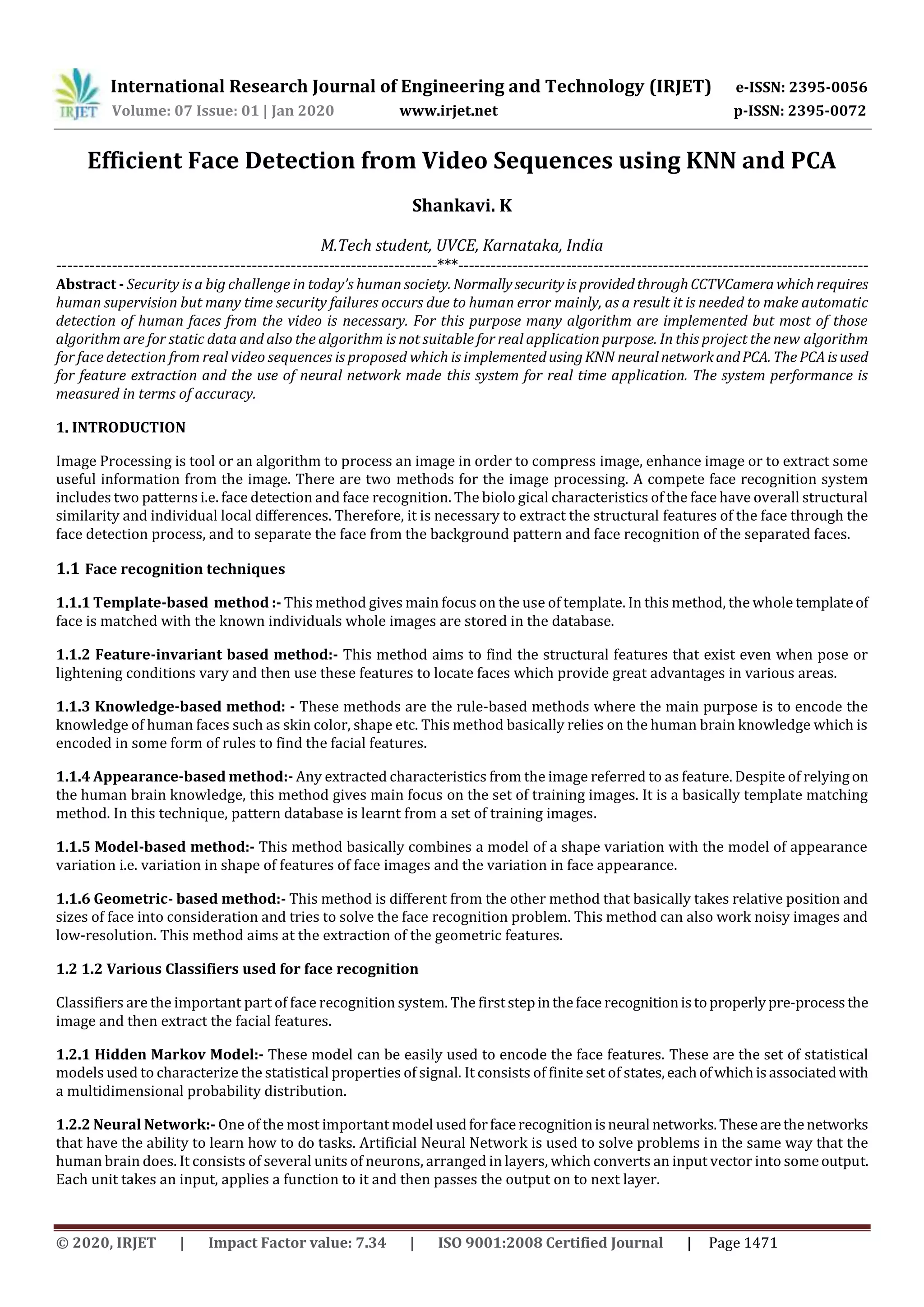
The proposed method flowchart shown in the figure1 provides a definition of the modules
Fig-1: Flowchart of the proposed method
The proposed method includes following modules i.e., pre-processing, average face, PCA and classification using K-NN.
2.1 Video Sequences:- The input to the proposed system is video sequences which consists of 100 frames in turn eachframe
consists of 10 subsets. Let a Face image Γ(x,y) be a two dimensional ‘M’ by ‘N’ array. An image may also be considered as a
vector of dimension MXN. Each face image in the dataset is transformed into a MNX1 array
2.2 Preprocessing:-In this task the images in each frame is resized to 512 X 512 pixel size.
2.3 Average Face:- In this task many face can be averaged together. This technique can be used to observe regularities in
different groups. Many different image of the some person might be combined to provide a single, average version of the
person. The average face vector (Ψ) is calculated using the formula in the equation 1,
Ψ= n …….(1)
Where, M is the number of images in the dataset
International Research Journal of Engineering and Technology (IRJET) e-ISSN: 2395-0056
Volume: 07 Issue: 01 | Jan 2020 www.irjet.net p-ISSN: 2395-0072
© 2020, IRJET | Impact Factor value: 7.34 | ISO 9001:2008 Certified Journal | Page 1473
2.4 PCA (Principal Component Analysis):-
PCA is generally used to extract the important features of an image. Basic principal of PCA is shown in figure 2 and it is a
method for dimensionality reduction and keeps some of the variations in image dataset. It is a mathematical procedure that
used to convert a set of observations of possibly correlated variables into a set of values of uncorrelated variables called
principal components.
PCA creates Eigenspace from the data by the means of removal and merging of its common attributes. The Eigenspace then
consists of Eigen vectors which help in the mathematical representation of various patterns. These patterns are result of the
feature matrix that has been developed from the images in the dataset. So, as a result the PCA forms the eigenspace that
consists of Eigenvalue, which helps in maximizing the variance.
Fig-2 : Basic Principal of PCA4.2 PCA for Face detection:-
2.4.1Prepare the data:- The first step is to obtain set ‘S’ with ‘M’ face images using equation 7
S={ 1, 2 , 3 , ……… M } …..(7)
Obtain the data:- After obtaining the set ‘S’ the mean Ψ is calculated it is calculated using equation 8 .
Ψ= n …….(8)
Subtract the mean from the original image it is calculated using equation 9.
ɸi = i – Ψ ………(9)
Calculate the Co-variance matrix C calculated using equation 10.
C= n ɸnT …….(10)
Calculate eigenvalue and eigen vector calculated using equation 11.
U = [u1 . . . u 𝐾] ……..(11)
The eigen vectors that is obtained from the 𝐾 largest eigenvalues corresponds to the set of eigenface which define the face
space.
Calculate Weight vectors calculated using equation 12
Wk = Uk T (1- Ψ) ……(12)
The new face is transformed into the eigenface components and resulting weights from the weight vectors are using equation
13,
ΩT = {W1,W2,W3….WM } ……..(13)
2.4.2 Advantages of PCA
1. Lack of redundancy and data given the orthogonal component
2. Reduced complexity in face images grouping with the use of PCA.
International Research Journal of Engineering and Technology (IRJET) e-ISSN: 2395-0056
Volume: 07 Issue: 01 | Jan 2020 www.irjet.net p-ISSN: 2395-0072
© 2020, IRJET | Impact Factor value: 7.34 | ISO 9001:2008 Certified Journal | Page 1474
3. Smaller database representation since only the trainee images are stored in the formof theirprojectionsona reduced
basis.
4. Noise reduction since the maximum variation basis is chosen and so the small variations in the background are
ignored automatically.
2.5 Threshold:-
After the calculation of feature vector , the means of the feature vector of the training set has to be calculated and the distance
with feature vector associated with each of training set is calculated. Threshold is chosen heuristically, if the mean is less than
the threshold chosen then it is classified as face and if its greater than the threshold then it is classified as non-face.
2.6 Classification using K-NN (K-Nearest Neighbor):-
The simplest classification scheme is a nearest neighbor classification in image space. Underthisschemeanimagein thetestis
recognized by assigning to the label of the closest point in the learning set, where distance is measured in image space. If all
images have been normalized to be zero mean and have unit variance, then this procedure is equivalent to choosingtheimage
in learning set that best correlates with test image. The Euclidean distance metric is often chosen to determine the closeness
between the data points in KNN. A distance is assigned between all pixels in dataset. Distance is defined as the Euclidean
distance between two pixels.
2.6.1 Mathematical Model of K-NN
K-Nearest Neighbors is a simple algorithm that stores all possible cases and classifies new cases basedona similaritymeasure
(ex: distance function). K-NN is used to solve both classification and regression problems.
K-Nearest Neighbor is the simplest technique and it is defined as, if {xi} dataset are labeled and then ‘y’ item want to classify,
then finds the K-elements in the dataset that are closed to y. The K-NN predict is computed using the featuresassembledinthe
matrices in two step process. In the first step, is to calculate the distance between the features in new dataset and features in
the previous dataset. In the second step is to choose the K-NNs and it should be k-smallest distance from the distance set. To
find the K-NN based on the Euclidean distance, the mathematical equation used is
d(x,y)= j2(Xj – Yj)2 ……(14)
2.7 EXPERIMENTAL RESULTS
The input to the proposed system is the video sequences which consists of 100 frames of 10 image subsets which is resized to
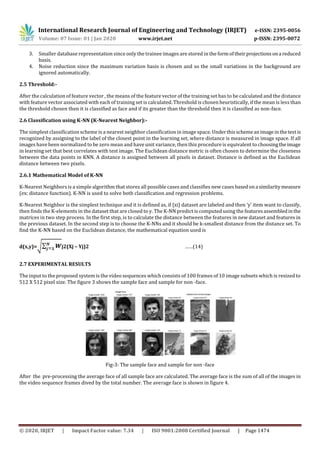
512 X 512 pixel size. The figure 3 shows the sample face and sample for non -face.
Fig-3: The sample face and sample for non -face
After the pre-processing the average face of all sample face are calculated. The average face is the sum of all of the images in
the video sequence frames dived by the total number. The average face is shown in figure 4.
International Research Journal of Engineering and Technology (IRJET) e-ISSN: 2395-0056
Volume: 07 Issue: 01 | Jan 2020 www.irjet.net p-ISSN: 2395-0072
© 2020, IRJET | Impact Factor value: 7.34 | ISO 9001:2008 Certified Journal | Page 1475
Fig-4:- Average Face
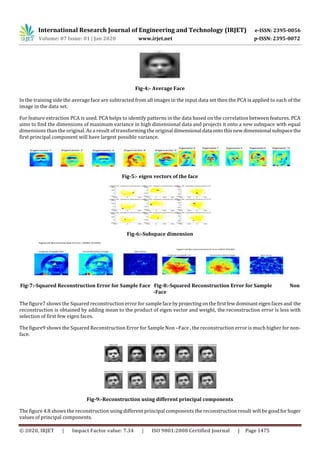
In the training side the average face are subtracted from all images in the input data set then the PCA is applied to each of the
image in the data set.
For feature extraction PCA is used. PCA helps to identify patterns in the data based on the correlation between features. PCA
aims to find the dimensions of maximum variance in high dimensional data and projects it onto a new subspace with equal
dimensions than the original. As a result of transforming the original dimensional data ontothisnewdimensional subspacethe
first principal component will have largest possible variance.
Fig-5:- eigen vectors of the face
Fig-6:-Subspace dimension
Fig-7:-Squared Reconstruction Error for Sample Face Fig-8:-Squared Reconstruction Error for Sample Non
-Face
The figure7 shows the Squared reconstruction error for samplefacebyprojectingonthefirstfewdominant eigenfacesand the
reconstruction is obtained by adding mean to the product of eigen vector and weight, the reconstruction error is less with
selection of first few eigen faces.
The figure9 shows the Squared Reconstruction Error for Sample Non –Face , the reconstruction error is much higher for non-
face.
Fig-9:-Reconstruction using different principal components
The figure 4.8 shows the reconstruction using different principal components the reconstruction result will be goodforhuger
values of principal components.
International Research Journal of Engineering and Technology (IRJET) e-ISSN: 2395-0056
Volume: 07 Issue: 01 | Jan 2020 www.irjet.net p-ISSN: 2395-0072
© 2020, IRJET | Impact Factor value: 7.34 | ISO 9001:2008 Certified Journal | Page 1476
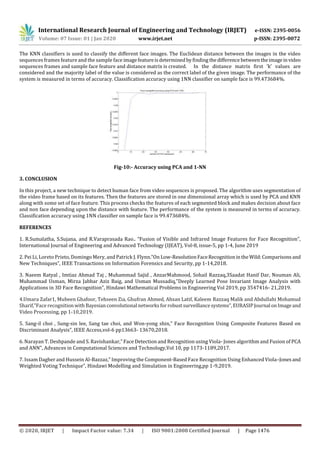
The KNN classifiers is used to classify the different face images. The Euclidean distance between the images in the video
sequences frames feature and the sample face imagefeatureisdeterminedbyfinding thedifference betweentheimageinvideo
sequences frames and sample face feature and distance matrix is created. In the distance matrix first ‘k’ values are
considered and the majority label of the value is considered as the correct label of the given image. The performance of the
system is measured in terms of accuracy. Classification accuracy using 1NN classifier on sample face is 99.473684%.
Fig-10:- Accuracy using PCA and 1-NN
3. CONCLUSION
In this project, a new technique to detect human face from video sequences is proposed. The algorithm uses segmentation of
the video frame based on its features. Then the features are stored in one dimensional array which is used by PCA and KNN
along with some set of face feature. This process checks the features of each segmented block and makes decision about face
and non face depending upon the distance with feature. The performance of the system is measured in terms of accuracy.
Classification accuracy using 1NN classifier on sample face is 99.473684%.
REFERENCES
1. R.Sumalatha, S.Sujana, and R.Varaprasada Rao.. “Fusion of Visible and Infrared Image Features for Face Recognition”,
International Journal of Engineering and Advanced Technology (IJEAT), Vol-8, issue-5, pp 1-4, June 2019
2. Pei Li, Loreto Prieto, Domingo Mery, and Patrick J. Flynn.“On Low-ResolutionFaceRecognitionintheWild:Comparisonsand
New Techniques”, IEEE Transactions on Information Forensics and Security, pp 1-14,2018.
3. Naeem Ratyal , Imtiaz Ahmad Taj , Muhammad Sajid , AnzarMahmood, Sohail Razzaq,3Saadat Hanif Dar, Nouman Ali,
Muhammad Usman, Mirza Jabbar Aziz Baig, and Usman Mussadiq,”Deeply Learned Pose Invariant Image Analysis with
Applications in 3D Face Recognition”, Hindawi Mathematical Problems in Engineering Vol 2019, pp 3547416- 21,2019.
4.Umara Zafar1, Mubeen Ghafoor, Tehseen Zia, Ghufran Ahmed, Ahsan Latif, Kaleem Razzaq Malik and Abdullahi Mohamud
Sharif,”Face recognitionwith Bayesian convolutional networksfor robustsurveillancesystems”,EURASIPJournal onImageand
Video Processing, pp 1-10,2019.
5. Sang-il choi , Sung-sin lee, Sang tae choi, and Won-yong shin,” Face Recognition Using Composite Features Based on
Discriminant Analysis”, IEEE Access,vol-6 pp13663- 13670,2018.
6. Narayan T. Deshpande and S. Ravishankar,” Face Detection and Recognition using Viola- Jones algorithm and Fusion of PCA
and ANN”, Advances in Computational Sciences and Technology,Vol 10, pp 1173-1189,2017.
7. Issam Dagher and Hussein Al-Bazzaz,” Improving the Component-Based Face Recognition Using Enhanced Viola–Jonesand
Weighted Voting Technique”, Hindawi Modelling and Simulation in Engineering,pp 1-9,2019.

IRJET- Efficient Face Detection from Video Sequences using KNN and PCA

  • 1.
    International Research Journalof Engineering and Technology (IRJET) e-ISSN: 2395-0056 Volume: 07 Issue: 01 | Jan 2020 www.irjet.net p-ISSN: 2395-0072 © 2020, IRJET | Impact Factor value: 7.34 | ISO 9001:2008 Certified Journal | Page 1471 Efficient Face Detection from Video Sequences using KNN and PCA Shankavi. K M.Tech student, UVCE, Karnataka, India ---------------------------------------------------------------------***---------------------------------------------------------------------------- Abstract - Security is a big challenge in today’s human society. Normallysecurityis providedthroughCCTVCamerawhichrequires human supervision but many time security failures occurs due to human error mainly, as a result it is needed to make automatic detection of human faces from the video is necessary. For this purpose many algorithm are implemented but most of those algorithm are for static data and also the algorithm is not suitable for real application purpose. In this project the new algorithm for face detection from real video sequences is proposed which is implementedusingKNN neuralnetworkandPCA. The PCAisused for feature extraction and the use of neural network made this system for real time application. The system performance is measured in terms of accuracy. 1. INTRODUCTION Image Processing is tool or an algorithm to process an image in order to compress image, enhance image or to extract some useful information from the image. There are two methods for the image processing. A compete face recognition system includes two patterns i.e. face detection and face recognition. The biolo gical characteristics of the face have overall structural similarity and individual local differences. Therefore, it is necessary to extract the structural features of the face through the face detection process, and to separate the face from the background pattern and face recognition of the separated faces. 1.1 Face recognition techniques 1.1.1 Template-based method :- This method gives main focus on the use of template. In this method, the whole templateof face is matched with the known individuals whole images are stored in the database. 1.1.2 Feature-invariant based method:- This method aims to find the structural features that exist even when pose or lightening conditions vary and then use these features to locate faces which provide great advantages in various areas. 1.1.3 Knowledge-based method: - These methods are the rule-based methods where the main purpose is to encode the knowledge of human faces such as skin color, shape etc. This method basically relies on the human brain knowledge which is encoded in some form of rules to find the facial features. 1.1.4 Appearance-based method:- Any extracted characteristics from the image referred to as feature. Despite of relyingon the human brain knowledge, this method gives main focus on the set of training images. It is a basically template matching method. In this technique, pattern database is learnt from a set of training images. 1.1.5 Model-based method:- This method basically combines a model of a shape variation with the model of appearance variation i.e. variation in shape of features of face images and the variation in face appearance. 1.1.6 Geometric- based method:- This method is different from the other method that basically takes relative position and sizes of face into consideration and tries to solve the face recognition problem. This method can also work noisy images and low-resolution. This method aims at the extraction of the geometric features. 1.2 1.2 Various Classifiers used for face recognition Classifiers are the important part of face recognition system. The firststepintheface recognitionistoproperlypre-processthe image and then extract the facial features. 1.2.1 Hidden Markov Model:- These model can be easily used to encode the face features. These are the set of statistical models used to characterize the statistical properties of signal. It consists of finite set of states,eachofwhichisassociatedwith a multidimensional probability distribution. 1.2.2 Neural Network:- One of the most important model usedforfacerecognitionisneural networks.Thesearethenetworks that have the ability to learn how to do tasks. Artificial Neural Network is used to solve problems in the same way that the human brain does. It consists of several units of neurons, arranged in layers, which converts an input vector into someoutput. Each unit takes an input, applies a function to it and then passes the output on to next layer.
  • 2.
    International Research Journalof Engineering and Technology (IRJET) e-ISSN: 2395-0056 Volume: 07 Issue: 01 | Jan 2020 www.irjet.net p-ISSN: 2395-0072 © 2020, IRJET | Impact Factor value: 7.34 | ISO 9001:2008 Certified Journal | Page 1472 1.2.3 Support Vector Machine:- In machine learning, SVM are supervised learning models that analyze data used for classification and regression analysis. SVM is superior of all machine learning algorithms, which uses optimization algorithms to locate optimal boundaries between classes. 1.2.4 AdaBoost Classifier Learning Algorithm:- Adaptive boost is an iterative learning algorithm that creates a ‘ strong ’ classifier using a training dataset and a ‘ weak ’ learning algorithmandateveryiterativestep,theweak classifierwithminimum classification error is selected. This method can be used in conjunction withothertechniquesduetowhich performancecanbe increased to larger extent. 1.2.5 Genetic Algorithm;- The recognition process used by the human brains is very challenging. Thus to deal with it, most important approach of genetic algorithm is used. Geneticalgorithmsarecharacterized likea searchtechnique,whichmakesthe algorithm strong and fast. This algorithm recognizesanunknownimagebycomparing itwiththeknowntrainingimagesstored in the database and also gives some information about the person. 2. PROPOSED MODEL The proposed method flowchart shown in the figure1 provides a definition of the modules Fig-1: Flowchart of the proposed method The proposed method includes following modules i.e., pre-processing, average face, PCA and classification using K-NN. 2.1 Video Sequences:- The input to the proposed system is video sequences which consists of 100 frames in turn eachframe consists of 10 subsets. Let a Face image Γ(x,y) be a two dimensional ‘M’ by ‘N’ array. An image may also be considered as a vector of dimension MXN. Each face image in the dataset is transformed into a MNX1 array 2.2 Preprocessing:-In this task the images in each frame is resized to 512 X 512 pixel size. 2.3 Average Face:- In this task many face can be averaged together. This technique can be used to observe regularities in different groups. Many different image of the some person might be combined to provide a single, average version of the person. The average face vector (Ψ) is calculated using the formula in the equation 1, Ψ= n …….(1) Where, M is the number of images in the dataset
  • 3.
    International Research Journalof Engineering and Technology (IRJET) e-ISSN: 2395-0056 Volume: 07 Issue: 01 | Jan 2020 www.irjet.net p-ISSN: 2395-0072 © 2020, IRJET | Impact Factor value: 7.34 | ISO 9001:2008 Certified Journal | Page 1473 2.4 PCA (Principal Component Analysis):- PCA is generally used to extract the important features of an image. Basic principal of PCA is shown in figure 2 and it is a method for dimensionality reduction and keeps some of the variations in image dataset. It is a mathematical procedure that used to convert a set of observations of possibly correlated variables into a set of values of uncorrelated variables called principal components. PCA creates Eigenspace from the data by the means of removal and merging of its common attributes. The Eigenspace then consists of Eigen vectors which help in the mathematical representation of various patterns. These patterns are result of the feature matrix that has been developed from the images in the dataset. So, as a result the PCA forms the eigenspace that consists of Eigenvalue, which helps in maximizing the variance. Fig-2 : Basic Principal of PCA4.2 PCA for Face detection:- 2.4.1Prepare the data:- The first step is to obtain set ‘S’ with ‘M’ face images using equation 7 S={ 1, 2 , 3 , ……… M } …..(7) Obtain the data:- After obtaining the set ‘S’ the mean Ψ is calculated it is calculated using equation 8 . Ψ= n …….(8) Subtract the mean from the original image it is calculated using equation 9. ɸi = i – Ψ ………(9) Calculate the Co-variance matrix C calculated using equation 10. C= n ɸnT …….(10) Calculate eigenvalue and eigen vector calculated using equation 11. U = [u1 . . . u 𝐾] ……..(11) The eigen vectors that is obtained from the 𝐾 largest eigenvalues corresponds to the set of eigenface which define the face space. Calculate Weight vectors calculated using equation 12 Wk = Uk T (1- Ψ) ……(12) The new face is transformed into the eigenface components and resulting weights from the weight vectors are using equation 13, ΩT = {W1,W2,W3….WM } ……..(13) 2.4.2 Advantages of PCA 1. Lack of redundancy and data given the orthogonal component 2. Reduced complexity in face images grouping with the use of PCA.
  • 4.
    International Research Journalof Engineering and Technology (IRJET) e-ISSN: 2395-0056 Volume: 07 Issue: 01 | Jan 2020 www.irjet.net p-ISSN: 2395-0072 © 2020, IRJET | Impact Factor value: 7.34 | ISO 9001:2008 Certified Journal | Page 1474 3. Smaller database representation since only the trainee images are stored in the formof theirprojectionsona reduced basis. 4. Noise reduction since the maximum variation basis is chosen and so the small variations in the background are ignored automatically. 2.5 Threshold:- After the calculation of feature vector , the means of the feature vector of the training set has to be calculated and the distance with feature vector associated with each of training set is calculated. Threshold is chosen heuristically, if the mean is less than the threshold chosen then it is classified as face and if its greater than the threshold then it is classified as non-face. 2.6 Classification using K-NN (K-Nearest Neighbor):- The simplest classification scheme is a nearest neighbor classification in image space. Underthisschemeanimagein thetestis recognized by assigning to the label of the closest point in the learning set, where distance is measured in image space. If all images have been normalized to be zero mean and have unit variance, then this procedure is equivalent to choosingtheimage in learning set that best correlates with test image. The Euclidean distance metric is often chosen to determine the closeness between the data points in KNN. A distance is assigned between all pixels in dataset. Distance is defined as the Euclidean distance between two pixels. 2.6.1 Mathematical Model of K-NN K-Nearest Neighbors is a simple algorithm that stores all possible cases and classifies new cases basedona similaritymeasure (ex: distance function). K-NN is used to solve both classification and regression problems. K-Nearest Neighbor is the simplest technique and it is defined as, if {xi} dataset are labeled and then ‘y’ item want to classify, then finds the K-elements in the dataset that are closed to y. The K-NN predict is computed using the featuresassembledinthe matrices in two step process. In the first step, is to calculate the distance between the features in new dataset and features in the previous dataset. In the second step is to choose the K-NNs and it should be k-smallest distance from the distance set. To find the K-NN based on the Euclidean distance, the mathematical equation used is d(x,y)= j2(Xj – Yj)2 ……(14) 2.7 EXPERIMENTAL RESULTS The input to the proposed system is the video sequences which consists of 100 frames of 10 image subsets which is resized to 512 X 512 pixel size. The figure 3 shows the sample face and sample for non -face. Fig-3: The sample face and sample for non -face After the pre-processing the average face of all sample face are calculated. The average face is the sum of all of the images in the video sequence frames dived by the total number. The average face is shown in figure 4.
  • 5.
    International Research Journalof Engineering and Technology (IRJET) e-ISSN: 2395-0056 Volume: 07 Issue: 01 | Jan 2020 www.irjet.net p-ISSN: 2395-0072 © 2020, IRJET | Impact Factor value: 7.34 | ISO 9001:2008 Certified Journal | Page 1475 Fig-4:- Average Face In the training side the average face are subtracted from all images in the input data set then the PCA is applied to each of the image in the data set. For feature extraction PCA is used. PCA helps to identify patterns in the data based on the correlation between features. PCA aims to find the dimensions of maximum variance in high dimensional data and projects it onto a new subspace with equal dimensions than the original. As a result of transforming the original dimensional data ontothisnewdimensional subspacethe first principal component will have largest possible variance. Fig-5:- eigen vectors of the face Fig-6:-Subspace dimension Fig-7:-Squared Reconstruction Error for Sample Face Fig-8:-Squared Reconstruction Error for Sample Non -Face The figure7 shows the Squared reconstruction error for samplefacebyprojectingonthefirstfewdominant eigenfacesand the reconstruction is obtained by adding mean to the product of eigen vector and weight, the reconstruction error is less with selection of first few eigen faces. The figure9 shows the Squared Reconstruction Error for Sample Non –Face , the reconstruction error is much higher for non- face. Fig-9:-Reconstruction using different principal components The figure 4.8 shows the reconstruction using different principal components the reconstruction result will be goodforhuger values of principal components.
  • 6.
    International Research Journalof Engineering and Technology (IRJET) e-ISSN: 2395-0056 Volume: 07 Issue: 01 | Jan 2020 www.irjet.net p-ISSN: 2395-0072 © 2020, IRJET | Impact Factor value: 7.34 | ISO 9001:2008 Certified Journal | Page 1476 The KNN classifiers is used to classify the different face images. The Euclidean distance between the images in the video sequences frames feature and the sample face imagefeatureisdeterminedbyfinding thedifference betweentheimageinvideo sequences frames and sample face feature and distance matrix is created. In the distance matrix first ‘k’ values are considered and the majority label of the value is considered as the correct label of the given image. The performance of the system is measured in terms of accuracy. Classification accuracy using 1NN classifier on sample face is 99.473684%. Fig-10:- Accuracy using PCA and 1-NN 3. CONCLUSION In this project, a new technique to detect human face from video sequences is proposed. The algorithm uses segmentation of the video frame based on its features. Then the features are stored in one dimensional array which is used by PCA and KNN along with some set of face feature. This process checks the features of each segmented block and makes decision about face and non face depending upon the distance with feature. The performance of the system is measured in terms of accuracy. Classification accuracy using 1NN classifier on sample face is 99.473684%. REFERENCES 1. R.Sumalatha, S.Sujana, and R.Varaprasada Rao.. “Fusion of Visible and Infrared Image Features for Face Recognition”, International Journal of Engineering and Advanced Technology (IJEAT), Vol-8, issue-5, pp 1-4, June 2019 2. Pei Li, Loreto Prieto, Domingo Mery, and Patrick J. Flynn.“On Low-ResolutionFaceRecognitionintheWild:Comparisonsand New Techniques”, IEEE Transactions on Information Forensics and Security, pp 1-14,2018. 3. Naeem Ratyal , Imtiaz Ahmad Taj , Muhammad Sajid , AnzarMahmood, Sohail Razzaq,3Saadat Hanif Dar, Nouman Ali, Muhammad Usman, Mirza Jabbar Aziz Baig, and Usman Mussadiq,”Deeply Learned Pose Invariant Image Analysis with Applications in 3D Face Recognition”, Hindawi Mathematical Problems in Engineering Vol 2019, pp 3547416- 21,2019. 4.Umara Zafar1, Mubeen Ghafoor, Tehseen Zia, Ghufran Ahmed, Ahsan Latif, Kaleem Razzaq Malik and Abdullahi Mohamud Sharif,”Face recognitionwith Bayesian convolutional networksfor robustsurveillancesystems”,EURASIPJournal onImageand Video Processing, pp 1-10,2019. 5. Sang-il choi , Sung-sin lee, Sang tae choi, and Won-yong shin,” Face Recognition Using Composite Features Based on Discriminant Analysis”, IEEE Access,vol-6 pp13663- 13670,2018. 6. Narayan T. Deshpande and S. Ravishankar,” Face Detection and Recognition using Viola- Jones algorithm and Fusion of PCA and ANN”, Advances in Computational Sciences and Technology,Vol 10, pp 1173-1189,2017. 7. Issam Dagher and Hussein Al-Bazzaz,” Improving the Component-Based Face Recognition Using Enhanced Viola–Jonesand Weighted Voting Technique”, Hindawi Modelling and Simulation in Engineering,pp 1-9,2019.