Inderjeet Singh
          7667292
Department of Computer Science
    University of Manitoba
   Introduction
   Classification with Neural Networks
    a) Advantages
    b) Disadvantages
   Performance Studies
   Application (Insurance Industry)
   Conclusion
   References
   Neural Networks are models of intelligence
    that consist of large numbers of simple
    processing units that collectively are able to
    perform very complex pattern matching
    tasks. These models perform stimulus
    response mapping

   Classification is the process of learning rules
    or models from training data to generalize
    the known structure and then to classify new
    data with these rules
Advantages (motivations)

1.   Data driven and self-adaptive
2.   Universal function approximators
3.   Non-linear model making, flexible for real
     world applications
4.   High accuracy and noise tolerance
Disadvantages (problems)

1.   Lack of transparency (black box)
2.   Learning time is long (trail and error)
3.   Defining classification rules (rule extraction)
     is difficult
   Comparison of Neural classifier [Lu et al.] and
    decision tree classifier
   People database consisting of 9 attributes
    (age, elevel, zipcode .etc.) and 1 output (Group A
    or Group B)
   3 layer feed forward neural network (38 input
    units, 6 hidden units and 1 output unit)
   Tested and compared their approach on 8
    classification problems used in earlier researches


                                  Func 3
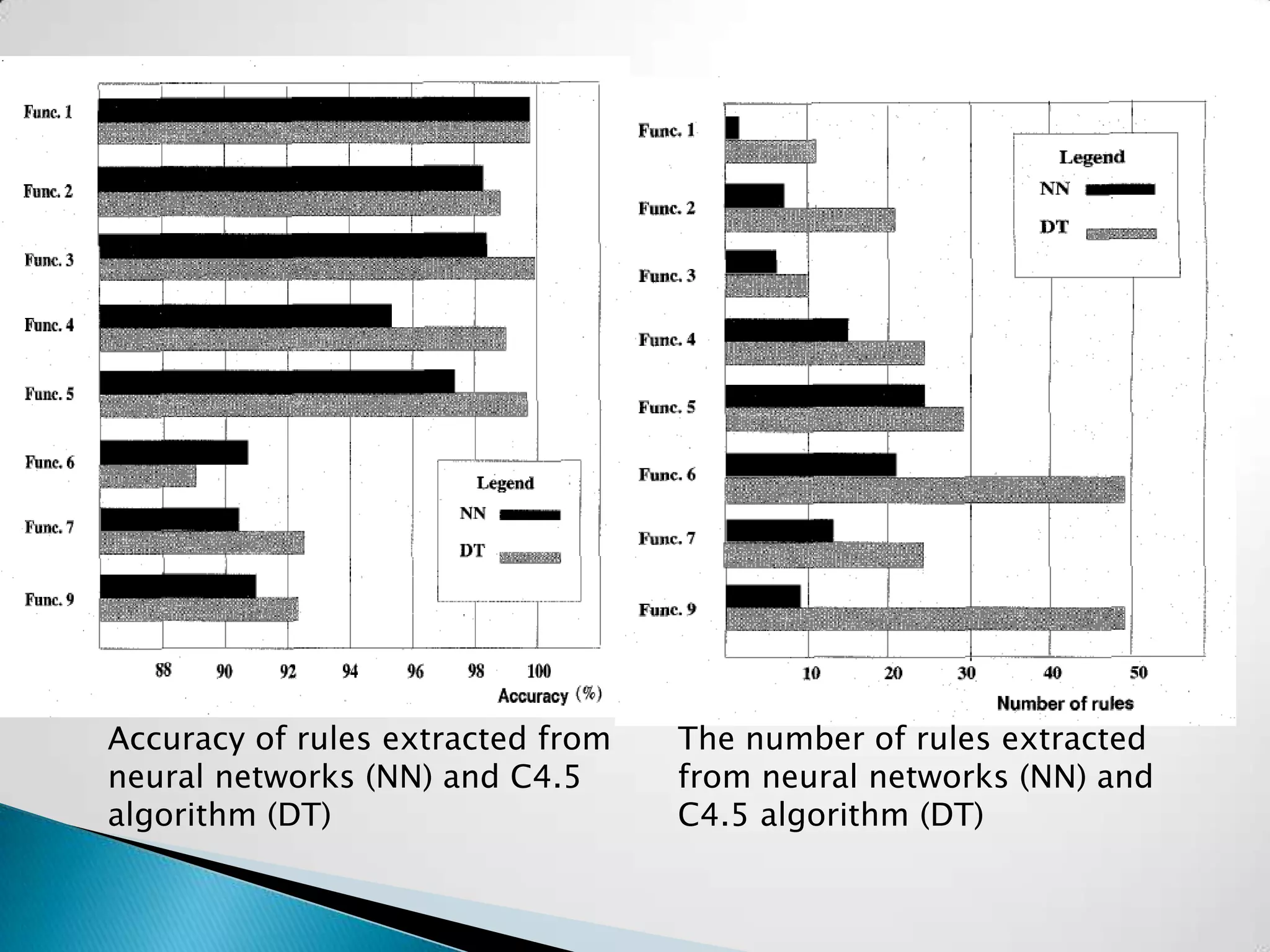
Accuracy of rules extracted from   The number of rules extracted
neural networks (NN) and C4.5      from neural networks (NN) and
algorithm (DT)                     C4.5 algorithm (DT)
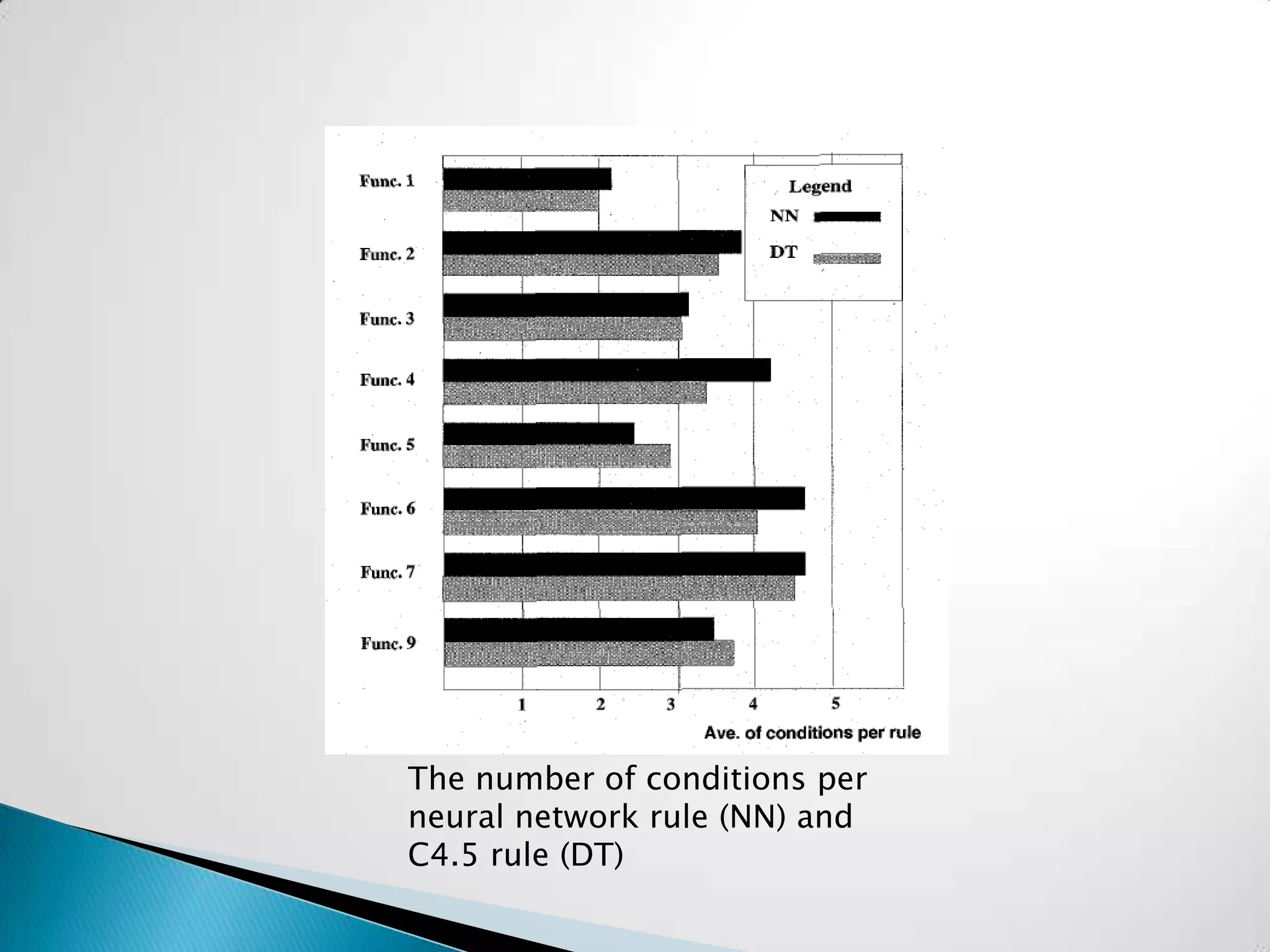
The number of conditions per
neural network rule (NN) and
C4.5 rule (DT)
   Profit and growth
   Neural networks: Understanding customer
    retention patterns (renewal or termination)
   Helps in Predicting likely terminations
   Direct marketing campaigns
   Misclassification costs
   Accuracy is important
   Helps in Price setting (balanced profit and
    growth)
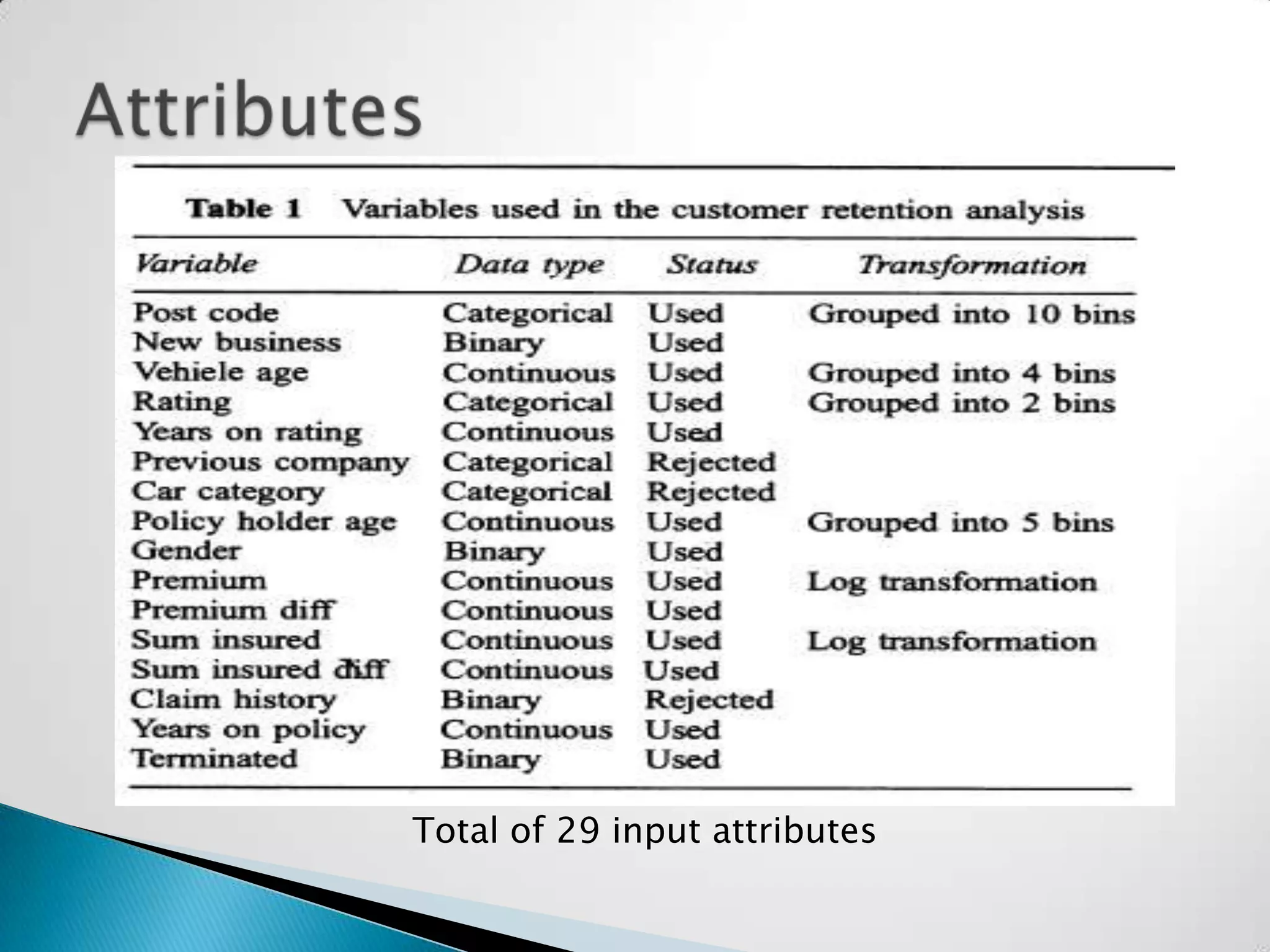
Total of 29 input attributes
   3 layer feed forward neural network, with
    hyperbolic tangent activation function and
    conjugate gradient technique to minimize
    the error

   29 input nodes (attributes), 25 hidden
    nodes and 1 output node, dataset-20914
    motor vehicle policy holders

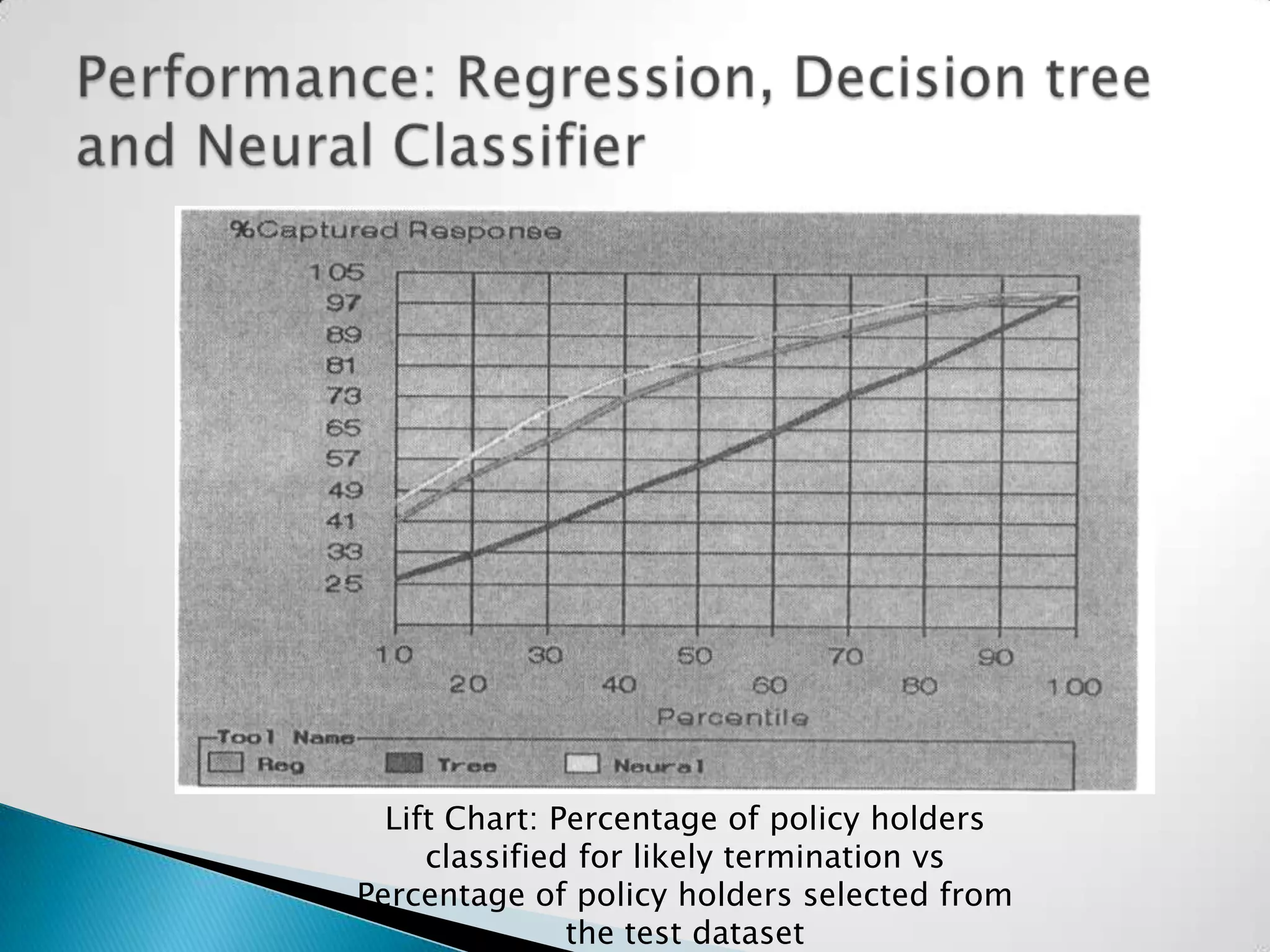
   Neural classifier outperformed regression
    analysis and decision trees
Lift Chart: Percentage of policy holders
     classified for likely termination vs
Percentage of policy holders selected from
               the test dataset
   Scope of improvement in terms of speed of
    classification

   Suits the need of many business applications
    which have lots of data available
1.   Hongjun Lu, Rudy Setiono and, Huan Liu, Effective Data Mining
     Using Neural Networks, Vol 8, IEEE Transactions on Knowledge
     and Data Engineering,1996, pp. 957-961

2.   David Scuse, Chapter 1 Intro, Class slides, University of
     Manitoba

3.   Wikipedia.com: http://en.wikipedia.org/wiki/Data_mining

4.   K.A. Smith, R.J. Willis and M. Brooks, An Analysis of Customer
     Retention and Insurance Claim Patterns Using Data Mining: A
     Case Study, The Journal of the Operational Research
     Society, Vol. 51, May 2000, pp. 532-541

5.   Image: http://www.genevievecharest.com/2011/09/26/do-a-
     easy-vehicle-insurance-comparability-before-choosing-an-
     auto
Neural Network Classification and its Applications in Insurance Industry

Neural Network Classification and its Applications in Insurance Industry

  • 1.
    Inderjeet Singh 7667292 Department of Computer Science University of Manitoba
  • 2.
    Introduction  Classification with Neural Networks a) Advantages b) Disadvantages  Performance Studies  Application (Insurance Industry)  Conclusion  References
  • 3.
    Neural Networks are models of intelligence that consist of large numbers of simple processing units that collectively are able to perform very complex pattern matching tasks. These models perform stimulus response mapping  Classification is the process of learning rules or models from training data to generalize the known structure and then to classify new data with these rules
  • 4.
    Advantages (motivations) 1. Data driven and self-adaptive 2. Universal function approximators 3. Non-linear model making, flexible for real world applications 4. High accuracy and noise tolerance
  • 5.
    Disadvantages (problems) 1. Lack of transparency (black box) 2. Learning time is long (trail and error) 3. Defining classification rules (rule extraction) is difficult
  • 6.
    Comparison of Neural classifier [Lu et al.] and decision tree classifier  People database consisting of 9 attributes (age, elevel, zipcode .etc.) and 1 output (Group A or Group B)  3 layer feed forward neural network (38 input units, 6 hidden units and 1 output unit)  Tested and compared their approach on 8 classification problems used in earlier researches Func 3
  • 7.
    Accuracy of rulesextracted from The number of rules extracted neural networks (NN) and C4.5 from neural networks (NN) and algorithm (DT) C4.5 algorithm (DT)
  • 8.
    The number ofconditions per neural network rule (NN) and C4.5 rule (DT)
  • 10.
    Profit and growth  Neural networks: Understanding customer retention patterns (renewal or termination)  Helps in Predicting likely terminations  Direct marketing campaigns  Misclassification costs  Accuracy is important  Helps in Price setting (balanced profit and growth)
  • 11.
    Total of 29input attributes
  • 12.
    3 layer feed forward neural network, with hyperbolic tangent activation function and conjugate gradient technique to minimize the error  29 input nodes (attributes), 25 hidden nodes and 1 output node, dataset-20914 motor vehicle policy holders  Neural classifier outperformed regression analysis and decision trees
  • 13.
    Lift Chart: Percentageof policy holders classified for likely termination vs Percentage of policy holders selected from the test dataset
  • 14.
    Scope of improvement in terms of speed of classification  Suits the need of many business applications which have lots of data available
  • 15.
    1. Hongjun Lu, Rudy Setiono and, Huan Liu, Effective Data Mining Using Neural Networks, Vol 8, IEEE Transactions on Knowledge and Data Engineering,1996, pp. 957-961 2. David Scuse, Chapter 1 Intro, Class slides, University of Manitoba 3. Wikipedia.com: http://en.wikipedia.org/wiki/Data_mining 4. K.A. Smith, R.J. Willis and M. Brooks, An Analysis of Customer Retention and Insurance Claim Patterns Using Data Mining: A Case Study, The Journal of the Operational Research Society, Vol. 51, May 2000, pp. 532-541 5. Image: http://www.genevievecharest.com/2011/09/26/do-a- easy-vehicle-insurance-comparability-before-choosing-an- auto

Editor's Notes

  • #3 conclusion
  • #6 Learning takes a lot of passes over the training data, so training time is long (trail and error)Defining classification rules (rule extraction) is difficult due to the complex structure of network and weights learned by branches between nodes