Face recognition using principal
      component analysis
                    by

 ABHILASH KOTAWAR
 VENKATA NARAYANA CHETTELA
 KOMIRISHETTI SRAVAN
   In today's networked world, the need to maintain
    the security of information is becoming both
    increasingly important and increasingly difficult.

   BIOMETRICS represents a good compromise
    between what’s socially acceptable and what’s
    reliable, even when operating under controlled
    conditions.

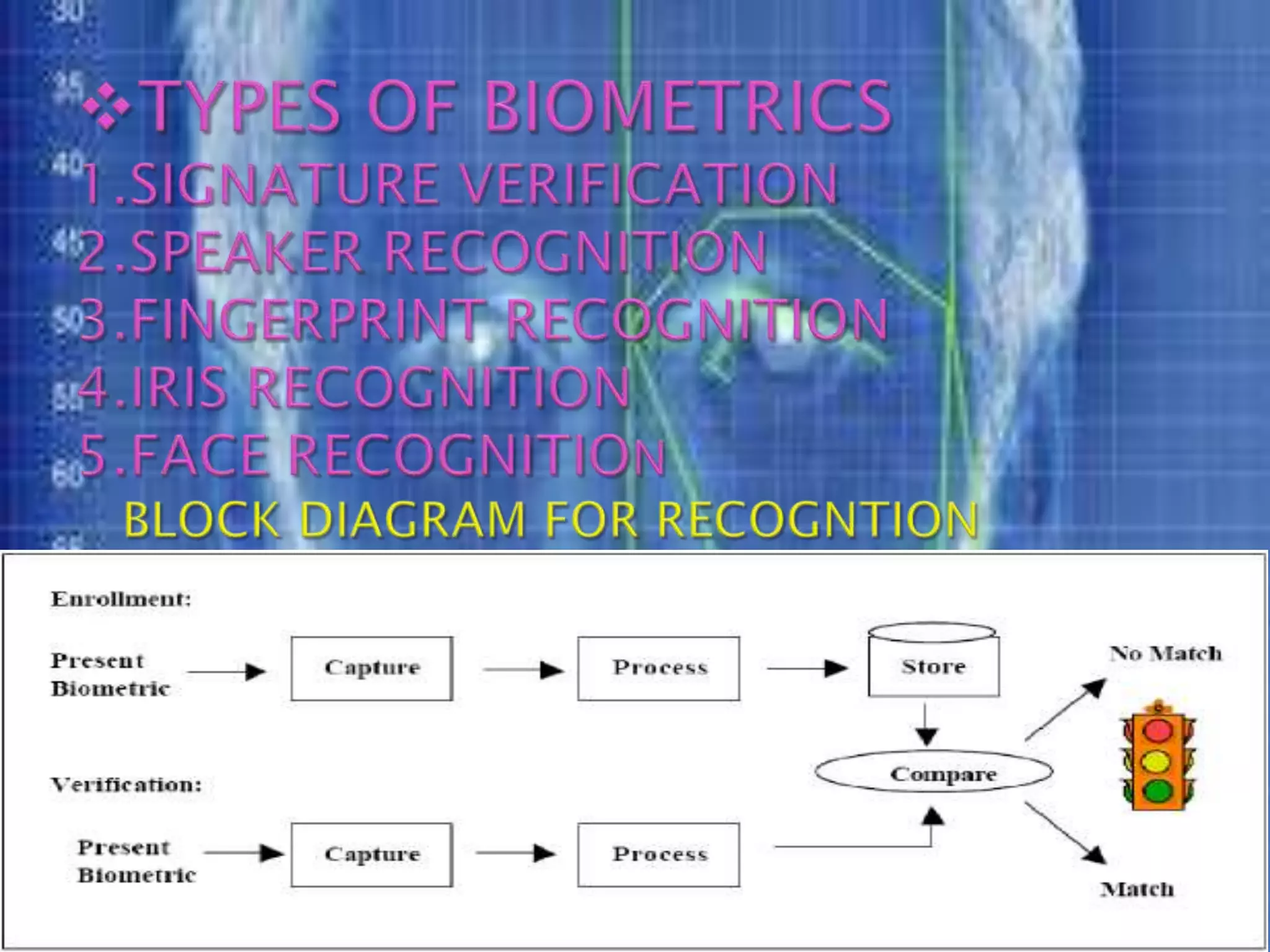
   Recently, technology became available to allow
    verification of "true" individual identity. This
    technology is based in a field called "biometrics".
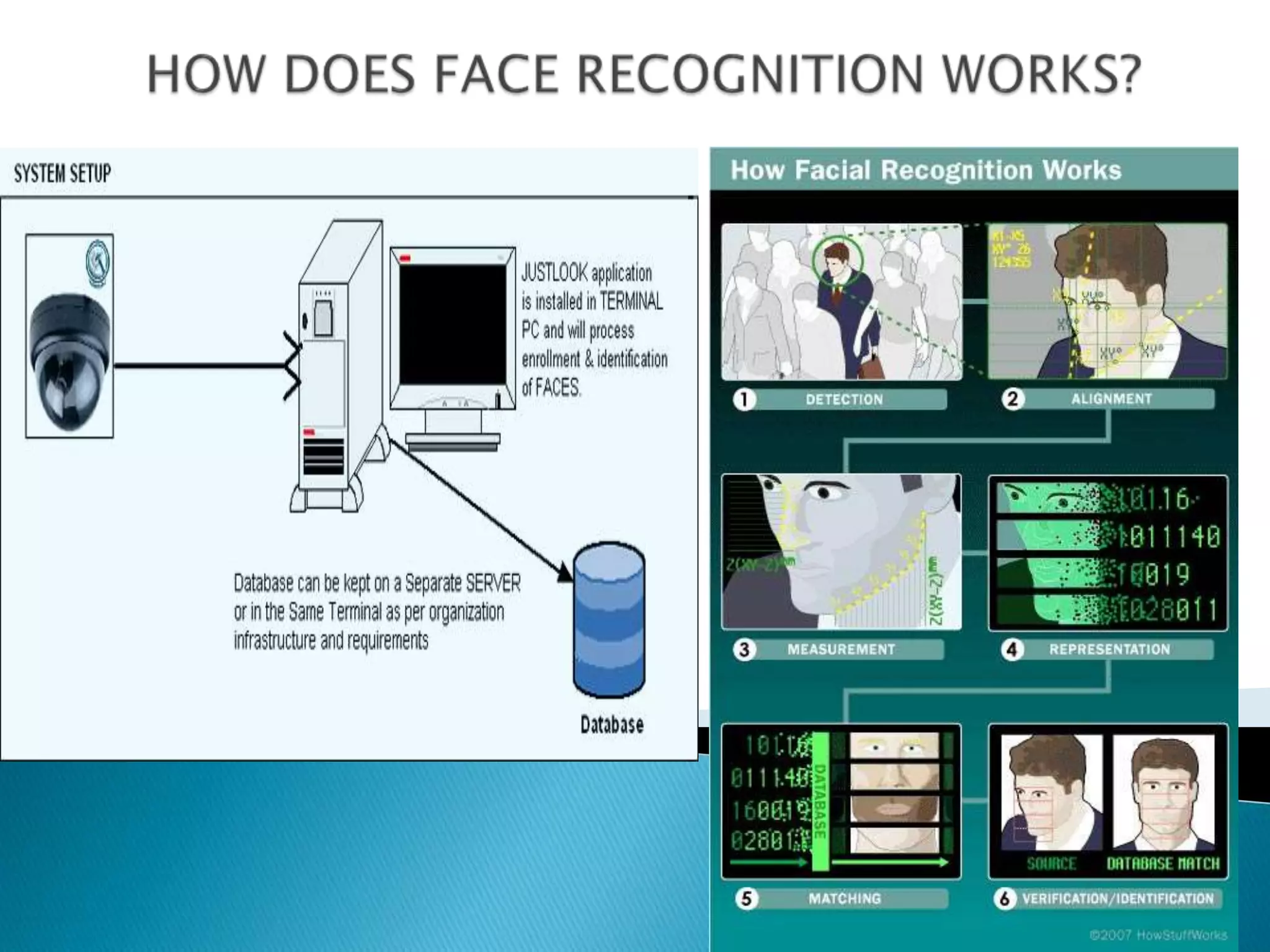
   Face Recognition is the process of identification of
    a person by their facial image. This technique
    makes it possible to use the facial images of a
    person to authenticate him into a secure
    system, for criminal identification, for passport
    verification,...

   Face recognition technology is the least intrusive
    and fastest biometric technology.

   Face recognition systems unobtrusively take
    pictures of people's faces as they enter a defined
    area.

   This method is found to be fast, relatively
    simple, and works well in a constrained
    environment.
   PCA is a dimensionality reduction technique
    based on extracting the desired number of
    principal components of the multi-dimensional
    data.

   PCA aims to:
   Summerise data with many independent
    variables to a smaller set of derived variables.

   identifying patterns in data, and expressing the
    data in such a way as to highlight
     their similarities and differences.
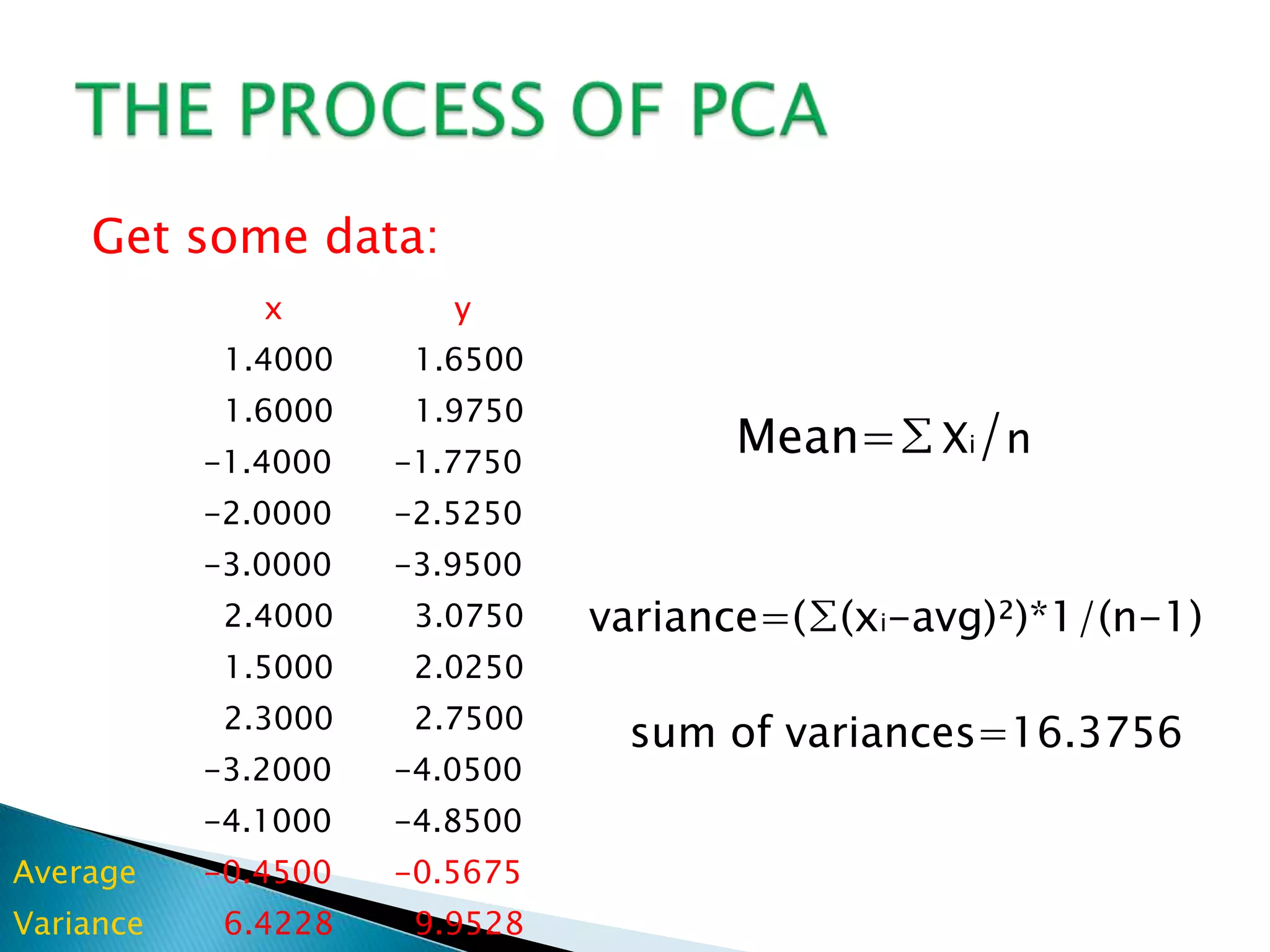
Get some data:
              x         y
            1.4000    1.6500
            1.6000    1.9750
           -1.4000   -1.7750
                                     Mean=∑ Xi/n
           -2.0000   -2.5250
           -3.0000   -3.9500
            2.4000    3.0750   variance=(∑(xi-avg)²)*1/(n-1)
            1.5000    2.0250
            2.3000    2.7500
                                sum of variances=16.3756
           -3.2000   -4.0500
           -4.1000   -4.8500
Average    -0.4500   -0.5675
Variance    6.4228    9.9528
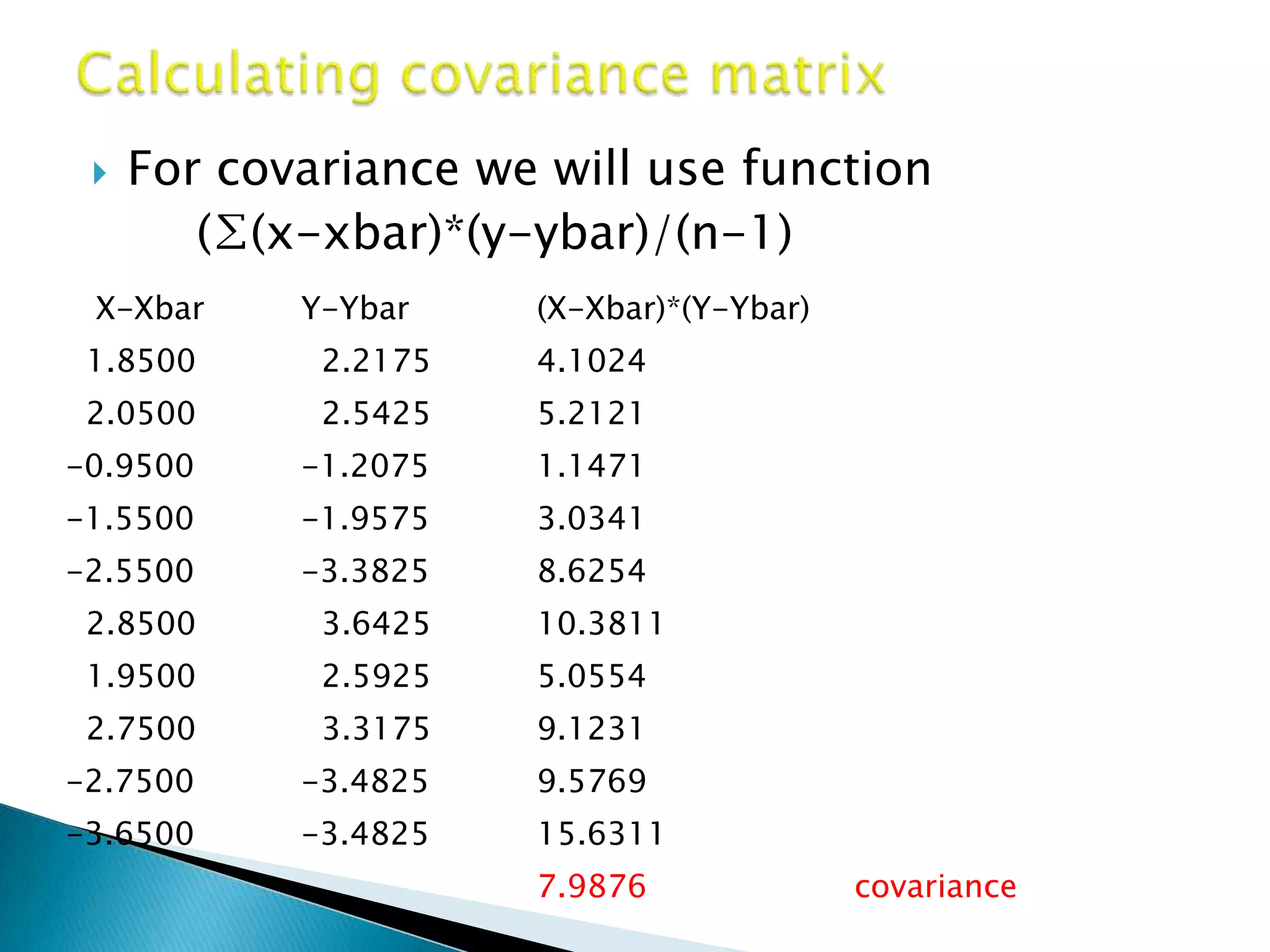
   For covariance we will use function
        (∑(x-xbar)*(y-ybar)/(n-1)
 X-Xbar     Y-Ybar    (X-Xbar)*(Y-Ybar)
 1.8500      2.2175   4.1024
 2.0500      2.5425   5.2121
-0.9500     -1.2075   1.1471
-1.5500     -1.9575   3.0341
-2.5500     -3.3825   8.6254
 2.8500      3.6425   10.3811
 1.9500      2.5925   5.0554
 2.7500      3.3175   9.1231
-2.7500     -3.4825   9.5769
-3.6500     -3.4825   15.6311
                      7.9876              covariance
   In general the covariance matrix is
         =      [covariance(x,x) covariance(x,y)
                 covariance(y,x) covariance(y,y)]

        =      [variance(x)    covariance(x,y)
               covariance(x,y)    variance(y)]

        =      [6.4228    7.9876
                7.9876    9.9528]

 To obtain Eigen values by solving function
  determinant {A-lamda(I)}=0
 Solving equation A, we get the Eigen values are
  lamda=16.36809984,0.007462657
 Here sum of two eigen values is always equal to
  the sum of variances
 To obtain Eigen vector by solving for matrix x in
  such a way that, {A-lambda(i)}*[X]=[0].
 For first Eigen value 16.36809984, we get
  [X]=[0.6262
        0.7797]
 For second Eigen value 0.007462657,we get
   [X]=[0.7797
        -0.6262]
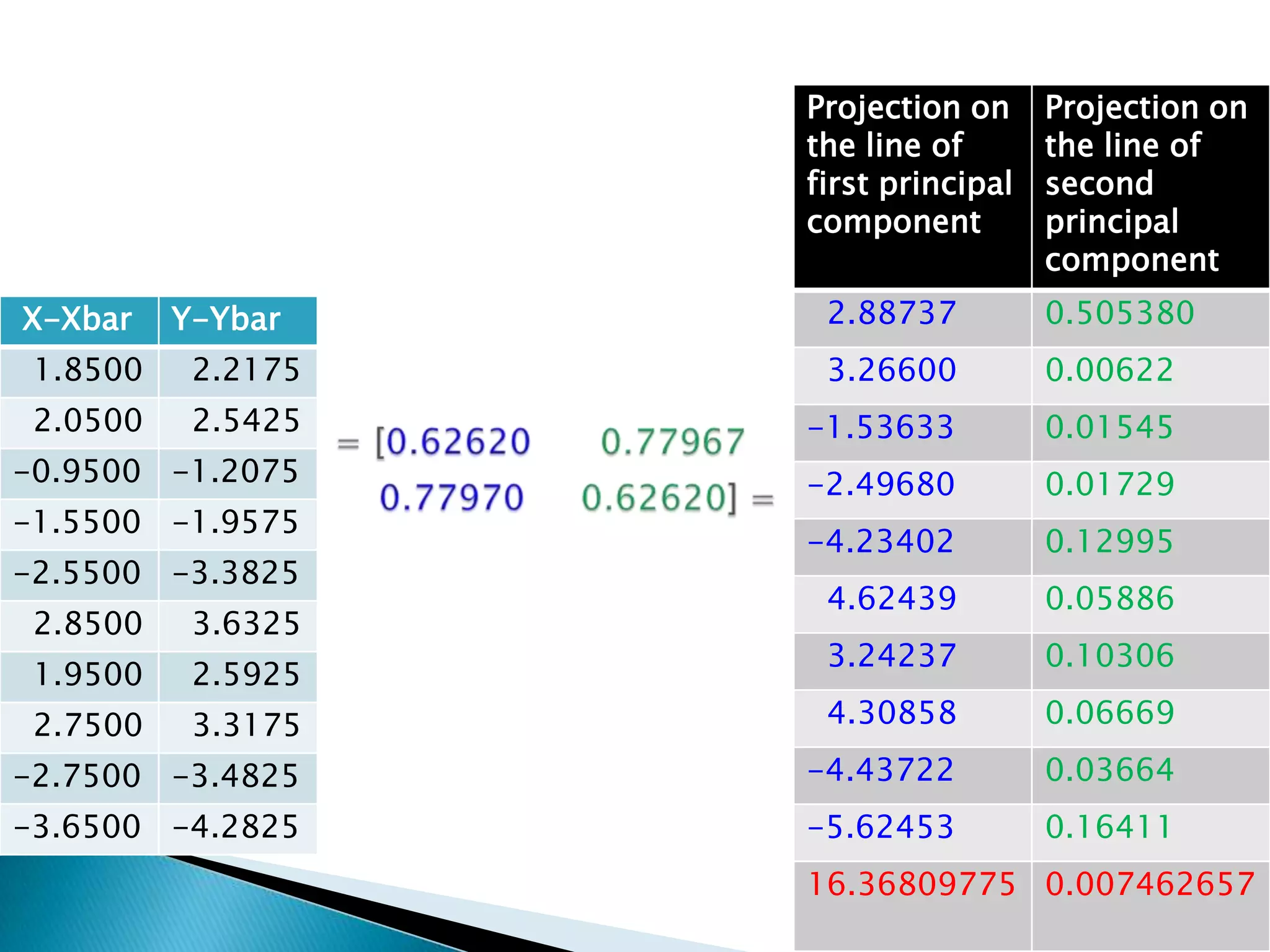
 To obtain coordinates of data point in the direction
  of Eigen vectors by multiplying the centered data
  matrix to the Eigen vector matrix
Projection on     Projection on
                    the line of       the line of
                    first principal   second
                    component         principal
                                      component
X-Xbar    Y-Ybar     2.88737          0.505380
 1.8500    2.2175    3.26600          0.00622
 2.0500    2.5425   -1.53633          0.01545
-0.9500 -1.2075     -2.49680          0.01729
-1.5500 -1.9575
                    -4.23402          0.12995
-2.5500 -3.3825
                     4.62439          0.05886
 2.8500    3.6325
                     3.24237          0.10306
 1.9500    2.5925
 2.7500    3.3175    4.30858          0.06669
-2.7500 -3.4825     -4.43722          0.03664
-3.6500 -4.2825     -5.62453          0.16411
                    16.36809775 0.007462657
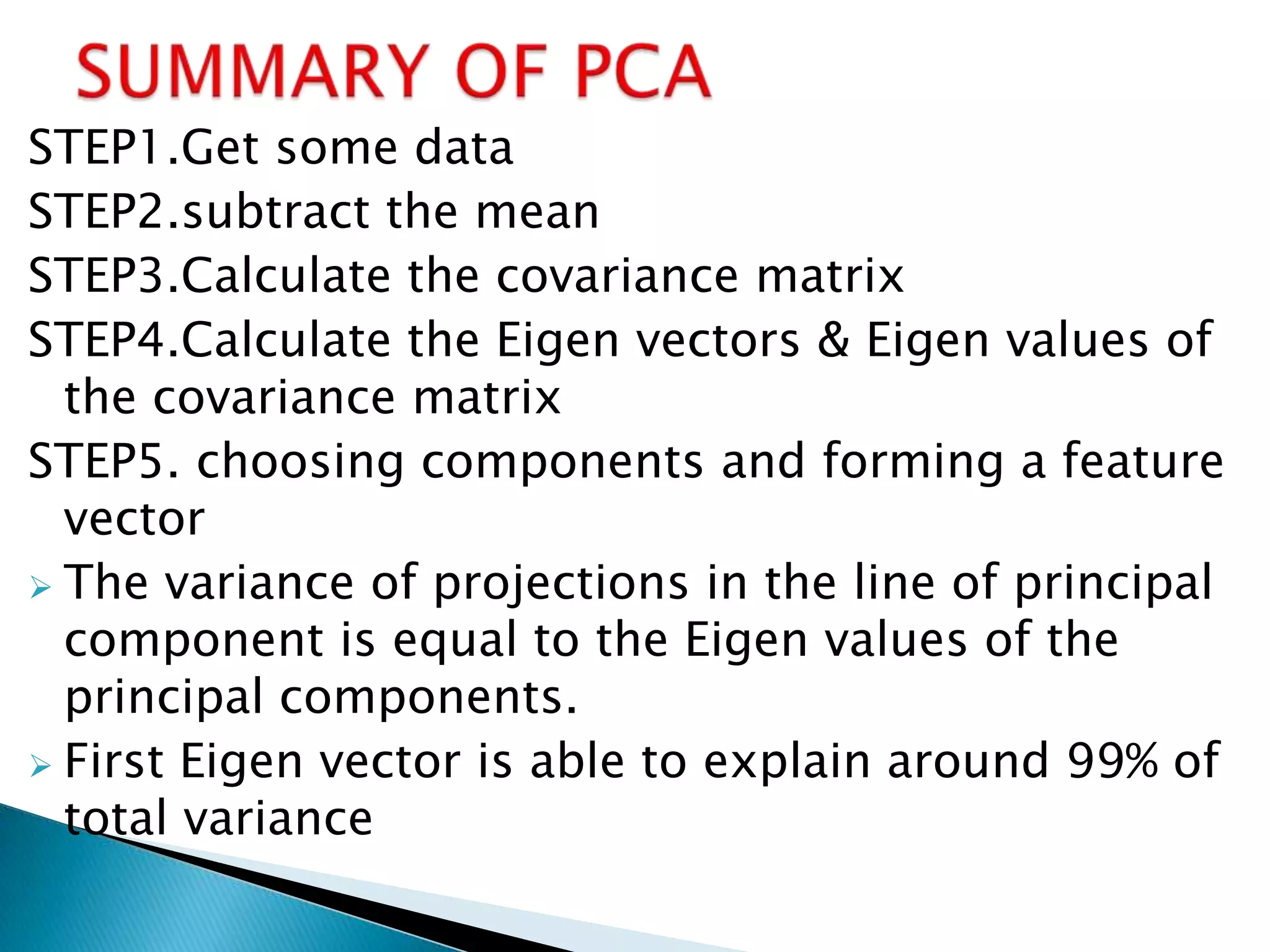
STEP1.Get some data
STEP2.subtract the mean
STEP3.Calculate the covariance matrix
STEP4.Calculate the Eigen vectors & Eigen values of
  the covariance matrix
STEP5. choosing components and forming a feature
  vector
 The variance of projections in the line of principal
  component is equal to the Eigen values of the
  principal components.
 First Eigen vector is able to explain around 99% of
  total variance
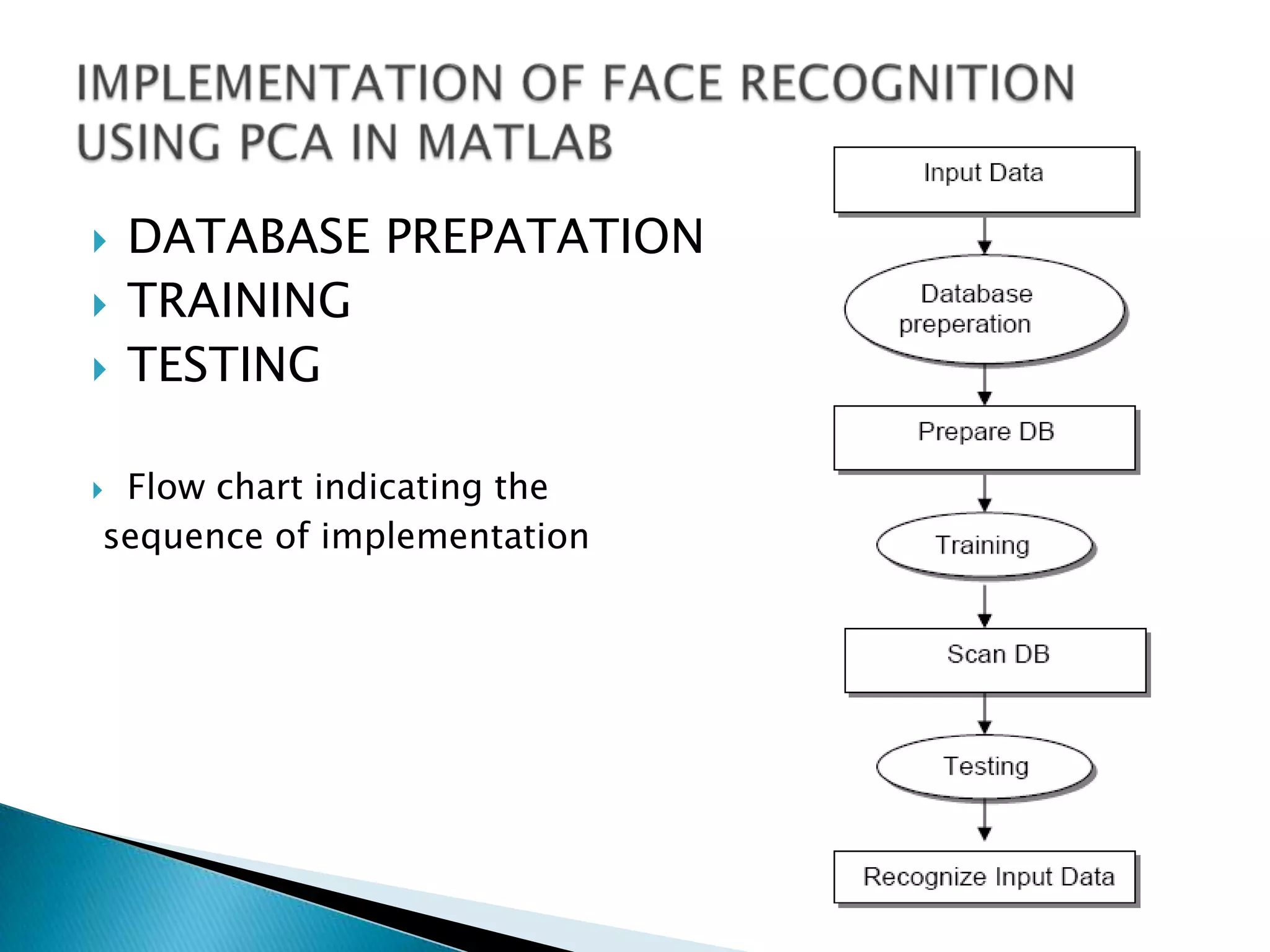
   DATABASE PREPATATION
   TRAINING
   TESTING

Flow chart indicating the
sequence of implementation
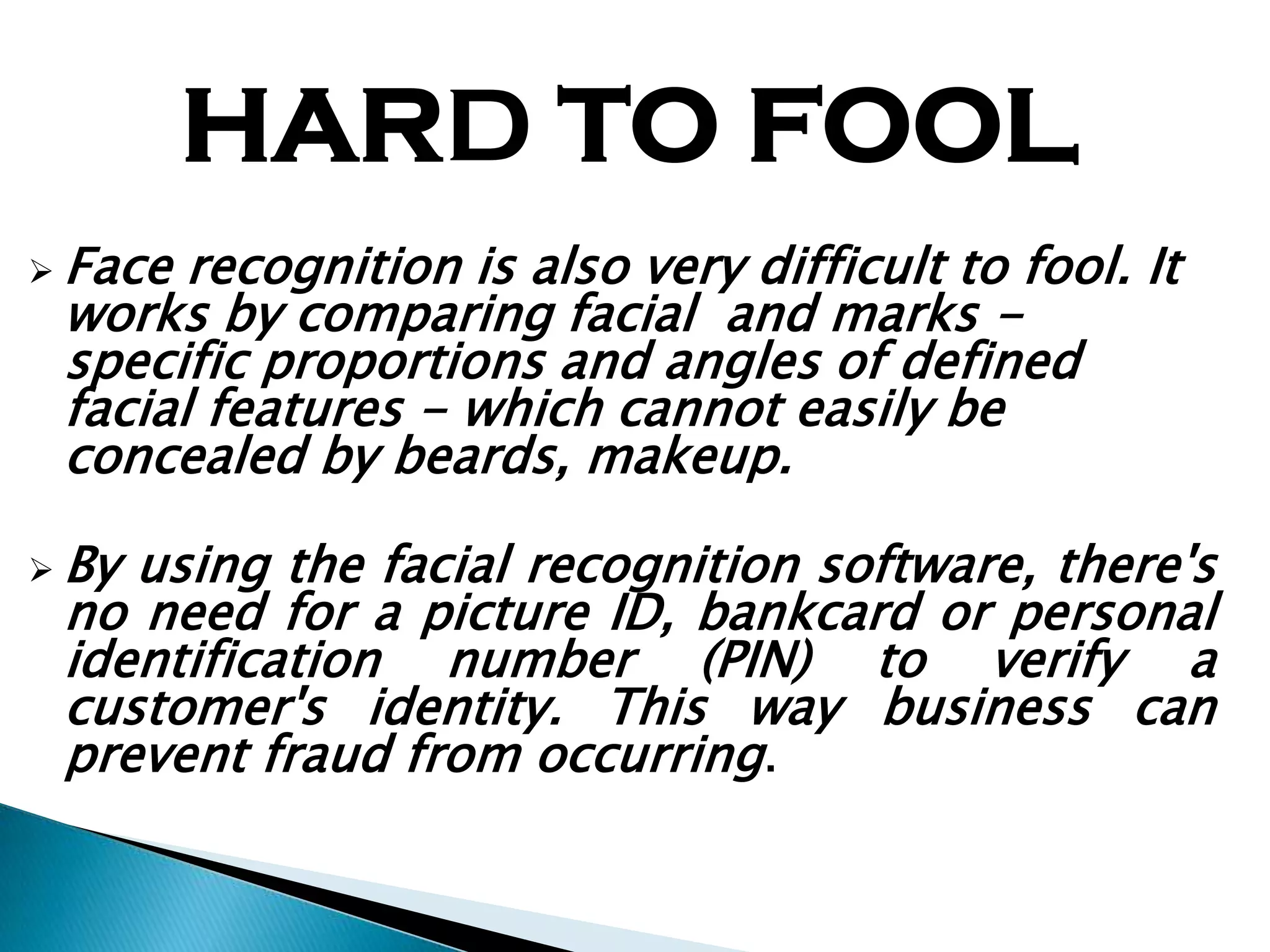
1.Acess control
 ATM

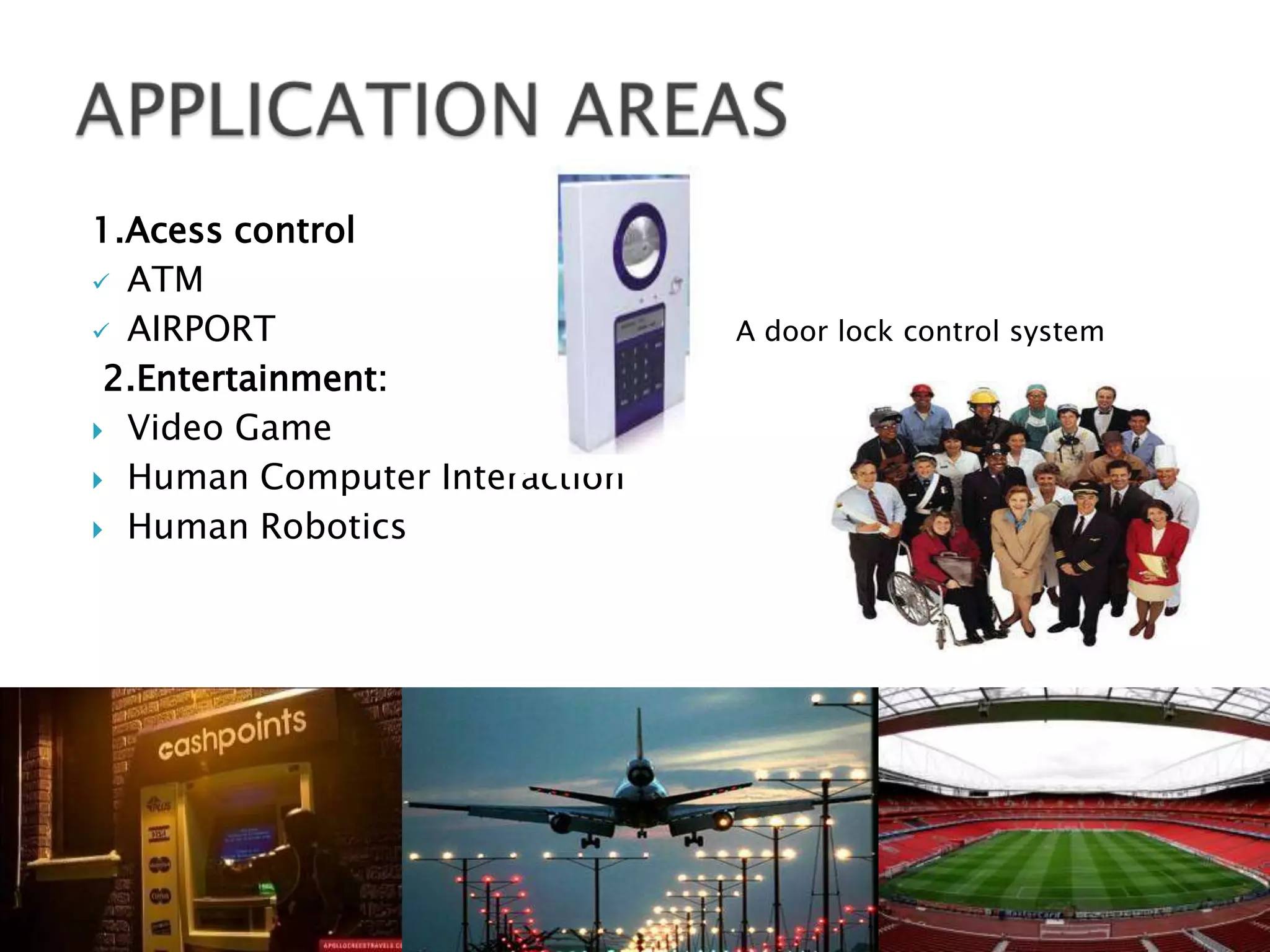
 AIRPORT                      A door lock control system
 2.Entertainment:
 Video Game

 Human Computer Interaction

 Human Robotics
3 Smart cards:
 Driver’s license
 Passports
 Voter registrations
 Pan card


4 Information Security:
   Desktop Logon
   Personal Driven Logon
   Database security

5 law Enforcement And Surveillance:
 Advanced video surveillance
 Drug trafficking


                     And some other Commercial Applications:
HARD TO FOOL
 Face recognition is also very difficult to fool. It
 works by comparing facial and marks -
 specific proportions and angles of defined
 facial features - which cannot easily be
 concealed by beards, makeup.

 Byusing the facial recognition software, there's
 no need for a picture ID, bankcard or personal
 identification number (PIN) to verify a
 customer's identity. This way business can
 prevent fraud from occurring.
A face needs to be well lighted by
 controlled light sources in
 automated face authentication systems.
 This is only a first challenge in a long list
 of technical challenges that are
 associated with
 robust face authentication.
The risk involved with identity theft.
   Face recognition is a both challenging and
    important recognition technique. Among all
    the biometric techniques, face recognition
    approach possesses one great advantage,
    which is its user-friendliness.

   Face recognition promises latest security
    invents in the upcoming trends based on bio-
    metrics and pattern matching techniques and
    algorithms.
CONCLUSION:
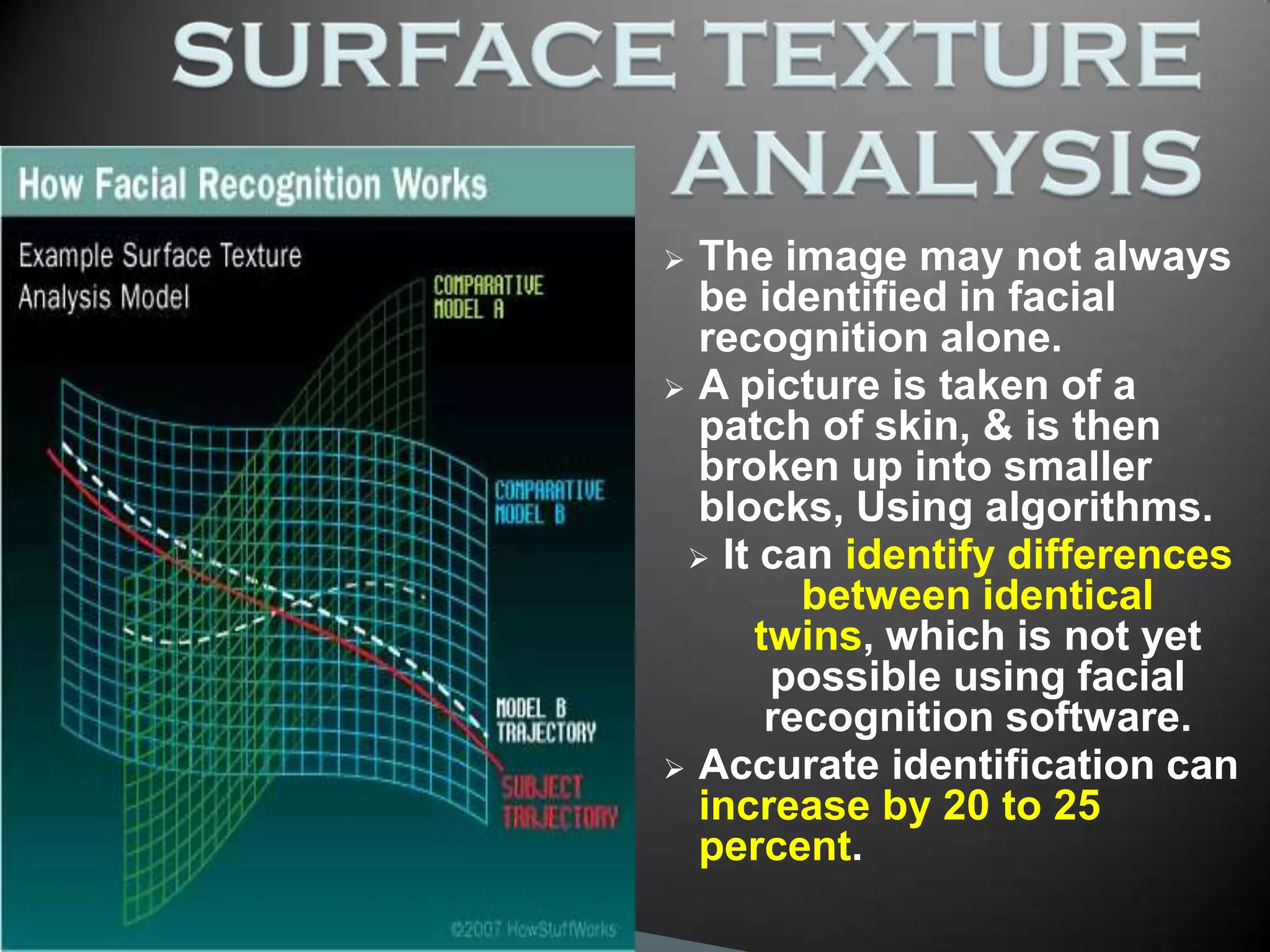
 The image may not always
  be identified in facial
  recognition alone.
 A picture is taken of a
  patch of skin, & is then
  broken up into smaller
  blocks, Using algorithms.
  It can identify differences
        between identical
     twins, which is not yet
      possible using facial
      recognition software.
 Accurate identification can
  increase by 20 to 25
  percent.

face recognition using Principle Componet Analysis

  • 1.
    Face recognition usingprincipal component analysis by ABHILASH KOTAWAR VENKATA NARAYANA CHETTELA KOMIRISHETTI SRAVAN
  • 2.
    In today's networked world, the need to maintain the security of information is becoming both increasingly important and increasingly difficult.  BIOMETRICS represents a good compromise between what’s socially acceptable and what’s reliable, even when operating under controlled conditions.  Recently, technology became available to allow verification of "true" individual identity. This technology is based in a field called "biometrics".
  • 4.
    Face Recognition is the process of identification of a person by their facial image. This technique makes it possible to use the facial images of a person to authenticate him into a secure system, for criminal identification, for passport verification,...  Face recognition technology is the least intrusive and fastest biometric technology.  Face recognition systems unobtrusively take pictures of people's faces as they enter a defined area.  This method is found to be fast, relatively simple, and works well in a constrained environment.
  • 6.
    PCA is a dimensionality reduction technique based on extracting the desired number of principal components of the multi-dimensional data.  PCA aims to:  Summerise data with many independent variables to a smaller set of derived variables.  identifying patterns in data, and expressing the data in such a way as to highlight their similarities and differences.
  • 7.
    Get some data: x y 1.4000 1.6500 1.6000 1.9750 -1.4000 -1.7750 Mean=∑ Xi/n -2.0000 -2.5250 -3.0000 -3.9500 2.4000 3.0750 variance=(∑(xi-avg)²)*1/(n-1) 1.5000 2.0250 2.3000 2.7500 sum of variances=16.3756 -3.2000 -4.0500 -4.1000 -4.8500 Average -0.4500 -0.5675 Variance 6.4228 9.9528
  • 8.
    For covariance we will use function (∑(x-xbar)*(y-ybar)/(n-1) X-Xbar Y-Ybar (X-Xbar)*(Y-Ybar) 1.8500 2.2175 4.1024 2.0500 2.5425 5.2121 -0.9500 -1.2075 1.1471 -1.5500 -1.9575 3.0341 -2.5500 -3.3825 8.6254 2.8500 3.6425 10.3811 1.9500 2.5925 5.0554 2.7500 3.3175 9.1231 -2.7500 -3.4825 9.5769 -3.6500 -3.4825 15.6311 7.9876 covariance
  • 9.
    In general the covariance matrix is = [covariance(x,x) covariance(x,y) covariance(y,x) covariance(y,y)] = [variance(x) covariance(x,y) covariance(x,y) variance(y)] = [6.4228 7.9876 7.9876 9.9528]  To obtain Eigen values by solving function determinant {A-lamda(I)}=0  Solving equation A, we get the Eigen values are lamda=16.36809984,0.007462657  Here sum of two eigen values is always equal to the sum of variances
  • 10.
     To obtainEigen vector by solving for matrix x in such a way that, {A-lambda(i)}*[X]=[0].  For first Eigen value 16.36809984, we get [X]=[0.6262 0.7797]  For second Eigen value 0.007462657,we get [X]=[0.7797 -0.6262]  To obtain coordinates of data point in the direction of Eigen vectors by multiplying the centered data matrix to the Eigen vector matrix
  • 11.
    Projection on Projection on the line of the line of first principal second component principal component X-Xbar Y-Ybar 2.88737 0.505380 1.8500 2.2175 3.26600 0.00622 2.0500 2.5425 -1.53633 0.01545 -0.9500 -1.2075 -2.49680 0.01729 -1.5500 -1.9575 -4.23402 0.12995 -2.5500 -3.3825 4.62439 0.05886 2.8500 3.6325 3.24237 0.10306 1.9500 2.5925 2.7500 3.3175 4.30858 0.06669 -2.7500 -3.4825 -4.43722 0.03664 -3.6500 -4.2825 -5.62453 0.16411 16.36809775 0.007462657
  • 12.
    STEP1.Get some data STEP2.subtractthe mean STEP3.Calculate the covariance matrix STEP4.Calculate the Eigen vectors & Eigen values of the covariance matrix STEP5. choosing components and forming a feature vector  The variance of projections in the line of principal component is equal to the Eigen values of the principal components.  First Eigen vector is able to explain around 99% of total variance
  • 13.
    DATABASE PREPATATION  TRAINING  TESTING Flow chart indicating the sequence of implementation
  • 15.
    1.Acess control  ATM AIRPORT A door lock control system 2.Entertainment:  Video Game  Human Computer Interaction  Human Robotics
  • 16.
    3 Smart cards: Driver’s license  Passports  Voter registrations  Pan card 4 Information Security:  Desktop Logon  Personal Driven Logon  Database security 5 law Enforcement And Surveillance:  Advanced video surveillance  Drug trafficking  And some other Commercial Applications:
  • 17.
    HARD TO FOOL Face recognition is also very difficult to fool. It works by comparing facial and marks - specific proportions and angles of defined facial features - which cannot easily be concealed by beards, makeup.  Byusing the facial recognition software, there's no need for a picture ID, bankcard or personal identification number (PIN) to verify a customer's identity. This way business can prevent fraud from occurring.
  • 18.
    A face needsto be well lighted by controlled light sources in automated face authentication systems. This is only a first challenge in a long list of technical challenges that are associated with robust face authentication. The risk involved with identity theft.
  • 19.
    Face recognition is a both challenging and important recognition technique. Among all the biometric techniques, face recognition approach possesses one great advantage, which is its user-friendliness.  Face recognition promises latest security invents in the upcoming trends based on bio- metrics and pattern matching techniques and algorithms.
  • 20.
  • 22.
     The imagemay not always be identified in facial recognition alone.  A picture is taken of a patch of skin, & is then broken up into smaller blocks, Using algorithms.  It can identify differences between identical twins, which is not yet possible using facial recognition software.  Accurate identification can increase by 20 to 25 percent.