Tendon Transfers around
the Shoulder
Mr Puneet Monga
Consultant Orthopaedic Shoulder Surgeon
Rules for tendon transfer
• Synergistic
• One motor = One function
• Straight line pull
• Mobile joint
• Donor function expendable
• Loss of one MRC power
Pre-requisite
• Intact Antagonist (Force couple)
• Working deltoid
• Mobile shoulder
• Patient compliance
Context
Brachial Plexus Injuries
Irreparable Rotator Cuff tears
Combined transfer with
Arthroplasty
Brachial Plexus Injury
• Key operations
• Nerve Repair
• Nerve Transfer
• Tendon Transfer
• Joint Fusion
Irreparable Cuff tears
• Postero-Superior- Supraspinatus, Infraspinatus
+/- Teres Minor
• Anterior - Subscapularis
TT in Irreparable Rotator
Cuff
History
• Lattisimus Dorsi Transfer for Irreparable
postero-superior Rotator cuff
• Earlier used for Brachial Plexus Injuries
• Gerber 1998
Lattisimus Dorsi transfer for treatment of Massive tears of the rotator cuff: Gerber et al. 1998
Options
• Tendon Transfer
• Partial repair
• Arthroscopic Debridement
• Superior Capsular reconstruction
• Interpositional Balloon
• Suprascapular Nerve Neurectomy
• Reverse geometry replacement
Treatment Author No Outcome Comments
Biceps
tenotomy/Tenodes
is
Boileau et al
2007
68 78%good Good for pain relief.
Contraindicated in Pseudoparalysis
Tendon Transfer Tauber et al,
2010
42 10-27% poor
results
Not applicable with subscap / teres minor tears
Dermal Subsitute Gupta et al, 2012 24 76% intact All reported pain relief.
Costly.
Role in psudopralysis ?
InSpace Balloon Savarese et al 20 ? Scores improved on average. Under trial.
Role in pseudoparalysis
Suprascapular
nerve ablation
Nizian et al 2009 20 75% good to
excellent
Indication intractable shoulder pain
No effect on pseudopralysis
Reverse geometry Ek et al, 2013 46 37.5% had
complications
Salvage option
Indication for Tendon
Transfer
• Young Active
• Large (irreparable) tear
• Weakness / Functional Loss
Role of Subscap
• Absent Subscap = poor results
• Biomechanically- improves joint stability
and balances the force couple
Technique
• Classic Gerber 2 incision
• First incision- Donor incision axillary-
Lattisimus Dorsi dissected from the
humerus
• Second incision - Deltoid split-
superior; for insertion
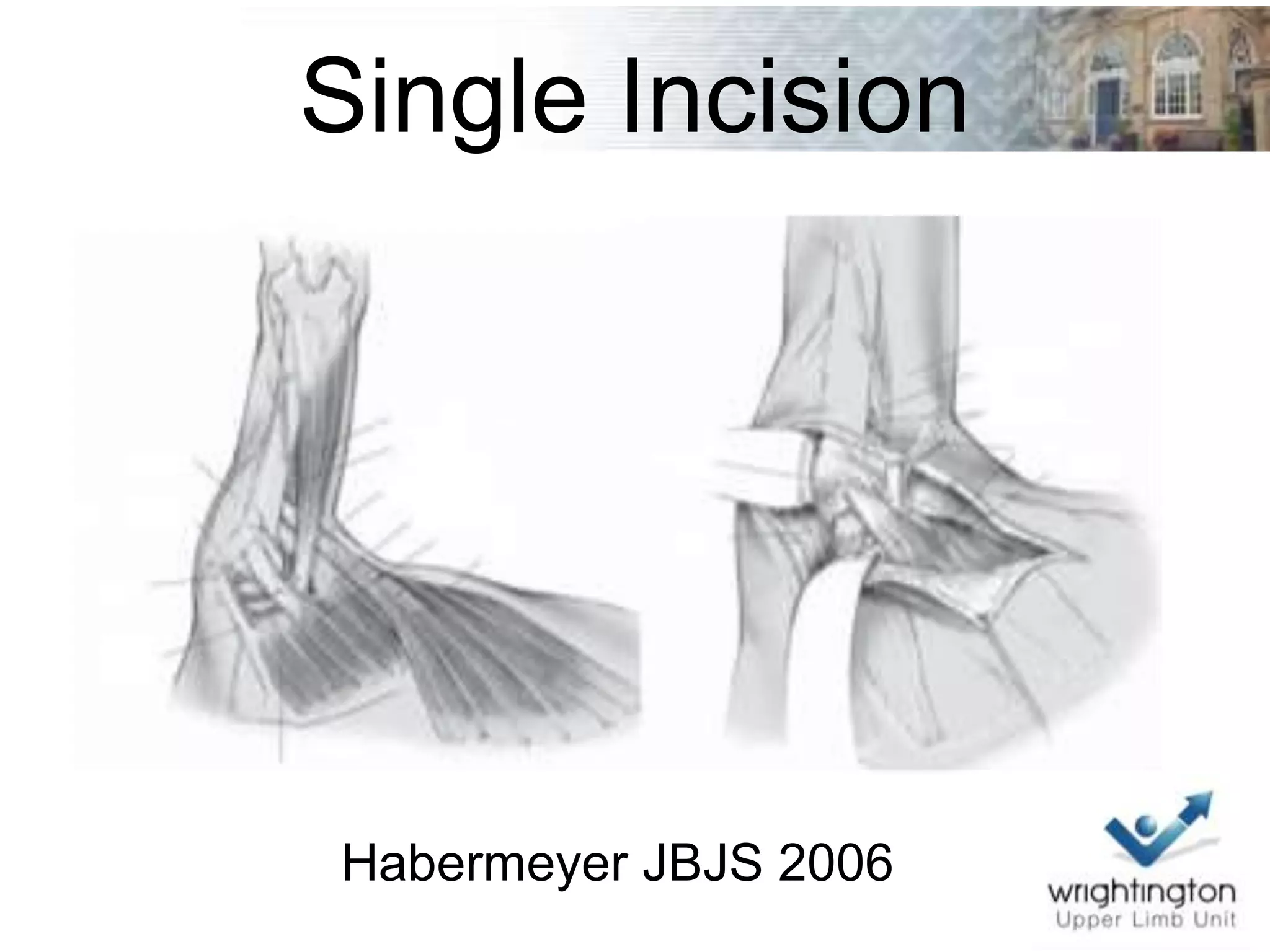
Single Incision
Habermeyer JBJS 2006
Arthroscopic
• Mini open Graft
harvest
• Arthroscopic fixation
• Suture anchors
• Interference screw
(tubularised tendon)
Outcomes
• LDT improves movements but not
strength
• LDT outcomes better with Subscap
intact
• LDT outcomes inferior with Teres Minor
Tears
Outcomes
• Continued Improved outcome scores
over time
• Good outcomes for failed RC repair
• Comparable outcomes with
arthroscopic technique
Anterior Cuff
Deficiency
Subscap deficiency
Indications
• Chronic FT subscap tears
• Retears
• Advanced Fatty degeneration
Combined deficiency
• Combined Posterosuperior and
Anterior deficiency
• 11 patients
• 5 good / 2 average / 4 no better
Aldridge, Atkinson, Mallon JSES. 2004 . 13(6): 621
Tendon Transfer in
Arthroplasty
Active ER is not restored in reverse
geometry arthroplasty
Tendon transfer in
arthroplasty
Modified L’Episcopo transfer
• Lattisimus Dorsi and Teres Major
released via the deltopectoral
approach
• Routed around and re-attached
• Restores Active ER
Outcomes
• LD transfer- 7 degree ER
gain.
• LD and Ter Maj combined
transfer - 34 degree ER gain
Serratus Palsy
LT Nerve Palsy
• Initial period of observation
• Neurolysis
• Tendon transfer
Split Pec Major to Medial border of scapula using allograft
Trapezius Palsy
Spinal Accessory N
• LN biopsy Post triangle of neck
• Penetrating trauma to Neck
Eden Lange
transfer
• Lev Scap to Lateral Spine
• Rh Minor to S Fossa
• Rh Major to I Fossa

Tendon transfers around the shoulder

  • 1.
    Tendon Transfers around theShoulder Mr Puneet Monga Consultant Orthopaedic Shoulder Surgeon
  • 2.
    Rules for tendontransfer • Synergistic • One motor = One function • Straight line pull • Mobile joint • Donor function expendable • Loss of one MRC power
  • 3.
    Pre-requisite • Intact Antagonist(Force couple) • Working deltoid • Mobile shoulder • Patient compliance
  • 4.
    Context Brachial Plexus Injuries IrreparableRotator Cuff tears Combined transfer with Arthroplasty
  • 5.
    Brachial Plexus Injury •Key operations • Nerve Repair • Nerve Transfer • Tendon Transfer • Joint Fusion
  • 6.
    Irreparable Cuff tears •Postero-Superior- Supraspinatus, Infraspinatus +/- Teres Minor • Anterior - Subscapularis
  • 7.
    TT in IrreparableRotator Cuff History • Lattisimus Dorsi Transfer for Irreparable postero-superior Rotator cuff • Earlier used for Brachial Plexus Injuries • Gerber 1998 Lattisimus Dorsi transfer for treatment of Massive tears of the rotator cuff: Gerber et al. 1998
  • 8.
    Options • Tendon Transfer •Partial repair • Arthroscopic Debridement • Superior Capsular reconstruction • Interpositional Balloon • Suprascapular Nerve Neurectomy • Reverse geometry replacement
  • 9.
    Treatment Author NoOutcome Comments Biceps tenotomy/Tenodes is Boileau et al 2007 68 78%good Good for pain relief. Contraindicated in Pseudoparalysis Tendon Transfer Tauber et al, 2010 42 10-27% poor results Not applicable with subscap / teres minor tears Dermal Subsitute Gupta et al, 2012 24 76% intact All reported pain relief. Costly. Role in psudopralysis ? InSpace Balloon Savarese et al 20 ? Scores improved on average. Under trial. Role in pseudoparalysis Suprascapular nerve ablation Nizian et al 2009 20 75% good to excellent Indication intractable shoulder pain No effect on pseudopralysis Reverse geometry Ek et al, 2013 46 37.5% had complications Salvage option
  • 10.
    Indication for Tendon Transfer •Young Active • Large (irreparable) tear • Weakness / Functional Loss
  • 11.
    Role of Subscap •Absent Subscap = poor results • Biomechanically- improves joint stability and balances the force couple
  • 12.
    Technique • Classic Gerber2 incision • First incision- Donor incision axillary- Lattisimus Dorsi dissected from the humerus • Second incision - Deltoid split- superior; for insertion
  • 13.
  • 14.
    Arthroscopic • Mini openGraft harvest • Arthroscopic fixation • Suture anchors • Interference screw (tubularised tendon)
  • 15.
    Outcomes • LDT improvesmovements but not strength • LDT outcomes better with Subscap intact • LDT outcomes inferior with Teres Minor Tears
  • 16.
    Outcomes • Continued Improvedoutcome scores over time • Good outcomes for failed RC repair • Comparable outcomes with arthroscopic technique
  • 17.
  • 18.
    Subscap deficiency Indications • ChronicFT subscap tears • Retears • Advanced Fatty degeneration
  • 19.
    Combined deficiency • CombinedPosterosuperior and Anterior deficiency • 11 patients • 5 good / 2 average / 4 no better Aldridge, Atkinson, Mallon JSES. 2004 . 13(6): 621
  • 20.
  • 21.
    Active ER isnot restored in reverse geometry arthroplasty
  • 22.
    Tendon transfer in arthroplasty ModifiedL’Episcopo transfer • Lattisimus Dorsi and Teres Major released via the deltopectoral approach • Routed around and re-attached • Restores Active ER
  • 23.
    Outcomes • LD transfer-7 degree ER gain. • LD and Ter Maj combined transfer - 34 degree ER gain
  • 24.
  • 25.
    LT Nerve Palsy •Initial period of observation • Neurolysis • Tendon transfer Split Pec Major to Medial border of scapula using allograft
  • 26.
  • 27.
    Spinal Accessory N •LN biopsy Post triangle of neck • Penetrating trauma to Neck
  • 28.
    Eden Lange transfer • LevScap to Lateral Spine • Rh Minor to S Fossa • Rh Major to I Fossa