
The Throwing shoulder
Puneet Monga
Consultant Orthopaedic Shoulder Surgeon,
Wrightington Upper Limb Unit
Scope of the talk
•Understanding the overhead athlete’s
shoulder
•Pathologies
•Surgeon’s perspective
•Outcomes
•Management Algorithm
Evolutionary function of the
shoulder
Shoulder is designed to place the hand in a three
dimensional space with the elbow acting as a length
adjusting Caliper
In an overhead
athlete
The power is gained from the Trunk and the upper thighs
and the shoulder fine tunes and controls the motion
Common features
• Power generation
• Position of the shoulder
• Force transmission
Kinetic chain
Mc Mullen and Uhl 2000
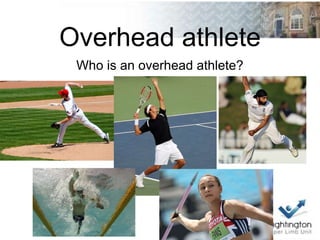
Overhead athlete
Who is an overhead athlete?
Pathologies seen
Lesions
• Specific to the overhead athlete
- Internal impingement
- UPS (Unstable Painful Shoulder)
• Not specific to the overhead athlete
- SLAP tears
- Anterior Instability
- Sub-acromial impingement
- Fractures/ dislocations
Internal Impingement
Pathology
• Cardinal lesions
• Articular sided rotator cuff tears
• Postero-superior labral lesions
• Landmark article: Walch G, Boileau P, Noel E, et al. Impingement of the deep surface of the
supraspinatus tendon on the posterosuperior glenoid rim: an arthroscopic study. J Shoulder
Elbow Surg. 1992;1:238-245.
Image Courtesy: Shoulderdoc.co.uk
Symptoms
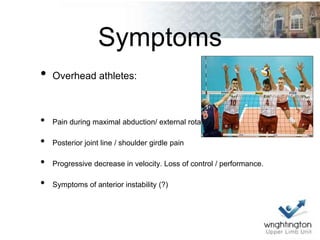
• Overhead athletes:
• Pain during maximal abduction/ external rotation
• Posterior joint line / shoulder girdle pain
• Progressive decrease in velocity. Loss of control / performance.
• Symptoms of anterior instability (?)
Signs
• Posterior glenohumeral joint-line tenderness
• Loss of Internal Rotation
• Excessive External rotation
• Special tests
- for SLAP, biceps, Cuff and instability
Specific test
• Internal impingement test
• Place arm in Abduction 90-110, Max ER, Ext 10-15.
• Deep posterior shoulder pain
• In non contact injuries; 95% sensitivity, 100%
specificity
Meister K, Buckley B, Batts J. The posterior impingement sign: diagnosis of rotator cuff and posterior
labral tears secondary to internal impingement in overhand athletes. Am J Orthop. 2004;33:412-415.
Specific test
• Jobe’s Relocation test
• Abduction and external rotation causes posterior
joint line pain.
• relieved by anterior pressure
UPS
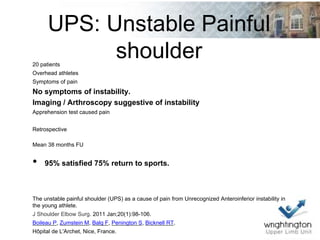
UPS: Unstable Painful
shoulder20 patients
Overhead athletes
Symptoms of pain
No symptoms of instability.
Imaging / Arthroscopy suggestive of instability
Apprehension test caused pain
Retrospective
Mean 38 months FU
• 95% satisfied 75% return to sports.
The unstable painful shoulder (UPS) as a cause of pain from Unrecognized Anteroinferior instability in
the young athlete.
J Shoulder Elbow Surg. 2011 Jan;20(1):98-106.
Boileau P, Zumstein M, Balg F, Penington S, Bicknell RT.
Hôpital de L'Archet, Nice, France.
Surgeon’s
perspective
Decision making
Sieve
• Level of participation
• Sport
• Motivation
• Season
Decision making
Surgeon
Therapist Coach
Patient
Role of Investigations
Early diagnosis paramount
• Consider Early definitive investigations
• MR arthrogram (vs MR vs CT arthrogram vs
Ultrasound)
Beware!
• Cuff tears in asymptomatic individuals !
• Labral tears in asymptomatic athletes !
• Pathologies which do not corelate with clinical
picture !
• Low sensitivity of scans to pick PT cuff tears
Avoid Excessive reliance on scans
Role of surgery
• After exhausting rehab options.
• “Trial of Therapy” vs “early surgery” = overuse vs
acute trauma
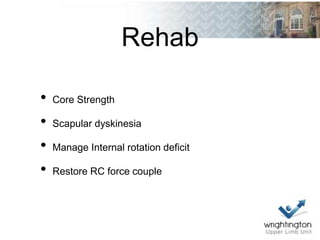
Rehab
• Core Strength
• Scapular dyskinesia
• Manage Internal rotation deficit
• Restore RC force couple
Surgical input
Precision strike and not carpet bombing!
Outcomes
Summary of
Evidence
Thermal Capsulorraphy Jansen et al, 2012 7 year follow up: significant deterioration 25%
Capsular Plication Jones et al, 2012 Pts with cuff tear, unable to return to play 85%
Capsular Plication in
swimmers
Montgomery et al,
2010
80% return to play, but at lower level 20%
Pancapsular plication Ma et al, 2012 Improvement in symptoms in all 18%
Review of SLAP 2
repairs
Gorantla et al 2012 return to overhead sports challenging 22-64%
Non op Mgx, SLAP 2 Edwards et al, 2010 Trail of non-op Mgx recommended 66%
Biceps tenodesis for
SLAP
Boileau et al 2009 Higher return to play in tenodesis cohort 87%
Tenodesis vs SLAP Ek et al2014 No difference 73%, 60%
and many more ...............
Summary / Reflection
• Predominantly SLAP lesion; 2/3 return to play
• Associated large cuff tear / repair : Poor RTP (1/3)
• Capsular shrinkage, plication: Poor RTP
• SLAP repair if the tendon looks good, tenodese if
looks diseased
Management
Algorithm
Management
Clinical suspicion of internal impingement
MR Arthrogram including ABER views
Other lesions
FT Cuff tear
Labral tear
Subacromial impingement
Features of Internal
impingement
PT Cuff tears
Post-sup Labral changes
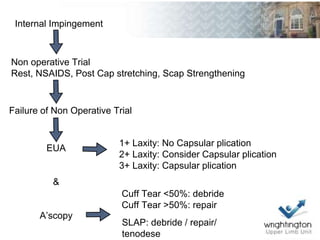
Internal Impingement
Non operative Trial
Rest, NSAIDS, Post Cap stretching, Scap Strengthening
Failure of Non Operative Trial
EUA
&
A’scopy
1+ Laxity: No Capsular plication
2+ Laxity: Consider Capsular plication
3+ Laxity: Capsular plication
Cuff Tear <50%: debride
Cuff Tear >50%: repair
SLAP: debride / repair/
tenodese

The overhead athlete

  • 1.
    The Throwing shoulder PuneetMonga Consultant Orthopaedic Shoulder Surgeon, Wrightington Upper Limb Unit
  • 3.
    Scope of thetalk •Understanding the overhead athlete’s shoulder •Pathologies •Surgeon’s perspective •Outcomes •Management Algorithm
  • 4.
    Evolutionary function ofthe shoulder Shoulder is designed to place the hand in a three dimensional space with the elbow acting as a length adjusting Caliper
  • 5.
    In an overhead athlete Thepower is gained from the Trunk and the upper thighs and the shoulder fine tunes and controls the motion
  • 7.
    Common features • Powergeneration • Position of the shoulder • Force transmission
  • 8.
  • 9.
    Overhead athlete Who isan overhead athlete?
  • 10.
  • 11.
    Lesions • Specific tothe overhead athlete - Internal impingement - UPS (Unstable Painful Shoulder) • Not specific to the overhead athlete - SLAP tears - Anterior Instability - Sub-acromial impingement - Fractures/ dislocations
  • 12.
  • 13.
    Pathology • Cardinal lesions •Articular sided rotator cuff tears • Postero-superior labral lesions • Landmark article: Walch G, Boileau P, Noel E, et al. Impingement of the deep surface of the supraspinatus tendon on the posterosuperior glenoid rim: an arthroscopic study. J Shoulder Elbow Surg. 1992;1:238-245.
  • 14.
  • 15.
    Symptoms • Overhead athletes: •Pain during maximal abduction/ external rotation • Posterior joint line / shoulder girdle pain • Progressive decrease in velocity. Loss of control / performance. • Symptoms of anterior instability (?)
  • 16.
    Signs • Posterior glenohumeraljoint-line tenderness • Loss of Internal Rotation • Excessive External rotation • Special tests - for SLAP, biceps, Cuff and instability
  • 17.
    Specific test • Internalimpingement test • Place arm in Abduction 90-110, Max ER, Ext 10-15. • Deep posterior shoulder pain • In non contact injuries; 95% sensitivity, 100% specificity Meister K, Buckley B, Batts J. The posterior impingement sign: diagnosis of rotator cuff and posterior labral tears secondary to internal impingement in overhand athletes. Am J Orthop. 2004;33:412-415.
  • 18.
    Specific test • Jobe’sRelocation test • Abduction and external rotation causes posterior joint line pain. • relieved by anterior pressure
  • 19.
  • 20.
    UPS: Unstable Painful shoulder20patients Overhead athletes Symptoms of pain No symptoms of instability. Imaging / Arthroscopy suggestive of instability Apprehension test caused pain Retrospective Mean 38 months FU • 95% satisfied 75% return to sports. The unstable painful shoulder (UPS) as a cause of pain from Unrecognized Anteroinferior instability in the young athlete. J Shoulder Elbow Surg. 2011 Jan;20(1):98-106. Boileau P, Zumstein M, Balg F, Penington S, Bicknell RT. Hôpital de L'Archet, Nice, France.
  • 21.
  • 22.
    Decision making Sieve • Levelof participation • Sport • Motivation • Season
  • 23.
  • 24.
    Role of Investigations Earlydiagnosis paramount • Consider Early definitive investigations • MR arthrogram (vs MR vs CT arthrogram vs Ultrasound)
  • 25.
    Beware! • Cuff tearsin asymptomatic individuals ! • Labral tears in asymptomatic athletes ! • Pathologies which do not corelate with clinical picture ! • Low sensitivity of scans to pick PT cuff tears Avoid Excessive reliance on scans
  • 26.
    Role of surgery •After exhausting rehab options. • “Trial of Therapy” vs “early surgery” = overuse vs acute trauma
  • 27.
    Rehab • Core Strength •Scapular dyskinesia • Manage Internal rotation deficit • Restore RC force couple
  • 28.
    Surgical input Precision strikeand not carpet bombing!
  • 30.
  • 31.
    Summary of Evidence Thermal CapsulorraphyJansen et al, 2012 7 year follow up: significant deterioration 25% Capsular Plication Jones et al, 2012 Pts with cuff tear, unable to return to play 85% Capsular Plication in swimmers Montgomery et al, 2010 80% return to play, but at lower level 20% Pancapsular plication Ma et al, 2012 Improvement in symptoms in all 18% Review of SLAP 2 repairs Gorantla et al 2012 return to overhead sports challenging 22-64% Non op Mgx, SLAP 2 Edwards et al, 2010 Trail of non-op Mgx recommended 66% Biceps tenodesis for SLAP Boileau et al 2009 Higher return to play in tenodesis cohort 87% Tenodesis vs SLAP Ek et al2014 No difference 73%, 60% and many more ...............
  • 32.
    Summary / Reflection •Predominantly SLAP lesion; 2/3 return to play • Associated large cuff tear / repair : Poor RTP (1/3) • Capsular shrinkage, plication: Poor RTP • SLAP repair if the tendon looks good, tenodese if looks diseased
  • 33.
  • 34.
    Management Clinical suspicion ofinternal impingement MR Arthrogram including ABER views Other lesions FT Cuff tear Labral tear Subacromial impingement Features of Internal impingement PT Cuff tears Post-sup Labral changes
  • 35.
    Internal Impingement Non operativeTrial Rest, NSAIDS, Post Cap stretching, Scap Strengthening Failure of Non Operative Trial EUA & A’scopy 1+ Laxity: No Capsular plication 2+ Laxity: Consider Capsular plication 3+ Laxity: Capsular plication Cuff Tear <50%: debride Cuff Tear >50%: repair SLAP: debride / repair/ tenodese