Common
Shoulder
FracturesPuneet Monga
Consultant Orthopaedic Surgeon
Upper Limb Unit,
Wrightington Hospital
Clavicle fractures
Direct fall usual mechanism
Lateral 1/3 (21%), middle 1/3
(76%), medial 1/3 (3%)
Beware; associated injuries
eg. Rib, scapula #
Proximal fragment pulled up,
distal gravitates down
Treatment of clavicle fractures
Good union rate treated conservatively; broad
arm sling
Operate if:
Short by > 2cm
Open # or skin tenting
Neurovascular injury
Pathological fracture
Floating shoulder
? Polytrauma
? Non-union
When can we start moving
Non operative Operative
Proximal humeral fractures
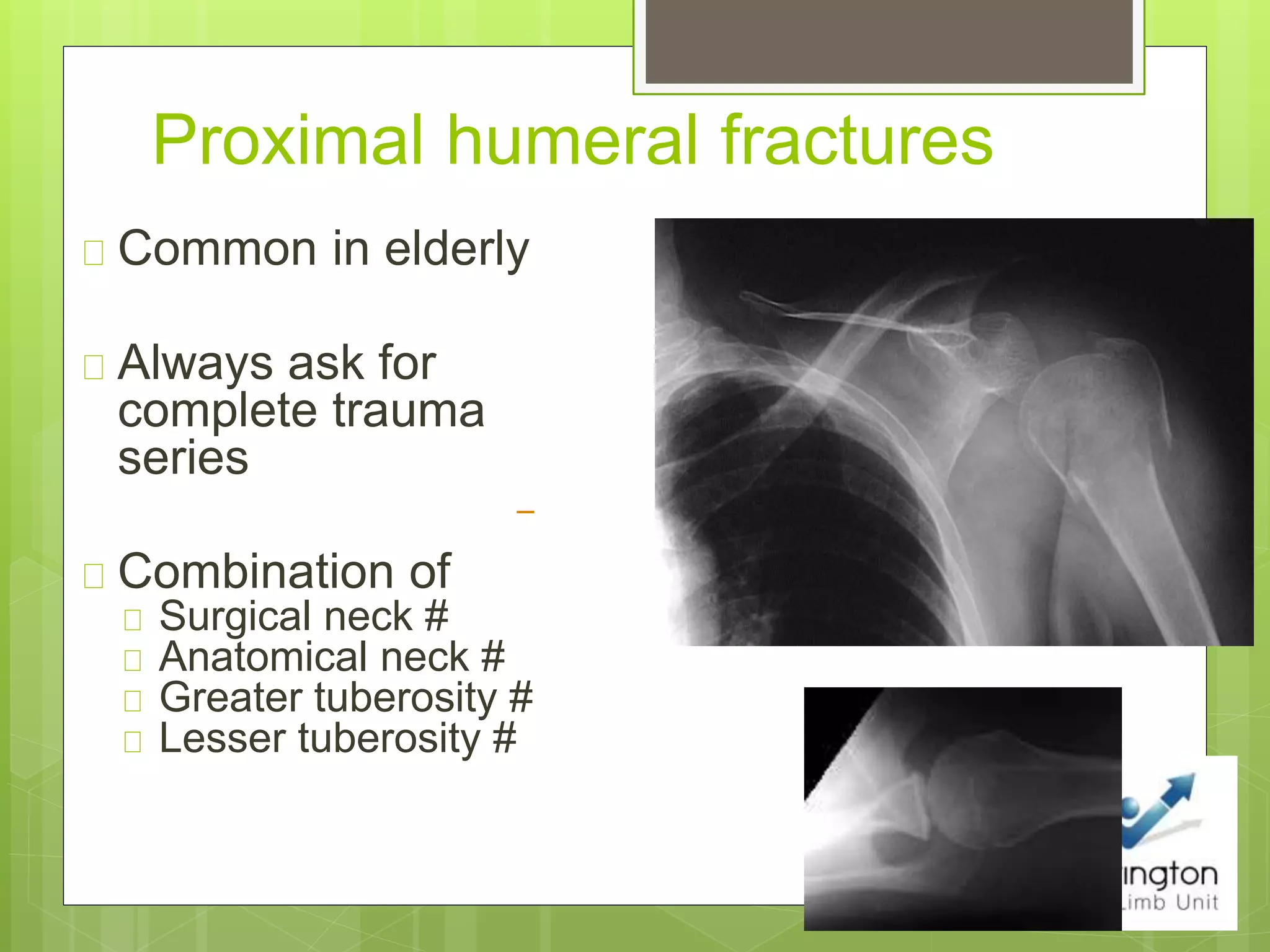
Common in elderly
Always ask for
complete trauma
series
Combination of
Surgical neck #
Anatomical neck #
Greater tuberosity #
Lesser tuberosity #
Proximal humeral fractures
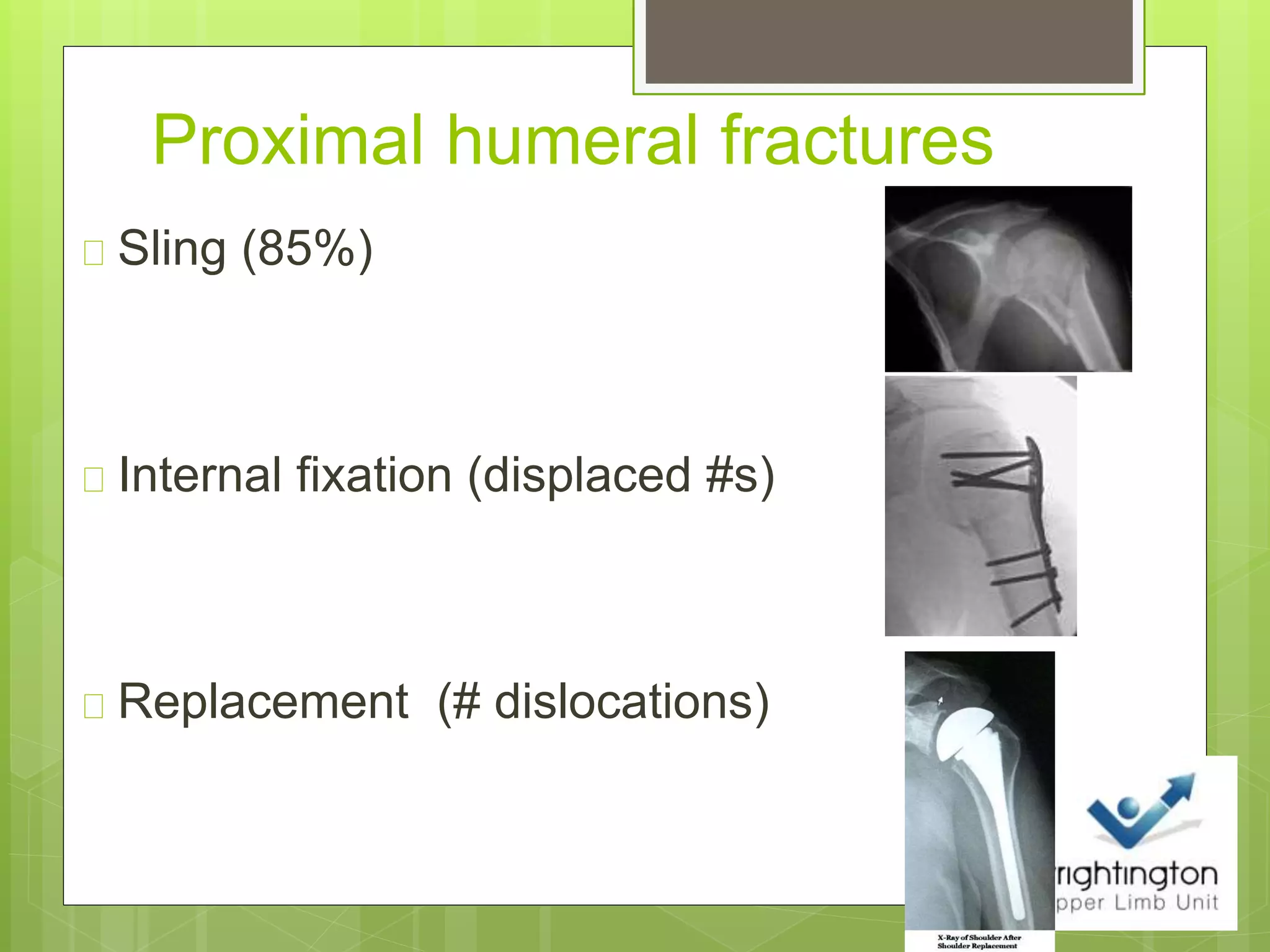
Sling (85%)
Internal fixation (displaced #s)
Replacement (# dislocations)
When can we start moving
Non operative Operative
Dislocation of the shoulder
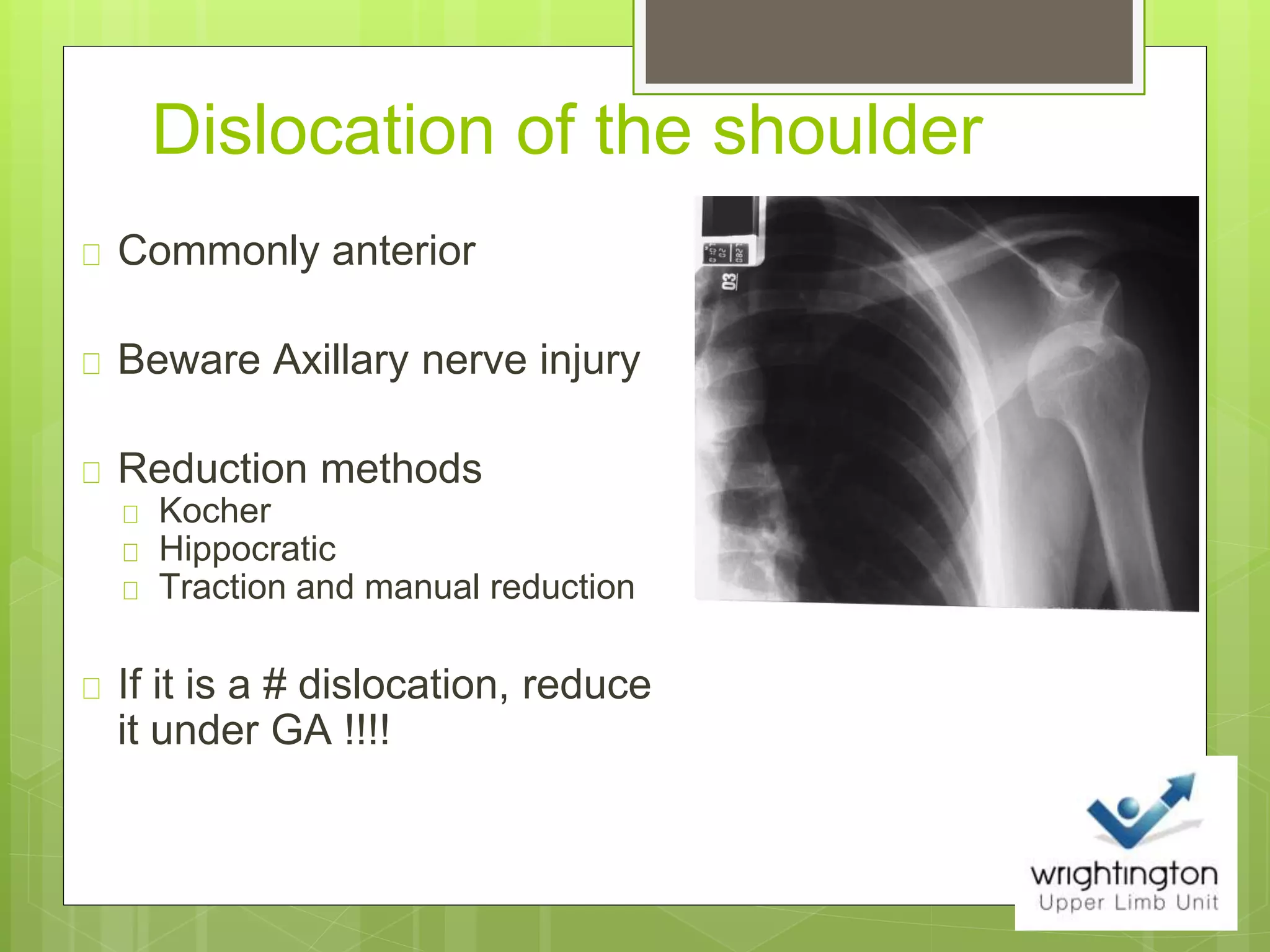
Commonly anterior
Beware Axillary nerve injury
Reduction methods
Kocher
Hippocratic
Traction and manual reduction
If it is a # dislocation, reduce
it under GA !!!!
When can we start moving
Non operative Operative
Humeral shaft fracture
3% of all fractures
Muscular attachments of
deltoid and pectoralis
cause differing degrees of
displacement depending on
level of fracture
Beware; radial nerve palsy
Humeral shaft fracture treatment
Conservative (70-80%)
U slab aligns fracture
Functional brace – early
mobilisation (in 2-3 wks)
Humeral shaft fracture treatment
Surgery – Plate or IM Nail
Indications for surgery
➢ Closed treatment failed
➢ open fracture
➢ vascular injury
➢ floating elbow
➢ pathological #
➢ Polytrauma
➢ articular injury
➢ distal 1/3 #
Radial nerve palsy
Presents with wrist drop
11% of humeral fractures
Distal 1/3 fractures most at risk
90% neuropraxia and will recover
(3-4m)
Treat with observation and wrist
extension splint
Surgically explore if: open #, or
appears after manipulation
When can we start moving
Non operative Operative
Global summary
Early surgery when indicated.
Early mobilization, esp after surgery.
Mobilize neighboring joints ASAP.
Team working crucial for good outcomes

Common shoulder injuries

  • 1.
    Common Shoulder FracturesPuneet Monga Consultant OrthopaedicSurgeon Upper Limb Unit, Wrightington Hospital
  • 3.
    Clavicle fractures Direct fallusual mechanism Lateral 1/3 (21%), middle 1/3 (76%), medial 1/3 (3%) Beware; associated injuries eg. Rib, scapula # Proximal fragment pulled up, distal gravitates down
  • 4.
    Treatment of claviclefractures Good union rate treated conservatively; broad arm sling Operate if: Short by > 2cm Open # or skin tenting Neurovascular injury Pathological fracture Floating shoulder ? Polytrauma ? Non-union
  • 5.
    When can westart moving Non operative Operative
  • 7.
    Proximal humeral fractures Commonin elderly Always ask for complete trauma series Combination of Surgical neck # Anatomical neck # Greater tuberosity # Lesser tuberosity #
  • 8.
    Proximal humeral fractures Sling(85%) Internal fixation (displaced #s) Replacement (# dislocations)
  • 9.
    When can westart moving Non operative Operative
  • 11.
    Dislocation of theshoulder Commonly anterior Beware Axillary nerve injury Reduction methods Kocher Hippocratic Traction and manual reduction If it is a # dislocation, reduce it under GA !!!!
  • 12.
    When can westart moving Non operative Operative
  • 14.
    Humeral shaft fracture 3%of all fractures Muscular attachments of deltoid and pectoralis cause differing degrees of displacement depending on level of fracture Beware; radial nerve palsy
  • 15.
    Humeral shaft fracturetreatment Conservative (70-80%) U slab aligns fracture Functional brace – early mobilisation (in 2-3 wks)
  • 16.
    Humeral shaft fracturetreatment Surgery – Plate or IM Nail Indications for surgery ➢ Closed treatment failed ➢ open fracture ➢ vascular injury ➢ floating elbow ➢ pathological # ➢ Polytrauma ➢ articular injury ➢ distal 1/3 #
  • 17.
    Radial nerve palsy Presentswith wrist drop 11% of humeral fractures Distal 1/3 fractures most at risk 90% neuropraxia and will recover (3-4m) Treat with observation and wrist extension splint Surgically explore if: open #, or appears after manipulation
  • 18.
    When can westart moving Non operative Operative
  • 19.
    Global summary Early surgerywhen indicated. Early mobilization, esp after surgery. Mobilize neighboring joints ASAP. Team working crucial for good outcomes