

My Techniques for Shoulder Joint 
Preservation 
Alan M. Hirahara, M.D., FRCS(C) 
Board Certified in Orthopaedic Surgery & Orthopaedic Sports Medicine 
Specializing in arthroscopic shoulder & knee surgery
Historical View of Rotator Cuff Pathology 
Diagnosis 
• Tendonitis / Impingement 
• Rotator cuff tear 
Treatment 
• Conservative treatment 
• Surgical treatment 
– Decompression 
– Open rotator cuff repair
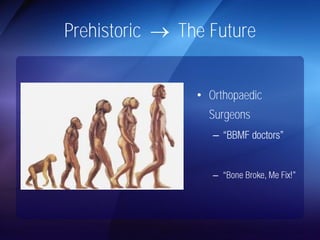
Prehistoric  The Future 
• Orthopaedic 
Surgeons 
– 
–
Spectrum of Rotator Cuff Disease 
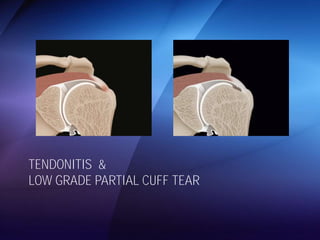
• Tendonitis / Low grade PASTA lesion 
• High grade PASTA lesion / Rotator cuff tear 
• Reparable massive rotator cuff tear 
• Irreparable rotator cuff tear 
• Cuff tear arthropathy
TENDONITIS & 
LOW GRADE PARTIAL CUFF TEAR
Options for 
Tendonitis / Low-Grade Partial RC Tear 
Traditional 
• 
• Physical Therapy 
• Cortisone 
• Surgery 
– Decompression / Acromioplasty 
– Debridement 
Advanced Technology 
• Platelet-rich plasma (PRP) 
• Stem cells (BMAC) (?)
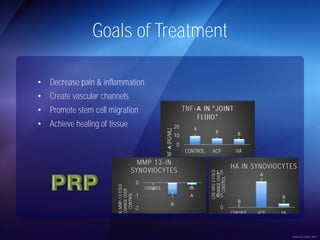
Goals of Treatment 
• Decrease pain & inflammation 
• Create vascular channels 
• Promote stem cell migration 
• Achieve healing of tissue 
B 
A 
B 
1.5 
1 
0.5 
0 
CONTROL ACP HA 
LOG HAS-2 FOLD 
CHANGE OVER 
CONTROL 
HA IN SYNOVIOCYTES 
20 
10 
MMP 13-IN 
SYNOVIOCYTES 
A 
B 
A 
0 
-1 
-2 
CONTROL ACP HA 
LOG MMP-13 FOLD 
CHANGE OVER 
CONTROL 
A 
B B 
0 
CONTROL ACP HA 
TNF-Α (PG/ML) 
TNF- Α 
Fortier et al, AJSM, 2014
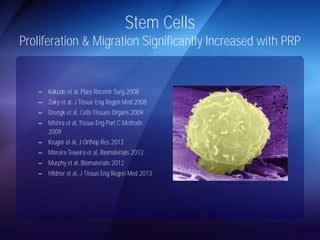
Stem Cells 
Proliferation & Migration Significantly Increased with PRP 
– Kakudo et al, Plast Recontr Surg 2008 
– Zaky et al, J Tissue Eng Regen Med 2008 
– Drengk et al, Cells Tissues Organs 2009 
– Mishra et al, Tissue Eng Part C Methods 
2009 
– Kruger et al, J Orthop Res 2012 
– Moreira Teixeira et al, Biomaterials 2012 
– Murphy et al, Biomaterials 2012 
– Hildner et al, J Tissue Eng Regen Med 2013
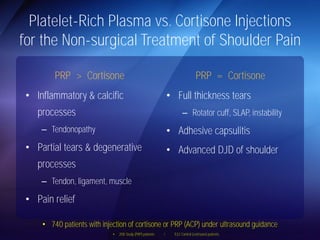
Platelet-Rich Plasma vs. Cortisone Injections 
for the Non-surgical Treatment of Shoulder Pain 
PRP > Cortisone 
• Inflammatory & calcific 
processes 
– Tendonopathy 
• Partial tears & degenerative 
processes 
– Tendon, ligament, muscle 
• Pain relief 
PRP = Cortisone 
• Full thickness tears 
– Rotator cuff, SLAP, instability 
• Adhesive capsulitis 
• Advanced DJD of shoulder 
• 740 patients with injection of cortisone or PRP (ACP) under ultrasound guidance 
• 208 Study (PRP) patients / 532 Control (cortisone) patients
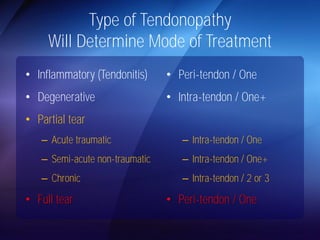
Type of Tendonopathy 
Will Determine Mode of Treatment 
• Inflammatory (Tendonitis) 
• Degenerative 
• Partial tear 
– Acute traumatic 
– Semi-acute non-traumatic 
– Chronic 
• Full tear 
• Peri-tendon / One 
• Intra-tendon / One+ 
– Intra-tendon / One 
– Intra-tendon / One+ 
– Intra-tendon / 2 or 3 
• Peri-tendon / One
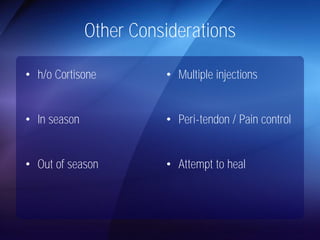
Other Considerations 
• h/o Cortisone 
• In season 
• Out of season 
• Multiple injections 
• Peri-tendon / Pain control 
• Attempt to heal
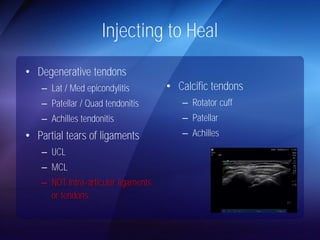
Injecting to Heal 
• Degenerative tendons 
– Lat / Med epicondylitis 
– Patellar / Quad tendonitis 
– Achilles tendonitis 
• Partial tears of ligaments 
– UCL 
– MCL 
– NOT Intra-articular ligaments 
or tendons 
• Calcific tendons 
– Rotator cuff 
– Patellar 
– Achilles
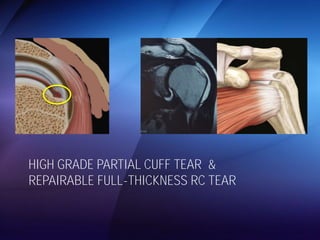
HIGH GRADE PARTIAL CUFF TEAR & 
REPAIRABLE FULL-THICKNESS RC TEAR
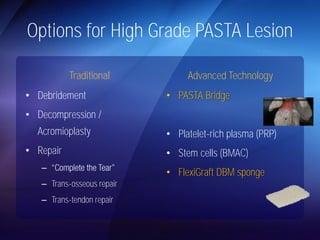
Options for High Grade PASTA Lesion 
Traditional 
• Debridement 
• Decompression / 
Acromioplasty 
• Repair 
– 
– Trans-osseous repair 
– Trans-tendon repair 
Advanced Technology 
• PASTA Bridge 
• Platelet-rich plasma (PRP) 
• Stem cells (BMAC) 
• FlexiGraft DBM sponge
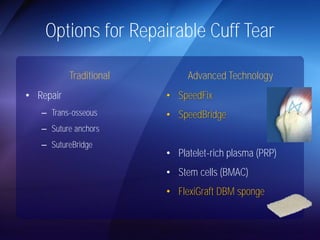
Options for Repairable Cuff Tear 
Traditional 
• Repair 
– Trans-osseous 
– Suture anchors 
– SutureBridge 
Advanced Technology 
• SpeedFix 
• SpeedBridge 
• Platelet-rich plasma (PRP) 
• Stem cells (BMAC) 
• FlexiGraft DBM sponge
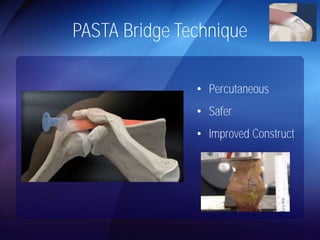
PASTA Bridge Technique 
• Percutaneous 
• Safer 
• Improved Construct
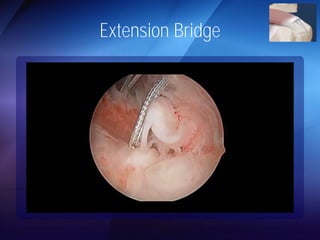
Extension Bridge
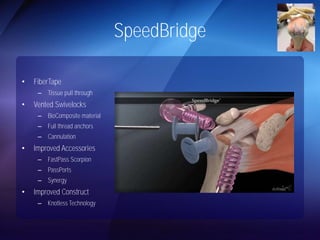
SpeedBridge 
• FiberTape 
– Tissue pull through 
• Vented Swivelocks 
– BioComposite material 
– Full thread anchors 
– Cannulation 
• Improved Accessories 
– FastPass Scorpion 
– PassPorts 
– Synergy 
• Improved Construct 
– Knotless Technology
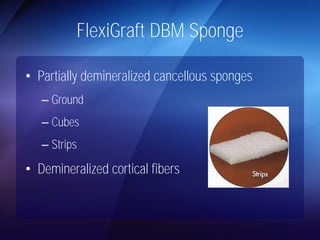
FlexiGraft DBM Sponge 
• Partially demineralized cancellous sponges 
– Ground 
– Cubes 
– Strips 
• Demineralized cortical fibers
FlexiGraft DBM Sponge 
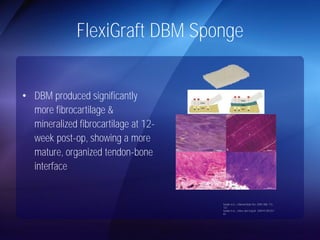
• DBM produced significantly 
more fibrocartilage & 
mineralized fibrocartilage at 12- 
week post-op, showing a more 
mature, organized tendon-bone 
interface 
Sundar et al., J Biomed Mater Res. 2009; 88B: 115- 
122 
Sundar et al., J Bone Joint Surg Br. 2009;91;(9)1257- 
62
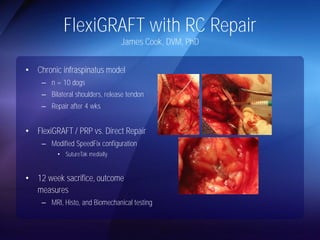
FlexiGRAFT with RC Repair 
James Cook, DVM, PhD 
• Chronic infraspinatus model 
– n = 10 dogs 
– Bilateral shoulders, release tendon 
– Repair after 4 wks 
• FlexiGRAFT / PRP vs. Direct Repair 
– Modified SpeedFix configuration 
• SutureTak medially 
• 12 week sacrifice, outcome 
measures 
– MRI, Histo, and Biomechanical testing
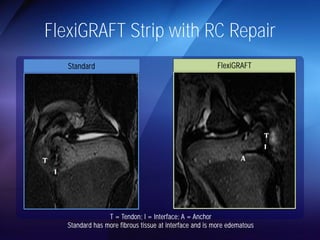
FlexiGRAFT Strip with RC Repair 
Standard FlexiGRAFT 
T = Tendon; I = Interface; A = Anchor 
Standard has more fibrous tissue at interface and is more edematous
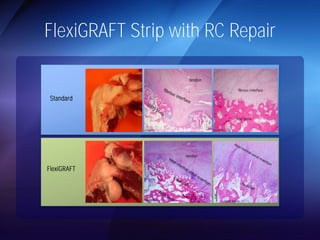
FlexiGRAFT Strip with RC Repair 
Standard 
FlexiGRAFT
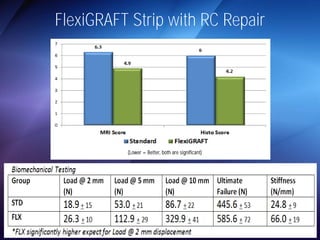
FlexiGRAFT Strip with RC Repair 
(Lower = Better, both are significant)
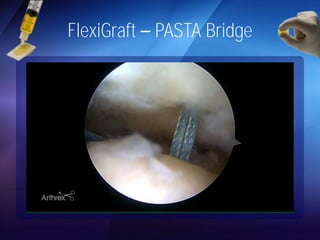
FlexiGraft PASTA Bridge
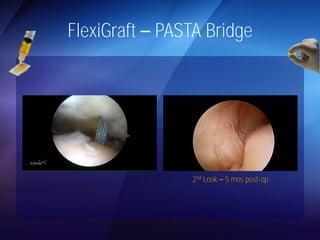
FlexiGraft PASTA Bridge 
2nd Look 5 mos post-op
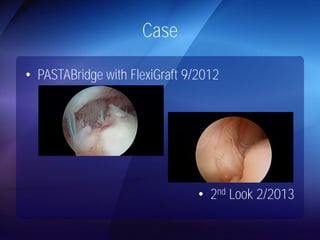
Case 
• PASTABridge with FlexiGraft 9/2012 
• 2nd Look 2/2013
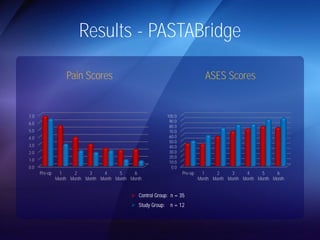
Results - PASTABridge 
Pain Scores ASES Scores 
100.0 
90.0 
80.0 
70.0 
60.0 
50.0 
40.0 
30.0 
20.0 
10.0 
0.0 
Pre-op 1 
 Control Group: n = 35 
 Study Group: n = 12 
Month 
2 
Month 
3 
Month 
4 
Month 
5 
Month 
6 
Month 
7.0 
6.0 
5.0 
4.0 
3.0 
2.0 
1.0 
0.0 
Pre-op 1 
Month 
2 
Month 
3 
Month 
4 
Month 
5 
Month 
6 
Month
SpeedBridge Augmented 
with FlexiGraft
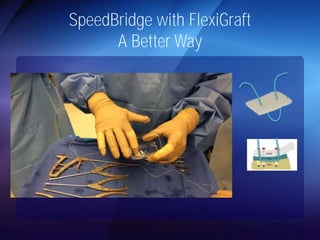
SpeedBridge with FlexiGraft 
A Better Way
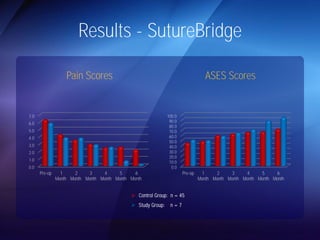
Results - SutureBridge 
Pain Scores 
7.0 
6.0 
5.0 
4.0 
3.0 
2.0 
1.0 
0.0 
Pre-op 1 
Month 
2 
Month 
3 
Month 
4 
Month 
5 
Month 
6 
Month 
ASES Scores 
100.0 
90.0 
80.0 
70.0 
60.0 
50.0 
40.0 
30.0 
20.0 
10.0 
0.0 
Pre-op 1 
Month 
2 
Month 
3 
Month 
4 
Month 
5 
Month 
6 
Month 
 Control Group: n = 45 
 Study Group: n = 7
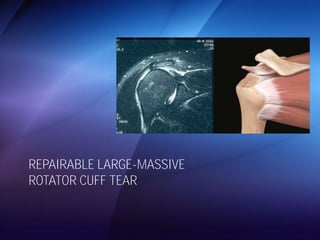
REPAIRABLE LARGE-MASSIVE 
ROTATOR CUFF TEAR
Options for Repairable Massive Tear 
Traditional 
• Repair 
– Trans-osseous 
– Suture anchors 
– SutureBridge 
Advanced Technology 
• SpeedBridge 
• Rip Stop 
• Platelet-rich plasma (PRP) 
• Stem cells (BMAC) 
• FlexiGraft DBM sponge 
• Patch augmentation
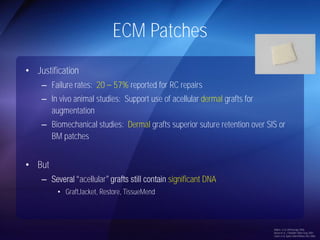
ECM Patches 
• Justification 
– Failure rates: 20 57% reported for RC repairs 
– In vivo animal studies: Support use of acellular dermal grafts for 
augmentation 
– Biomechanical studies: Dermal grafts superior suture retention over SIS or 
BM patches 
• But 
– acellular significant DNA 
• GraftJacket, Restore, TissueMend 
Adams et al, Arthroscopy 2006. 
Aurura et al, J Shoulder Elbow Surg 2007. 
Coons et al, Sports Med Arthrosc Rev 2006.
RC Repair Augmentation 
• Peer reviewed clinical studies do not support SIS grafts 
• Iannotti et al, (JBJS 2006) - Randomized prospective controlled trial using (Restore) augmentation for 
massive tears showing no benefit using SIS. Discontinued study early! 
• Walton et al. (JBJS 2007) - 19 pts. 4 of which had severe early inflammatory rxn. 2 yr. MRI shows no 
difference in failure rate vs non-augmented, abandoned study early! Porcine graft (Level 3) 
• Schlamberg et al. (J Shoulder Elbow Surg 2004) All patients re-tore 
• Zheng et al. (J Biomed Mater Res B Appl Biomater 2005) Adverse outcomes related to retained 
cellular elements 
• Dermis grafts show potential 
• Burkhead et al. (Semin Arthroplasty 2007) 17 pts, GJA augmentation, 1.2 yrs F/U, improved UCLA 
scores but 3 retears per MRI & no reversal of atrophy or fatty infiltration. No Control group 
Iannotti et al, JBJS 2006 
Walton et al, JBJS 2007 
Schlamberg et al, JSES 2004 
Zheng et al, J Biomed Mater Res B Appl Biomater 2005 
Burkhead et al, Semin Arthroplasty 2007
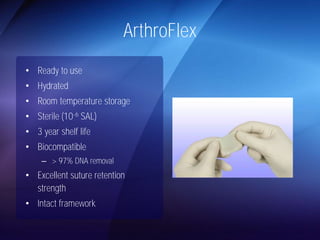
ArthroFlex 
• Ready to use 
• Hydrated 
• Room temperature storage 
• Sterile (10-6 SAL) 
• 3 year shelf life 
• Biocompatible 
– > 97% DNA removal 
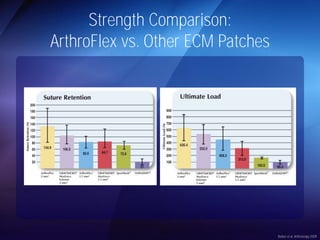
• Excellent suture retention 
strength 
• Intact framework
Strength Comparison: 
ArthroFlex vs. Other ECM Patches 
Barber et al, Arthroscopy 2009
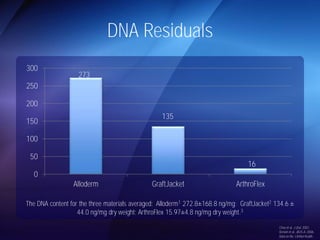
DNA Residuals 
273 
135 
16 
300 
250 
200 
150 
100 
50 
0 
Alloderm GraftJacket ArthroFlex 
The DNA content for the three materials averaged: Alloderm1 272.8±168.8 ng/mg; GraftJacket2 134.6 ± 
44.0 ng/mg dry weight; ArthroFlex 15.97±4.8 ng/mg dry weight.3 
Choe et al. J Urol. 2001. 
Derwin et al. JBJS-A. 2006. 
Data on file, LifeNet Health.
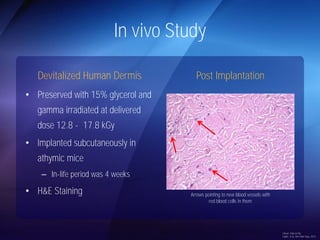
In vivo Study 
Devitalized Human Dermis 
• Preserved with 15% glycerol and 
gamma irradiated at delivered 
dose 12.8 - 17.8 kGy 
• Implanted subcutaneously in 
athymic mice 
– In-life period was 4 weeks 
• H&E Staining 
Post Implantation 
Arrows pointing to new blood vessels with 
red blood cells in them 
Lifenet. Data on file. 
Capito et al, Ann Plast Surg. 2012.
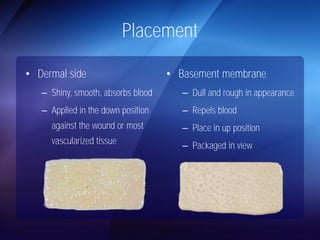
Placement 
• Dermal side 
– Shiny, smooth, absorbs blood 
– Applied in the down position 
against the wound or most 
vascularized tissue 
• Basement membrane 
– Dull and rough in appearance 
– Repels blood 
– Place in up position 
– Packaged in view
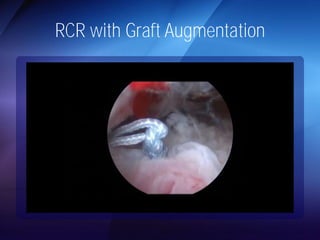
RCR with Graft Augmentation
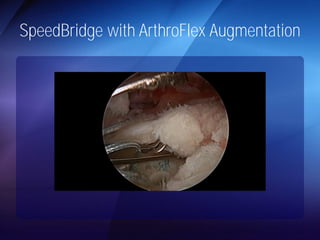
SpeedBridge with ArthroFlex Augmentation
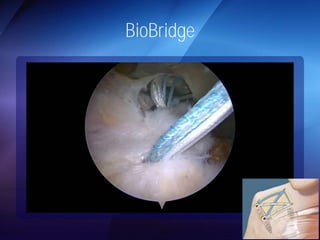
BioBridge
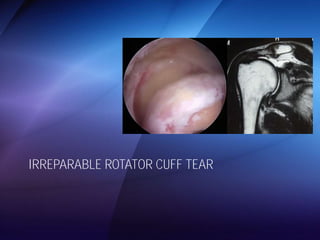
IRREPARABLE ROTATOR CUFF TEAR
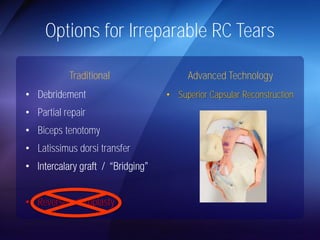
Options for Irreparable RC Tears 
Traditional 
• Debridement 
• Partial repair 
• Biceps tenotomy 
• Latissimus dorsi transfer 
• 
• Reverse arthroplasty 
Advanced Technology 
• Superior Capsular Reconstruction
Disadvantages to Reverse Total Shoulder 
• Subject to overuse 
• Too easily seen as a solution for all previously untreatable shoulder 
pathologies 
• Challenging surgical technique 
• Requires extensive training and experience limits availability 
• Arthroplasty 
• Limited life span 
• Wide range of complication rates
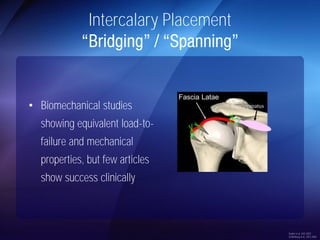
Intercalary Placement 
• Biomechanical studies 
showing equivalent load-to-failure 
and mechanical 
properties, but few articles 
show success clinically 
Snyder et al, IJSS 2007 
Schlamberg et al, JSES 2004
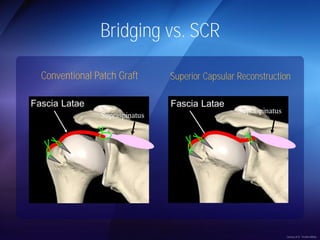
Bridging vs. SCR 
Conventional Patch Graft Superior Capsular Reconstruction 
Courtesy of Dr. Teruhisa Mihata
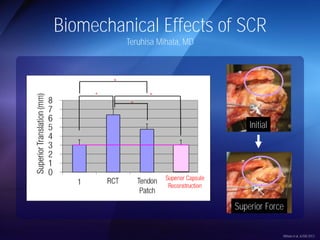
Biomechanical Effects of SCR 
Teruhisa Mihata, MD 
Initial 
Superior Force 
Mihata et al, AJSM 2012
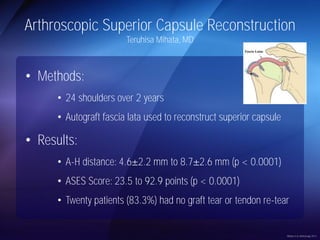
Arthroscopic Superior Capsule Reconstruction 
Teruhisa Mihata, MD 
• Methods: 
• 24 shoulders over 2 years 
• Autograft fascia lata used to reconstruct superior capsule 
• Results: 
• A-H distance: 4.6 2.2 mm to 8.7 2.6 mm (p < 0.0001) 
• ASES Score: 23.5 to 92.9 points (p < 0.0001) 
• Twenty patients (83.3%) had no graft tear or tendon re-tear 
Mihata et al, Arthroscopy 2013
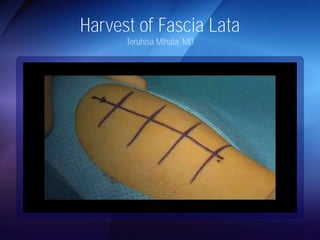
Harvest of Fascia Lata 
Teruhisa Mihata, MD
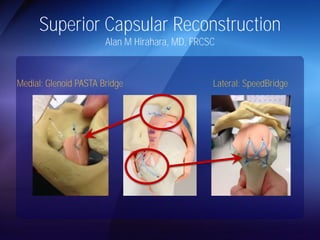
Superior Capsular Reconstruction 
Alan M Hirahara, MD, FRCSC 
Medial: Glenoid PASTA Bridge Lateral: SpeedBridge
ArthroFlex Sizes Available 
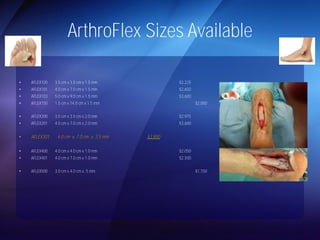
• AFLEX100 3.5 cm x 3.5 cm x 1.5 mm $2,225 
• AFLEX101 4.0 cm x 7.0 cm x 1.5 mm $2,650 
• AFLEX103 5.0 cm x 9.0 cm x 1.5 mm $3,600 
• AFLEX150 1.5 cm x 14.0 cm x 1.5 mm $2,000 
• AFLEX200 3.5 cm x 3.5 cm x 2.0 mm $2,975 
• AFLEX201 4.0 cm x 7.0 cm x 2.0 mm $3,600 
• AFLEX301 4.0 cm x 7.0 cm x 3.5 mm $3,850 
• AFLEX400 4.0 cm x 4.0 cm x 1.0 mm $2,050 
• AFLEX401 4.0 cm x 7.0 cm x 1.0 mm $2,500 
• AFLEX500 3.0 cm x 4.0 cm x .5 mm $1,150
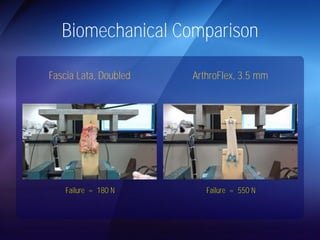
Biomechanical Comparison 
Fascia Lata, Doubled ArthroFlex, 3.5 mm 
Failure = 180 N Failure = 550 N
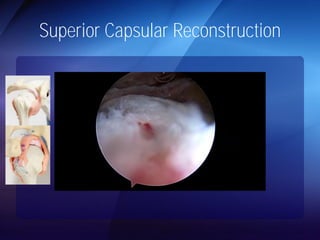
Superior Capsular Reconstruction
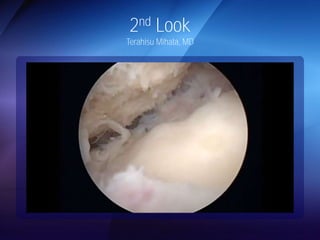
2nd Look 
Terahisu Mihata, MD
Case #1 
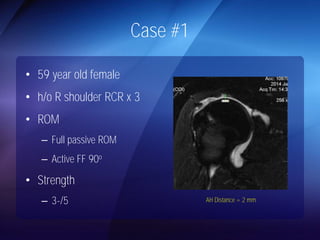
• 59 year old female 
• h/o R shoulder RCR x 3 
• ROM 
– Full passive ROM 
– Active FF 90o 
• Strength 
– 3-/5 AH Distance = 2 mm
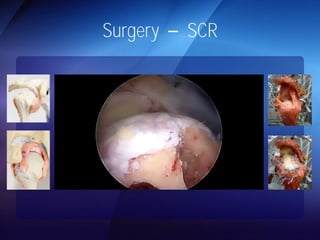
Surgery SCR
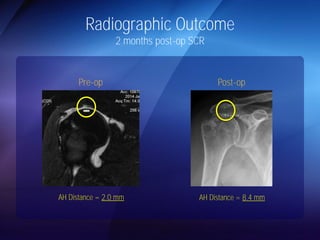
Radiographic Outcome 
2 months post-op SCR 
Pre-op Post-op 
AH Distance = 2.0 mm AH Distance = 8.4 mm
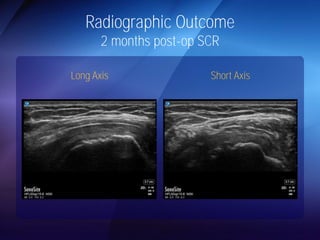
Radiographic Outcome 
2 months post-op SCR 
Long Axis Short Axis
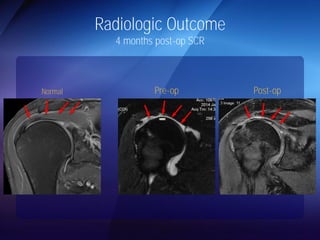
Radiologic Outcome 
4 months post-op SCR 
Normal Pre-op Post-op
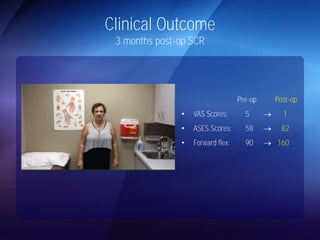
Clinical Outcome 
3 months post-op SCR 
Pre-op Post-op 
• VAS Scores: 5  1 
• ASES Scores: 58  82 
• Forward flex: 90  160
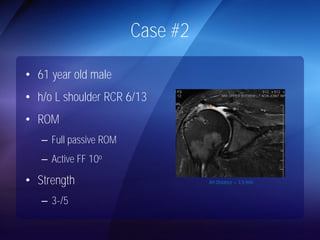
Case #2 
• 61 year old male 
• h/o L shoulder RCR 6/13 
• ROM 
– Full passive ROM 
– Active FF 10o 
• Strength 
– 3-/5 
AH Distance = 3.5 mm
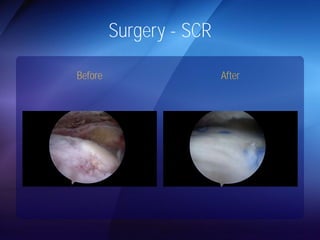
Surgery - SCR 
Before After
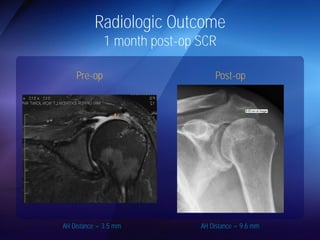
Radiologic Outcome 
1 month post-op SCR 
Pre-op Post-op 
AH Distance = 3.5 mm AH Distance = 9.6 mm
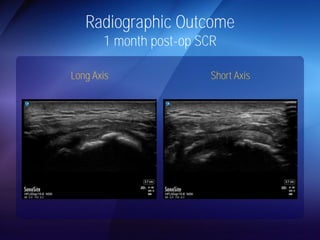
Radiographic Outcome 
1 month post-op SCR 
Long Axis Short Axis
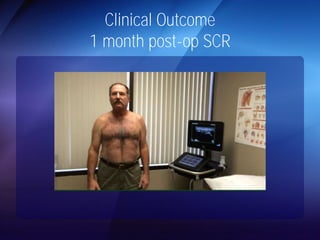
Clinical Outcome 
1 month post-op SCR
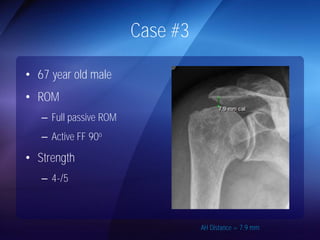
Case #3 
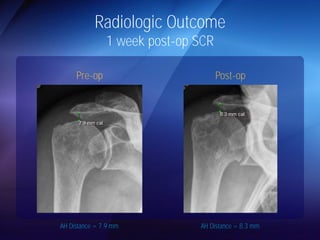
AH Distance = 7.9 mm 
• 67 year old male 
• ROM 
– Full passive ROM 
– Active FF 90o 
• Strength 
– 4-/5
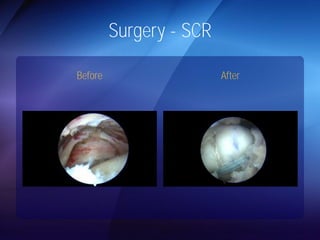
Surgery - SCR 
Before After
Radiologic Outcome 
1 week post-op SCR 
Pre-op Post-op 
AH Distance = 7.9 mm AH Distance = 8.3 mm
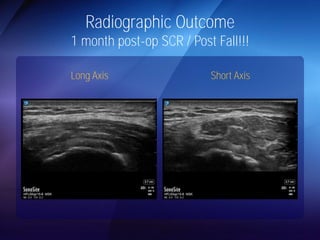
Radiographic Outcome 
1 month post-op SCR / Post Fall!!! 
Long Axis Short Axis
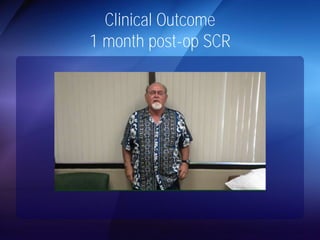
Clinical Outcome 
1 month post-op SCR
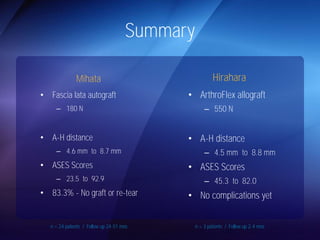
Summary 
Mihata 
• Fascia lata autograft 
– 180 N 
• A-H distance 
– 4.6 mm to 8.7 mm 
• ASES Scores 
– 23.5 to 92.9 
• 83.3% - No graft or re-tear 
Hirahara 
• ArthroFlex allograft 
– 550 N 
• A-H distance 
– 4.5 mm to 8.8 mm 
• ASES Scores 
– 45.3 to 82.0 
• No complications yet 
n = 24 patients / Follow up 24-51 mos n = 3 patients / Follow up 2-4 mos
for my patients? 
• NO Bone Loss! 
• NO Large Incisions! 
• NO Prolonged 
Rehabiliation 
• NO Burned Bridges! 
• NO Reverse Prosthesis! 
• Less pain! 
• Better Function!!
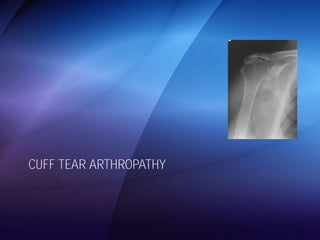
CUFF TEAR ARTHROPATHY
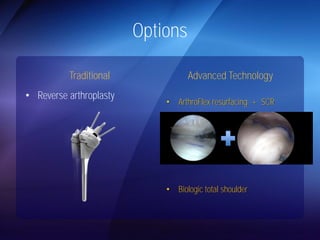
Options 
Traditional 
• Reverse arthroplasty 
Advanced Technology 
• ArthroFlex resurfacing + SCR 
• Biologic total shoulder
The Future?
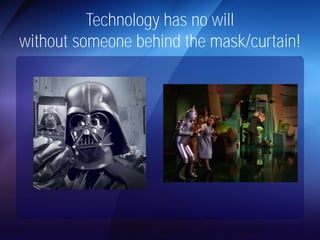
Technology has no will 
without someone behind the mask/curtain!
HiraharaMD.com

My Techniques for Shoulder Joint Preservation

  • 1.
    My Techniques forShoulder Joint Preservation Alan M. Hirahara, M.D., FRCS(C) Board Certified in Orthopaedic Surgery & Orthopaedic Sports Medicine Specializing in arthroscopic shoulder & knee surgery
  • 2.
    Historical View ofRotator Cuff Pathology Diagnosis • Tendonitis / Impingement • Rotator cuff tear Treatment • Conservative treatment • Surgical treatment – Decompression – Open rotator cuff repair
  • 3.
    Prehistoric  TheFuture • Orthopaedic Surgeons – –
  • 4.
    Spectrum of RotatorCuff Disease • Tendonitis / Low grade PASTA lesion • High grade PASTA lesion / Rotator cuff tear • Reparable massive rotator cuff tear • Irreparable rotator cuff tear • Cuff tear arthropathy
  • 5.
    TENDONITIS & LOWGRADE PARTIAL CUFF TEAR
  • 6.
    Options for Tendonitis/ Low-Grade Partial RC Tear Traditional • • Physical Therapy • Cortisone • Surgery – Decompression / Acromioplasty – Debridement Advanced Technology • Platelet-rich plasma (PRP) • Stem cells (BMAC) (?)
  • 7.
    Goals of Treatment • Decrease pain & inflammation • Create vascular channels • Promote stem cell migration • Achieve healing of tissue B A B 1.5 1 0.5 0 CONTROL ACP HA LOG HAS-2 FOLD CHANGE OVER CONTROL HA IN SYNOVIOCYTES 20 10 MMP 13-IN SYNOVIOCYTES A B A 0 -1 -2 CONTROL ACP HA LOG MMP-13 FOLD CHANGE OVER CONTROL A B B 0 CONTROL ACP HA TNF-Α (PG/ML) TNF- Α Fortier et al, AJSM, 2014
  • 8.
    Stem Cells Proliferation& Migration Significantly Increased with PRP – Kakudo et al, Plast Recontr Surg 2008 – Zaky et al, J Tissue Eng Regen Med 2008 – Drengk et al, Cells Tissues Organs 2009 – Mishra et al, Tissue Eng Part C Methods 2009 – Kruger et al, J Orthop Res 2012 – Moreira Teixeira et al, Biomaterials 2012 – Murphy et al, Biomaterials 2012 – Hildner et al, J Tissue Eng Regen Med 2013
  • 9.
    Platelet-Rich Plasma vs.Cortisone Injections for the Non-surgical Treatment of Shoulder Pain PRP > Cortisone • Inflammatory & calcific processes – Tendonopathy • Partial tears & degenerative processes – Tendon, ligament, muscle • Pain relief PRP = Cortisone • Full thickness tears – Rotator cuff, SLAP, instability • Adhesive capsulitis • Advanced DJD of shoulder • 740 patients with injection of cortisone or PRP (ACP) under ultrasound guidance • 208 Study (PRP) patients / 532 Control (cortisone) patients
  • 10.
    Type of Tendonopathy Will Determine Mode of Treatment • Inflammatory (Tendonitis) • Degenerative • Partial tear – Acute traumatic – Semi-acute non-traumatic – Chronic • Full tear • Peri-tendon / One • Intra-tendon / One+ – Intra-tendon / One – Intra-tendon / One+ – Intra-tendon / 2 or 3 • Peri-tendon / One
  • 11.
    Other Considerations •h/o Cortisone • In season • Out of season • Multiple injections • Peri-tendon / Pain control • Attempt to heal
  • 12.
    Injecting to Heal • Degenerative tendons – Lat / Med epicondylitis – Patellar / Quad tendonitis – Achilles tendonitis • Partial tears of ligaments – UCL – MCL – NOT Intra-articular ligaments or tendons • Calcific tendons – Rotator cuff – Patellar – Achilles
  • 13.
    HIGH GRADE PARTIALCUFF TEAR & REPAIRABLE FULL-THICKNESS RC TEAR
  • 14.
    Options for HighGrade PASTA Lesion Traditional • Debridement • Decompression / Acromioplasty • Repair – – Trans-osseous repair – Trans-tendon repair Advanced Technology • PASTA Bridge • Platelet-rich plasma (PRP) • Stem cells (BMAC) • FlexiGraft DBM sponge
  • 15.
    Options for RepairableCuff Tear Traditional • Repair – Trans-osseous – Suture anchors – SutureBridge Advanced Technology • SpeedFix • SpeedBridge • Platelet-rich plasma (PRP) • Stem cells (BMAC) • FlexiGraft DBM sponge
  • 16.
    PASTA Bridge Technique • Percutaneous • Safer • Improved Construct
  • 17.
  • 18.
    SpeedBridge • FiberTape – Tissue pull through • Vented Swivelocks – BioComposite material – Full thread anchors – Cannulation • Improved Accessories – FastPass Scorpion – PassPorts – Synergy • Improved Construct – Knotless Technology
  • 19.
    FlexiGraft DBM Sponge • Partially demineralized cancellous sponges – Ground – Cubes – Strips • Demineralized cortical fibers
  • 20.
    FlexiGraft DBM Sponge • DBM produced significantly more fibrocartilage & mineralized fibrocartilage at 12- week post-op, showing a more mature, organized tendon-bone interface Sundar et al., J Biomed Mater Res. 2009; 88B: 115- 122 Sundar et al., J Bone Joint Surg Br. 2009;91;(9)1257- 62
  • 21.
    FlexiGRAFT with RCRepair James Cook, DVM, PhD • Chronic infraspinatus model – n = 10 dogs – Bilateral shoulders, release tendon – Repair after 4 wks • FlexiGRAFT / PRP vs. Direct Repair – Modified SpeedFix configuration • SutureTak medially • 12 week sacrifice, outcome measures – MRI, Histo, and Biomechanical testing
  • 22.
    FlexiGRAFT Strip withRC Repair Standard FlexiGRAFT T = Tendon; I = Interface; A = Anchor Standard has more fibrous tissue at interface and is more edematous
  • 23.
    FlexiGRAFT Strip withRC Repair Standard FlexiGRAFT
  • 24.
    FlexiGRAFT Strip withRC Repair (Lower = Better, both are significant)
  • 25.
  • 26.
    FlexiGraft PASTA Bridge 2nd Look 5 mos post-op
  • 27.
    Case • PASTABridgewith FlexiGraft 9/2012 • 2nd Look 2/2013
  • 28.
    Results - PASTABridge Pain Scores ASES Scores 100.0 90.0 80.0 70.0 60.0 50.0 40.0 30.0 20.0 10.0 0.0 Pre-op 1  Control Group: n = 35  Study Group: n = 12 Month 2 Month 3 Month 4 Month 5 Month 6 Month 7.0 6.0 5.0 4.0 3.0 2.0 1.0 0.0 Pre-op 1 Month 2 Month 3 Month 4 Month 5 Month 6 Month
  • 29.
  • 30.
  • 31.
    Results - SutureBridge Pain Scores 7.0 6.0 5.0 4.0 3.0 2.0 1.0 0.0 Pre-op 1 Month 2 Month 3 Month 4 Month 5 Month 6 Month ASES Scores 100.0 90.0 80.0 70.0 60.0 50.0 40.0 30.0 20.0 10.0 0.0 Pre-op 1 Month 2 Month 3 Month 4 Month 5 Month 6 Month  Control Group: n = 45  Study Group: n = 7
  • 32.
  • 33.
    Options for RepairableMassive Tear Traditional • Repair – Trans-osseous – Suture anchors – SutureBridge Advanced Technology • SpeedBridge • Rip Stop • Platelet-rich plasma (PRP) • Stem cells (BMAC) • FlexiGraft DBM sponge • Patch augmentation
  • 34.
    ECM Patches •Justification – Failure rates: 20 57% reported for RC repairs – In vivo animal studies: Support use of acellular dermal grafts for augmentation – Biomechanical studies: Dermal grafts superior suture retention over SIS or BM patches • But – acellular significant DNA • GraftJacket, Restore, TissueMend Adams et al, Arthroscopy 2006. Aurura et al, J Shoulder Elbow Surg 2007. Coons et al, Sports Med Arthrosc Rev 2006.
  • 35.
    RC Repair Augmentation • Peer reviewed clinical studies do not support SIS grafts • Iannotti et al, (JBJS 2006) - Randomized prospective controlled trial using (Restore) augmentation for massive tears showing no benefit using SIS. Discontinued study early! • Walton et al. (JBJS 2007) - 19 pts. 4 of which had severe early inflammatory rxn. 2 yr. MRI shows no difference in failure rate vs non-augmented, abandoned study early! Porcine graft (Level 3) • Schlamberg et al. (J Shoulder Elbow Surg 2004) All patients re-tore • Zheng et al. (J Biomed Mater Res B Appl Biomater 2005) Adverse outcomes related to retained cellular elements • Dermis grafts show potential • Burkhead et al. (Semin Arthroplasty 2007) 17 pts, GJA augmentation, 1.2 yrs F/U, improved UCLA scores but 3 retears per MRI & no reversal of atrophy or fatty infiltration. No Control group Iannotti et al, JBJS 2006 Walton et al, JBJS 2007 Schlamberg et al, JSES 2004 Zheng et al, J Biomed Mater Res B Appl Biomater 2005 Burkhead et al, Semin Arthroplasty 2007
  • 36.
    ArthroFlex • Readyto use • Hydrated • Room temperature storage • Sterile (10-6 SAL) • 3 year shelf life • Biocompatible – > 97% DNA removal • Excellent suture retention strength • Intact framework
  • 37.
    Strength Comparison: ArthroFlexvs. Other ECM Patches Barber et al, Arthroscopy 2009
  • 38.
    DNA Residuals 273 135 16 300 250 200 150 100 50 0 Alloderm GraftJacket ArthroFlex The DNA content for the three materials averaged: Alloderm1 272.8±168.8 ng/mg; GraftJacket2 134.6 ± 44.0 ng/mg dry weight; ArthroFlex 15.97±4.8 ng/mg dry weight.3 Choe et al. J Urol. 2001. Derwin et al. JBJS-A. 2006. Data on file, LifeNet Health.
  • 39.
    In vivo Study Devitalized Human Dermis • Preserved with 15% glycerol and gamma irradiated at delivered dose 12.8 - 17.8 kGy • Implanted subcutaneously in athymic mice – In-life period was 4 weeks • H&E Staining Post Implantation Arrows pointing to new blood vessels with red blood cells in them Lifenet. Data on file. Capito et al, Ann Plast Surg. 2012.
  • 40.
    Placement • Dermalside – Shiny, smooth, absorbs blood – Applied in the down position against the wound or most vascularized tissue • Basement membrane – Dull and rough in appearance – Repels blood – Place in up position – Packaged in view
  • 41.
    RCR with GraftAugmentation
  • 42.
  • 43.
  • 44.
  • 45.
    Options for IrreparableRC Tears Traditional • Debridement • Partial repair • Biceps tenotomy • Latissimus dorsi transfer • • Reverse arthroplasty Advanced Technology • Superior Capsular Reconstruction
  • 46.
    Disadvantages to ReverseTotal Shoulder • Subject to overuse • Too easily seen as a solution for all previously untreatable shoulder pathologies • Challenging surgical technique • Requires extensive training and experience limits availability • Arthroplasty • Limited life span • Wide range of complication rates
  • 47.
    Intercalary Placement •Biomechanical studies showing equivalent load-to-failure and mechanical properties, but few articles show success clinically Snyder et al, IJSS 2007 Schlamberg et al, JSES 2004
  • 48.
    Bridging vs. SCR Conventional Patch Graft Superior Capsular Reconstruction Courtesy of Dr. Teruhisa Mihata
  • 49.
    Biomechanical Effects ofSCR Teruhisa Mihata, MD Initial Superior Force Mihata et al, AJSM 2012
  • 50.
    Arthroscopic Superior CapsuleReconstruction Teruhisa Mihata, MD • Methods: • 24 shoulders over 2 years • Autograft fascia lata used to reconstruct superior capsule • Results: • A-H distance: 4.6 2.2 mm to 8.7 2.6 mm (p < 0.0001) • ASES Score: 23.5 to 92.9 points (p < 0.0001) • Twenty patients (83.3%) had no graft tear or tendon re-tear Mihata et al, Arthroscopy 2013
  • 51.
    Harvest of FasciaLata Teruhisa Mihata, MD
  • 52.
    Superior Capsular Reconstruction Alan M Hirahara, MD, FRCSC Medial: Glenoid PASTA Bridge Lateral: SpeedBridge
  • 53.
    ArthroFlex Sizes Available • AFLEX100 3.5 cm x 3.5 cm x 1.5 mm $2,225 • AFLEX101 4.0 cm x 7.0 cm x 1.5 mm $2,650 • AFLEX103 5.0 cm x 9.0 cm x 1.5 mm $3,600 • AFLEX150 1.5 cm x 14.0 cm x 1.5 mm $2,000 • AFLEX200 3.5 cm x 3.5 cm x 2.0 mm $2,975 • AFLEX201 4.0 cm x 7.0 cm x 2.0 mm $3,600 • AFLEX301 4.0 cm x 7.0 cm x 3.5 mm $3,850 • AFLEX400 4.0 cm x 4.0 cm x 1.0 mm $2,050 • AFLEX401 4.0 cm x 7.0 cm x 1.0 mm $2,500 • AFLEX500 3.0 cm x 4.0 cm x .5 mm $1,150
  • 54.
    Biomechanical Comparison FasciaLata, Doubled ArthroFlex, 3.5 mm Failure = 180 N Failure = 550 N
  • 55.
  • 56.
  • 57.
    Case #1 •59 year old female • h/o R shoulder RCR x 3 • ROM – Full passive ROM – Active FF 90o • Strength – 3-/5 AH Distance = 2 mm
  • 58.
  • 59.
    Radiographic Outcome 2months post-op SCR Pre-op Post-op AH Distance = 2.0 mm AH Distance = 8.4 mm
  • 60.
    Radiographic Outcome 2months post-op SCR Long Axis Short Axis
  • 61.
    Radiologic Outcome 4months post-op SCR Normal Pre-op Post-op
  • 62.
    Clinical Outcome 3months post-op SCR Pre-op Post-op • VAS Scores: 5  1 • ASES Scores: 58  82 • Forward flex: 90  160
  • 63.
    Case #2 •61 year old male • h/o L shoulder RCR 6/13 • ROM – Full passive ROM – Active FF 10o • Strength – 3-/5 AH Distance = 3.5 mm
  • 64.
    Surgery - SCR Before After
  • 65.
    Radiologic Outcome 1month post-op SCR Pre-op Post-op AH Distance = 3.5 mm AH Distance = 9.6 mm
  • 66.
    Radiographic Outcome 1month post-op SCR Long Axis Short Axis
  • 67.
    Clinical Outcome 1month post-op SCR
  • 68.
    Case #3 AHDistance = 7.9 mm • 67 year old male • ROM – Full passive ROM – Active FF 90o • Strength – 4-/5
  • 69.
    Surgery - SCR Before After
  • 70.
    Radiologic Outcome 1week post-op SCR Pre-op Post-op AH Distance = 7.9 mm AH Distance = 8.3 mm
  • 71.
    Radiographic Outcome 1month post-op SCR / Post Fall!!! Long Axis Short Axis
  • 72.
    Clinical Outcome 1month post-op SCR
  • 73.
    Summary Mihata •Fascia lata autograft – 180 N • A-H distance – 4.6 mm to 8.7 mm • ASES Scores – 23.5 to 92.9 • 83.3% - No graft or re-tear Hirahara • ArthroFlex allograft – 550 N • A-H distance – 4.5 mm to 8.8 mm • ASES Scores – 45.3 to 82.0 • No complications yet n = 24 patients / Follow up 24-51 mos n = 3 patients / Follow up 2-4 mos
  • 74.
    for my patients? • NO Bone Loss! • NO Large Incisions! • NO Prolonged Rehabiliation • NO Burned Bridges! • NO Reverse Prosthesis! • Less pain! • Better Function!!
  • 75.
  • 76.
    Options Traditional •Reverse arthroplasty Advanced Technology • ArthroFlex resurfacing + SCR • Biologic total shoulder
  • 77.
  • 78.
    Technology has nowill without someone behind the mask/curtain!
  • 79.