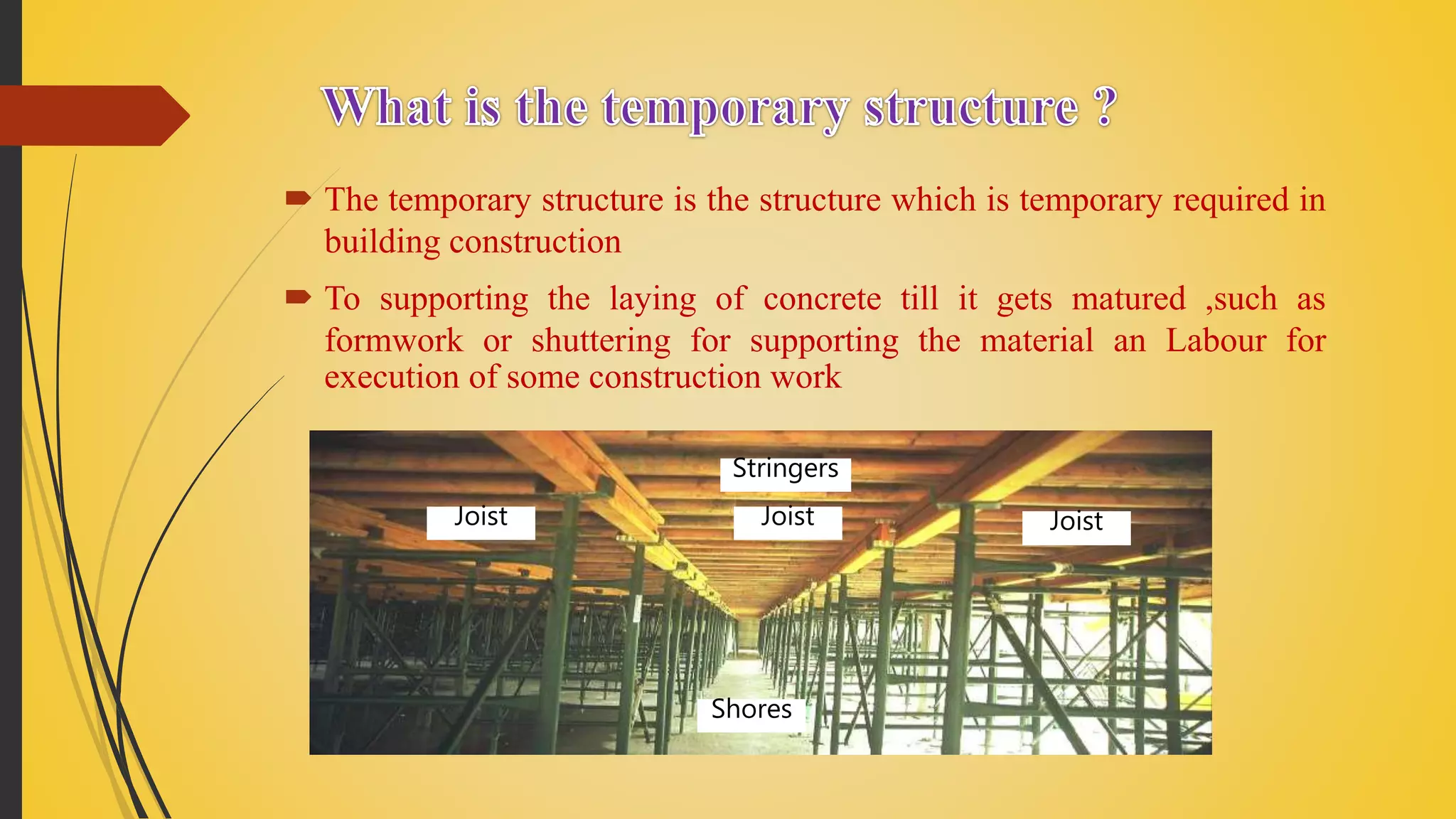
 The temporary structure is the structure which is temporary required in
building construction
 To supporting the laying of concrete till it gets matured ,such as
formwork or shuttering for supporting the material an Labour for
execution of some construction work
Stringers
JoistJoist Joist
Shores
 1. Easy removal
 2. Economy
 3. Strength
 4. Rigidity
 5. Less leakage
 6. Smooth surface
 7. Light weight
 8. Quality
 9. Supports
 1. Timber formwork
 2. Steel formwork
 3. Aluminum sheet formwork
 4. Fiberglass sheet formwork
 5. Plywood formwork
 It should be well seasoned.
 It should be light in weight.
 It should be easily workable with nails without splitting.
 It should be free from knots.
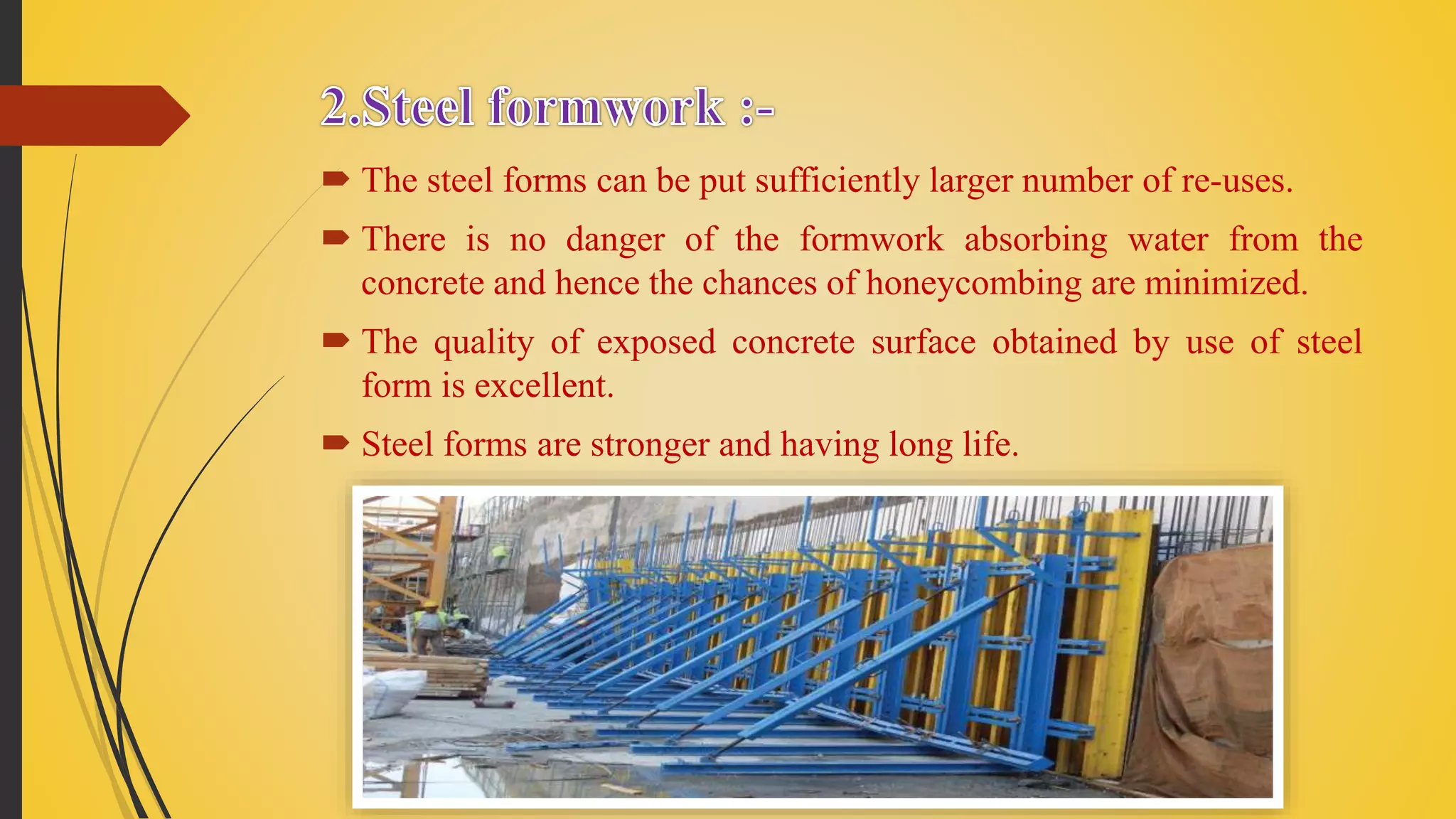
 The steel forms can be put sufficiently larger number of re-uses.
 There is no danger of the formwork absorbing water from the
concrete and hence the chances of honeycombing are minimized.
 The quality of exposed concrete surface obtained by use of steel
form is excellent.
 Steel forms are stronger and having long life.
 It is possible to have perfectly plain and smooth surface by
use of plywood shuttering.
 By use of large size panels it is possible to effect saving in the
labour cost of fixing and dismantling.
 Number of re-uses are more as compared with timber
shuttering.
The formwork for R.C.C. wall consists of sheets, studs , braces,
wedges, M.S. tie bars , sole plate, stakes etc.
 The sheets are supported by vertical studs and horizontal Wales.
 The ties are provided to maintain the distance between the sheets
and to resist the bursting action of concrete.
 The small pieces of timber knows as spacers may be used and they
are to be removed as the concrete reaches that level.
 In addition the wire ties and bolts may be also provide.
 If bolts are used, they are to be provided with grease so as to make
their removal easy after 2 to 3 days of pouring concrete.
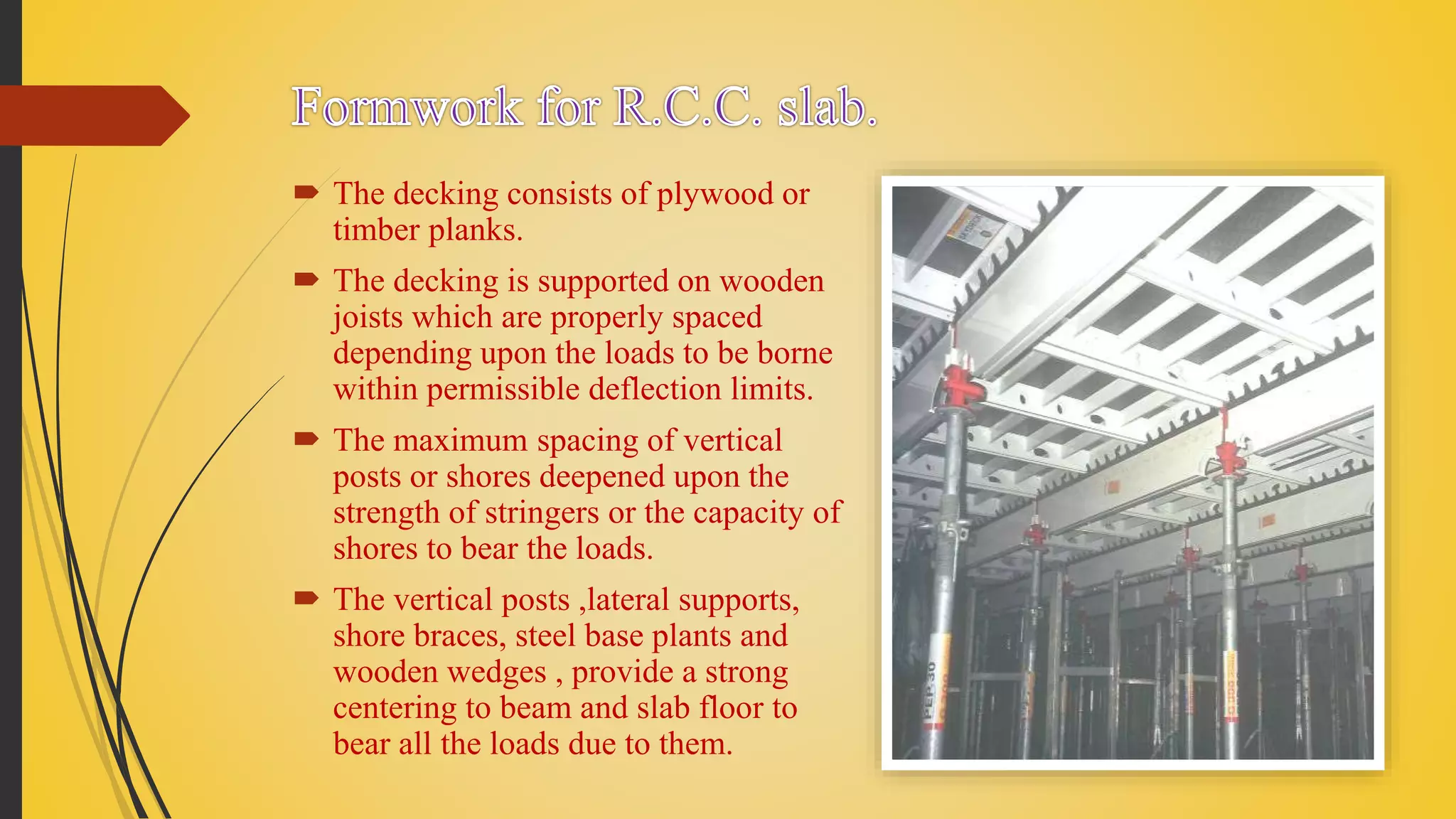
 The decking consists of plywood or
timber planks.
 The decking is supported on wooden
joists which are properly spaced
depending upon the loads to be borne
within permissible deflection limits.
 The maximum spacing of vertical
posts or shores deepened upon the
strength of stringers or the capacity of
shores to bear the loads.
 The vertical posts ,lateral supports,
shore braces, steel base plants and
wooden wedges , provide a strong
centering to beam and slab floor to
bear all the loads due to them.
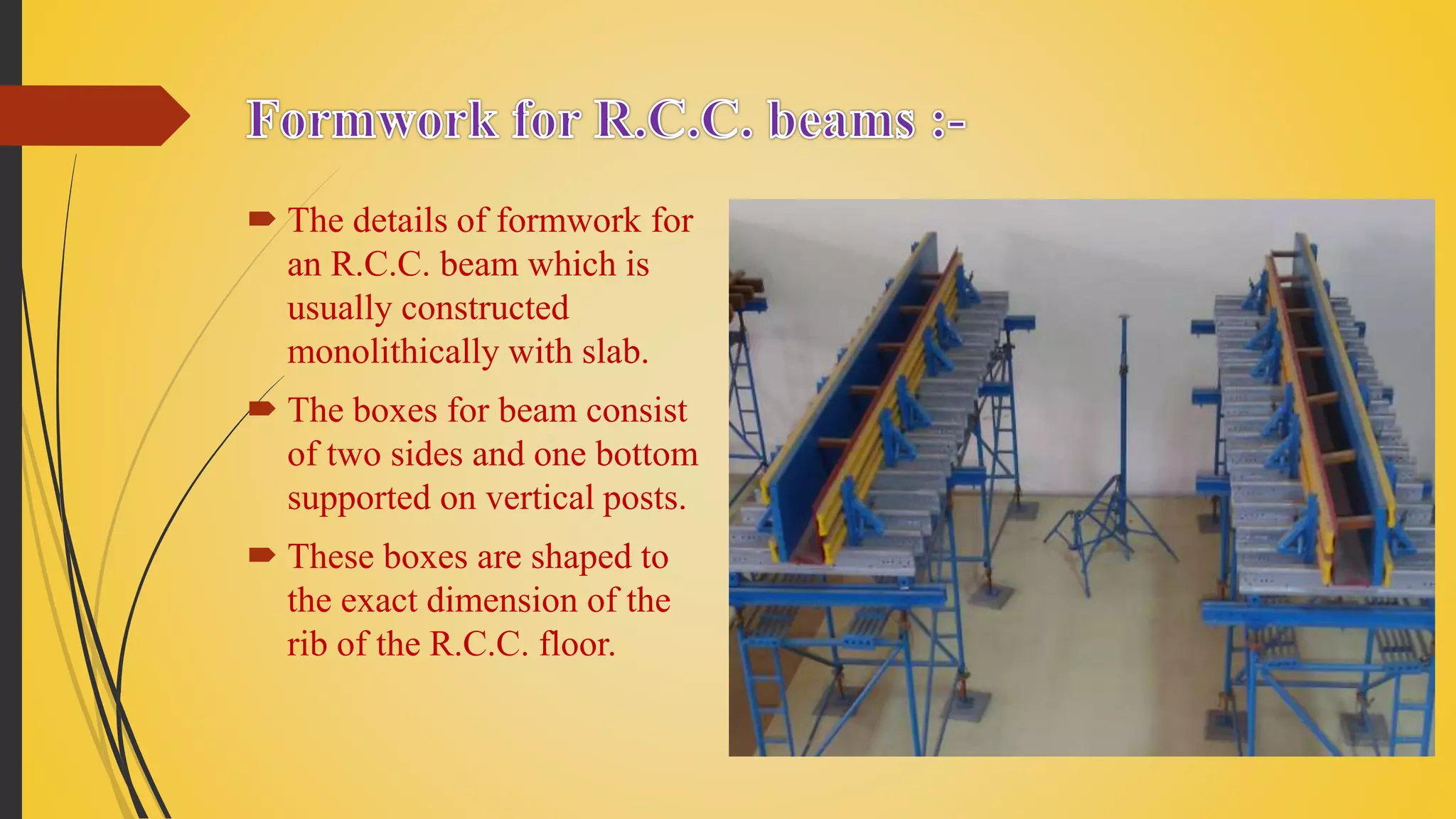
 The details of formwork for
an R.C.C. beam which is
usually constructed
monolithically with slab.
 The boxes for beam consist
of two sides and one bottom
supported on vertical posts.
 These boxes are shaped to
the exact dimension of the
rib of the R.C.C. floor.
 Column box consists of two ends and two sides ,
each built as panel of planks sheeting. At top, cuts
are made if column is to receive girder or beam.
 The height of each panel is equal to the storey
height minus the slab thickness and the floor
sheeting.
 The width between two opposite panels is kept
equal to the actual dimension of the column plus
twice the thickness of sheeting.
 Yokes are equally spaced on both the sides and
ends. They project at both the ends by about 25
cm.
 Formwork components for any column are
require to be designed properly to resist high
pressure resulting from the quick filling of the
concrete.
 Slip form technique is a special technique of placing concrete.
 This technique is useful for vertical construction as well as horizontal
construction.
 In case of vertical construction like chimneys and silos, using slip formwork,
concrete is continuously placed, compacted and formwork is pulled up by
hydraulic jacks , giving reaction against main reinforcements. the rate of concrete
to withstand without the support of formwork. This technique is suitable for
uniform shaped structures.
 This technique was adopted for the core construction of Bombay stock exchange
building having irregular shape and may opening. This core of 380 feet tall
structure was completed in 38 days with formwork slipping rate of about 12.5 cm
per hour.
 The slip form paving method was first time adopted delhi-mathura concrete road
construction in1990.
 In the Mumbai- Pune six lane express highway construction and Ahmedabad-
baroda express highway construction slip form pavers were used.
Temporary Works (Form Work)

Temporary Works (Form Work)

  • 2.
     The temporarystructure is the structure which is temporary required in building construction  To supporting the laying of concrete till it gets matured ,such as formwork or shuttering for supporting the material an Labour for execution of some construction work Stringers JoistJoist Joist Shores
  • 3.
     1. Easyremoval  2. Economy  3. Strength  4. Rigidity  5. Less leakage  6. Smooth surface  7. Light weight  8. Quality  9. Supports
  • 4.
     1. Timberformwork  2. Steel formwork  3. Aluminum sheet formwork  4. Fiberglass sheet formwork  5. Plywood formwork
  • 5.
     It shouldbe well seasoned.  It should be light in weight.  It should be easily workable with nails without splitting.  It should be free from knots.
  • 6.
     The steelforms can be put sufficiently larger number of re-uses.  There is no danger of the formwork absorbing water from the concrete and hence the chances of honeycombing are minimized.  The quality of exposed concrete surface obtained by use of steel form is excellent.  Steel forms are stronger and having long life.
  • 7.
     It ispossible to have perfectly plain and smooth surface by use of plywood shuttering.  By use of large size panels it is possible to effect saving in the labour cost of fixing and dismantling.  Number of re-uses are more as compared with timber shuttering.
  • 8.
    The formwork forR.C.C. wall consists of sheets, studs , braces, wedges, M.S. tie bars , sole plate, stakes etc.
  • 9.
     The sheetsare supported by vertical studs and horizontal Wales.  The ties are provided to maintain the distance between the sheets and to resist the bursting action of concrete.  The small pieces of timber knows as spacers may be used and they are to be removed as the concrete reaches that level.  In addition the wire ties and bolts may be also provide.  If bolts are used, they are to be provided with grease so as to make their removal easy after 2 to 3 days of pouring concrete.
  • 10.
     The deckingconsists of plywood or timber planks.  The decking is supported on wooden joists which are properly spaced depending upon the loads to be borne within permissible deflection limits.  The maximum spacing of vertical posts or shores deepened upon the strength of stringers or the capacity of shores to bear the loads.  The vertical posts ,lateral supports, shore braces, steel base plants and wooden wedges , provide a strong centering to beam and slab floor to bear all the loads due to them.
  • 11.
     The detailsof formwork for an R.C.C. beam which is usually constructed monolithically with slab.  The boxes for beam consist of two sides and one bottom supported on vertical posts.  These boxes are shaped to the exact dimension of the rib of the R.C.C. floor.
  • 12.
     Column boxconsists of two ends and two sides , each built as panel of planks sheeting. At top, cuts are made if column is to receive girder or beam.  The height of each panel is equal to the storey height minus the slab thickness and the floor sheeting.  The width between two opposite panels is kept equal to the actual dimension of the column plus twice the thickness of sheeting.  Yokes are equally spaced on both the sides and ends. They project at both the ends by about 25 cm.  Formwork components for any column are require to be designed properly to resist high pressure resulting from the quick filling of the concrete.
  • 14.
     Slip formtechnique is a special technique of placing concrete.  This technique is useful for vertical construction as well as horizontal construction.  In case of vertical construction like chimneys and silos, using slip formwork, concrete is continuously placed, compacted and formwork is pulled up by hydraulic jacks , giving reaction against main reinforcements. the rate of concrete to withstand without the support of formwork. This technique is suitable for uniform shaped structures.  This technique was adopted for the core construction of Bombay stock exchange building having irregular shape and may opening. This core of 380 feet tall structure was completed in 38 days with formwork slipping rate of about 12.5 cm per hour.  The slip form paving method was first time adopted delhi-mathura concrete road construction in1990.  In the Mumbai- Pune six lane express highway construction and Ahmedabad- baroda express highway construction slip form pavers were used.