BY: CHAKAMBA JOHN
 Is a temporary support to pre-cast or in-situ concrete
structures.
 Is the surface, support and framing used to define the shape
of concrete until it is self-supporting.
 It holds the concrete until it has set and can stand on its own
and it maintains the required shape.
 Includes :
 Form on or within which the concrete is poured.
 The supports which carry the forms and the concrete.
 The bracing which may be added to ensure stability as well as
foundations and footings.
 It is used for Concrete :
- Lintels.
- Window sills.
- Columns and beams.
- Decking, floors and roofs.
- Retaining walls, stairs, drains.
- Reinforced concrete walls.
 Any temporary structure that is used to support a permanent
structure, material, plant, equipment and personnel until the
construction of permanent structure has advanced to the
stage that it is self-supporting.
 Includes:
 Foundations, footings and all structural members supporting
the permanent structural elements.
 Commonly used to support spanning or arched structures,
such as bridges, while they are being constructed.
 All formwork must be:
 Sufficiently strong and rigid to support the dead load of the
concrete.
 Designed to allow for the temporary live load of workmen,
wheelbarrows and tamping operations.
 Easy to strip after concreting.
 Constructed within reasonable cost limits.
 It should :
 Support both live and dead loads that is, weight of wet
concrete and its reinforcement, weight of workers and their
equipment as well as force of wind and rain.
 Be rigid, water tight, braced and tied together so as to
maintain position and shape during all construction activities.
 Be constructed in such a way that it can be removed easily and
safely, without damaging formed concrete.
 If to be re-used, retain formwork strength during design so as
to minimise deterioration of materials through use and
handling.
 Withstand the force of internal or external vibration during the
consolidation of concrete.
 Have smooth surfaces and avoid warped timbers which may
make the surfaces of concrete uneven.
 Be Constructed and dismantled after use so that it is capable
of being re-used and this is ensured by coating internal
surfaces with non-staining oil, white wash or soft soap to
permit easy striking off.
 Designers should consider the work practises necessary to
carryout erection and dismantling of the formwork as well as
identifying health and safety risks and controls at the design
stage.
 Possibility of using designs that do not require in-situ formwork,
such as tilt-up or pre-cast concrete elements that may be
constructed elsewhere and lifted into position.
 Method and sequence of erecting and dismantling the formwork
or false work and its supports as well as related risks especially
manual handling.
 Provision of safe access to and egress from the work areas on
and around the formwork.
 Minimizing the working heights for persons erecting and
dismantling.
 Guardrail systems including toe-boards, perimeter safety
screens, scaffolding or other means should be installed when
working at heights.
 Fall arrest systems including safety lines can be installed if
required.
 Formwork drawings should include details of formwork,
formwork joints, sealing procedures, ties, size and spacing of
framing and details of any proprietary fittings or systems
proposed to be used.
 Details of the construction and erection sequence should be
included on the drawings,
 Choice is influenced by economy and necessity or both.
 Materials commonly used are timber, plywood and steel.
 Are used either separately or jointly.
 Steel formwork
 Merits
 It is durable and can be used as many times as necessary.
 It gives a smooth and better surface finish of concrete.
 It is not liable to warp.
 It is more economical than timber where repetitive work is
necessary.
 Speed of erection with fewer workmen required to
assemble it onsite.
 Demerits
 The initial outlay of money is great.
 It is easily dented.
 It is easily affected by rust under humid conditions.
 Timber formwork
Merits
 It is adaptable.
 It is relatively cheap.
 It is more economical than steel where work is non-
repetitive.
 It can be found locally.
 It is susceptible to insect and fungal attack.
 It warps, especially when it is not well seasoned.
 It is not good for repetitive work.
 Timber
 Timber for formwork should be neither too dry nor too wet.
 If too dry the timber will absorb water from the concrete
and swell resulting in distortion or decay.
 If too wet shrinkage may result especially during hot
weather which might result to warpage or cracking.
 The normal moisture content of timber used for formwork
should be 20 %.
 It is used where a large area of exposed concrete is to be
constructed, for instance walls.
 Merit
 The elimination of joint marks.
 If carefully fixed on site, the finished concrete does not
require further treatment
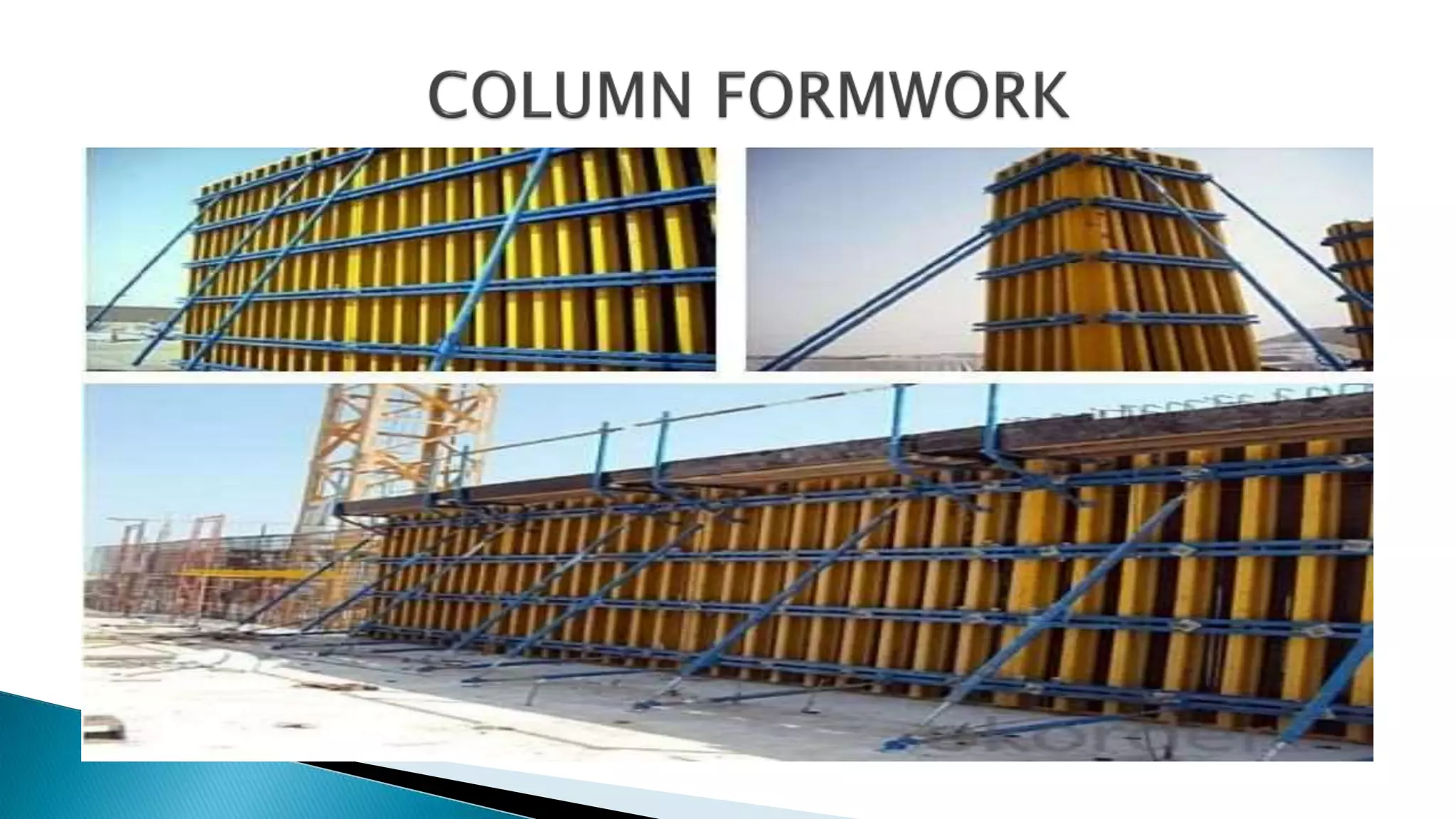
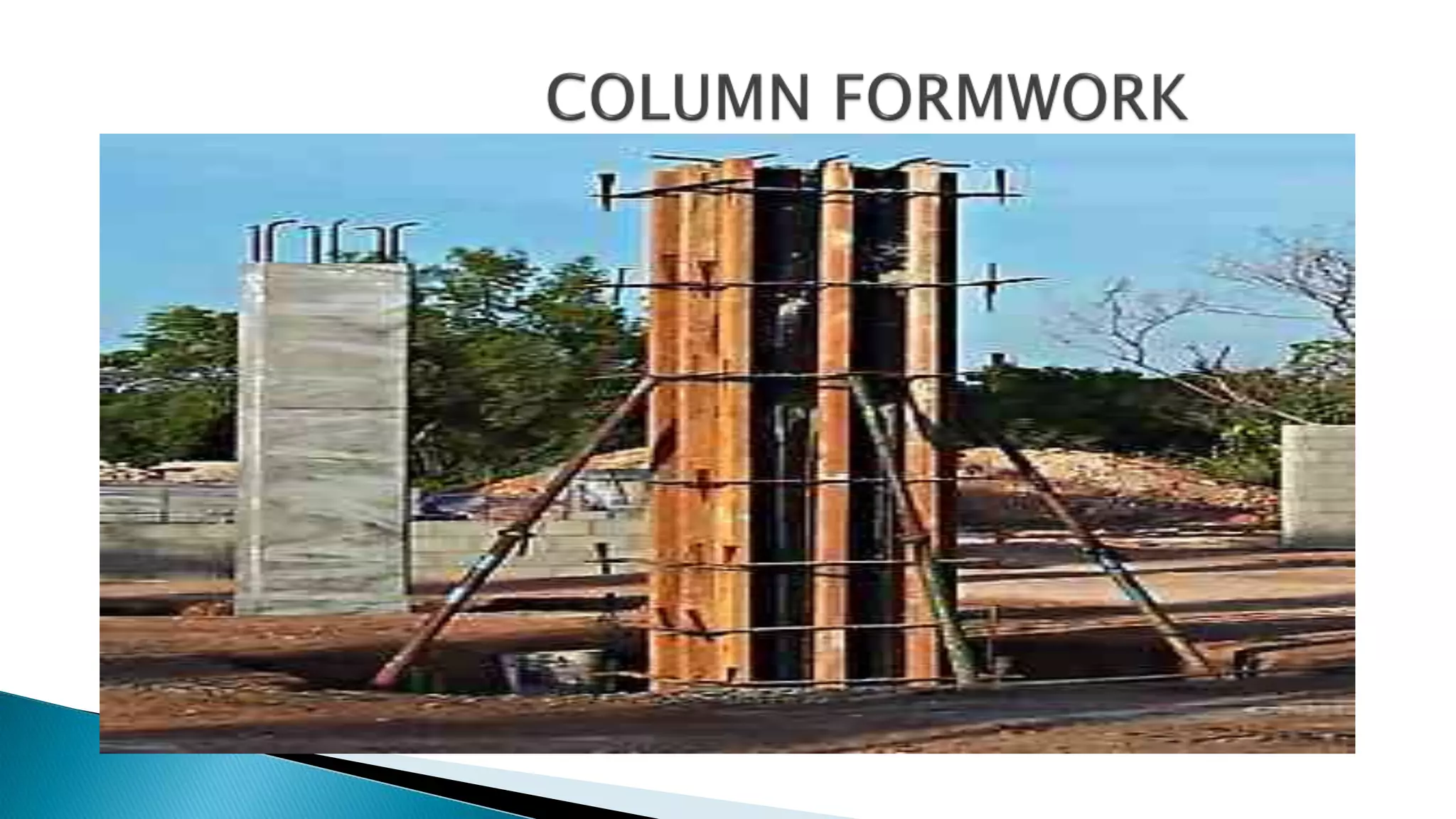
 It is also known as a column box.
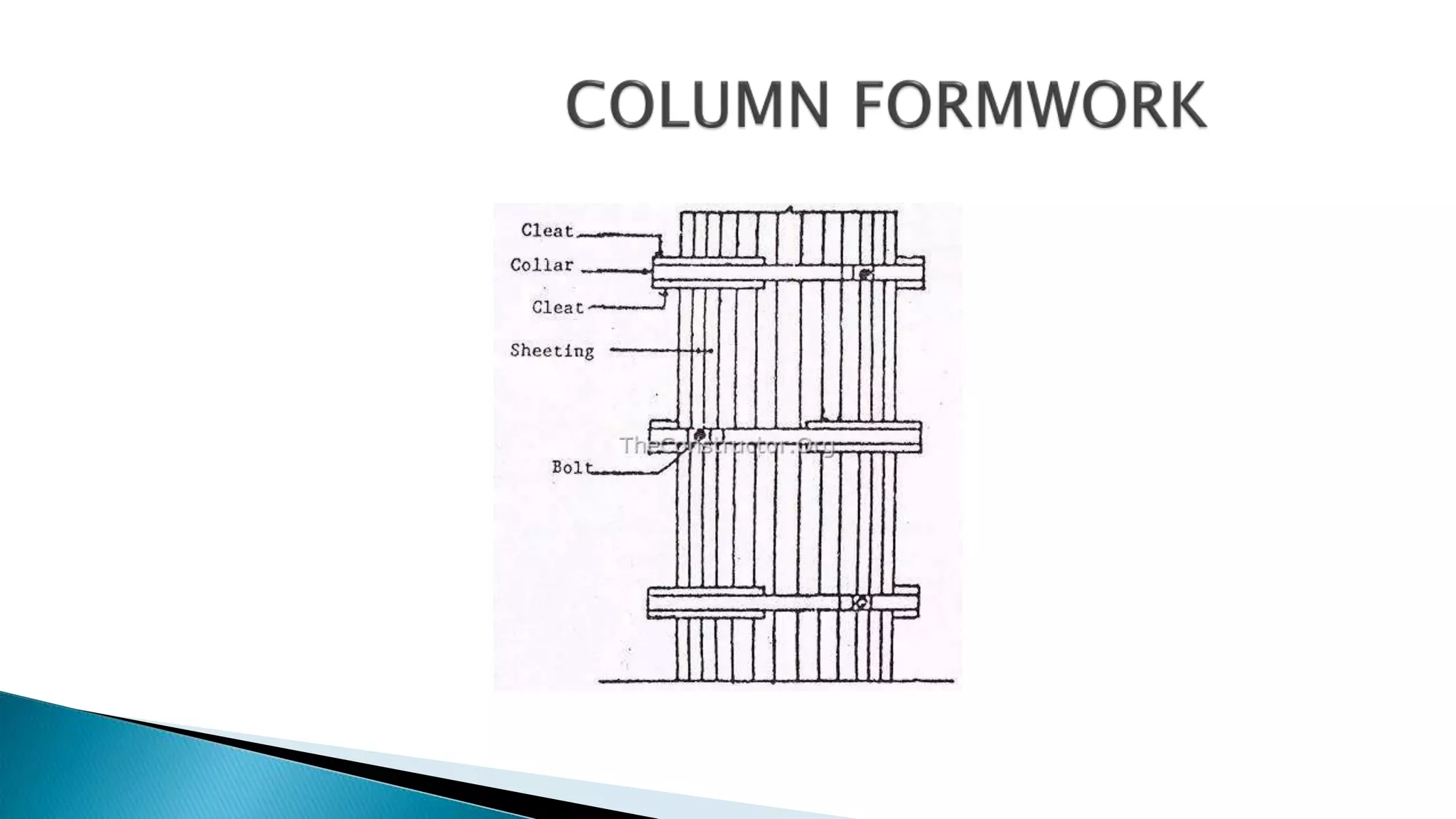
 Consists of vertical boards which have battens nailed across
them.
 The battens are called cleats usually 32mm; and the boarding
is called sheeting usually 25mm thick.
 Cleats used at the bottom are usually larger so as to
withstand the pressure which is exerted by the weight of the
concrete.
 The sides of the box are secured firmly together by means of
yokes of about 50 by 75mm which may be replaced by use of
sash clamps.
 The column box should be located against a 75mm high
plinth or kicker which has been cast monolithic with base or
floor.
 The reinforcement rods and stirrups must be set and well
plumbed up before erecting the column.
 The box is held in position by means of braces fastened to
sole pieces on the floor.
 If the corners of the columns are to be shaped, triangular
fillets or mouldings of the desired shapes are nailed to the
corners of the formwork.
 Concrete is poured as soon as the form base has been
cleaned.
 Vertical mould- resist considerable horizontal pressures in
the early stages of casting.
 Kicker – accurately positions the formwork onto the base or
floor. Also prevents the loss of grout
from the bottom edge of the form.
 Soldiers – vertical studs used to strengthen panels forming
the column sides.
 Cleats – horizontal battens used to strengthen panels
forming the column sides or mould.
 Margin piece – piece of plank fixed around the opening of a
cut out to provide sufficient bearing for the beam boxes.
 Yokes – pieces of timber used to firmly secure the sides of
the box together.
 Yokes – collars of timber or metal used to hold together
column forms timber yokes are purpose made whereas
steel column clamps are adjustable within limits of the
blades.
 Spacing of yokes and clamps should vary with the
anticipated pressures, the greatest occurring at the base of
the column box.
 Variance of actual pressure :
a. Rate of placing
b. Type of mix being used- generally the richer the mix the
greater the pressure.
c. Method of placing- if vibrators are used pressures can
increase up to 50 % over hand placing and compacting.
d. Air temperature – the lower the temperature the slower is
hydration process and consequently higher pressures are
encountered.
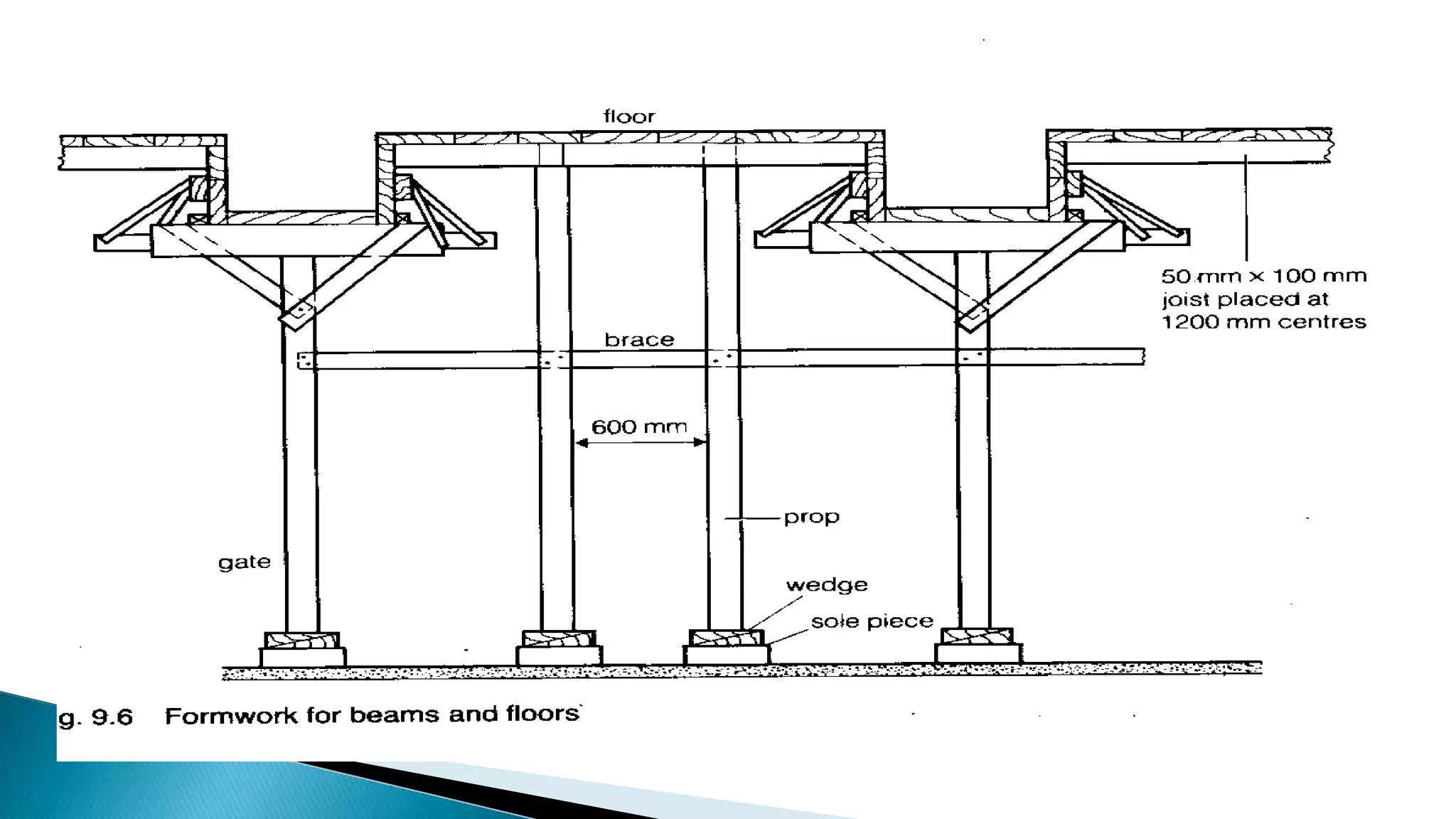
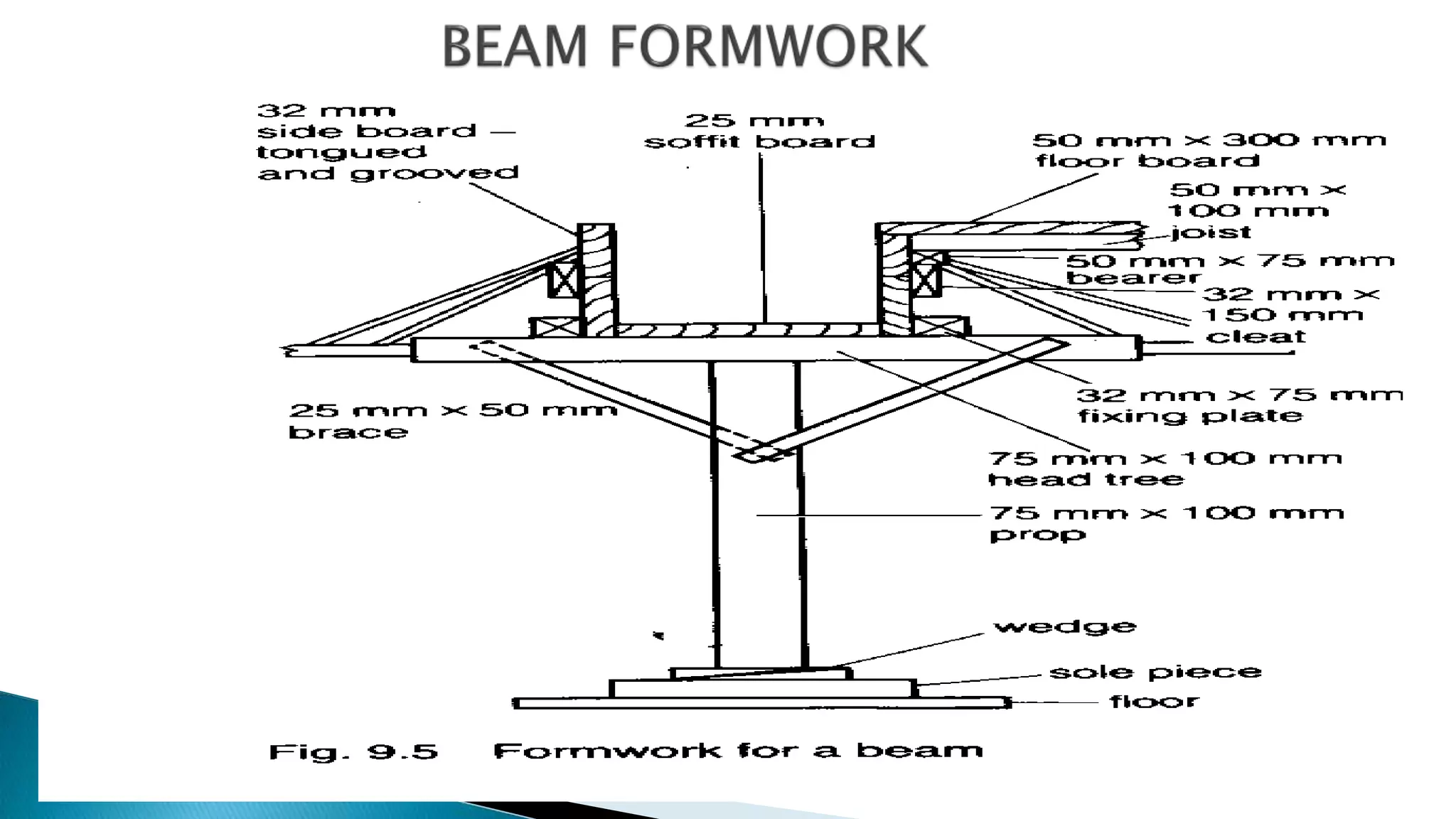
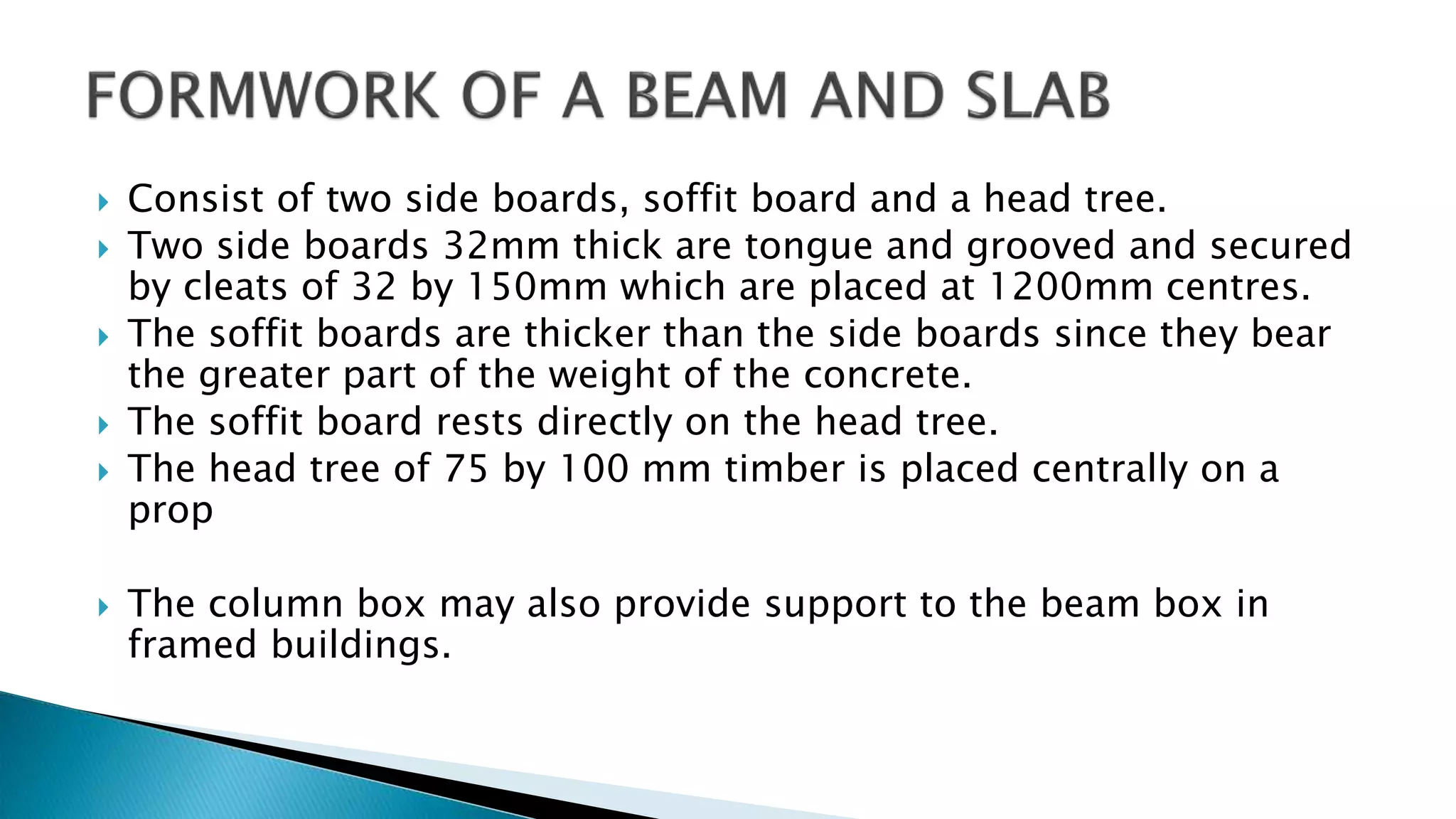
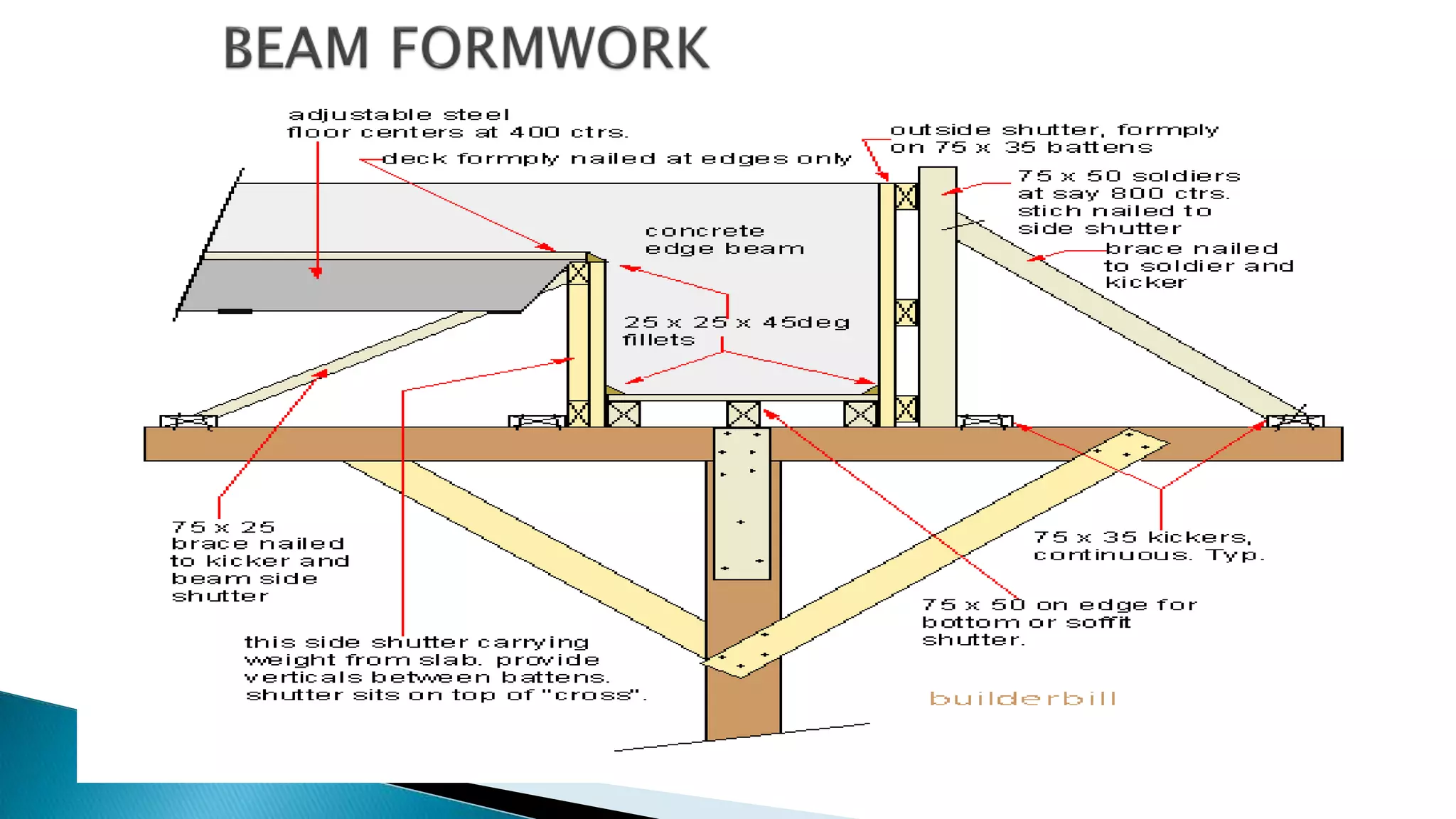
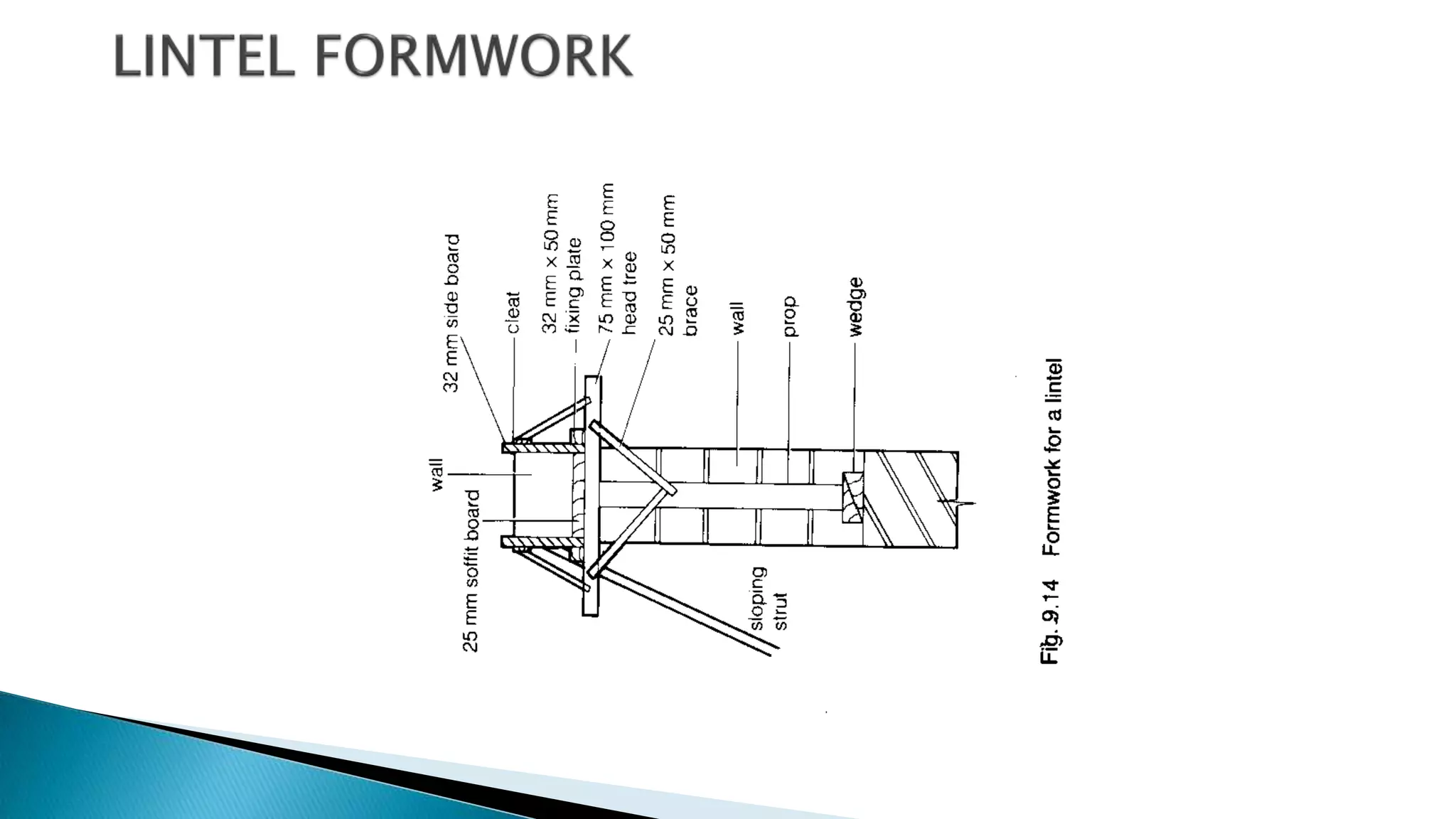
 Consist of two side boards, soffit board and a head tree.
 Two side boards 32mm thick are tongue and grooved and secured
by cleats of 32 by 150mm which are placed at 1200mm centres.
 The soffit boards are thicker than the side boards since they bear
the greater part of the weight of the concrete.
 The soffit board rests directly on the head tree.
 The head tree of 75 by 100 mm timber is placed centrally on a
prop
 The column box may also provide support to the beam box in
framed buildings.
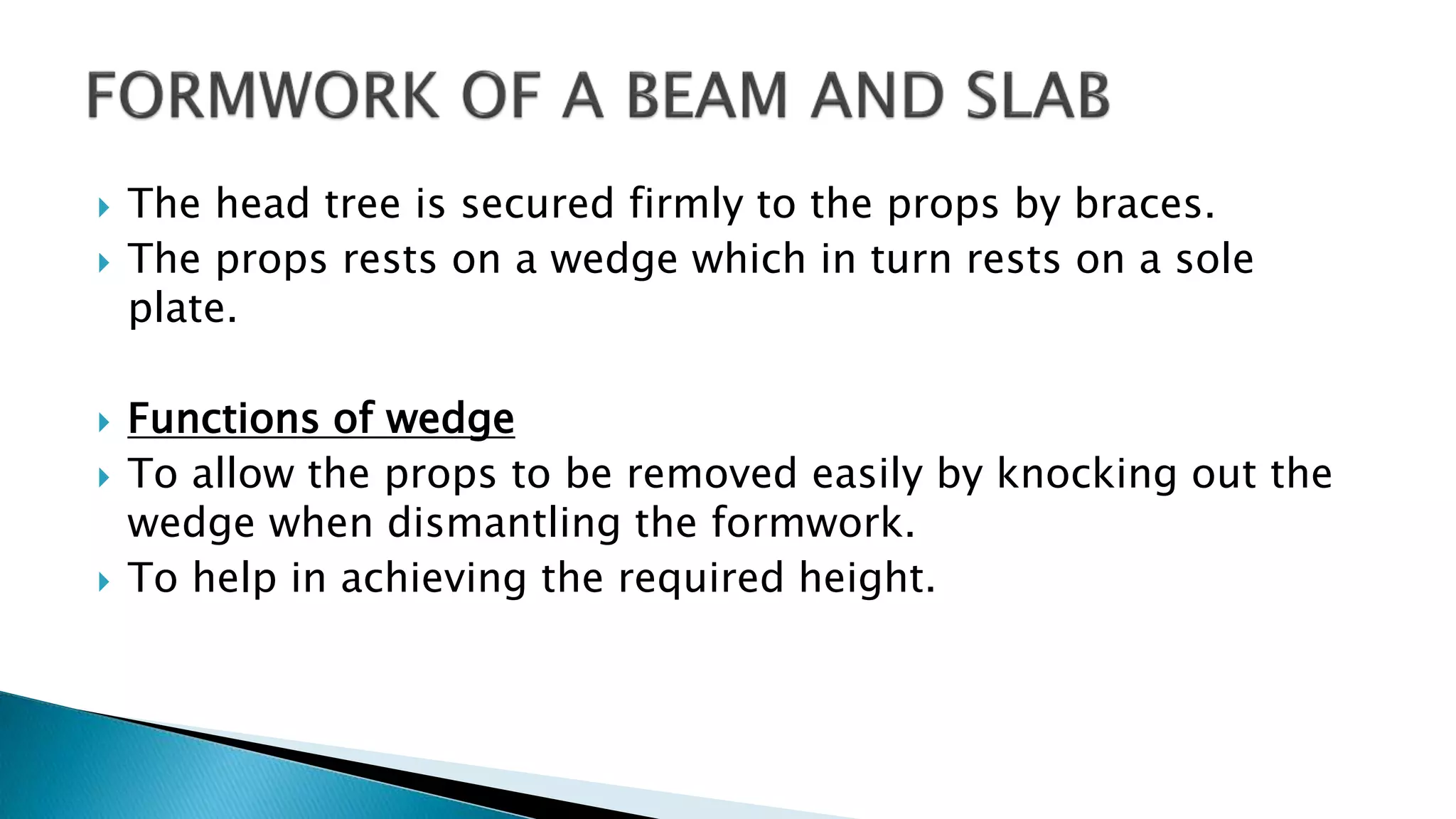
 The head tree is secured firmly to the props by braces.
 The props rests on a wedge which in turn rests on a sole
plate.
 Functions of wedge
 To allow the props to be removed easily by knocking out the
wedge when dismantling the formwork.
 To help in achieving the required height.
 Some concrete lintels are pre-cast while some are cast in-situ.
 In-situ casting:
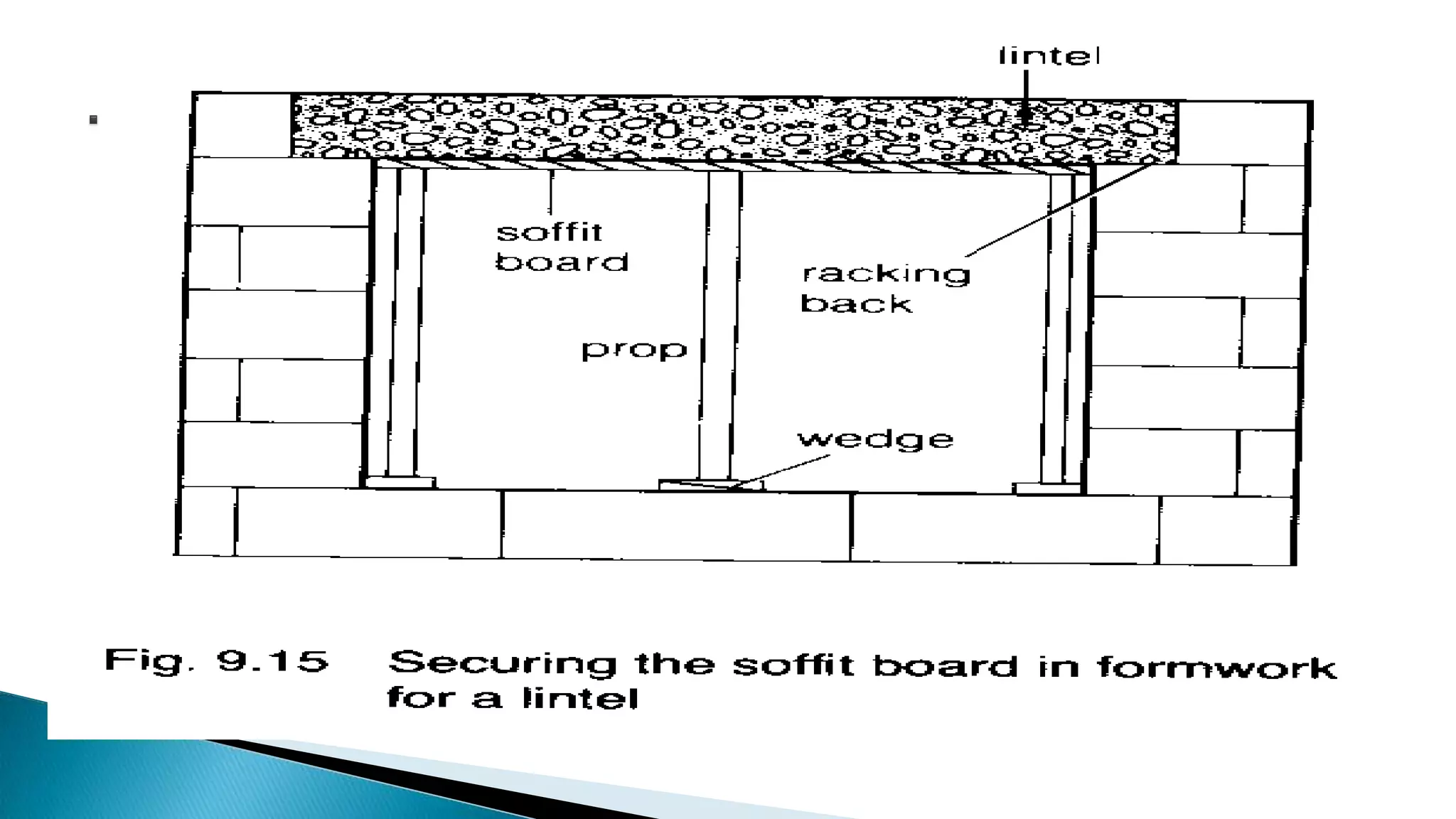
 Consist of two side boards and a soffit board which are
sometimes supported by the jambs and, if necessary
immediately between the jambs by wooden posts on a pair of
folding wedges.
 Walls are normally built to lintel level before setting lintel
formwork.
 A racking back of about 225 mm on the wall will provide
space where the concrete lintel will rest.
 The soffit rests on the head tree of the props.
 Props are cut little less than the height of wall but required
height will be obtained by striking sole pieces and folding
wedges into the base of the props.
 The side boards are placed so that they are flush with the
wall.
 Boards are held by struts nailed to the head tree or by sloping
struts firmly secured to the ground.
 Sometimes side boards are held together by cross-battens
nailed on the top of the side boards at suitable intervals.
 Formwork failures are the cause of many accidents and
building failures that occur during concrete construction,
usually when fresh concrete is being placed.
 Generally some unexpected event causes one member to fail,
then others become overloaded or misaligned and the entire
formwork structure collapses.

 The main causes of formwork failure are:
 1. improper stripping and shore removal
2. inadequate bracing
3. vibration
4. unstable soil under mudsills (A plank, frame, or small
footing on the ground used as a base for a shore or post in
formwork), shoring not plumb
5. inadequate control of concrete placement
6. lack of attention to formwork details
 It is one in which the form is left as an integral part of the
structure.
 Becomes apparent when pouring concrete into the ground
 Can be utilised as the facing materials of in-situ reinforced
concrete.
 They can be of two types participating and non-participating.
 The materials used for this form must be durable and of
sufficient strength.
 Commonly used materials include polyvinyl chloride,
galvanised coiled, fabricated steel.
 low cost of transportation and installation,
 precise form design,
 maximum flexibility,
 greater durability with reduced long term maintenance and
 Versatile.
 DISADVANTAGES
 high initial cost of design and installation
 lack of familiarity for installation and maintenance

Formwork by chakamba john

  • 1.
  • 2.
     Is atemporary support to pre-cast or in-situ concrete structures.  Is the surface, support and framing used to define the shape of concrete until it is self-supporting.  It holds the concrete until it has set and can stand on its own and it maintains the required shape.  Includes :  Form on or within which the concrete is poured.  The supports which carry the forms and the concrete.  The bracing which may be added to ensure stability as well as foundations and footings.
  • 3.
     It isused for Concrete : - Lintels. - Window sills. - Columns and beams. - Decking, floors and roofs. - Retaining walls, stairs, drains. - Reinforced concrete walls.
  • 4.
     Any temporarystructure that is used to support a permanent structure, material, plant, equipment and personnel until the construction of permanent structure has advanced to the stage that it is self-supporting.  Includes:  Foundations, footings and all structural members supporting the permanent structural elements.  Commonly used to support spanning or arched structures, such as bridges, while they are being constructed.
  • 5.
     All formworkmust be:  Sufficiently strong and rigid to support the dead load of the concrete.  Designed to allow for the temporary live load of workmen, wheelbarrows and tamping operations.  Easy to strip after concreting.  Constructed within reasonable cost limits.
  • 6.
     It should:  Support both live and dead loads that is, weight of wet concrete and its reinforcement, weight of workers and their equipment as well as force of wind and rain.  Be rigid, water tight, braced and tied together so as to maintain position and shape during all construction activities.  Be constructed in such a way that it can be removed easily and safely, without damaging formed concrete.  If to be re-used, retain formwork strength during design so as to minimise deterioration of materials through use and handling.
  • 7.
     Withstand theforce of internal or external vibration during the consolidation of concrete.  Have smooth surfaces and avoid warped timbers which may make the surfaces of concrete uneven.  Be Constructed and dismantled after use so that it is capable of being re-used and this is ensured by coating internal surfaces with non-staining oil, white wash or soft soap to permit easy striking off.
  • 8.
     Designers shouldconsider the work practises necessary to carryout erection and dismantling of the formwork as well as identifying health and safety risks and controls at the design stage.  Possibility of using designs that do not require in-situ formwork, such as tilt-up or pre-cast concrete elements that may be constructed elsewhere and lifted into position.  Method and sequence of erecting and dismantling the formwork or false work and its supports as well as related risks especially manual handling.  Provision of safe access to and egress from the work areas on and around the formwork.  Minimizing the working heights for persons erecting and dismantling.
  • 9.
     Guardrail systemsincluding toe-boards, perimeter safety screens, scaffolding or other means should be installed when working at heights.  Fall arrest systems including safety lines can be installed if required.  Formwork drawings should include details of formwork, formwork joints, sealing procedures, ties, size and spacing of framing and details of any proprietary fittings or systems proposed to be used.  Details of the construction and erection sequence should be included on the drawings,
  • 10.
     Choice isinfluenced by economy and necessity or both.  Materials commonly used are timber, plywood and steel.  Are used either separately or jointly.  Steel formwork  Merits  It is durable and can be used as many times as necessary.  It gives a smooth and better surface finish of concrete.  It is not liable to warp.  It is more economical than timber where repetitive work is necessary.  Speed of erection with fewer workmen required to assemble it onsite.
  • 11.
     Demerits  Theinitial outlay of money is great.  It is easily dented.  It is easily affected by rust under humid conditions.  Timber formwork Merits  It is adaptable.  It is relatively cheap.  It is more economical than steel where work is non- repetitive.  It can be found locally.
  • 12.
     It issusceptible to insect and fungal attack.  It warps, especially when it is not well seasoned.  It is not good for repetitive work.  Timber  Timber for formwork should be neither too dry nor too wet.  If too dry the timber will absorb water from the concrete and swell resulting in distortion or decay.  If too wet shrinkage may result especially during hot weather which might result to warpage or cracking.  The normal moisture content of timber used for formwork should be 20 %.
  • 13.
     It isused where a large area of exposed concrete is to be constructed, for instance walls.  Merit  The elimination of joint marks.  If carefully fixed on site, the finished concrete does not require further treatment
  • 17.
     It isalso known as a column box.  Consists of vertical boards which have battens nailed across them.  The battens are called cleats usually 32mm; and the boarding is called sheeting usually 25mm thick.
  • 18.
     Cleats usedat the bottom are usually larger so as to withstand the pressure which is exerted by the weight of the concrete.  The sides of the box are secured firmly together by means of yokes of about 50 by 75mm which may be replaced by use of sash clamps.  The column box should be located against a 75mm high plinth or kicker which has been cast monolithic with base or floor.
  • 19.
     The reinforcementrods and stirrups must be set and well plumbed up before erecting the column.  The box is held in position by means of braces fastened to sole pieces on the floor.  If the corners of the columns are to be shaped, triangular fillets or mouldings of the desired shapes are nailed to the corners of the formwork.  Concrete is poured as soon as the form base has been cleaned.
  • 20.
     Vertical mould-resist considerable horizontal pressures in the early stages of casting.  Kicker – accurately positions the formwork onto the base or floor. Also prevents the loss of grout from the bottom edge of the form.  Soldiers – vertical studs used to strengthen panels forming the column sides.
  • 21.
     Cleats –horizontal battens used to strengthen panels forming the column sides or mould.  Margin piece – piece of plank fixed around the opening of a cut out to provide sufficient bearing for the beam boxes.  Yokes – pieces of timber used to firmly secure the sides of the box together.
  • 22.
     Yokes –collars of timber or metal used to hold together column forms timber yokes are purpose made whereas steel column clamps are adjustable within limits of the blades.  Spacing of yokes and clamps should vary with the anticipated pressures, the greatest occurring at the base of the column box.
  • 23.
     Variance ofactual pressure : a. Rate of placing b. Type of mix being used- generally the richer the mix the greater the pressure. c. Method of placing- if vibrators are used pressures can increase up to 50 % over hand placing and compacting. d. Air temperature – the lower the temperature the slower is hydration process and consequently higher pressures are encountered.
  • 26.
     Consist oftwo side boards, soffit board and a head tree.  Two side boards 32mm thick are tongue and grooved and secured by cleats of 32 by 150mm which are placed at 1200mm centres.  The soffit boards are thicker than the side boards since they bear the greater part of the weight of the concrete.  The soffit board rests directly on the head tree.  The head tree of 75 by 100 mm timber is placed centrally on a prop  The column box may also provide support to the beam box in framed buildings.
  • 27.
     The headtree is secured firmly to the props by braces.  The props rests on a wedge which in turn rests on a sole plate.  Functions of wedge  To allow the props to be removed easily by knocking out the wedge when dismantling the formwork.  To help in achieving the required height.
  • 29.
     Some concretelintels are pre-cast while some are cast in-situ.  In-situ casting:  Consist of two side boards and a soffit board which are sometimes supported by the jambs and, if necessary immediately between the jambs by wooden posts on a pair of folding wedges.  Walls are normally built to lintel level before setting lintel formwork.
  • 30.
     A rackingback of about 225 mm on the wall will provide space where the concrete lintel will rest.  The soffit rests on the head tree of the props.  Props are cut little less than the height of wall but required height will be obtained by striking sole pieces and folding wedges into the base of the props.
  • 31.
     The sideboards are placed so that they are flush with the wall.  Boards are held by struts nailed to the head tree or by sloping struts firmly secured to the ground.  Sometimes side boards are held together by cross-battens nailed on the top of the side boards at suitable intervals.
  • 34.
     Formwork failuresare the cause of many accidents and building failures that occur during concrete construction, usually when fresh concrete is being placed.  Generally some unexpected event causes one member to fail, then others become overloaded or misaligned and the entire formwork structure collapses.   The main causes of formwork failure are:  1. improper stripping and shore removal
  • 35.
    2. inadequate bracing 3.vibration 4. unstable soil under mudsills (A plank, frame, or small footing on the ground used as a base for a shore or post in formwork), shoring not plumb 5. inadequate control of concrete placement 6. lack of attention to formwork details
  • 36.
     It isone in which the form is left as an integral part of the structure.  Becomes apparent when pouring concrete into the ground  Can be utilised as the facing materials of in-situ reinforced concrete.  They can be of two types participating and non-participating.  The materials used for this form must be durable and of sufficient strength.  Commonly used materials include polyvinyl chloride, galvanised coiled, fabricated steel.
  • 37.
     low costof transportation and installation,  precise form design,  maximum flexibility,  greater durability with reduced long term maintenance and  Versatile.  DISADVANTAGES  high initial cost of design and installation  lack of familiarity for installation and maintenance