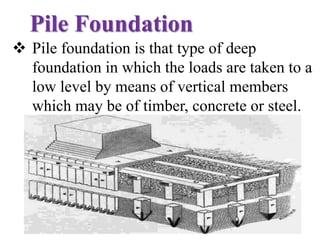
 Pile foundation is that type of deep
foundation in which the loads are taken to a
low level by means of vertical members
which may be of timber, concrete or steel.
Pile Foundation
Purpose of Pile foundation:-
 Pile foundation generally used, when simple spread
foundation at a suitable depth is not possible either
because the stratum of required bearing capacity is at a
greater depth or steep slopes are encountered.
 In compressible soil or water logged soil or soil of made-
up type, piles are used with advantage for providing safe
foundation for any type of structure.
 The load coming from the structure is very heavy and the
distribution of load on soil is uneven
 Piles are used for foundation for buildings, trestles,
bridges and water front installations.
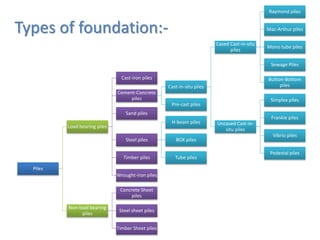
Types of foundation:-
Piles
Load bearing piles
Cast-iron piles
Cement-Concrete
piles
Cast-in-situ piles
Cased Cast-in-situ
piles
Raymond piles
Mac-Arthur piles
Mono tube piles
Sewage Piles
Button-Bottom
piles
Uncased Cast-in-
situ piles
Simplex piles
Frankie piles
Vibrio piles
Pedestal piles
Pre-cast piles
Sand piles
Steel piles
H-beam piles
BOX piles
Tube pilesTimber piles
Wrought-iron piles
Non-load bearing
piles
Concrete Sheet
piles
Steel sheet piles
Timber Sheet piles
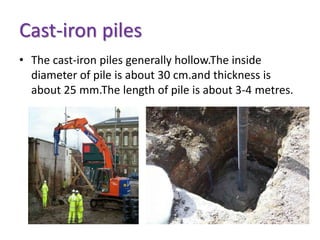
Cast-iron piles
• The cast-iron piles generally hollow.The inside
diameter of pile is about 30 cm.and thickness is
about 25 mm.The length of pile is about 3-4 metres.
Sand piles
• The Sand piles are formed by making holes in the
ground and then filling the holes by sand. A bore of
required diameter, usually 30cm. formed either by
driving a wooden pile or by an auger.
H-beam piles
• The H-beam piles are usually of wide flange section
and they are the most common variety of steel piles
in general use.The driving of H-piles is very simple
and the energy from a pile hammer is effectively
transmitted to the lower portion of the pile.
BOX piles
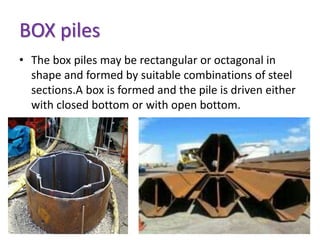
• The box piles may be rectangular or octagonal in
shape and formed by suitable combinations of steel
sections.A box is formed and the pile is driven either
with closed bottom or with open bottom.
Tube piles
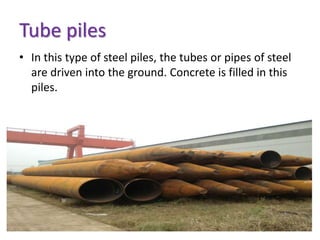
• In this type of steel piles, the tubes or pipes of steel
are driven into the ground. Concrete is filled in this
piles.
Timber piles
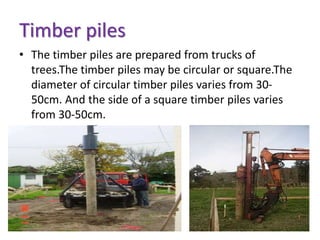
• The timber piles are prepared from trucks of
trees.The timber piles may be circular or square.The
diameter of circular timber piles varies from 30-
50cm. And the side of a square timber piles varies
from 30-50cm.
Wrought-iron piles
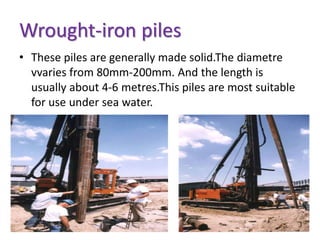
• These piles are generally made solid.The diametre
vvaries from 80mm-200mm. And the length is
usually about 4-6 metres.This piles are most suitable
for use under sea water.
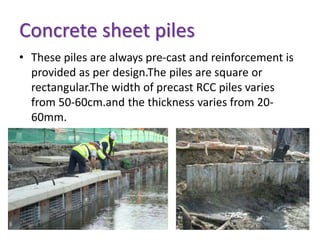
Concrete sheet piles
• These piles are always pre-cast and reinforcement is
provided as per design.The piles are square or
rectangular.The width of precast RCC piles varies
from 50-60cm.and the thickness varies from 20-
60mm.
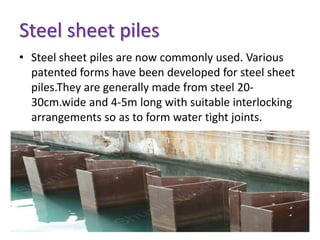
Steel sheet piles
• Steel sheet piles are now commonly used. Various
patented forms have been developed for steel sheet
piles.They are generally made from steel 20-
30cm.wide and 4-5m long with suitable interlocking
arrangements so as to form water tight joints.
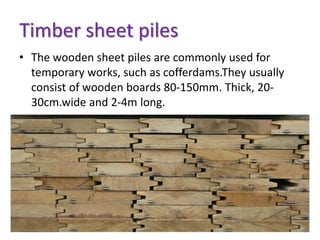
Timber sheet piles
• The wooden sheet piles are commonly used for
temporary works, such as cofferdams.They usually
consist of wooden boards 80-150mm. Thick, 20-
30cm.wide and 2-4m long.
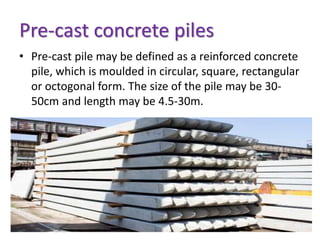
Pre-cast concrete piles
• Pre-cast pile may be defined as a reinforced concrete
pile, which is moulded in circular, square, rectangular
or octogonal form. The size of the pile may be 30-
50cm and length may be 4.5-30m.
Raymond piles
• The Raymond standard pile is used primarily as
friction piles. The length of piles vary from 6-12m.The
diameter of piles vary from 40-60cm at the top and
20-30cm at the bottom.
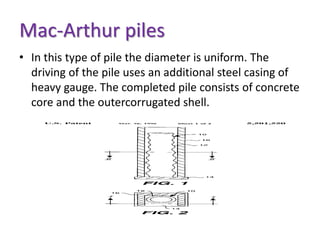
Mac-Arthur piles
• In this type of pile the diameter is uniform. The
driving of the pile uses an additional steel casing of
heavy gauge. The completed pile consists of concrete
core and the outercorrugated shell.
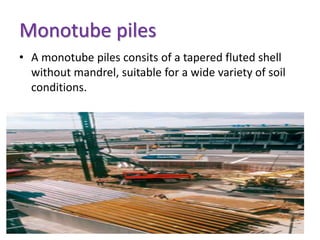
Monotube piles
• A monotube piles consits of a tapered fluted shell
without mandrel, suitable for a wide variety of soil
conditions.
Swage piles
• In this type of pile, a precast concrete plug of conical
shape is provided at the bottom of a steel shell. The
various stages of forming these piles.
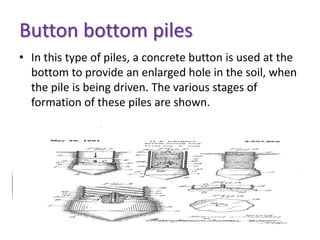
Button bottom piles
• In this type of piles, a concrete button is used at the
bottom to provide an enlarged hole in the soil, when
the pile is being driven. The various stages of
formation of these piles are shown.
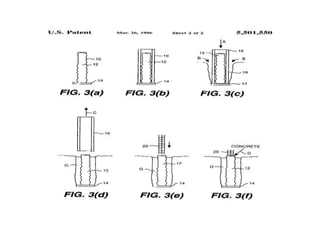
Simplex piles
• In this type of pile, a steel tube is fitted with cast-iron
shoe is driven into the ground upto the desired
depth as shown in figure. The concrete is not tamped
and the pile is completed .such a pile is known as
simplex standard pile.
Frankie piles
• The pile has an enlarged base of mush-room shape,
which gives the effect of a spread footing.
Reinforcement cage can be placed if necessary, after
the enlarged base has been formed.
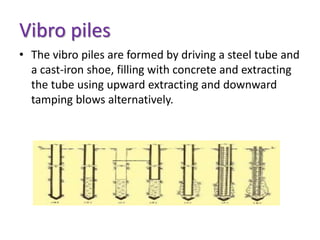
Vibro piles
• The vibro piles are formed by driving a steel tube and
a cast-iron shoe, filling with concrete and extracting
the tube using upward extracting and downward
tamping blows alternatively.
THANK
YOU…

Pile foundation

  • 2.
     Pile foundationis that type of deep foundation in which the loads are taken to a low level by means of vertical members which may be of timber, concrete or steel. Pile Foundation
  • 3.
    Purpose of Pilefoundation:-  Pile foundation generally used, when simple spread foundation at a suitable depth is not possible either because the stratum of required bearing capacity is at a greater depth or steep slopes are encountered.  In compressible soil or water logged soil or soil of made- up type, piles are used with advantage for providing safe foundation for any type of structure.  The load coming from the structure is very heavy and the distribution of load on soil is uneven  Piles are used for foundation for buildings, trestles, bridges and water front installations.
  • 4.
    Types of foundation:- Piles Loadbearing piles Cast-iron piles Cement-Concrete piles Cast-in-situ piles Cased Cast-in-situ piles Raymond piles Mac-Arthur piles Mono tube piles Sewage Piles Button-Bottom piles Uncased Cast-in- situ piles Simplex piles Frankie piles Vibrio piles Pedestal piles Pre-cast piles Sand piles Steel piles H-beam piles BOX piles Tube pilesTimber piles Wrought-iron piles Non-load bearing piles Concrete Sheet piles Steel sheet piles Timber Sheet piles
  • 5.
    Cast-iron piles • Thecast-iron piles generally hollow.The inside diameter of pile is about 30 cm.and thickness is about 25 mm.The length of pile is about 3-4 metres.
  • 6.
    Sand piles • TheSand piles are formed by making holes in the ground and then filling the holes by sand. A bore of required diameter, usually 30cm. formed either by driving a wooden pile or by an auger.
  • 7.
    H-beam piles • TheH-beam piles are usually of wide flange section and they are the most common variety of steel piles in general use.The driving of H-piles is very simple and the energy from a pile hammer is effectively transmitted to the lower portion of the pile.
  • 8.
    BOX piles • Thebox piles may be rectangular or octagonal in shape and formed by suitable combinations of steel sections.A box is formed and the pile is driven either with closed bottom or with open bottom.
  • 9.
    Tube piles • Inthis type of steel piles, the tubes or pipes of steel are driven into the ground. Concrete is filled in this piles.
  • 10.
    Timber piles • Thetimber piles are prepared from trucks of trees.The timber piles may be circular or square.The diameter of circular timber piles varies from 30- 50cm. And the side of a square timber piles varies from 30-50cm.
  • 11.
    Wrought-iron piles • Thesepiles are generally made solid.The diametre vvaries from 80mm-200mm. And the length is usually about 4-6 metres.This piles are most suitable for use under sea water.
  • 12.
    Concrete sheet piles •These piles are always pre-cast and reinforcement is provided as per design.The piles are square or rectangular.The width of precast RCC piles varies from 50-60cm.and the thickness varies from 20- 60mm.
  • 13.
    Steel sheet piles •Steel sheet piles are now commonly used. Various patented forms have been developed for steel sheet piles.They are generally made from steel 20- 30cm.wide and 4-5m long with suitable interlocking arrangements so as to form water tight joints.
  • 14.
    Timber sheet piles •The wooden sheet piles are commonly used for temporary works, such as cofferdams.They usually consist of wooden boards 80-150mm. Thick, 20- 30cm.wide and 2-4m long.
  • 15.
    Pre-cast concrete piles •Pre-cast pile may be defined as a reinforced concrete pile, which is moulded in circular, square, rectangular or octogonal form. The size of the pile may be 30- 50cm and length may be 4.5-30m.
  • 16.
    Raymond piles • TheRaymond standard pile is used primarily as friction piles. The length of piles vary from 6-12m.The diameter of piles vary from 40-60cm at the top and 20-30cm at the bottom.
  • 17.
    Mac-Arthur piles • Inthis type of pile the diameter is uniform. The driving of the pile uses an additional steel casing of heavy gauge. The completed pile consists of concrete core and the outercorrugated shell.
  • 18.
    Monotube piles • Amonotube piles consits of a tapered fluted shell without mandrel, suitable for a wide variety of soil conditions.
  • 19.
    Swage piles • Inthis type of pile, a precast concrete plug of conical shape is provided at the bottom of a steel shell. The various stages of forming these piles.
  • 20.
    Button bottom piles •In this type of piles, a concrete button is used at the bottom to provide an enlarged hole in the soil, when the pile is being driven. The various stages of formation of these piles are shown.
  • 21.
    Simplex piles • Inthis type of pile, a steel tube is fitted with cast-iron shoe is driven into the ground upto the desired depth as shown in figure. The concrete is not tamped and the pile is completed .such a pile is known as simplex standard pile.
  • 23.
    Frankie piles • Thepile has an enlarged base of mush-room shape, which gives the effect of a spread footing. Reinforcement cage can be placed if necessary, after the enlarged base has been formed.
  • 24.
    Vibro piles • Thevibro piles are formed by driving a steel tube and a cast-iron shoe, filling with concrete and extracting the tube using upward extracting and downward tamping blows alternatively.
  • 25.