TEMPERATURE
REGULATION
DISORDERS
Introduction
 Body temperature -controlled by the hypothalamus.
 Neurons in the preoptic anterior hypothalamus and the posterior
hypothalamus
 Receive two kinds of signals: from peripheral nerves and the other
from the temperature of the blood bathing the region.
 Maintain the core temperature between 36.5 & 37.5°C, despite
environmental variations
Introduction
 The mean oral temperature is 36.8° ± 0.4°C (98.2° ± 0.7°F)
 with low levels at 6 a.m. and higher levels at 4–6 p.m.
 The maximum normal oral temperature is 37.2°C (98.9°F) at 6 a.m.
and 37.7°C (99.9°F) at 4 p.m.; define the 99th percentile for healthy
individuals.
 In light of these studies, an am temperature of >37.2°C (>98.9°F)
or a pm temperature of >37.7°C (>99.9°F) defines a fever.
 Variations in oral, rectal and tympanic membrane temperature are
observed
FEVER
 Fever is an elevation of body temperature that exceeds the
normal daily variation and occurs in conjunction with an increase
in the hypothalamic set point
 A fever of >41.5°C (>106.7°F) is called hyperpyrexia.
 Hyperpyrexia can develop in patients with severe infections but
most commonly occurs in patients with CNS hemorrhages.
 Infectious causes rarely cause temperatures to go above 41.1°C
HYPERTHERMIA
HYPERTHERMIA
 Most patients with elevated body temperature have fever,
there are circumstances in which elevated temperature
represents not fever but hyperthermia
 Hyperthermia is characterized by an uncontrolled
increase in body temperature that exceeds the body’s
ability to lose heat.
 does not involve pyrogenic molecules
 2 mechanisms – Exogenous heat exposure & Endogenous
heat production
HYPERTHERMIA
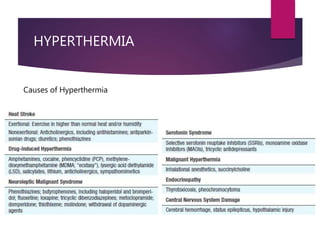
Causes of Hyperthermia
HYPERTHERMIA – Heat Stroke
Exertional heat stroke – typically exercising at
elevated ambient temperatures and/or
humidity.
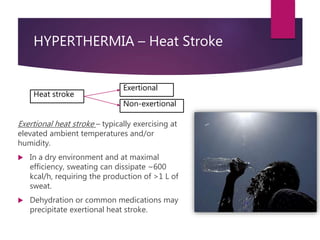
 In a dry environment and at maximal
efficiency, sweating can dissipate ~600
kcal/h, requiring the production of >1 L of
sweat.
 Dehydration or common medications may
precipitate exertional heat stroke.
Heat stroke
Exertional
Non-exertional
HYPERTHERMIA – Heat Stroke
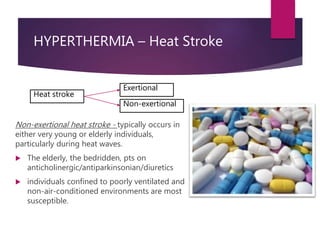
Non-exertional heat stroke - typically occurs in
either very young or elderly individuals,
particularly during heat waves.
 The elderly, the bedridden, pts on
anticholinergic/antiparkinsonian/diuretics
 individuals confined to poorly ventilated and
non-air-conditioned environments are most
susceptible.
Heat stroke
Exertional
Non-exertional
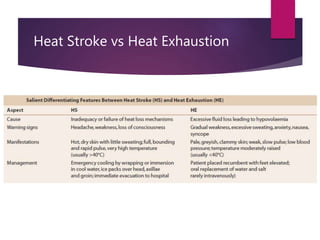
Heat Stroke vs Heat Exhaustion
Exhaustion
HYPERTHERMIA – Drug induced
Drug-induced hyperthermia may be caused by
 Monoamine oxidase inhibitors (MAOIs)
 Tricyclic antidepressants
 Amphetamines
 Illicit use of phencyclidine (PCP), lysergic
acid diethylamide (LSD), methylene-dioxy-
methamphetamine (MDMA, “ecstasy”),
crystal methamphetamine and cocaine.
HYPERTHERMIA – The neuroleptic
malignant syndrome
 Occurs in the setting of the use of neuroleptic agents (0.02% to 3% among
patients taking them)
 antipsychotic phenothiazines, haloperidol, prochlorperazine, metoclopramide
OR
 The withdrawal of dopaminergic drugs (characterized by “lead-pipe” rigidity,
extrapyramidal side effects, autonomic dysregulation, and hyperthermia)
 Caused by the inhibition of central dopamine receptor in the
hypothalamus
 Resulting in increased heat generation and decreased heat dissipation
HYPERTHERMIA – The neuroleptic
malignant syndrome
 The four defining features that characterize NMS are:
1. Motor symptoms
2. Altered mental status
3. Hyperthermia
4. Autonomic instability
 Lab findings:
 Creatine Kinase is typically more than 1,000 IU/L and can be as high as 100,000
IU/L
 Elevated LDH
 Leukocytosis
HYPERTHERMIA – The neuroleptic
malignant syndrome
 Differential Diagnosis
1. Central nervous system infection (meningitis/encephalitis)
2. Heat stroke
3. Delirium tremens
4. Parkinsonism
5. Seizures
6. Acute porphyria
7. Septic shock
8. Tetanus
9. Strychnine toxicity
10. Pheochromocytoma
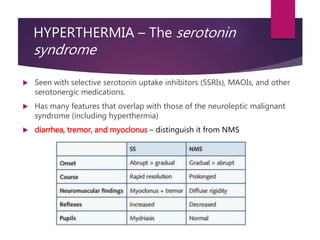
HYPERTHERMIA – The serotonin
syndrome
 Seen with selective serotonin uptake inhibitors (SSRIs), MAOIs, and other
serotonergic medications.
 Has many features that overlap with those of the neuroleptic malignant
syndrome (including hyperthermia)
 diarrhea, tremor, and myoclonus – distinguish it from NMS
HYPERTHERMIA – Malignant
Hyperthermia
 A life threatening reaction that is most often triggered by the use of
anesthetics (mostly inhalational)
 Desflurane • Enflurane • Halothane • Isoflurane • Methoxyflurane •
Sevoflurane
 Succinyl choline – non inhalational
 Nitrous Oxide – no malignant hyperthemia
 increased cytosol Ca2+ concentrations  Increased muscle contracture,
hypermetabolism & ATP hydrolysis by myosin causes hyperthermia
 hyperthermia is usually not the initial presenting sign
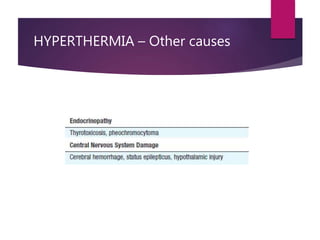
HYPERTHERMIA – Other causes
HYPERTHERMIA – Evaluation
 It is important to distinguish between fever and hyperthermia
 Hyperthermia can be rapidly fatal and does not respond to antipyretics
 Hyperthermia is diagnosed on the basis of the events immediately
preceding the elevation of core temperature
 However, a full workup for fever is mandated in cases where history is
suggestive of an infection.
TREATING HYPERTHERMIA
 A high core temperature in a patient with an appropriate history along
with appropriate clinical findings suggests hyperthermia.
 Physical cooling with sponging, fans, cooling blankets, and even ice baths
should be initiated immediately in conjunction with the administration of
IV fluids
 If sufficient cooling is not achieved by external means, internal cooling can
be achieved by gastric or peritoneal lavage with iced saline.
 Hemodialysis or even cardiopulmonary bypass with cooling of blood may
be performed – in extreme cases
TREATING HYPERTHERMIA
 In NMS - Supportive medical care, specific pharmacotherapy and electroconvulsive
therapy
 Intensive monitoring and supportive treatment need admission to the intensive care unit
 Discontinue neuroleptic agent or precipitating drug
 Maintain cardiorespiratory stability.
 Mechanical ventilation, antiarrhythmic agents
 Maintain euvolemic state using intravenous (IV) fluids
 If CK is very elevated, high volume IV fluids and urine alkalinization with IV sodium
bicarbonate [Na(HCO3)] may help to prevent renal failure from rhabdomyolysis.
 Lower the temperature using cooling blankets, ice cold water, gastric lavage and ice
packets in axilla and cold sponging.
 Lower BP, if markedly elevated (Clonidine)
 LMWH for DVT prevention
 Use benzodiazepines (clonazepam or lorazepam) to control agitation if necessary
TREATING HYPERTHERMIA
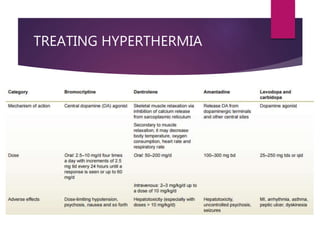
 Malignant hyperthermia should be treated immediately with cessation of
anesthesia and IV administration of dantrolene sodium.
 The recommended dose of dantrolene is 1–2.5 mg/kg iv q6 h for at least
24–48 h—until oral dantrolene can be administered
 May even be useful in the hyperthermia of the serotonin syndrome and
thyrotoxicosis
 Induction of muscle paralysis with curare and pancuronium may be
attempted as well.
HYPOTHERMIA
HYPOTHERMIA
 Hypothermia occurs when there is an unintentional drop
in the body’s core temperature below 35°C (95°F)
 Many of the compensatory physiologic mechanisms that
conserve heat begin to fail.
 Primary accidental hypothermia is a result of the direct
exposure of a previously healthy individual to the cold.
 Secondary hypothermia is a complication of a serious
systemic disordermortality rate is much higher
HYPOTHERMIA
HYPOTHERMIA
 Heat loss occurs through five mechanisms:
1. Radiation (55–65% of heat loss)
2. Conduction (10–15% of heat loss but much greater in cold water)
3. convection (increased in the wind)
4. Respiration
5. Evaporation (which are affected by the ambient temperature and the
relative humidity)
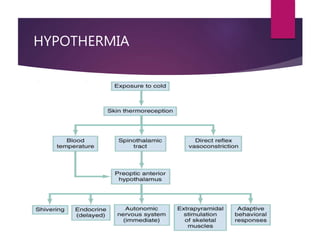
 The immediate defense of thermoneutrality is via the autonomic
nervous system, whereas delayed control is mediated by the
endocrine system
 Prolonged exposure to cold also stimulates the thyroid axis, leading
to an increased metabolic rate
HYPOTHERMIA
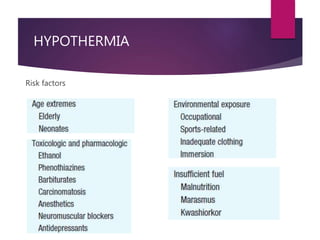
Risk factors
HYPOTHERMIA
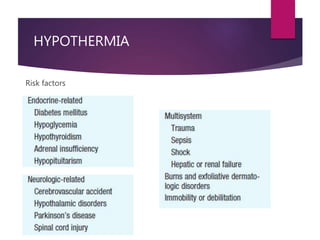
Risk factors
HYPOTHERMIA
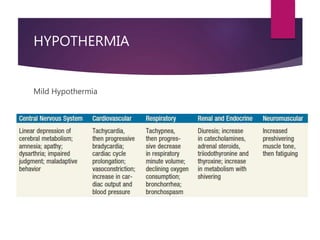
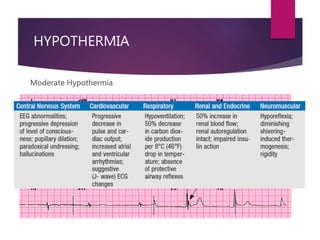
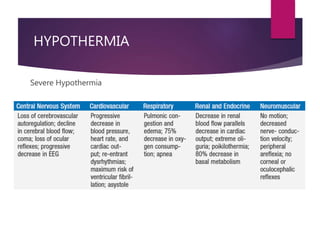
 Mild  35°C (95°F)– 32.2°C (90°F)
 Moderate  <32.2°C (90°F)– 28°C (82.4°F)
 Severe  <28°C (82.4°F)
HYPOTHERMIA
Mild Hypothermia
HYPOTHERMIA
Moderate Hypothermia
HYPOTHERMIA
Severe Hypothermia
HYPOTHERMIA - Treatment
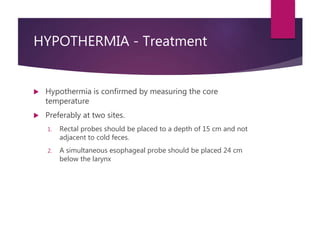
 Hypothermia is confirmed by measuring the core
temperature
 Preferably at two sites.
1. Rectal probes should be placed to a depth of 15 cm and not
adjacent to cold feces.
2. A simultaneous esophageal probe should be placed 24 cm
below the larynx
HYPOTHERMIA - Treatment
 After a diagnosis of hypothermia is established, cardiac monitoring
should be instituted + attempts to limit further heat loss.
 If the patient is in ventricular fibrillation, one defibrillation is
attempted  if failed, rewarm to >30°C and shock again
 Supplemental oxygenation is always warranted
 Ryle’s tube and Foley’s catheter
 Dehydration is common and most patients benefit from a bolus of
Normal (RL not preferred due to liver’s inability to metabolize lactate)
HYPOTHERMIA - Treatment
REWARMING STRATEGIES
A. Passive external rewarming simply involves covering and insulating the
patient in a warm environment.
 With the head also covered, the rate of rewarming is usually 0.5° to 2°C /h.
 Ideal for previously healthy patients who develop acute, mild primary
accidental hypothermia.
 The patient must have sufficient glycogen to support endogenous
thermogenesis.
 Application of heat directly to the extremities of patients should be avoided
as it can induce peripheral vasodilation and precipitate core temperature
“afterdrop,” a response characterized by a continual decline in the core
temperature after removal of the patient from the cold.
 Truncal heat application reduces the risk of afterdrop.
HYPOTHERMIA - Treatment
REWARMING STRATEGIES
B. Active rewarming is necessary in severe hypothermia
2 types Active external rewarming
Active core rewarming
Active external rewarming
 is best accomplished with forced-air heating blankets.
 Other options include devices that circulate water through external heat
exchange pads, radiant heat sources, and hot packs.
 Electric blankets are avoided burns
HYPOTHERMIA - Treatment
REWARMING STRATEGIES
Active core rewarming
 Airway rewarming with heated humidified oxygen 40°–45°C via mask or
endotracheal tube. it eliminates respiratory heat loss and adds 1°–2°C (34°–
36°F) to the overall rewarming rate.
 Crystalloids should be heated to 40°–42°C, but the quantity of heat provided is
significant only during massive volume resuscitation.
 The most efficient method for heating and delivering fluid or blood is with a
countercurrent in-line heat exchanger.
 Heated irrigation of the gastrointestinal tract or bladder transfers minimal heat
because of the limited available surface area.
 Hemodialysis is especially useful for patients with electrolyte abnormalities,
rhabdomyolysis, or toxin ingestions.
HYPOTHERMIA - Treatment
 Achieving a mean arterial pressure of at least 60 mmHg should be an
early objective.
 If the hypotension does not respond to crystalloid/colloid infusion and
rewarming, low-dose dopamine (2–5 μg/kg per min) support should be
considered.
 Perfusion of the vasoconstricted cardiovascular system also may be
improved with low-dose IV nitroglycerin.
 Bad Prognostic indicators are:
1. intravascular thrombosis (fibrinogen <50)
2. cell lysis (K>10)
3. ammonia (>250)
HYPOTHERMIA - Prevention
The importance of layered clothing and headgear,
adequate shelter, increased caloric intake, and the
avoidance of ethanol should be emphasized…
FROSTBITE
Introduction
 Peripheral cold injuries include both freezing and
nonfreezing injuries to tissue
 Freezes quickly – metallic/volatile substances
 Occurs when the tissue temperature drops below 0°C
(32°F)
 Ice crystal formation subsequently distorts and destroys
the cellular architecture.
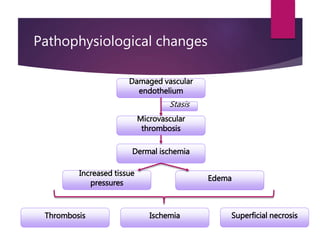
Pathophysiological changes
Damaged vascular
endothelium
Microvascular
thrombosis
Stasis
Dermal ischemia
Increased tissue
pressures
Edema
Superficial necrosisIschemiaThrombosis
Clinical presentation
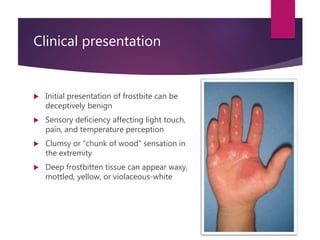
 Initial presentation of frostbite can be
deceptively benign
 Sensory deficiency affecting light touch,
pain, and temperature perception
 Clumsy or “chunk of wood” sensation in
the extremity
 Deep frostbitten tissue can appear waxy,
mottled, yellow, or violaceous-white
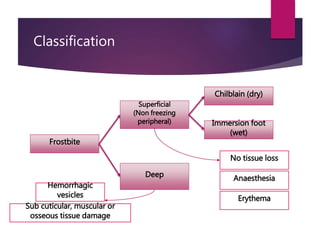
Classification
Frostbite
Superficial
(Non freezing
peripheral)
Deep
Chilblain (dry)
Immersion foot
(wet)
No tissue loss
Anaesthesia
Erythema
Hemorrhagic
vesicles
Sub cuticular, muscular or
osseous tissue damage

Temperature regulation disorders

  • 1.
  • 2.
    Introduction  Body temperature-controlled by the hypothalamus.  Neurons in the preoptic anterior hypothalamus and the posterior hypothalamus  Receive two kinds of signals: from peripheral nerves and the other from the temperature of the blood bathing the region.  Maintain the core temperature between 36.5 & 37.5°C, despite environmental variations
  • 3.
    Introduction  The meanoral temperature is 36.8° ± 0.4°C (98.2° ± 0.7°F)  with low levels at 6 a.m. and higher levels at 4–6 p.m.  The maximum normal oral temperature is 37.2°C (98.9°F) at 6 a.m. and 37.7°C (99.9°F) at 4 p.m.; define the 99th percentile for healthy individuals.  In light of these studies, an am temperature of >37.2°C (>98.9°F) or a pm temperature of >37.7°C (>99.9°F) defines a fever.  Variations in oral, rectal and tympanic membrane temperature are observed
  • 4.
    FEVER  Fever isan elevation of body temperature that exceeds the normal daily variation and occurs in conjunction with an increase in the hypothalamic set point  A fever of >41.5°C (>106.7°F) is called hyperpyrexia.  Hyperpyrexia can develop in patients with severe infections but most commonly occurs in patients with CNS hemorrhages.  Infectious causes rarely cause temperatures to go above 41.1°C
  • 5.
  • 6.
    HYPERTHERMIA  Most patientswith elevated body temperature have fever, there are circumstances in which elevated temperature represents not fever but hyperthermia  Hyperthermia is characterized by an uncontrolled increase in body temperature that exceeds the body’s ability to lose heat.  does not involve pyrogenic molecules  2 mechanisms – Exogenous heat exposure & Endogenous heat production
  • 7.
  • 8.
    HYPERTHERMIA – HeatStroke Exertional heat stroke – typically exercising at elevated ambient temperatures and/or humidity.  In a dry environment and at maximal efficiency, sweating can dissipate ~600 kcal/h, requiring the production of >1 L of sweat.  Dehydration or common medications may precipitate exertional heat stroke. Heat stroke Exertional Non-exertional
  • 9.
    HYPERTHERMIA – HeatStroke Non-exertional heat stroke - typically occurs in either very young or elderly individuals, particularly during heat waves.  The elderly, the bedridden, pts on anticholinergic/antiparkinsonian/diuretics  individuals confined to poorly ventilated and non-air-conditioned environments are most susceptible. Heat stroke Exertional Non-exertional
  • 10.
    Heat Stroke vsHeat Exhaustion Exhaustion
  • 11.
    HYPERTHERMIA – Druginduced Drug-induced hyperthermia may be caused by  Monoamine oxidase inhibitors (MAOIs)  Tricyclic antidepressants  Amphetamines  Illicit use of phencyclidine (PCP), lysergic acid diethylamide (LSD), methylene-dioxy- methamphetamine (MDMA, “ecstasy”), crystal methamphetamine and cocaine.
  • 12.
    HYPERTHERMIA – Theneuroleptic malignant syndrome  Occurs in the setting of the use of neuroleptic agents (0.02% to 3% among patients taking them)  antipsychotic phenothiazines, haloperidol, prochlorperazine, metoclopramide OR  The withdrawal of dopaminergic drugs (characterized by “lead-pipe” rigidity, extrapyramidal side effects, autonomic dysregulation, and hyperthermia)  Caused by the inhibition of central dopamine receptor in the hypothalamus  Resulting in increased heat generation and decreased heat dissipation
  • 13.
    HYPERTHERMIA – Theneuroleptic malignant syndrome  The four defining features that characterize NMS are: 1. Motor symptoms 2. Altered mental status 3. Hyperthermia 4. Autonomic instability  Lab findings:  Creatine Kinase is typically more than 1,000 IU/L and can be as high as 100,000 IU/L  Elevated LDH  Leukocytosis
  • 14.
    HYPERTHERMIA – Theneuroleptic malignant syndrome  Differential Diagnosis 1. Central nervous system infection (meningitis/encephalitis) 2. Heat stroke 3. Delirium tremens 4. Parkinsonism 5. Seizures 6. Acute porphyria 7. Septic shock 8. Tetanus 9. Strychnine toxicity 10. Pheochromocytoma
  • 15.
    HYPERTHERMIA – Theserotonin syndrome  Seen with selective serotonin uptake inhibitors (SSRIs), MAOIs, and other serotonergic medications.  Has many features that overlap with those of the neuroleptic malignant syndrome (including hyperthermia)  diarrhea, tremor, and myoclonus – distinguish it from NMS
  • 16.
    HYPERTHERMIA – Malignant Hyperthermia A life threatening reaction that is most often triggered by the use of anesthetics (mostly inhalational)  Desflurane • Enflurane • Halothane • Isoflurane • Methoxyflurane • Sevoflurane  Succinyl choline – non inhalational  Nitrous Oxide – no malignant hyperthemia  increased cytosol Ca2+ concentrations  Increased muscle contracture, hypermetabolism & ATP hydrolysis by myosin causes hyperthermia  hyperthermia is usually not the initial presenting sign
  • 17.
  • 18.
    HYPERTHERMIA – Evaluation It is important to distinguish between fever and hyperthermia  Hyperthermia can be rapidly fatal and does not respond to antipyretics  Hyperthermia is diagnosed on the basis of the events immediately preceding the elevation of core temperature  However, a full workup for fever is mandated in cases where history is suggestive of an infection.
  • 19.
    TREATING HYPERTHERMIA  Ahigh core temperature in a patient with an appropriate history along with appropriate clinical findings suggests hyperthermia.  Physical cooling with sponging, fans, cooling blankets, and even ice baths should be initiated immediately in conjunction with the administration of IV fluids  If sufficient cooling is not achieved by external means, internal cooling can be achieved by gastric or peritoneal lavage with iced saline.  Hemodialysis or even cardiopulmonary bypass with cooling of blood may be performed – in extreme cases
  • 20.
    TREATING HYPERTHERMIA  InNMS - Supportive medical care, specific pharmacotherapy and electroconvulsive therapy  Intensive monitoring and supportive treatment need admission to the intensive care unit  Discontinue neuroleptic agent or precipitating drug  Maintain cardiorespiratory stability.  Mechanical ventilation, antiarrhythmic agents  Maintain euvolemic state using intravenous (IV) fluids  If CK is very elevated, high volume IV fluids and urine alkalinization with IV sodium bicarbonate [Na(HCO3)] may help to prevent renal failure from rhabdomyolysis.  Lower the temperature using cooling blankets, ice cold water, gastric lavage and ice packets in axilla and cold sponging.  Lower BP, if markedly elevated (Clonidine)  LMWH for DVT prevention  Use benzodiazepines (clonazepam or lorazepam) to control agitation if necessary
  • 21.
  • 22.
    TREATING HYPERTHERMIA  Malignanthyperthermia should be treated immediately with cessation of anesthesia and IV administration of dantrolene sodium.  The recommended dose of dantrolene is 1–2.5 mg/kg iv q6 h for at least 24–48 h—until oral dantrolene can be administered  May even be useful in the hyperthermia of the serotonin syndrome and thyrotoxicosis  Induction of muscle paralysis with curare and pancuronium may be attempted as well.
  • 23.
  • 24.
    HYPOTHERMIA  Hypothermia occurswhen there is an unintentional drop in the body’s core temperature below 35°C (95°F)  Many of the compensatory physiologic mechanisms that conserve heat begin to fail.  Primary accidental hypothermia is a result of the direct exposure of a previously healthy individual to the cold.  Secondary hypothermia is a complication of a serious systemic disordermortality rate is much higher
  • 25.
  • 26.
    HYPOTHERMIA  Heat lossoccurs through five mechanisms: 1. Radiation (55–65% of heat loss) 2. Conduction (10–15% of heat loss but much greater in cold water) 3. convection (increased in the wind) 4. Respiration 5. Evaporation (which are affected by the ambient temperature and the relative humidity)  The immediate defense of thermoneutrality is via the autonomic nervous system, whereas delayed control is mediated by the endocrine system  Prolonged exposure to cold also stimulates the thyroid axis, leading to an increased metabolic rate
  • 27.
  • 28.
  • 29.
    HYPOTHERMIA  Mild 35°C (95°F)– 32.2°C (90°F)  Moderate  <32.2°C (90°F)– 28°C (82.4°F)  Severe  <28°C (82.4°F)
  • 30.
  • 31.
  • 32.
  • 33.
    HYPOTHERMIA - Treatment Hypothermia is confirmed by measuring the core temperature  Preferably at two sites. 1. Rectal probes should be placed to a depth of 15 cm and not adjacent to cold feces. 2. A simultaneous esophageal probe should be placed 24 cm below the larynx
  • 34.
    HYPOTHERMIA - Treatment After a diagnosis of hypothermia is established, cardiac monitoring should be instituted + attempts to limit further heat loss.  If the patient is in ventricular fibrillation, one defibrillation is attempted  if failed, rewarm to >30°C and shock again  Supplemental oxygenation is always warranted  Ryle’s tube and Foley’s catheter  Dehydration is common and most patients benefit from a bolus of Normal (RL not preferred due to liver’s inability to metabolize lactate)
  • 35.
    HYPOTHERMIA - Treatment REWARMINGSTRATEGIES A. Passive external rewarming simply involves covering and insulating the patient in a warm environment.  With the head also covered, the rate of rewarming is usually 0.5° to 2°C /h.  Ideal for previously healthy patients who develop acute, mild primary accidental hypothermia.  The patient must have sufficient glycogen to support endogenous thermogenesis.  Application of heat directly to the extremities of patients should be avoided as it can induce peripheral vasodilation and precipitate core temperature “afterdrop,” a response characterized by a continual decline in the core temperature after removal of the patient from the cold.  Truncal heat application reduces the risk of afterdrop.
  • 36.
    HYPOTHERMIA - Treatment REWARMINGSTRATEGIES B. Active rewarming is necessary in severe hypothermia 2 types Active external rewarming Active core rewarming Active external rewarming  is best accomplished with forced-air heating blankets.  Other options include devices that circulate water through external heat exchange pads, radiant heat sources, and hot packs.  Electric blankets are avoided burns
  • 37.
    HYPOTHERMIA - Treatment REWARMINGSTRATEGIES Active core rewarming  Airway rewarming with heated humidified oxygen 40°–45°C via mask or endotracheal tube. it eliminates respiratory heat loss and adds 1°–2°C (34°– 36°F) to the overall rewarming rate.  Crystalloids should be heated to 40°–42°C, but the quantity of heat provided is significant only during massive volume resuscitation.  The most efficient method for heating and delivering fluid or blood is with a countercurrent in-line heat exchanger.  Heated irrigation of the gastrointestinal tract or bladder transfers minimal heat because of the limited available surface area.  Hemodialysis is especially useful for patients with electrolyte abnormalities, rhabdomyolysis, or toxin ingestions.
  • 38.
    HYPOTHERMIA - Treatment Achieving a mean arterial pressure of at least 60 mmHg should be an early objective.  If the hypotension does not respond to crystalloid/colloid infusion and rewarming, low-dose dopamine (2–5 μg/kg per min) support should be considered.  Perfusion of the vasoconstricted cardiovascular system also may be improved with low-dose IV nitroglycerin.  Bad Prognostic indicators are: 1. intravascular thrombosis (fibrinogen <50) 2. cell lysis (K>10) 3. ammonia (>250)
  • 39.
    HYPOTHERMIA - Prevention Theimportance of layered clothing and headgear, adequate shelter, increased caloric intake, and the avoidance of ethanol should be emphasized…
  • 40.
  • 41.
    Introduction  Peripheral coldinjuries include both freezing and nonfreezing injuries to tissue  Freezes quickly – metallic/volatile substances  Occurs when the tissue temperature drops below 0°C (32°F)  Ice crystal formation subsequently distorts and destroys the cellular architecture.
  • 42.
    Pathophysiological changes Damaged vascular endothelium Microvascular thrombosis Stasis Dermalischemia Increased tissue pressures Edema Superficial necrosisIschemiaThrombosis
  • 43.
    Clinical presentation  Initialpresentation of frostbite can be deceptively benign  Sensory deficiency affecting light touch, pain, and temperature perception  Clumsy or “chunk of wood” sensation in the extremity  Deep frostbitten tissue can appear waxy, mottled, yellow, or violaceous-white
  • 44.
    Classification Frostbite Superficial (Non freezing peripheral) Deep Chilblain (dry) Immersionfoot (wet) No tissue loss Anaesthesia Erythema Hemorrhagic vesicles Sub cuticular, muscular or osseous tissue damage