DR.VISWANATHAN, ASST PROF
INTERNAL MEDICINE, SRMC
OBJECTIVES OF THE SESSION
Thermoregulation- mechanisms and its responses in
hot and cold environments
Knowing about abnormal core temperatures in heat-
related illness and hypothermia
Clinical features of heat and cold related illness
Management
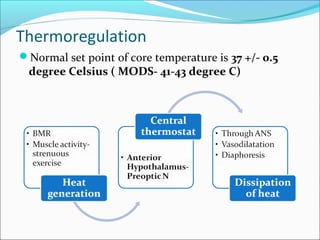
Thermoregulation
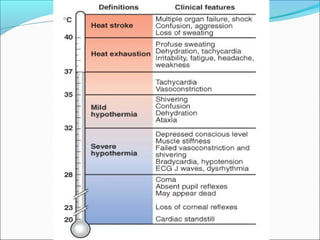
Normal set point of core temperature is 37 +/- 0.5
degree Celsius ( MODS- 41-43 degree C)
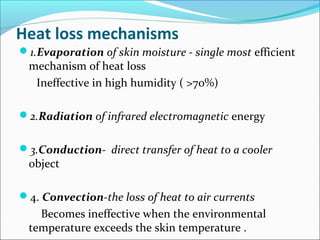
Heat loss mechanisms
1.Evaporation of skin moisture - single most efficient
mechanism of heat loss
Ineffective in high humidity ( >70%)
2.Radiation of infrared electromagnetic energy
3.Conduction- direct transfer of heat to a cooler
object
4. Convection-the loss of heat to air currents
Becomes ineffective when the environmental
temperature exceeds the skin temperature .
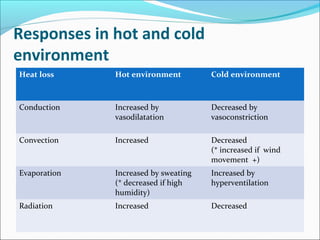
Responses in hot and cold
environment
Heat loss Hot environment Cold environment
Conduction Increased by
vasodilatation
Decreased by
vasoconstriction
Convection Increased Decreased
(* increased if wind
movement +)
Evaporation Increased by sweating
(* decreased if high
humidity)
Increased by
hyperventilation
Radiation Increased Decreased
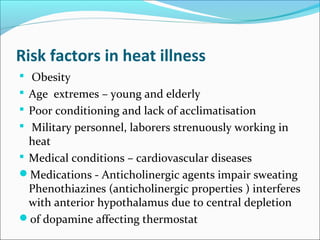
Risk factors in heat illness
 Obesity
 Age extremes – young and elderly
 Poor conditioning and lack of acclimatisation
 Military personnel, laborers strenuously working in
heat
 Medical conditions – cardiovascular diseases
Medications - Anticholinergic agents impair sweating
Phenothiazines (anticholinergic properties ) interferes
with anterior hypothalamus due to central depletion
of dopamine affecting thermostat
Environmental Heat Problems
Normal body temperature range: 97.1 to 99.7 F (35-37 C)
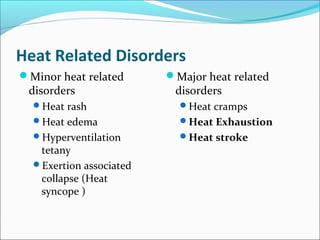
Heat Related Disorders
Minor heat related
disorders
Heat rash
Heat edema
Hyperventilation
tetany
Exertion associated
collapse (Heat
syncope )
Major heat related
disorders
Heat cramps
Heat Exhaustion
Heat stroke
Heat Rash
Prickly heat (miliaria rubra)
Maculopapular erythematous rash in clothed areas
Predominant Sx- Itching
Blockage of the sweat pores by debris causes
inflammation and ducts dilate ----rupture and produce
superficial vesicles.
Rx Antihistamines, chlorhexidine
 Clothing should be clean and loose fitting
Heat Edema
Dependent edema in the hands, feet, and ankles
It is self limiting
Management: loosening clothes and elevating the
legs, diuretics are not indicated.
Involves cutaneous vasodilation and pooling of
interstitial fluid. Heat also increases the secretion of
ADH and aldosterone
Heat Tetany
Main cause is hyperventilation
Clinical features : Produces respiratory alkalosis
causing paraesthesias and carpo pedal spasm and
tetany
Management: removal from source of heat, and
controlling hyperventilation.
Exertion Associated Collapse (Heat syncope)
Mechanism: Decreased vasomotor tone, and
peripheral vasodilation causing postural hypotension
After removal from the heat source, most patients
will
recover promptly with cooling and rehydration.
Major Heat related illness
Heat Cramps
Intermittent, painful, and involuntary spasmodic
contractions of skeletal muscles.
Typically occur in an unacclimated individual who is
at rest after vigorous exertion in a humid, hot
environment
 No elevation of core temperature.
 D/t extracellular sodium depletion as a result of
persistent sweating, exacerbated by replacement of
water but not salt.
Symptoms usually respond rapidly to salt
replacement
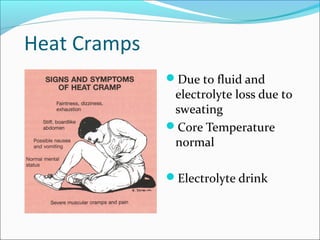
Heat Cramps
Due to fluid and
electrolyte loss due to
sweating
Core Temperature
normal
Electrolyte drink
Heat Exhaustion
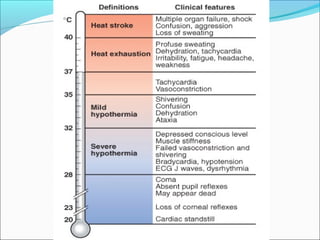
Physiologic hallmarks of heat exhaustion in
contrast to heatstroke are the maintenance of
thermoregulatory control and CNS function
Core temperature is elevated >37 C < 40 C
Inadequate salt and water replacement
Diagnosis of exclusion
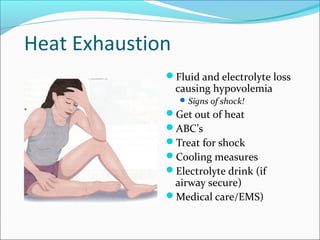
Heat Exhaustion
Fluid and electrolyte loss
causing hypovolemia
Signs of shock!
Get out of heat
ABC’s
Treat for shock
Cooling measures
Electrolyte drink (if
airway secure)
Medical care/EMS)
Heat stroke
Total loss of thermoregulatory function.
Typical vital-sign abnormalities include
tachypnea,tachycardias, hypotension, and a widened
pulse pressure, anhidrosis
Triad :
1.Exposure to a heat stress,
2.CNS dysfunction, and
3. core temperature >40.5°C helps establish the
preliminary diagnosis
Exclude the following (DDs)
Sepsis including meningitis, cerebral abcess,
Malaria
Drug overdose- cocaine, amphetamines,
hallucinogens
Malignant hyperthermia/NMS
Thyroid storm
Pheochromocytoma
Clinical features:
Headache, nausea and vomiting.
Neurological manifestations: coarse muscle tremor ,
confusion, loss of consciousness.
The patient's skin feels very hot, and sweating is
often absent due to failure of thermoregulatory
mechanisms.
Complications:
Hypovolaemic shock, lactic acidosis, disseminated
intravascular coagulation(DIC), rhabdomyolysis,
hepatic and renal failure (MODS)
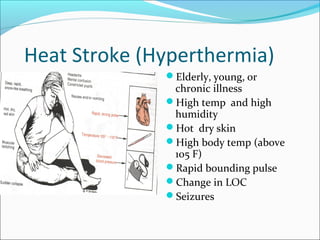
Heat Stroke (Hyperthermia)
Elderly, young, or
chronic illness
High temp and high
humidity
Hot dry skin
High body temp (above
105 F)
Rapid bounding pulse
Change in LOC
Seizures
Cooling tecniques
Spraying Cool water (15°C [60° F]) on exposed skin
 Fans direct continuous airflow over the moistened
skin.
 Cold packs applied to the axillae and groin
Safety of Immersion cooling (only for young,
previously healthy patients )
Other methods:
IV infusion of cold fluids
Cold irrigation of the bladder or GIT
Cold thoracic and peritoneal lavage (efficient
maneuvers but invasive )
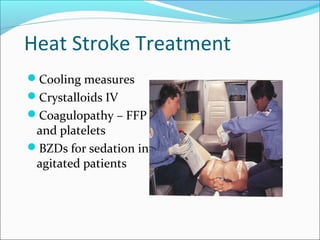
Heat Stroke Treatment
Cooling measures
Crystalloids IV
Coagulopathy – FFP
and platelets
BZDs for sedation in
agitated patients
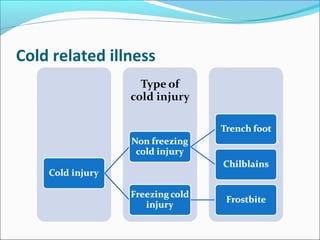
Cold related illness
Predisposing factors of hypothermia
Elderly
Chronic illness – CVA, parkinsons, spinal cord
injury
Malnourishment
Endocrine diseases: Hypothyroidism
Cortisol insufficiency
diabetes
hypopituitarism
Alcoholism and drugs ( phenothiazines,
sedatives)
Endocrine dysfunction leads to hypothermia
1.Hypothyroidism and myxedema coma reduces the
metabolic rate and impairs thermogenesis
2.Adrenal insufficiency and hypopituitarism increase
susceptibility to hypothermia.
3.Hypoglycemia - because of neuroglycopenic effects on
hypothalamic function.
4.Increased osmolality and metabolic derangements
associated with uremia, DKA and lactic acidosis can
lead to altered hypothalamic thermoregulation
Localized Cutaneous Cold Injury
Occur s at peripheral sites on the body
It classified into:
Freezing (Frostbite)
Nonfreezing (immersion)
Nonfreezing Cold Injury
 Trench Foot or Immersion Foot
 Less severe form of cold injury resulting from
prolonged exposure to cold and usually damp
conditions.
 Initially the limb (usually foot) appears cold, and
numb but there is no freezing of the tissue.
On rewarming the limb appears mottled, swollen and
painful.
Recovery may take many months
Probably involves endothelial injury
Gradual rewarming is associated with less pain than
rapid rewarming
Chilblains:
Tender red skin lesions
Self limiting
Often seen in swimmers, cyclists
Freezing Cold Injury- Frostbite
Direct freezing of body tissues
Usually affects the extremities, in particular the fingers,
toes, ears and face
Risk factors : smoking, peripheral vascular disease,
dehydration and alcohol consumption.
The tissues may become anaesthetised before freezing
and as a result the injury is often not recognised until
later, e.g. when boots are removed.
Frostbitten tissue is initially pale and doughy to the
touch and insensitive to pain.
Once frozen, the tissue is hard.
Amputations should be delayed for 2-3 months as
good recovery may occur over an extended period
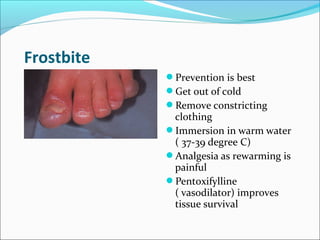
Frostbite
Prevention is best
Get out of cold
Remove constricting
clothing
Immersion in warm water
( 37-39 degree C)
Analgesia as rewarming is
painful
Pentoxifylline
( vasodilator) improves
tissue survival
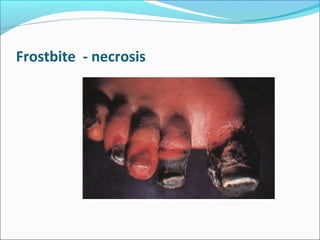
Frostbite - necrosis
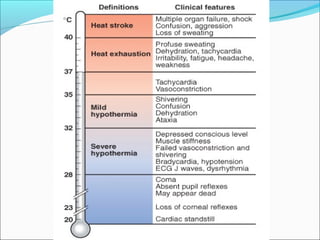
Hypothermia
Hypothermia exists when the body's normal thermal
regulatory mechanisms are unable to maintain heat in
a cold environment and core temperature falls below
35°C
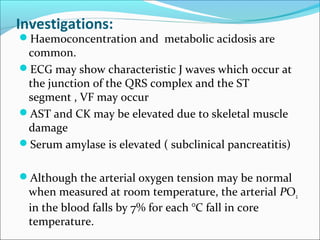
Investigations:
Haemoconcentration and metabolic acidosis are
common.
ECG may show characteristic J waves which occur at
the junction of the QRS complex and the ST
segment , VF may occur
AST and CK may be elevated due to skeletal muscle
damage
Serum amylase is elevated ( subclinical pancreatitis)
Although the arterial oxygen tension may be normal
when measured at room temperature, the arterial PO2
in the blood falls by 7% for each °C fall in core
temperature.
Management:
1.Rewarm the patient in a controlled manner
2.Treating the associated hypoxia, fluid and electrolyte
disturbance, and
3.Treating cardiovascular abnormalities, particularly
dysarhythmias
Mild hypothermia:
Sheltering the patient from the cold,
Replacing wet clothing, covering the head and
insulating him or her from the ground.
Patients should be maintained in a warm room, with
additional thermal insulation (blankets and/or space
film blanket).
Warm fluids to drink
Core temperature will rise slowly over a few hours
Underlying conditions should be treated e.g.
hypothyroidism with tri-iodothyronine 10 μg i.v. 8-
hourly
Severe hypothermia
In addition,
Supplementary oxygen,
warm intravenous fluids
 Monitoring of cardiac rhythm and arterial blood
gases, including H+
(pH) is essential.
 Active rewarming measures - administration of
warm humidified oxygen, lavage of the stomach,
peritoneal cavity or rectum with warm fluid,
haemodialysis and cardiac bypass.
Thank you

Heat and cold injuries

  • 1.
  • 2.
    OBJECTIVES OF THESESSION Thermoregulation- mechanisms and its responses in hot and cold environments Knowing about abnormal core temperatures in heat- related illness and hypothermia Clinical features of heat and cold related illness Management
  • 3.
    Thermoregulation Normal set pointof core temperature is 37 +/- 0.5 degree Celsius ( MODS- 41-43 degree C)
  • 4.
    Heat loss mechanisms 1.Evaporationof skin moisture - single most efficient mechanism of heat loss Ineffective in high humidity ( >70%) 2.Radiation of infrared electromagnetic energy 3.Conduction- direct transfer of heat to a cooler object 4. Convection-the loss of heat to air currents Becomes ineffective when the environmental temperature exceeds the skin temperature .
  • 5.
    Responses in hotand cold environment Heat loss Hot environment Cold environment Conduction Increased by vasodilatation Decreased by vasoconstriction Convection Increased Decreased (* increased if wind movement +) Evaporation Increased by sweating (* decreased if high humidity) Increased by hyperventilation Radiation Increased Decreased
  • 6.
    Risk factors inheat illness  Obesity  Age extremes – young and elderly  Poor conditioning and lack of acclimatisation  Military personnel, laborers strenuously working in heat  Medical conditions – cardiovascular diseases Medications - Anticholinergic agents impair sweating Phenothiazines (anticholinergic properties ) interferes with anterior hypothalamus due to central depletion of dopamine affecting thermostat
  • 7.
    Environmental Heat Problems Normalbody temperature range: 97.1 to 99.7 F (35-37 C)
  • 8.
    Heat Related Disorders Minorheat related disorders Heat rash Heat edema Hyperventilation tetany Exertion associated collapse (Heat syncope ) Major heat related disorders Heat cramps Heat Exhaustion Heat stroke
  • 9.
    Heat Rash Prickly heat(miliaria rubra) Maculopapular erythematous rash in clothed areas Predominant Sx- Itching Blockage of the sweat pores by debris causes inflammation and ducts dilate ----rupture and produce superficial vesicles. Rx Antihistamines, chlorhexidine  Clothing should be clean and loose fitting
  • 10.
    Heat Edema Dependent edemain the hands, feet, and ankles It is self limiting Management: loosening clothes and elevating the legs, diuretics are not indicated. Involves cutaneous vasodilation and pooling of interstitial fluid. Heat also increases the secretion of ADH and aldosterone
  • 11.
    Heat Tetany Main causeis hyperventilation Clinical features : Produces respiratory alkalosis causing paraesthesias and carpo pedal spasm and tetany Management: removal from source of heat, and controlling hyperventilation.
  • 12.
    Exertion Associated Collapse(Heat syncope) Mechanism: Decreased vasomotor tone, and peripheral vasodilation causing postural hypotension After removal from the heat source, most patients will recover promptly with cooling and rehydration.
  • 13.
  • 14.
    Heat Cramps Intermittent, painful,and involuntary spasmodic contractions of skeletal muscles. Typically occur in an unacclimated individual who is at rest after vigorous exertion in a humid, hot environment  No elevation of core temperature.  D/t extracellular sodium depletion as a result of persistent sweating, exacerbated by replacement of water but not salt. Symptoms usually respond rapidly to salt replacement
  • 15.
    Heat Cramps Due tofluid and electrolyte loss due to sweating Core Temperature normal Electrolyte drink
  • 17.
    Heat Exhaustion Physiologic hallmarksof heat exhaustion in contrast to heatstroke are the maintenance of thermoregulatory control and CNS function Core temperature is elevated >37 C < 40 C Inadequate salt and water replacement Diagnosis of exclusion
  • 18.
    Heat Exhaustion Fluid andelectrolyte loss causing hypovolemia Signs of shock! Get out of heat ABC’s Treat for shock Cooling measures Electrolyte drink (if airway secure) Medical care/EMS)
  • 20.
    Heat stroke Total lossof thermoregulatory function. Typical vital-sign abnormalities include tachypnea,tachycardias, hypotension, and a widened pulse pressure, anhidrosis Triad : 1.Exposure to a heat stress, 2.CNS dysfunction, and 3. core temperature >40.5°C helps establish the preliminary diagnosis
  • 21.
    Exclude the following(DDs) Sepsis including meningitis, cerebral abcess, Malaria Drug overdose- cocaine, amphetamines, hallucinogens Malignant hyperthermia/NMS Thyroid storm Pheochromocytoma
  • 22.
    Clinical features: Headache, nauseaand vomiting. Neurological manifestations: coarse muscle tremor , confusion, loss of consciousness. The patient's skin feels very hot, and sweating is often absent due to failure of thermoregulatory mechanisms. Complications: Hypovolaemic shock, lactic acidosis, disseminated intravascular coagulation(DIC), rhabdomyolysis, hepatic and renal failure (MODS)
  • 23.
    Heat Stroke (Hyperthermia) Elderly,young, or chronic illness High temp and high humidity Hot dry skin High body temp (above 105 F) Rapid bounding pulse Change in LOC Seizures
  • 24.
    Cooling tecniques Spraying Coolwater (15°C [60° F]) on exposed skin  Fans direct continuous airflow over the moistened skin.  Cold packs applied to the axillae and groin Safety of Immersion cooling (only for young, previously healthy patients )
  • 25.
    Other methods: IV infusionof cold fluids Cold irrigation of the bladder or GIT Cold thoracic and peritoneal lavage (efficient maneuvers but invasive )
  • 26.
    Heat Stroke Treatment Coolingmeasures Crystalloids IV Coagulopathy – FFP and platelets BZDs for sedation in agitated patients
  • 27.
  • 28.
    Predisposing factors ofhypothermia Elderly Chronic illness – CVA, parkinsons, spinal cord injury Malnourishment Endocrine diseases: Hypothyroidism Cortisol insufficiency diabetes hypopituitarism Alcoholism and drugs ( phenothiazines, sedatives)
  • 29.
    Endocrine dysfunction leadsto hypothermia 1.Hypothyroidism and myxedema coma reduces the metabolic rate and impairs thermogenesis 2.Adrenal insufficiency and hypopituitarism increase susceptibility to hypothermia. 3.Hypoglycemia - because of neuroglycopenic effects on hypothalamic function. 4.Increased osmolality and metabolic derangements associated with uremia, DKA and lactic acidosis can lead to altered hypothalamic thermoregulation
  • 30.
    Localized Cutaneous ColdInjury Occur s at peripheral sites on the body It classified into: Freezing (Frostbite) Nonfreezing (immersion)
  • 31.
    Nonfreezing Cold Injury Trench Foot or Immersion Foot  Less severe form of cold injury resulting from prolonged exposure to cold and usually damp conditions.  Initially the limb (usually foot) appears cold, and numb but there is no freezing of the tissue.
  • 32.
    On rewarming thelimb appears mottled, swollen and painful. Recovery may take many months Probably involves endothelial injury Gradual rewarming is associated with less pain than rapid rewarming
  • 33.
    Chilblains: Tender red skinlesions Self limiting Often seen in swimmers, cyclists
  • 34.
    Freezing Cold Injury-Frostbite Direct freezing of body tissues Usually affects the extremities, in particular the fingers, toes, ears and face Risk factors : smoking, peripheral vascular disease, dehydration and alcohol consumption. The tissues may become anaesthetised before freezing and as a result the injury is often not recognised until later, e.g. when boots are removed.
  • 35.
    Frostbitten tissue isinitially pale and doughy to the touch and insensitive to pain. Once frozen, the tissue is hard. Amputations should be delayed for 2-3 months as good recovery may occur over an extended period
  • 36.
    Frostbite Prevention is best Getout of cold Remove constricting clothing Immersion in warm water ( 37-39 degree C) Analgesia as rewarming is painful Pentoxifylline ( vasodilator) improves tissue survival
  • 37.
  • 38.
    Hypothermia Hypothermia exists whenthe body's normal thermal regulatory mechanisms are unable to maintain heat in a cold environment and core temperature falls below 35°C
  • 40.
    Investigations: Haemoconcentration and metabolicacidosis are common. ECG may show characteristic J waves which occur at the junction of the QRS complex and the ST segment , VF may occur AST and CK may be elevated due to skeletal muscle damage Serum amylase is elevated ( subclinical pancreatitis) Although the arterial oxygen tension may be normal when measured at room temperature, the arterial PO2 in the blood falls by 7% for each °C fall in core temperature.
  • 41.
    Management: 1.Rewarm the patientin a controlled manner 2.Treating the associated hypoxia, fluid and electrolyte disturbance, and 3.Treating cardiovascular abnormalities, particularly dysarhythmias
  • 42.
    Mild hypothermia: Sheltering thepatient from the cold, Replacing wet clothing, covering the head and insulating him or her from the ground. Patients should be maintained in a warm room, with additional thermal insulation (blankets and/or space film blanket). Warm fluids to drink Core temperature will rise slowly over a few hours Underlying conditions should be treated e.g. hypothyroidism with tri-iodothyronine 10 μg i.v. 8- hourly
  • 43.
    Severe hypothermia In addition, Supplementaryoxygen, warm intravenous fluids  Monitoring of cardiac rhythm and arterial blood gases, including H+ (pH) is essential.  Active rewarming measures - administration of warm humidified oxygen, lavage of the stomach, peritoneal cavity or rectum with warm fluid, haemodialysis and cardiac bypass.
  • 44.