Hyperthermia
Zhang Yinglan
MD, Associate chief physician
Emergency Department
Longhua Hospital Affiliated Shanghai
University of TCM
What is hyperthermia?
 It is an acute heat injury disease resulting from
prolonged exposure to high environmental
temperature which causes a dysfunction of the
temperature-regulating mechanism and
excessive loss of water-electrolyte of the body.
Causitive Factors
 high temperature climate
 dry-heat working condition and high humid-warm
environment
 dysfunction of the temperature-regulating mechanism
• increased heat production
• poor heat adaptation
• impedient heat dissipation
Causitive Factors
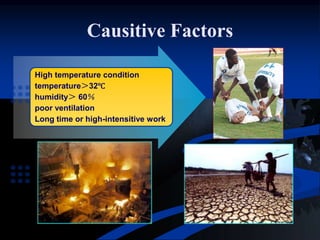
High temperature condition
temperature>32℃
humidity> 60%
poor ventilation
Long time or high-intensitive work
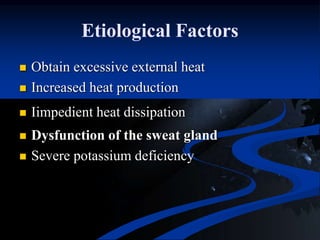
Etiological Factors
 Obtain excessive external heat
 Increased heat production
 Iimpedient heat dissipation
 Dysfunction of the sweat gland
 Severe potassium deficiency
pathogenesis
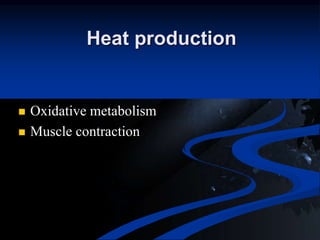
Heat production
 Oxidative metabolism
 Muscle contraction
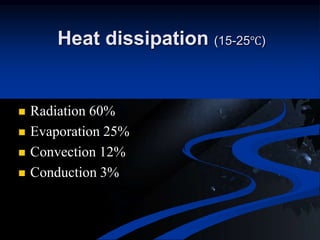
Heat dissipation (15-25℃)
 Radiation 60%
 Evaporation 25%
 Convection 12%
 Conduction 3%
Regulation of heat production and
dissipation
Radiation
•the major way of heat dissipation
•depends on the difference between the body surface and
environmental temperature( 15-25℃ →60%, 33℃ →0% )
the most heat dissipation part of the body is head(50%),
then hands and feet
Convection
Conduction
•depends on the air flow rates
•the conduction power of water is 240 times than the air
Evaporation
•1g water evaporation for 2.4kj(0.58kcal)heat dissipation
•more humidity less evaporation
&
The influence of hyperthermia
on the human body
central nervous system
 inhibiting effect
• inattention
• slow in reacting
• decreased accuracy and Coordination of action
 dysfunction
• delirium、 mania
• coma
cardiovascular system
 arrhythmia
 heart failure
 decreased cardiac output
respiratory system
 respiratory alkalosis
 ARDS
water-electrolyte metabolism
 loss of water and sodium and chlorinum
urinary system
 reduction in renal blood flow and
glomerular filtration rate
• proteinuria and cylindruria
 rhabdomyolysis(横纹肌溶解)
• myoglobinuria(肌红蛋白尿)
• acute renal failure
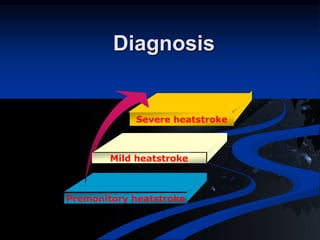
Diagnosis
Severe heatstroke
Mild heatstroke
Premonitory heatstroke
Prodrome
 High temperature environment
 Thirsty、fatigue、 excessive sweating、 dizziness、
headache、palpitation、nausea…
 The body temperature is about normal or slightly high
Mild Hyperthermia
 The exacerbation of premonitory hyperthermia
 The early stage of dysfunction of the circulation:
flushed face or pale complexion、 dysphoria or
apathia 、nausea and vomiting 、 sweating 、
clammy skin, 、thin and rapid pulse、
hypotension 、 increased heart rate
 The body temperature is slightly increased
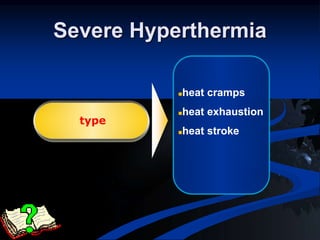
Severe Hyperthermia
heat cramps
heat exhaustion
heat stroke
type
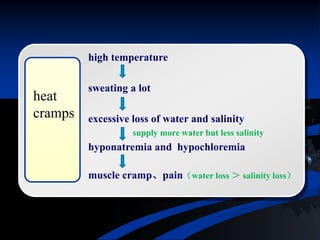
high temperature
sweating a lot
excessive loss of water and salinity
supply more water but less salinity
hyponatremia and hypochloremia
muscle cramp、pain(water loss > salinity loss)
heat
cramps
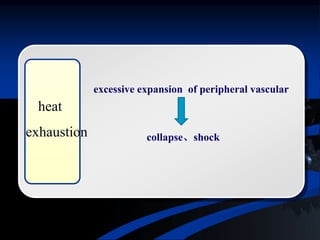
excessive expansion of peripheral vascular
collapse、shock
heat
exhaustion
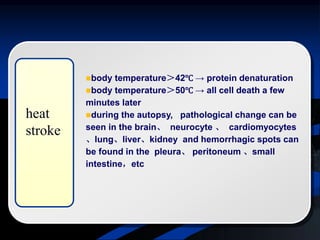
body temperature>42℃ → protein denaturation
body temperature>50℃ → all cell death a few
minutes later
during the autopsy, pathological change can be
seen in the brain、 neurocyte 、 cardiomyocytes
、lung、liver、kidney and hemorrhagic spots can
be found in the pleura、 peritoneum 、small
intestine,etc
heat
stroke
Clinical symptoms of severe
hyperthermia
Heat cramps
 it refers to a severe muscle cramp and contraction pain
(the muscle of four limbs and abdomen)
 it happens at the beginning of the hot season and before
the heat adaptation of the body
 young people who do manual work under the high
temperature circumstance and sweat a lot
Heat exhaustion
 acute onset
 dizziness, headache, suddenly faint , pale complexion ,
cold sweat in the skin, weak or slow pulse, hypotension
but with normal pulse pressure
 awake after lie on the back or leave the high temperature
environment
 old people or individuals with heat intolerance
Heat stroke
 typical symptoms:hyperpyrexia , anidrosis ,
disturbance of consciousness
 prodrome:fatigue, dizziness, headache, nausea,
sweat reduced
 body temperature increases rapidly(>41℃) →
somnolence, apathy, coma
 hot and dry skin ,no sweat, flushed or pale skin ,
or even cyanosis
Heat stroke
 pulse quicken , increased pulse pressure , decreased
blood pressure
 arrhythmia
 fast and shallow breathing ,Chyne-Stokes respiration
 muscle twitches
 pupil contraction ,pupillary light reflex disappear
Heat stroke
shock
heat stroke
heatfailure
arrhythmia
pulmonary edema
cerebral edema
liver and kidney failure
ARDS
gastrointestinal bleeding
DIC…
Laboratory examination
Heat cramps
 blood natrium ↓
 blood chlorine ↓
 ucre urine creatine ↑
Heat exhaustion
 hematocrit (HCT) ↑
 hyponatremia 、 hypokalemia 、slight
azotemia or abnormal liver function
Heat stroke
 hyperkalemia, hypercalcemia, hemoconcentration,
leukocytosis , thrombocytopenia
 Cr、BUN、AST、ALT、LDH、CPK ↑
 proteinuria , cylindruria, myoglobinuria , acidosis
 EKG
Diagnosis
Heat cramps or exhaustion
 exposure history to high temperature environment
 symptoms:sweat a lot, muscle cramps, postural
syncope , transient fall of blood pressure
 laboratory examination
Heat stroke
 three characteristics
• hyperpyrexial fever
• dry and hot skin
• severe central nervous system symptoms
 acute onset
 causitive factors
Differential diagnosis
 diseases cause high fever and coma
• cerebral malaria
• Japanese encephalitis
• meningitis
• acute cerebrovascular disease
• organic phosphorus pesticide poisoning
• …
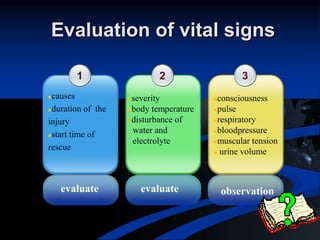
Evaluation of vital signs
1
causes
duration of the
injury
start time of
rescue
2
severity
body temperature
disturbance of
water and
electrolyte
3
consciousness
pulse
respiratory
bloodpressure
muscular tension
 urine volume
evaluate evaluate observation
Treatment
On-site treatment
 leave the high temperature environment immediately
 have a quiet rest in a shelter, loosen the clothing
 drink some cold salty water
 NS、GS、KCL ivgtt (for a circulatory failure patient)
 no massage for the muscle cramp and contraction pain
 electrolyte supplement
 a positive rescue for a heat sroke patient
Hypothermia therapy
lower the temperature of
environment
 cool and ventilated place
 indoor temperature <20 oC
lower the temperature of the body
surface
 rub the body surface
 put the ice bag on the main artery(head, bilateral
carotid artery, armpit, groin)
 avoid shivering
 cold bath
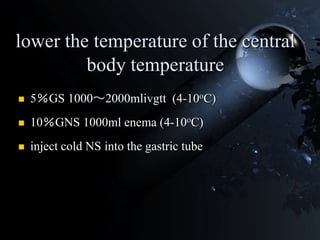
lower the temperature of the central
body temperature
 5%GS 1000~2000mlivgtt (4-10oC)
 10%GNS 1000ml enema (4-10oC)
 inject cold NS into the gastric tube
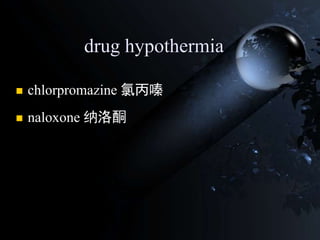
drug hypothermia
 chlorpromazine 氯丙嗪
 naloxone 纳洛酮
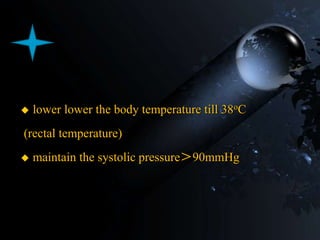
 lower lower the body temperature till 38oC
(rectal temperature)
 maintain the systolic pressure>90mmHg
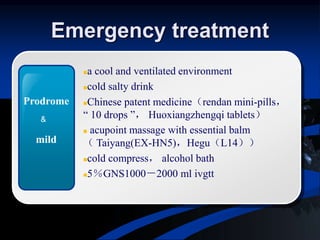
Emergency treatment
a cool and ventilated environment
cold salty drink
Chinese patent medicine(rendan mini-pills,
“ 10 drops ”, Huoxiangzhengqi tablets)
 acupoint massage with essential balm
( Taiyang(EX-HN5),Hegu(L14))
cold compress, alcohol bath
5%GNS1000-2000 ml ivgtt
Prodrome
mild
&
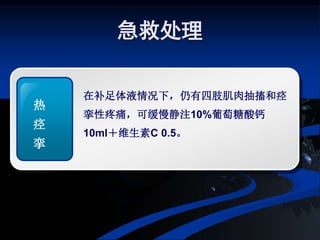
急救处理
热
痉
挛
在补足体液情况下,仍有四肢肌肉抽搐和痉
挛性疼痛,可缓慢静注10%葡萄糖酸钙
10ml+维生素C 0.5。
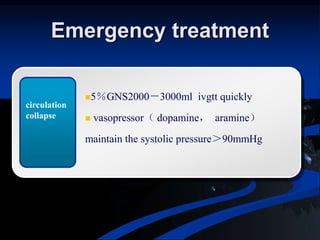
Emergency treatment
5%GNS2000-3000ml ivgtt quickly
 vasopressor( dopamine, aramine)
maintain the systolic pressure>90mmHg
circulation
collapse
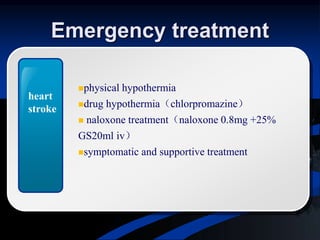
Emergency treatment
physical hypothermia
drug hypothermia(chlorpromazine)
 naloxone treatment(naloxone 0.8mg +25%
GS20ml iv)
symptomatic and supportive treatment
heart
stroke
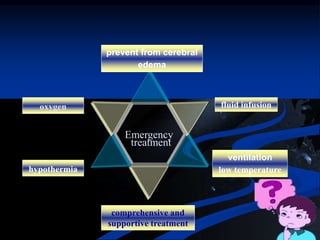
ventilation
low temperature
hypothermia
comprehensive and
supportive treatment
fluid infusion
prevent from cerebral
edema
Emergency
treatment
oxygen
symptomatic treatment
 respiratory function
 circulatory function
 cerebral edema
 renal dysfunction
 hepatic dysfunction
 DIC
 water-electrolyte and acid-base balance
 intensive nursing
prevention and treatment of
multiple organs failure
 lower the central body temperature as soon as
possible
 decrease the metabolic rate
 complication treatment
Prognosis
 mortality:20% -70%
 the worst type:heat stroke
 sequela
• mild neural dysfunction
• several weeks of muscular weakness
• permanent brain damage
Prevention
TCM treatment
Heat-clearing drinks
hawthorn tea(山楂汤)
hawthorn 100g, dark plum 50g, feverfew20g
iced water melon juice
sweet mung bean soup and plum juice(绿豆酸梅汤)
lotus leaf tea
fresh lotus leaf10g, baizhu10g, huoxiang6g, gancao6g
lonicera japonica tea(金银花汤)
Chinese patent medicine
Rendan mini-pills 人丹
“10 drops”(a popular medicine for summer aliments)
十滴水
 essential balm清凉油
thank you!

20161011092733102.ppt

  • 1.
    Hyperthermia Zhang Yinglan MD, Associatechief physician Emergency Department Longhua Hospital Affiliated Shanghai University of TCM
  • 2.
    What is hyperthermia? It is an acute heat injury disease resulting from prolonged exposure to high environmental temperature which causes a dysfunction of the temperature-regulating mechanism and excessive loss of water-electrolyte of the body.
  • 3.
    Causitive Factors  hightemperature climate  dry-heat working condition and high humid-warm environment  dysfunction of the temperature-regulating mechanism • increased heat production • poor heat adaptation • impedient heat dissipation
  • 4.
    Causitive Factors High temperaturecondition temperature>32℃ humidity> 60% poor ventilation Long time or high-intensitive work
  • 5.
    Etiological Factors  Obtainexcessive external heat  Increased heat production  Iimpedient heat dissipation  Dysfunction of the sweat gland  Severe potassium deficiency
  • 6.
  • 7.
    Heat production  Oxidativemetabolism  Muscle contraction
  • 8.
    Heat dissipation (15-25℃) Radiation 60%  Evaporation 25%  Convection 12%  Conduction 3%
  • 9.
    Regulation of heatproduction and dissipation Radiation •the major way of heat dissipation •depends on the difference between the body surface and environmental temperature( 15-25℃ →60%, 33℃ →0% ) the most heat dissipation part of the body is head(50%), then hands and feet Convection Conduction •depends on the air flow rates •the conduction power of water is 240 times than the air Evaporation •1g water evaporation for 2.4kj(0.58kcal)heat dissipation •more humidity less evaporation &
  • 10.
    The influence ofhyperthermia on the human body
  • 11.
    central nervous system inhibiting effect • inattention • slow in reacting • decreased accuracy and Coordination of action  dysfunction • delirium、 mania • coma
  • 12.
    cardiovascular system  arrhythmia heart failure  decreased cardiac output
  • 13.
  • 14.
    water-electrolyte metabolism  lossof water and sodium and chlorinum
  • 15.
    urinary system  reductionin renal blood flow and glomerular filtration rate • proteinuria and cylindruria  rhabdomyolysis(横纹肌溶解) • myoglobinuria(肌红蛋白尿) • acute renal failure
  • 16.
  • 17.
    Prodrome  High temperatureenvironment  Thirsty、fatigue、 excessive sweating、 dizziness、 headache、palpitation、nausea…  The body temperature is about normal or slightly high
  • 18.
    Mild Hyperthermia  Theexacerbation of premonitory hyperthermia  The early stage of dysfunction of the circulation: flushed face or pale complexion、 dysphoria or apathia 、nausea and vomiting 、 sweating 、 clammy skin, 、thin and rapid pulse、 hypotension 、 increased heart rate  The body temperature is slightly increased
  • 19.
    Severe Hyperthermia heat cramps heatexhaustion heat stroke type
  • 20.
    high temperature sweating alot excessive loss of water and salinity supply more water but less salinity hyponatremia and hypochloremia muscle cramp、pain(water loss > salinity loss) heat cramps
  • 21.
    excessive expansion ofperipheral vascular collapse、shock heat exhaustion
  • 22.
    body temperature>42℃ →protein denaturation body temperature>50℃ → all cell death a few minutes later during the autopsy, pathological change can be seen in the brain、 neurocyte 、 cardiomyocytes 、lung、liver、kidney and hemorrhagic spots can be found in the pleura、 peritoneum 、small intestine,etc heat stroke
  • 23.
    Clinical symptoms ofsevere hyperthermia
  • 24.
    Heat cramps  itrefers to a severe muscle cramp and contraction pain (the muscle of four limbs and abdomen)  it happens at the beginning of the hot season and before the heat adaptation of the body  young people who do manual work under the high temperature circumstance and sweat a lot
  • 25.
    Heat exhaustion  acuteonset  dizziness, headache, suddenly faint , pale complexion , cold sweat in the skin, weak or slow pulse, hypotension but with normal pulse pressure  awake after lie on the back or leave the high temperature environment  old people or individuals with heat intolerance
  • 26.
    Heat stroke  typicalsymptoms:hyperpyrexia , anidrosis , disturbance of consciousness  prodrome:fatigue, dizziness, headache, nausea, sweat reduced  body temperature increases rapidly(>41℃) → somnolence, apathy, coma  hot and dry skin ,no sweat, flushed or pale skin , or even cyanosis
  • 27.
    Heat stroke  pulsequicken , increased pulse pressure , decreased blood pressure  arrhythmia  fast and shallow breathing ,Chyne-Stokes respiration  muscle twitches  pupil contraction ,pupillary light reflex disappear
  • 28.
    Heat stroke shock heat stroke heatfailure arrhythmia pulmonaryedema cerebral edema liver and kidney failure ARDS gastrointestinal bleeding DIC…
  • 29.
  • 30.
    Heat cramps  bloodnatrium ↓  blood chlorine ↓  ucre urine creatine ↑
  • 31.
    Heat exhaustion  hematocrit(HCT) ↑  hyponatremia 、 hypokalemia 、slight azotemia or abnormal liver function
  • 32.
    Heat stroke  hyperkalemia,hypercalcemia, hemoconcentration, leukocytosis , thrombocytopenia  Cr、BUN、AST、ALT、LDH、CPK ↑  proteinuria , cylindruria, myoglobinuria , acidosis  EKG
  • 33.
  • 34.
    Heat cramps orexhaustion  exposure history to high temperature environment  symptoms:sweat a lot, muscle cramps, postural syncope , transient fall of blood pressure  laboratory examination
  • 35.
    Heat stroke  threecharacteristics • hyperpyrexial fever • dry and hot skin • severe central nervous system symptoms  acute onset  causitive factors
  • 36.
    Differential diagnosis  diseasescause high fever and coma • cerebral malaria • Japanese encephalitis • meningitis • acute cerebrovascular disease • organic phosphorus pesticide poisoning • …
  • 37.
    Evaluation of vitalsigns 1 causes duration of the injury start time of rescue 2 severity body temperature disturbance of water and electrolyte 3 consciousness pulse respiratory bloodpressure muscular tension  urine volume evaluate evaluate observation
  • 38.
  • 39.
    On-site treatment  leavethe high temperature environment immediately  have a quiet rest in a shelter, loosen the clothing  drink some cold salty water  NS、GS、KCL ivgtt (for a circulatory failure patient)  no massage for the muscle cramp and contraction pain  electrolyte supplement  a positive rescue for a heat sroke patient
  • 40.
  • 41.
    lower the temperatureof environment  cool and ventilated place  indoor temperature <20 oC
  • 42.
    lower the temperatureof the body surface  rub the body surface  put the ice bag on the main artery(head, bilateral carotid artery, armpit, groin)  avoid shivering  cold bath
  • 43.
    lower the temperatureof the central body temperature  5%GS 1000~2000mlivgtt (4-10oC)  10%GNS 1000ml enema (4-10oC)  inject cold NS into the gastric tube
  • 44.
    drug hypothermia  chlorpromazine氯丙嗪  naloxone 纳洛酮
  • 45.
     lower lowerthe body temperature till 38oC (rectal temperature)  maintain the systolic pressure>90mmHg
  • 46.
    Emergency treatment a cooland ventilated environment cold salty drink Chinese patent medicine(rendan mini-pills, “ 10 drops ”, Huoxiangzhengqi tablets)  acupoint massage with essential balm ( Taiyang(EX-HN5),Hegu(L14)) cold compress, alcohol bath 5%GNS1000-2000 ml ivgtt Prodrome mild &
  • 47.
  • 48.
    Emergency treatment 5%GNS2000-3000ml ivgttquickly  vasopressor( dopamine, aramine) maintain the systolic pressure>90mmHg circulation collapse
  • 49.
    Emergency treatment physical hypothermia drughypothermia(chlorpromazine)  naloxone treatment(naloxone 0.8mg +25% GS20ml iv) symptomatic and supportive treatment heart stroke
  • 50.
    ventilation low temperature hypothermia comprehensive and supportivetreatment fluid infusion prevent from cerebral edema Emergency treatment oxygen
  • 51.
    symptomatic treatment  respiratoryfunction  circulatory function  cerebral edema  renal dysfunction  hepatic dysfunction  DIC  water-electrolyte and acid-base balance  intensive nursing
  • 52.
    prevention and treatmentof multiple organs failure  lower the central body temperature as soon as possible  decrease the metabolic rate  complication treatment
  • 53.
    Prognosis  mortality:20% -70% the worst type:heat stroke  sequela • mild neural dysfunction • several weeks of muscular weakness • permanent brain damage
  • 54.
  • 55.
  • 56.
    Heat-clearing drinks hawthorn tea(山楂汤) hawthorn100g, dark plum 50g, feverfew20g iced water melon juice sweet mung bean soup and plum juice(绿豆酸梅汤) lotus leaf tea fresh lotus leaf10g, baizhu10g, huoxiang6g, gancao6g lonicera japonica tea(金银花汤)
  • 57.
    Chinese patent medicine Rendanmini-pills 人丹 “10 drops”(a popular medicine for summer aliments) 十滴水  essential balm清凉油
  • 58.