THERMOMETRY
Presented by
Dheeraj kakde
Jagadale Saurabh
Sankpal Adesh
Saraf Akshay
THERMOMETRY
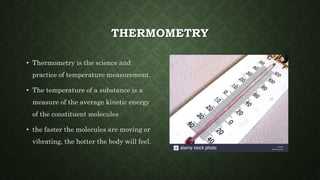
• Thermometry is the science and
practice of temperature measurement.
• The temperature of a substance is a
measure of the average kinetic energy
of the constituent molecules
• the faster the molecules are moving or
vibrating, the hotter the body will feel.
THERMOMETRY (CONTD.)
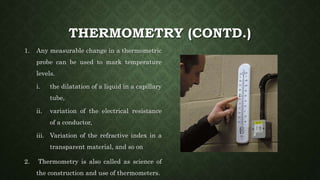
1. Any measurable change in a thermometric
probe can be used to mark temperature
levels.
i. the dilatation of a liquid in a capillary
tube,
ii. variation of the electrical resistance
of a conductor,
iii. Variation of the refractive index in a
transparent material, and so on
2. Thermometry is also called as science of
the construction and use of thermometers.
HISTORY
• Philo of Byzantium (280 - 220 BC) was aware
that air expands and contracts with changes
in temperature
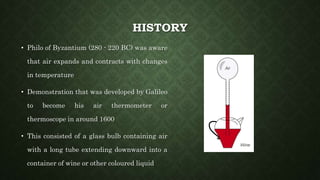
• Demonstration that was developed by Galileo
to become his air thermometer or
thermoscope in around 1600
• This consisted of a glass bulb containing air
with a long tube extending downward into a
container of wine or other coloured liquid
HISTORY (CONTD.)
• Engraving a scale on the tube converted
the thermoscope into the first
thermometer.
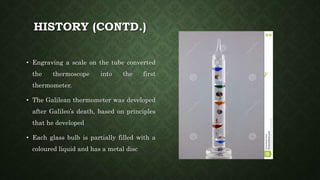
• The Galilean thermometer was developed
after Galileo’s death, based on principles
that he developed
• Each glass bulb is partially filled with a
coloured liquid and has a metal disc
TYPES OF THERMOMETRY
• Contact Thermometry: -
1. when there exists physical contact
between the tested object and the
thermometer.
2. Examples: -
1. Temperature of hot water
2. Temperature of body
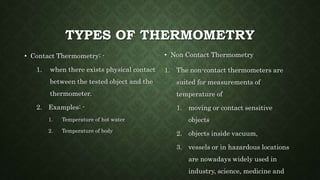
• Non Contact Thermometry
1. The non-contact thermometers are
suited for measurements of
temperature of
1. moving or contact sensitive
objects
2. objects inside vacuum,
3. vessels or in hazardous locations
are nowadays widely used in
industry, science, medicine and
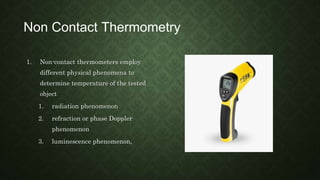
Non Contact Thermometry
1. Non-contact thermometers employ
different physical phenomena to
determine temperature of the tested
object
1. radiation phenomenon
2. refraction or phase Doppler
phenomenon
3. luminescence phenomenon,
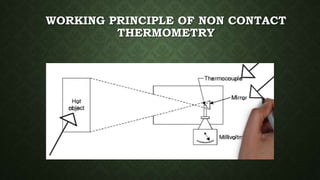
WORKING PRINCIPLE OF NON CONTACT
THERMOMETRY
CONTACT TYPE
THERMOMETRY
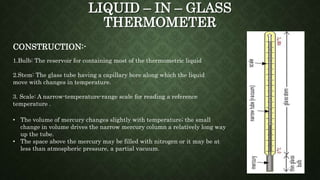
LIQUID – IN – GLASS
THERMOMETER
1.Bulb: The reservoir for containing most of the thermometric liquid
2.Stem: The glass tube having a capillary bore along which the liquid
move with changes in temperature.
3. Scale: A narrow-temperature-range scale for reading a reference
temperature .
• The volume of mercury changes slightly with temperature; the small
change in volume drives the narrow mercury column a relatively long way
up the tube.
• The space above the mercury may be filled with nitrogen or it may be at
less than atmospheric pressure, a partial vacuum.
CONSTRUCTION:-
WORKING
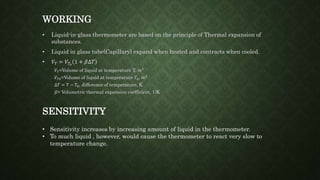
• Liquid-in-glass thermometer are based on the principle of Thermal expansion of
substances.
• Liquid in glass tube(Capillary) expand when heated and contracts when cooled.
• 𝑉𝑇 = 𝑉𝑇0
1 + 𝛽∆𝑇
𝑉𝑇=Volume of liquid at temperature T, 𝑚3
𝑉𝑇0=Volume of liquid at temperature 𝑇0, 𝑚3
∆𝑇 = 𝑇 − 𝑇0, difference of temperature, K
𝛽= Volumetric thermal expansion coefficient, 1/K
SENSITIVITY
• Sensitivity increases by increasing amount of liquid in the thermometer.
• To much liquid , however, would cause the thermometer to react very slow to
temperature change.
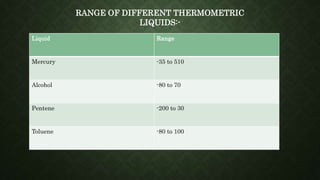
Liquid Range
Mercury -35 to 510
Alcohol -80 to 70
Pentene -200 to 30
Toluene -80 to 100
RANGE OF DIFFERENT THERMOMETRIC
LIQUIDS:-
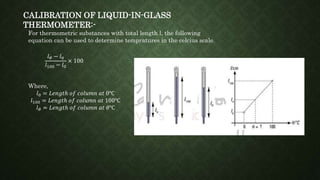
CALIBRATION OF LIQUID-IN-GLASS
THERMOMETER:-
For thermometric substances with total length l, the following
equation can be used to determine tempratures in the celcius scale.
𝑙 𝜃 − 𝑙0
𝑙100 − 𝑙0
× 100
Where,
𝑙0 = 𝐿𝑒𝑛𝑔𝑡ℎ 𝑜𝑓 𝑐𝑜𝑙𝑢𝑚𝑛 𝑎𝑡 0℃
𝑙100 = 𝐿𝑒𝑛𝑔𝑡ℎ 𝑜𝑓 𝑐𝑜𝑙𝑢𝑚𝑛 𝑎𝑡 100℃
𝑙 𝜃 = 𝐿𝑒𝑛𝑔𝑡ℎ 𝑜𝑓 𝑐𝑜𝑙𝑢𝑚𝑛 𝑎𝑡 𝜃℃
Advantages
1) Simplicity in use & low cost.
2) Portable device.
3) Checking physical damage is easy.
4) Power source not require.
Disadvantages
1) Can not used for automatic recording.
2) Time lag in measurement.
3) Range is limited to about 600 °C .
4) Fragile construction
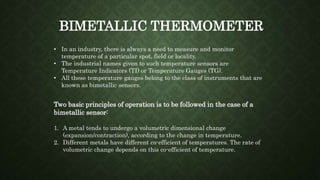
BIMETALLIC THERMOMETER
• In an industry, there is always a need to measure and monitor
temperature of a particular spot, field or locality.
• The industrial names given to such temperature sensors are
Temperature Indicators (TI) or Temperature Gauges (TG).
• All these temperature gauges belong to the class of instruments that are
known as bimetallic sensors.
Two basic principles of operation is to be followed in the case of a
bimetallic sensor:
1. A metal tends to undergo a volumetric dimensional change
(expansion/contraction), according to the change in temperature.
2. Different metals have different co-efficient of temperatures. The rate of
volumetric change depends on this co-efficient of temperature.
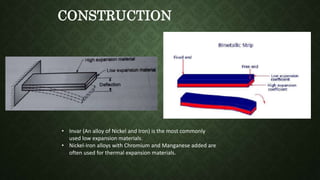
• Invar (An alloy of Nickel and Iron) is the most commonly
used low expansion materials.
• Nickel-Iron alloys with Chromium and Manganese added are
often used for thermal expansion materials.
CONSTRUCTION
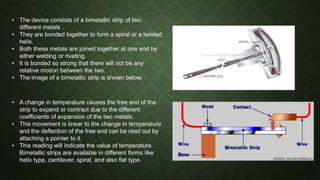
• The device consists of a bimetallic strip of two
different metals .
• They are bonded together to form a spiral or a twisted
helix.
• Both these metals are joined together at one end by
either welding or riveting.
• It is bonded so strong that there will not be any
relative motion between the two.
• The image of a bimetallic strip is shown below.
• A change in temperature causes the free end of the
strip to expand or contract due to the different
coefficients of expansion of the two metals.
• This movement is linear to the change in temperature
and the deflection of the free end can be read out by
attaching a pointer to it.
• This reading will indicate the value of temperature.
Bimetallic strips are available in different forms like
helix type, cantilever, spiral, and also flat type.
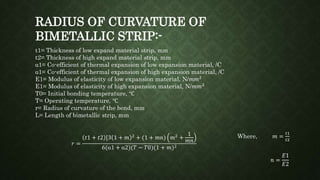
t1= Thickness of low expand material strip, mm
t2= Thickness of high expand material strip, mm
α1= Co-efficient of thermal expansion of low expansion material, /C
α1= Co-efficient of thermal expansion of high expansion material, /C
E1= Modulus of elasticity of low expansion material, N/𝑚𝑚2
E1= Modulus of elasticity of high expansion material, N/𝑚𝑚2
T0= Initial bonding temperature, ℃
T= Operating temperature, ℃
r= Radius of curvature of the bend, mm
L= Length of bimetallic strip, mm
Where, 𝑚 =
𝑡1
𝑡2
𝑛 =
𝐸1
𝐸2
𝑟 =
𝑡1 + 𝑡2 [3 1 + 𝑚 2
+ (1 + 𝑚𝑛) 𝑚2
+
1
𝑚𝑛
6(α1 + α2)(𝑇 − 𝑇0)(1 + 𝑚)2
RADIUS OF CURVATURE OF
BIMETALLIC STRIP:-
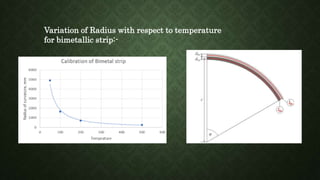
Variation of Radius with respect to temperature
for bimetallic strip:-
Advantages
1. Power source not required
2. Robust, easy to use and cheap.
3. Can be used to 500 °C.
Disadvantages
1. Not very accurate.
2. Limited to applications where manual reading is acceptable.
3. Not suitable for very low temperatures because the expansion of
metals tend to be too similar, so the device becomes a rather
insensitive thermometer
RESISTANCE
TEMPERATURE DETECTOR
(RTD)
 PRINCIPLE : TEMPATURE = RESISTANCE
 Positive temperature coefficient
 classified according to the different sensing elements
used –Platinum, Nickel, Copper
 RTDs are more accurate but also larger and more
expensive than thermocouples.
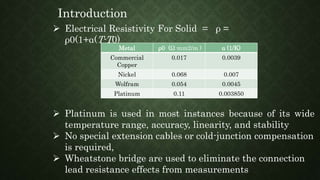
 Electrical Resistivity For Solid = ρ =
ρ0(1+α(T-T0)
Metal ρ0 (Ω·mm2/m ) α (1/K)
Commercial
Copper
0.017 0.0039
Nickel 0.068 0.007
Wolfram 0.054 0.0045
Platinum 0.11 0.003850
 Platinum is used in most instances because of its wide
temperature range, accuracy, linearity, and stability
 No special extension cables or cold-junction compensation
is required,
 Wheatstone bridge are used to eliminate the connection
lead resistance effects from measurements
Introduction
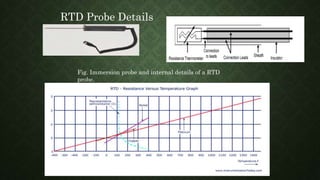
Fig. Immersion probe and internal details of a RTD
probe.
RTD Probe Details
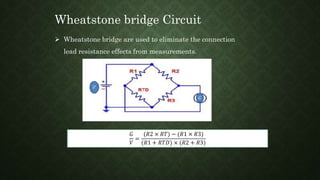
Wheatstone bridge Circuit
 Wheatstone bridge are used to eliminate the connection
lead resistance effects from measurements.
𝐺
𝑉
=
(𝑅2 × 𝑅𝑇) − (𝑅1 × 𝑅3)
(𝑅1 + 𝑅𝑇𝐷) × (𝑅2 + 𝑅3)
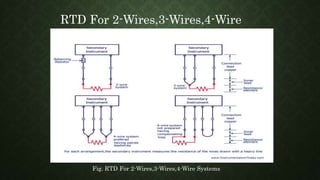
Fig. RTD For 2-Wires,3-Wires,4-Wire Systems
RTD For 2-Wires,3-Wires,4-Wire
Systems
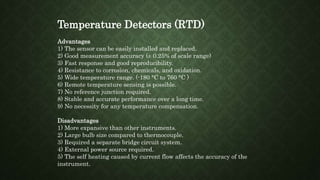
Temperature Detectors (RTD)
Advantages
1) The sensor can be easily installed and replaced.
2) Good measurement accuracy (± 0.25% of scale range)
3) Fast response and good reproducibility.
4) Resistance to corrosion, chemicals, and oxidation.
5) Wide temperature range. (-180 °C to 760 °C )
6) Remote temperature sensing is possible.
7) No reference junction required.
8) Stable and accurate performance over a long time.
9) No necessity for any temperature compensation.
Disadvantages
1) More expansive than other instruments.
2) Large bulb size compared to thermocouple.
3) Required a separate bridge circuit system.
4) External power source required.
5) The self heating caused by current flow affects the accuracy of the
instrument.
Thermocouples
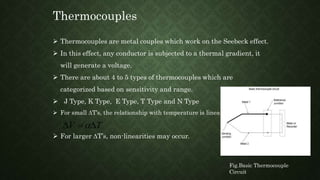
Fig.Basic Thermocouple
Circuit
 Thermocouples are metal couples which work on the Seebeck effect.
 In this effect, any conductor is subjected to a thermal gradient, it
will generate a voltage.
 There are about 4 to 5 types of thermocouples which are
categorized based on sensitivity and range.
 J Type, K Type, E Type, T Type and N Type
 For small DT’s, the relationship with temperature is linear
 For larger DT’s, non-linearities may occur.
V TD  D
Working
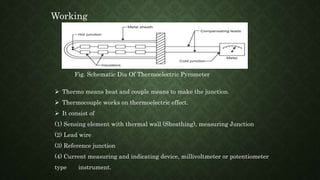
Fig. Schematic Dia Of Thermoelectric Pyrometer
 Thermo means heat and couple means to make the junction.
 Thermocouple works on thermoelectric effect.
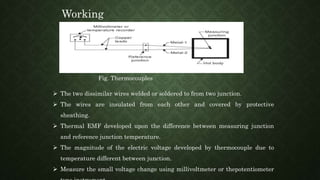
 It consist of
(1) Sensing element with thermal wall (Sheathing), measuring Junction
(2) Lead wire
(3) Reference junction
(4) Current measuring and indicating device, millivoltmeter or potentiometer
type instrument.
 The two dissimilar wires welded or soldered to from two junction.
 The wires are insulated from each other and covered by protective
sheathing.
 Thermal EMF developed upon the difference between measuring junction
and reference junction temperature.
 The magnitude of the electric voltage developed by thermocouple due to
temperature different between junction.
 Measure the small voltage change using millivoltmeter or thepotentiometer
Working
Fig. Thermocouples
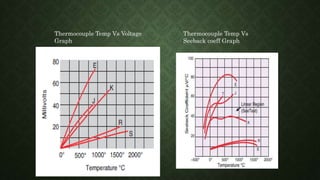
Thermocouple Temp Vs Voltage
Graph
Thermocouple Temp Vs
Seeback coeff Graph
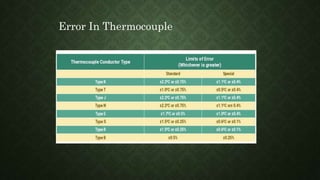
Error In Thermocouple
Advantages
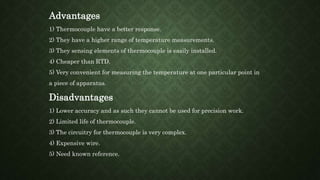
1) Thermocouple have a better response.
2) They have a higher range of temperature measurements.
3) They sensing elements of thermocouple is easily installed.
4) Cheaper than RTD.
5) Very convenient for measuring the temperature at one particular point in
a piece of apparatus.
Disadvantages
1) Lower accuracy and as such they cannot be used for precision work.
2) Limited life of thermocouple.
3) The circuitry for thermocouple is very complex.
4) Expensive wire.
5) Need known reference.
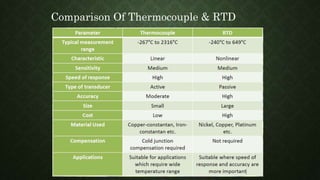
Comparison Of Thermocouple & RTD
Thermistors:
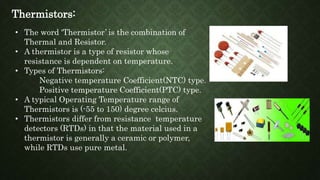
• The word ‘Thermistor’ is the combination of
Thermal and Resistor.
• A thermistor is a type of resistor whose
resistance is dependent on temperature.
• Types of Thermistors:
Negative temperature Coefficient(NTC) type.
Positive temperature Coefficient(PTC) type.
• A typical Operating Temperature range of
Thermistors is (-55 to 150) degree celcius.
• Thermistors differ from resistance temperature
detectors (RTDs) in that the material used in a
thermistor is generally a ceramic or polymer,
while RTDs use pure metal.
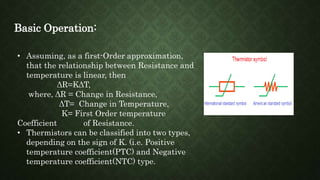
Basic Operation:
• Assuming, as a first-Order approximation,
that the relationship between Resistance and
temperature is linear, then
ΔR=KΔT,
where, ΔR = Change in Resistance,
ΔT= Change in Temperature,
K= First Order temperature
Coefficient of Resistance.
• Thermistors can be classified into two types,
depending on the sign of K. (i.e. Positive
temperature coefficient(PTC) and Negative
temperature coefficient(NTC) type.
Conduction Model:
1] Negative Temperature coefficient(NTC)
• NTC thermistors are made from a pressed disc, rod,
plate, bed or caste chip of semiconducting material
such as Sintered metal oxides.
• They work because raising the temperature of a
semiconductor increases the number of active charge
carriers, it promotes them into the conduction band.
• The more charge carriers that are available, the
more current a material can conduct.
• The more the current conducted, the less will be its
Resistance.
• This is described in the formula,
I= ρAve
2] Positive temperature coefficient(PTC):
• Most PTC thermistors are made from doped polycrystalline
ceramic (containing barium titanate (BaTiO3) and other
compounds.
• These material have the property that their resistance rises
suddenly at a certain critical temperature.
• Below the Curie point temperature, the high dielectric
constant prevents the formation of potential barriers
between the crystal grains, leading to a low resistance.
• At Curie point temperature, the dielectric constant drops
sufficiently to allow the formation of potential barriers at
the grain boundaries,and the resistance increases sharply
with temperature.
Applications:
1] PTC:
-As Current limiting devices for circuit problem.
-In temperature compensated synthesizer voltage controlled
Oscillators.
-In Lithium Battery protection circuits.
-In an electrically actuated wax motor to provide the heat
necessary to
expand the wax.
2] NTC:
- As a resistance thermometer for low temperature
measurements of the
order of 10K.
-To monitor the temperature of an Incubator.
-Modern digital thermostats.
-3 D printers.
Calibration of Thermistors:
• Linear approximation is valid only for limited tem-
perature range but not for wide temperature range.
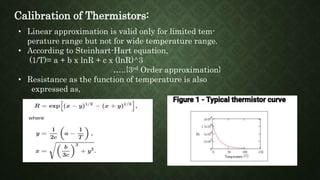
• According to Steinhart-Hart equation,
(1/T)= a + b x lnR + c x (lnR)^3
…..{3rd Order approximation}
• Resistance as the function of temperature is also
expressed as,
Advantages:
• It has fast response over narrow temperature range.
• It is small in Size.
• Contact and lead resistance problem not occurred due to large resistance.
• It has good sensitivity in NTC region.
• Its cost is low.
Disadvantages:
• The Thermistor needs shielding Power lines.
• The excitation current should be low to avoid self heating.
• Not suitable for large temperature range.
• Resistance – Temperature characteristics are non linear.

thermometry

  • 1.
    THERMOMETRY Presented by Dheeraj kakde JagadaleSaurabh Sankpal Adesh Saraf Akshay
  • 2.
    THERMOMETRY • Thermometry isthe science and practice of temperature measurement. • The temperature of a substance is a measure of the average kinetic energy of the constituent molecules • the faster the molecules are moving or vibrating, the hotter the body will feel.
  • 3.
    THERMOMETRY (CONTD.) 1. Anymeasurable change in a thermometric probe can be used to mark temperature levels. i. the dilatation of a liquid in a capillary tube, ii. variation of the electrical resistance of a conductor, iii. Variation of the refractive index in a transparent material, and so on 2. Thermometry is also called as science of the construction and use of thermometers.
  • 4.
    HISTORY • Philo ofByzantium (280 - 220 BC) was aware that air expands and contracts with changes in temperature • Demonstration that was developed by Galileo to become his air thermometer or thermoscope in around 1600 • This consisted of a glass bulb containing air with a long tube extending downward into a container of wine or other coloured liquid
  • 5.
    HISTORY (CONTD.) • Engravinga scale on the tube converted the thermoscope into the first thermometer. • The Galilean thermometer was developed after Galileo’s death, based on principles that he developed • Each glass bulb is partially filled with a coloured liquid and has a metal disc
  • 6.
    TYPES OF THERMOMETRY •Contact Thermometry: - 1. when there exists physical contact between the tested object and the thermometer. 2. Examples: - 1. Temperature of hot water 2. Temperature of body • Non Contact Thermometry 1. The non-contact thermometers are suited for measurements of temperature of 1. moving or contact sensitive objects 2. objects inside vacuum, 3. vessels or in hazardous locations are nowadays widely used in industry, science, medicine and
  • 7.
    Non Contact Thermometry 1.Non-contact thermometers employ different physical phenomena to determine temperature of the tested object 1. radiation phenomenon 2. refraction or phase Doppler phenomenon 3. luminescence phenomenon,
  • 8.
    WORKING PRINCIPLE OFNON CONTACT THERMOMETRY
  • 9.
  • 10.
    LIQUID – IN– GLASS THERMOMETER 1.Bulb: The reservoir for containing most of the thermometric liquid 2.Stem: The glass tube having a capillary bore along which the liquid move with changes in temperature. 3. Scale: A narrow-temperature-range scale for reading a reference temperature . • The volume of mercury changes slightly with temperature; the small change in volume drives the narrow mercury column a relatively long way up the tube. • The space above the mercury may be filled with nitrogen or it may be at less than atmospheric pressure, a partial vacuum. CONSTRUCTION:-
  • 11.
    WORKING • Liquid-in-glass thermometerare based on the principle of Thermal expansion of substances. • Liquid in glass tube(Capillary) expand when heated and contracts when cooled. • 𝑉𝑇 = 𝑉𝑇0 1 + 𝛽∆𝑇 𝑉𝑇=Volume of liquid at temperature T, 𝑚3 𝑉𝑇0=Volume of liquid at temperature 𝑇0, 𝑚3 ∆𝑇 = 𝑇 − 𝑇0, difference of temperature, K 𝛽= Volumetric thermal expansion coefficient, 1/K SENSITIVITY • Sensitivity increases by increasing amount of liquid in the thermometer. • To much liquid , however, would cause the thermometer to react very slow to temperature change.
  • 12.
    Liquid Range Mercury -35to 510 Alcohol -80 to 70 Pentene -200 to 30 Toluene -80 to 100 RANGE OF DIFFERENT THERMOMETRIC LIQUIDS:-
  • 13.
    CALIBRATION OF LIQUID-IN-GLASS THERMOMETER:- Forthermometric substances with total length l, the following equation can be used to determine tempratures in the celcius scale. 𝑙 𝜃 − 𝑙0 𝑙100 − 𝑙0 × 100 Where, 𝑙0 = 𝐿𝑒𝑛𝑔𝑡ℎ 𝑜𝑓 𝑐𝑜𝑙𝑢𝑚𝑛 𝑎𝑡 0℃ 𝑙100 = 𝐿𝑒𝑛𝑔𝑡ℎ 𝑜𝑓 𝑐𝑜𝑙𝑢𝑚𝑛 𝑎𝑡 100℃ 𝑙 𝜃 = 𝐿𝑒𝑛𝑔𝑡ℎ 𝑜𝑓 𝑐𝑜𝑙𝑢𝑚𝑛 𝑎𝑡 𝜃℃
  • 14.
    Advantages 1) Simplicity inuse & low cost. 2) Portable device. 3) Checking physical damage is easy. 4) Power source not require. Disadvantages 1) Can not used for automatic recording. 2) Time lag in measurement. 3) Range is limited to about 600 °C . 4) Fragile construction
  • 15.
    BIMETALLIC THERMOMETER • Inan industry, there is always a need to measure and monitor temperature of a particular spot, field or locality. • The industrial names given to such temperature sensors are Temperature Indicators (TI) or Temperature Gauges (TG). • All these temperature gauges belong to the class of instruments that are known as bimetallic sensors. Two basic principles of operation is to be followed in the case of a bimetallic sensor: 1. A metal tends to undergo a volumetric dimensional change (expansion/contraction), according to the change in temperature. 2. Different metals have different co-efficient of temperatures. The rate of volumetric change depends on this co-efficient of temperature.
  • 16.
    • Invar (Analloy of Nickel and Iron) is the most commonly used low expansion materials. • Nickel-Iron alloys with Chromium and Manganese added are often used for thermal expansion materials. CONSTRUCTION
  • 17.
    • The deviceconsists of a bimetallic strip of two different metals . • They are bonded together to form a spiral or a twisted helix. • Both these metals are joined together at one end by either welding or riveting. • It is bonded so strong that there will not be any relative motion between the two. • The image of a bimetallic strip is shown below. • A change in temperature causes the free end of the strip to expand or contract due to the different coefficients of expansion of the two metals. • This movement is linear to the change in temperature and the deflection of the free end can be read out by attaching a pointer to it. • This reading will indicate the value of temperature. Bimetallic strips are available in different forms like helix type, cantilever, spiral, and also flat type.
  • 18.
    t1= Thickness oflow expand material strip, mm t2= Thickness of high expand material strip, mm α1= Co-efficient of thermal expansion of low expansion material, /C α1= Co-efficient of thermal expansion of high expansion material, /C E1= Modulus of elasticity of low expansion material, N/𝑚𝑚2 E1= Modulus of elasticity of high expansion material, N/𝑚𝑚2 T0= Initial bonding temperature, ℃ T= Operating temperature, ℃ r= Radius of curvature of the bend, mm L= Length of bimetallic strip, mm Where, 𝑚 = 𝑡1 𝑡2 𝑛 = 𝐸1 𝐸2 𝑟 = 𝑡1 + 𝑡2 [3 1 + 𝑚 2 + (1 + 𝑚𝑛) 𝑚2 + 1 𝑚𝑛 6(α1 + α2)(𝑇 − 𝑇0)(1 + 𝑚)2 RADIUS OF CURVATURE OF BIMETALLIC STRIP:-
  • 19.
    Variation of Radiuswith respect to temperature for bimetallic strip:-
  • 20.
    Advantages 1. Power sourcenot required 2. Robust, easy to use and cheap. 3. Can be used to 500 °C. Disadvantages 1. Not very accurate. 2. Limited to applications where manual reading is acceptable. 3. Not suitable for very low temperatures because the expansion of metals tend to be too similar, so the device becomes a rather insensitive thermometer
  • 21.
    RESISTANCE TEMPERATURE DETECTOR (RTD)  PRINCIPLE: TEMPATURE = RESISTANCE  Positive temperature coefficient  classified according to the different sensing elements used –Platinum, Nickel, Copper  RTDs are more accurate but also larger and more expensive than thermocouples.
  • 22.
     Electrical ResistivityFor Solid = ρ = ρ0(1+α(T-T0) Metal ρ0 (Ω·mm2/m ) α (1/K) Commercial Copper 0.017 0.0039 Nickel 0.068 0.007 Wolfram 0.054 0.0045 Platinum 0.11 0.003850  Platinum is used in most instances because of its wide temperature range, accuracy, linearity, and stability  No special extension cables or cold-junction compensation is required,  Wheatstone bridge are used to eliminate the connection lead resistance effects from measurements Introduction
  • 23.
    Fig. Immersion probeand internal details of a RTD probe. RTD Probe Details
  • 24.
    Wheatstone bridge Circuit Wheatstone bridge are used to eliminate the connection lead resistance effects from measurements. 𝐺 𝑉 = (𝑅2 × 𝑅𝑇) − (𝑅1 × 𝑅3) (𝑅1 + 𝑅𝑇𝐷) × (𝑅2 + 𝑅3)
  • 25.
    Fig. RTD For2-Wires,3-Wires,4-Wire Systems RTD For 2-Wires,3-Wires,4-Wire Systems
  • 26.
    Temperature Detectors (RTD) Advantages 1)The sensor can be easily installed and replaced. 2) Good measurement accuracy (± 0.25% of scale range) 3) Fast response and good reproducibility. 4) Resistance to corrosion, chemicals, and oxidation. 5) Wide temperature range. (-180 °C to 760 °C ) 6) Remote temperature sensing is possible. 7) No reference junction required. 8) Stable and accurate performance over a long time. 9) No necessity for any temperature compensation. Disadvantages 1) More expansive than other instruments. 2) Large bulb size compared to thermocouple. 3) Required a separate bridge circuit system. 4) External power source required. 5) The self heating caused by current flow affects the accuracy of the instrument.
  • 27.
    Thermocouples Fig.Basic Thermocouple Circuit  Thermocouplesare metal couples which work on the Seebeck effect.  In this effect, any conductor is subjected to a thermal gradient, it will generate a voltage.  There are about 4 to 5 types of thermocouples which are categorized based on sensitivity and range.  J Type, K Type, E Type, T Type and N Type  For small DT’s, the relationship with temperature is linear  For larger DT’s, non-linearities may occur. V TD  D
  • 28.
    Working Fig. Schematic DiaOf Thermoelectric Pyrometer  Thermo means heat and couple means to make the junction.  Thermocouple works on thermoelectric effect.  It consist of (1) Sensing element with thermal wall (Sheathing), measuring Junction (2) Lead wire (3) Reference junction (4) Current measuring and indicating device, millivoltmeter or potentiometer type instrument.
  • 29.
     The twodissimilar wires welded or soldered to from two junction.  The wires are insulated from each other and covered by protective sheathing.  Thermal EMF developed upon the difference between measuring junction and reference junction temperature.  The magnitude of the electric voltage developed by thermocouple due to temperature different between junction.  Measure the small voltage change using millivoltmeter or thepotentiometer Working Fig. Thermocouples
  • 30.
    Thermocouple Temp VsVoltage Graph Thermocouple Temp Vs Seeback coeff Graph
  • 31.
  • 32.
    Advantages 1) Thermocouple havea better response. 2) They have a higher range of temperature measurements. 3) They sensing elements of thermocouple is easily installed. 4) Cheaper than RTD. 5) Very convenient for measuring the temperature at one particular point in a piece of apparatus. Disadvantages 1) Lower accuracy and as such they cannot be used for precision work. 2) Limited life of thermocouple. 3) The circuitry for thermocouple is very complex. 4) Expensive wire. 5) Need known reference.
  • 33.
  • 34.
    Thermistors: • The word‘Thermistor’ is the combination of Thermal and Resistor. • A thermistor is a type of resistor whose resistance is dependent on temperature. • Types of Thermistors: Negative temperature Coefficient(NTC) type. Positive temperature Coefficient(PTC) type. • A typical Operating Temperature range of Thermistors is (-55 to 150) degree celcius. • Thermistors differ from resistance temperature detectors (RTDs) in that the material used in a thermistor is generally a ceramic or polymer, while RTDs use pure metal.
  • 35.
    Basic Operation: • Assuming,as a first-Order approximation, that the relationship between Resistance and temperature is linear, then ΔR=KΔT, where, ΔR = Change in Resistance, ΔT= Change in Temperature, K= First Order temperature Coefficient of Resistance. • Thermistors can be classified into two types, depending on the sign of K. (i.e. Positive temperature coefficient(PTC) and Negative temperature coefficient(NTC) type.
  • 36.
    Conduction Model: 1] NegativeTemperature coefficient(NTC) • NTC thermistors are made from a pressed disc, rod, plate, bed or caste chip of semiconducting material such as Sintered metal oxides. • They work because raising the temperature of a semiconductor increases the number of active charge carriers, it promotes them into the conduction band. • The more charge carriers that are available, the more current a material can conduct. • The more the current conducted, the less will be its Resistance. • This is described in the formula, I= ρAve
  • 37.
    2] Positive temperaturecoefficient(PTC): • Most PTC thermistors are made from doped polycrystalline ceramic (containing barium titanate (BaTiO3) and other compounds. • These material have the property that their resistance rises suddenly at a certain critical temperature. • Below the Curie point temperature, the high dielectric constant prevents the formation of potential barriers between the crystal grains, leading to a low resistance. • At Curie point temperature, the dielectric constant drops sufficiently to allow the formation of potential barriers at the grain boundaries,and the resistance increases sharply with temperature.
  • 38.
    Applications: 1] PTC: -As Currentlimiting devices for circuit problem. -In temperature compensated synthesizer voltage controlled Oscillators. -In Lithium Battery protection circuits. -In an electrically actuated wax motor to provide the heat necessary to expand the wax. 2] NTC: - As a resistance thermometer for low temperature measurements of the order of 10K. -To monitor the temperature of an Incubator. -Modern digital thermostats. -3 D printers.
  • 39.
    Calibration of Thermistors: •Linear approximation is valid only for limited tem- perature range but not for wide temperature range. • According to Steinhart-Hart equation, (1/T)= a + b x lnR + c x (lnR)^3 …..{3rd Order approximation} • Resistance as the function of temperature is also expressed as,
  • 40.
    Advantages: • It hasfast response over narrow temperature range. • It is small in Size. • Contact and lead resistance problem not occurred due to large resistance. • It has good sensitivity in NTC region. • Its cost is low. Disadvantages: • The Thermistor needs shielding Power lines. • The excitation current should be low to avoid self heating. • Not suitable for large temperature range. • Resistance – Temperature characteristics are non linear.