Subject: MMM
Topic :-Working OF Thermocouples
By Prof. Apurv Raval Sir
What is A Thermocouple & How
Does it Work?
A thermocouple is comprised of at least two
metals joined together to form two junctions.
 One is connected to the body whose
temperature is to be measured; this is the hot or
measuring junction.
 The other junction is connected to a body of
known temperature; this is the cold or reference
junction.
Therefore the thermocouple measures unknown
temperature of the body with reference to the
known temperature of the other body.
Working Principle…
• The working principle of thermocouple is based
on three effects, discovered by Seebeck, Peltier
and Thomson.
• 1) Seebeck effect: The Seebeck effect states
that when two different or unlike metals are
joined together at two junctions, an
electromotive force (emf) is generated at the two
junctions.
• The amount of emf generated is different for
different combinations of the metals.
Working Principle…
2) Peltier effect: As per the Peltier effect,
when two dissimilar metals are joined together
to form two junctions, emf is generated within
the circuit due to the different temperatures of
the two junctions of the circuit.
3) Thomson effect: As per the Thomson effect,
when two unlike metals are joined together
forming two junctions, the potential exists within
the circuit due to temperature gradient along the
entire length of the conductors within the circuit.
How it Works…
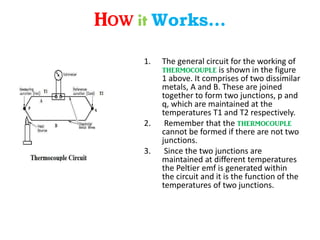
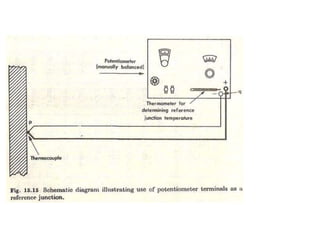
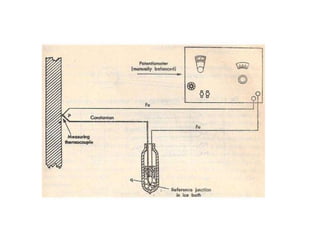
1. The general circuit for the working of
thermocouple is shown in the figure
1 above. It comprises of two dissimilar
metals, A and B. These are joined
together to form two junctions, p and
q, which are maintained at the
temperatures T1 and T2 respectively.
2. Remember that the thermocouple
cannot be formed if there are not two
junctions.
3. Since the two junctions are
maintained at different temperatures
the Peltier emf is generated within
the circuit and it is the function of the
temperatures of two junctions.
• If the temperature of both the junctions is same, equal
and opposite emf will be generated at both junctions
and the net current flowing through the junction is
zero.
• If the junctions are maintained at different
temperatures, the emf’s will not become zero and
there will be a net current flowing through the circuit.
• The total emf flowing through this circuit depends on
the metals used within the circuit as well as the
temperature of the two junctions.
• The total emf or the current flowing through the circuit
can be measured easily by the suitable device.
How it Works…
Working of thermocouples

Working of thermocouples

  • 1.
    Subject: MMM Topic :-WorkingOF Thermocouples By Prof. Apurv Raval Sir
  • 2.
    What is AThermocouple & How Does it Work? A thermocouple is comprised of at least two metals joined together to form two junctions.  One is connected to the body whose temperature is to be measured; this is the hot or measuring junction.  The other junction is connected to a body of known temperature; this is the cold or reference junction. Therefore the thermocouple measures unknown temperature of the body with reference to the known temperature of the other body.
  • 3.
    Working Principle… • Theworking principle of thermocouple is based on three effects, discovered by Seebeck, Peltier and Thomson. • 1) Seebeck effect: The Seebeck effect states that when two different or unlike metals are joined together at two junctions, an electromotive force (emf) is generated at the two junctions. • The amount of emf generated is different for different combinations of the metals.
  • 4.
    Working Principle… 2) Peltiereffect: As per the Peltier effect, when two dissimilar metals are joined together to form two junctions, emf is generated within the circuit due to the different temperatures of the two junctions of the circuit. 3) Thomson effect: As per the Thomson effect, when two unlike metals are joined together forming two junctions, the potential exists within the circuit due to temperature gradient along the entire length of the conductors within the circuit.
  • 5.
    How it Works… 1.The general circuit for the working of thermocouple is shown in the figure 1 above. It comprises of two dissimilar metals, A and B. These are joined together to form two junctions, p and q, which are maintained at the temperatures T1 and T2 respectively. 2. Remember that the thermocouple cannot be formed if there are not two junctions. 3. Since the two junctions are maintained at different temperatures the Peltier emf is generated within the circuit and it is the function of the temperatures of two junctions.
  • 8.
    • If thetemperature of both the junctions is same, equal and opposite emf will be generated at both junctions and the net current flowing through the junction is zero. • If the junctions are maintained at different temperatures, the emf’s will not become zero and there will be a net current flowing through the circuit. • The total emf flowing through this circuit depends on the metals used within the circuit as well as the temperature of the two junctions. • The total emf or the current flowing through the circuit can be measured easily by the suitable device. How it Works…