Manjunatha S
I M.Sc.(Botany)
University of Mysore
SIPHONOCLADALES
1. Introduction
2. Characteristics of Siphonocladales
3. Segregative cell division
4. Classification
5. Conclusion
6. Reference
CONTENTS
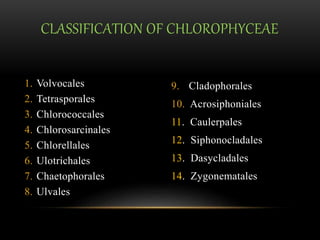
9. Cladophorales
10. Acrosiphoniales
11. Caulerpales
12. Siphonocladales
13. Dasycladales
14. Zygonematales
1. Volvocales
2. Tetrasporales
3. Chlorococcales
4. Chlorosarcinales
5. Chlorellales
6. Ulotrichales
7. Chaetophorales
8. Ulvales
CLASSIFICATION OF CHLOROPHYCEAE
Siphonocladales have multicellular thalli
attached to substratum by a system of Rhizoids and
divide in an unique manner called Segregative cell
division.
Introduction
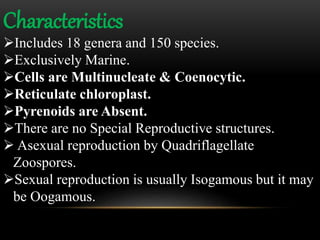
Characteristics
Includes 18 genera and 150 species.
Exclusively Marine.
Cells are Multinucleate & Coenocytic.
Reticulate chloroplast.
Pyrenoids are Absent.
There are no Special Reproductive structures.
 Asexual reproduction by Quadriflagellate
Zoospores.
Sexual reproduction is usually Isogamous but it may
be Oogamous.
Segregative cell division
1.Cleavage of Protoplast
2.Secretion of Enveloping membrane
3.Increasing in size.
4.Expansion of segments
it may be a) Endogenous or
b) Exogenous
Exogenous type Eg: Siphonocladus tropicus
Endogenous type Eg: Dictyosphaeria cavernosa
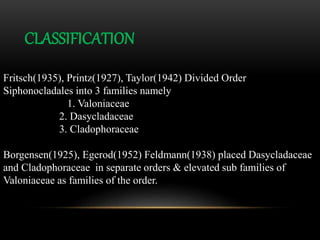
CLASSIFICATION
Fritsch(1935), Printz(1927), Taylor(1942) Divided Order
Siphonocladales into 3 families namely
1. Valoniaceae
2. Dasycladaceae
3. Cladophoraceae
Borgensen(1925), Egerod(1952) Feldmann(1938) placed Dasycladaceae
and Cladophoraceae in separate orders & elevated sub families of
Valoniaceae as families of the order.
Classification
Divided into 3 families
1.Siphonocladaceae
2.Valoniaceae
3.Anadyomenaceae
SIPHONOCLADACEAE
1. Thallus is generally loosely
branched.
2. Lack the small lenticular cells.
3. Segments mature Exogenously.
Eg: Cladophoropsis,
Siphonocladus Cladophoropsis membranacea
VALONIACEAE
1. Lack Central axis
2. Lenticular cells are present
3. Segments mature
Exogenously.
Eg: Valonia
ANADYOMENACEAE
1.It is closely aligned with
the Cladophorales.
2.Monostromatic thallus.
3.Absence of Segregative
cell division.
4. Isomorphic alternation of generation is seen.
Eg: Anadyomene soldanhae
CONCLUSION
The characteristic of Segregative cell division makes
the order Siphonocladales as an unique order which is not
shown by any organisms and there are some confusions in
classifying Siphonocladales into families and subfamilies.
References
1. Harold C. Bold & Michael J. Wyne-1978,
Introduction to Algae: Structure & Reproduction
Prentice Hall of India Private Limited, New Delhi
Page number: 211-216
2. Gilbert M. Smith (Stanford University) 2nd Edition -1955,
Cryptogamic Botany Volume I (Algae and Fungi)
McGraw Hill Book Company, INC.
New York Toronto London
Page number: 20, 116-118
3.
https://www.google.co.in/search?q=siphonocladales&biw=1366&bih=667&source=lnms&tbm=isc
h&sa=X&sqi=2&ved=0CAYQ_AUoAWoVChMIzfLU7Z7fyAIVhrCUCh0UBwbK#tbm=isch&q=dicty
osphaeria+cavernosa&imgrc=yiFBpYPBjjiHfM%3A
4. The Japanese Journal of Phycology Vol.30 No.2 , 20 June 1982 Page number: 106-106
Thank you

Siphonocladales

  • 1.
    Manjunatha S I M.Sc.(Botany) Universityof Mysore SIPHONOCLADALES
  • 2.
    1. Introduction 2. Characteristicsof Siphonocladales 3. Segregative cell division 4. Classification 5. Conclusion 6. Reference CONTENTS
  • 3.
    9. Cladophorales 10. Acrosiphoniales 11.Caulerpales 12. Siphonocladales 13. Dasycladales 14. Zygonematales 1. Volvocales 2. Tetrasporales 3. Chlorococcales 4. Chlorosarcinales 5. Chlorellales 6. Ulotrichales 7. Chaetophorales 8. Ulvales CLASSIFICATION OF CHLOROPHYCEAE
  • 4.
    Siphonocladales have multicellularthalli attached to substratum by a system of Rhizoids and divide in an unique manner called Segregative cell division. Introduction
  • 5.
    Characteristics Includes 18 generaand 150 species. Exclusively Marine. Cells are Multinucleate & Coenocytic. Reticulate chloroplast. Pyrenoids are Absent. There are no Special Reproductive structures.  Asexual reproduction by Quadriflagellate Zoospores. Sexual reproduction is usually Isogamous but it may be Oogamous.
  • 6.
    Segregative cell division 1.Cleavageof Protoplast 2.Secretion of Enveloping membrane 3.Increasing in size. 4.Expansion of segments it may be a) Endogenous or b) Exogenous
  • 7.
    Exogenous type Eg:Siphonocladus tropicus
  • 8.
    Endogenous type Eg:Dictyosphaeria cavernosa
  • 10.
    CLASSIFICATION Fritsch(1935), Printz(1927), Taylor(1942)Divided Order Siphonocladales into 3 families namely 1. Valoniaceae 2. Dasycladaceae 3. Cladophoraceae Borgensen(1925), Egerod(1952) Feldmann(1938) placed Dasycladaceae and Cladophoraceae in separate orders & elevated sub families of Valoniaceae as families of the order.
  • 11.
    Classification Divided into 3families 1.Siphonocladaceae 2.Valoniaceae 3.Anadyomenaceae
  • 12.
    SIPHONOCLADACEAE 1. Thallus isgenerally loosely branched. 2. Lack the small lenticular cells. 3. Segments mature Exogenously. Eg: Cladophoropsis, Siphonocladus Cladophoropsis membranacea
  • 13.
    VALONIACEAE 1. Lack Centralaxis 2. Lenticular cells are present 3. Segments mature Exogenously. Eg: Valonia
  • 14.
    ANADYOMENACEAE 1.It is closelyaligned with the Cladophorales. 2.Monostromatic thallus. 3.Absence of Segregative cell division. 4. Isomorphic alternation of generation is seen. Eg: Anadyomene soldanhae
  • 15.
    CONCLUSION The characteristic ofSegregative cell division makes the order Siphonocladales as an unique order which is not shown by any organisms and there are some confusions in classifying Siphonocladales into families and subfamilies.
  • 16.
    References 1. Harold C.Bold & Michael J. Wyne-1978, Introduction to Algae: Structure & Reproduction Prentice Hall of India Private Limited, New Delhi Page number: 211-216 2. Gilbert M. Smith (Stanford University) 2nd Edition -1955, Cryptogamic Botany Volume I (Algae and Fungi) McGraw Hill Book Company, INC. New York Toronto London Page number: 20, 116-118 3. https://www.google.co.in/search?q=siphonocladales&biw=1366&bih=667&source=lnms&tbm=isc h&sa=X&sqi=2&ved=0CAYQ_AUoAWoVChMIzfLU7Z7fyAIVhrCUCh0UBwbK#tbm=isch&q=dicty osphaeria+cavernosa&imgrc=yiFBpYPBjjiHfM%3A 4. The Japanese Journal of Phycology Vol.30 No.2 , 20 June 1982 Page number: 106-106
  • 17.