Tropical Rain Forest
Ecological Biome
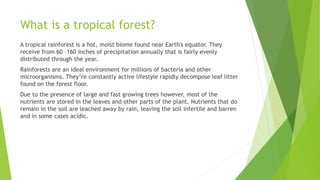
What is a tropical forest?
A tropical rainforest is a hot, moist biome found near Earth's equator. They
receive from 60 –160 inches of precipitation annually that is fairly evenly
distributed through the year.
Rainforests are an ideal environment for millions of bacteria and other
microorganisms. They’re constantly active lifestyle rapidly decompose leaf litter
found on the forest floor.
Due to the presence of large and fast growing trees however, most of the
nutrients are stored in the leaves and other parts of the plant. Nutrients that do
remain in the soil are leached away by rain, leaving the soil infertile and barren
and in some cases acidic.
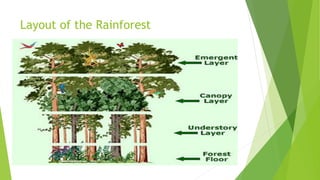
Layers of the Rainforest
There are four very distinct layers of trees in a tropical rain forest. These layers
have been identified as the;
 Emergent
 upper canopy
 Understory
 Forest floor.
Layout of the Rainforest
Types of tropical forests;
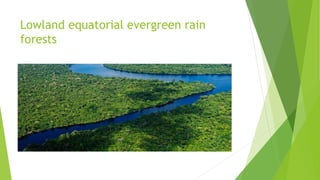
 Lowland equatorial evergreen rainforests:
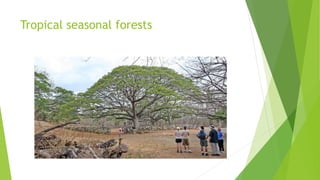
 Tropical seasonal rainforests
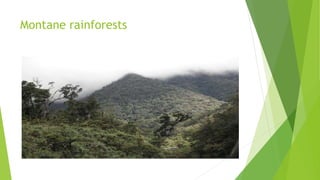
 Montane rainforests
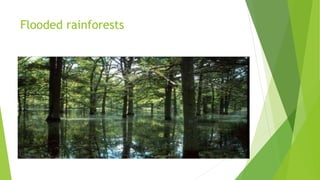
 Flooded rainforests
Lowland equatorial evergreen rain
forests
Tropical seasonal forests
Montane rainforests
Flooded rainforests
Flora and Fauna
Dominant species do not exist in tropical rainforests.
All the rainforests on earth are home to a variety 15 million plant and animal
species due to constant warmth and supply of water which provides a variety of
food for them.
The most common animals found in rainforests are monkeys, birds, snakes,
rodents, frogs and lizards many of which including insect never set foot on the
ground. The use these tall trees, some of which can reach 200 feet in height and
10 feet in diameter as their food source and to hide from predators.
Due to the large number of animals that call the rainforest home there is a very
stiff competition for food and have adapted to eating foods that no other animals
eat.
Climate
Tropical rain forests are located near the equator and have a wet climate with
the combination of constant warmth and plenty of moisture and humidity being
constantly high.
Graph of Annual rainfall
Benefits
 Help stabilize the world’s climate
 Provide a home to many plants and animals
 Help maintain the water cycle
 Protect against flood, drought, and erosion
Environmental Impacts
 Habitat Loss
 Climate Change
 Soil Erosion
 Extinction
Social Impacts
 Lost of culture
 Increases the risks of diseases being incurable
 Lack of food
Economic Impacts
 As resources reduces prices increases
 Funding rainforest conservation
Conservation Practices/Efforts
Efforts to protect and conserve tropical rainforest habitats are diverse and
widespread.
Tropical rainforest conservation ranges from strict preservation of habitat to
finding sustainable management:
 Incentive program called Reducing Emissions from Deforestation and Forest
Degradation (REDD)
 Carbon credits
 Restoration
Bibliography
Websites:
 http://www.blueplanetbiomes.org/rainforest.htm
 https://en.wikipedia.org/wiki/Reducing_emissions_from_deforestation_and_f
orest_degradation
 http://www.tropical-rainforest-animals.com/borneo-rainforest.html
 http://tropicalrainfore.weebly.com/geology.html
 http://kerrapes.wikispaces.com/22-
tropical+seasonal+forest+(4)+camille+nguyen,+ana+espaderos,+mohammed+fr
aaz
 http://www.blueplanetbiomes.org/rnfrst_climate_page.htm
 http://wwf.panda.org/what_we_do/where_we_work/amazon/about_the_am
azon/ecosystems_amazon/floodplain_forests/
Rainforests
 The tropical rain forest can be found in three major geographical areas
around the world.
• Central America in the Amazon river basin.
• Africa - Zaire basin, with a small area in West Africa; also eastern Madagascar.
• Indo-Malaysia - west coast of India, Assam, Southeast Asia, New Guinea and
Queensland, Australia.
Layers of the Rainforests
 Emergent trees are spaced wide apart, and are 100 to 240 feet tall with
umbrella-shaped canopies that grow above the forest. Because emergent
trees are exposed to drying winds, they tend to have small, pointed leaves.
 The upper canopy of 60 to 130 foot trees allows light to be easily available at
the top of this layer, but greatly reduced any light below it.
 The understory, or lower canopy, consists of 60 foot trees. This layer is made
up of the trunks of canopy trees, shrubs, plants and small trees.
 The forest floor is usually completely shaded, except where a canopy tree has
fallen and created an opening. Most areas of the forest floor receive so little
light that few bushes or herbs can grow there.
Types of Rainforest
 Lowland equatorial evergreen rainforests: These forests occur in a belt
around the equator, with the largest areas in the Amazon basin of South
America, the Congo Basin of Central Africa, Philippines, Indonesia, and New
Guinea. In Peru, lowland evergreen forest is found on the eastern portion of
the country from the Amazonian plain up to 900 m along the foothill of the
Andes. These forests reach 25-40 m in height; with emergents of 50-60 m.
Forests are typically rich in buttressed trees, and undergrowth palms, woody
vines, and vascular epiphytes. Lowland Evergreen forests can be further
subdivided into Floodplain or Varzea Forest and Upland or Terra Firme
Forests, and Flooded Forests. These forest types are relevant in influencing
bird distribution in Amazonia. which receive high rainfall (more than
2000 mm, or 80 inches, annually) throughout the year.
Types of Rainforest (cont’d)
 Moist tropical season rainforest: Some trees in these forests drop some or all
of their leaves during the winter dry season, thus they are sometimes called
"tropical mixed forest". receive high overall rainfall with a warm summer wet
season and a cooler winter dry season.
 Montane rainforests, some of which are known as cloud forests, are found in
cooler-climate mountain areas. Depending on latitude, the lower limit of
montane rainforests on large mountains is generally between 1500 and 2500
m while the upper limit is usually from 2400 to 3300 m
 Freshwater swamp forests, or flooded forests, are forests which are inundated
with freshwater, either permanently or seasonally. They normally occur along
the lower reaches of rivers and around freshwater lakes.
Climate
 Tropical rainforests produce 40% of Earth's oxygen.
 The temperature in a rain forest rarely gets higher than 93 °F (34 °C) or drops
below 68 °F (20 °C); average humidity is between 77 and 88%;
 rainfall is often more than 100 inches a year. There is usually a brief season of
less rain. In monsoonal areas, there is a real dry season.
 There is little air movement. As a result the humidity is constantly high. This
level is in constant shade.
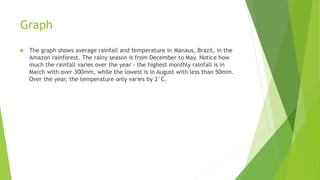
Graph
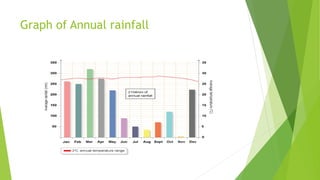
 The graph shows average rainfall and temperature in Manaus, Brazil, in the
Amazon rainforest. The rainy season is from December to May. Notice how
much the rainfall varies over the year - the highest monthly rainfall is in
March with over 300mm, while the lowest is in August with less than 50mm.
Over the year, the temperature only varies by 2°C.
Flora and Fauna
 Most of the rainforest's animals live in the upper canopy. There is so much
food available at this level that some animals never go down to the forest
floor. The leaves have "drip spouts" that allows rain to run off. This keeps
them dry and prevents mould and mildew from forming in the humid
environment.
 Less than 1 % of the light that strikes the top of the forest penetrates to the
forest floor. The top soil is very thin and of poor quality. A lot of litter falls to
the ground where it is quickly broken down by decomposers like termites,
earthworms and fungi. The heat and humidity further help to break down the
litter. This organic matter is then just as quickly absorbed by the trees'
shallow roots.
Flora and Fauna (cont’d)
 Trees of the same species are very seldom found growing close together. This
bio diversity and separation of the species prevents mass contamination and
die-off from disease or insect infestation. Bio diversity also insures that there
will be enough pollinators to take care of each species' needs. Animals depend
on the staggered blooming and fruiting of rainforest plants to supply them
with a year-round source of food.
 Many animals of the rainforest are camouflaged which aids them in avoiding
predators and predators hide and wait for their prey
 The forest floors have insects and decomposers and large mammals and other
animals that are too heavy for the upper canopy
 Animals adapt to survive. Eg. Toucans developed large, long bills to enable
them to reach small fruit on branches too small to support the birds weight.
Flora and Fauna (cont’d)
 Plants on the forest floors compete for sunlight and food and force plants to
adapt or grow on other plants and/ or even strangle larger trees.
 Trees of the same species are very seldom found growing close together. This
bio diversity and separation of the species prevents mass contamination and
die-off from disease or insect infestation. Bio diversity also insures that there
will be enough pollinators to take care of each species' needs. Animals depend
on the staggered blooming and fruiting of rainforest plants to supply them
with a year-round source of food.
Benefits
 Rainforests help stabilize the world’s climate by absorbing carbon dioxide
from the atmosphere
 Rainforests are home to a large number of the world’s plant and animals
species, including many endangered species.
 The role of rainforests in the water cycle is to add water to the atmosphere
through the process of transpiration
 Rainforests have been compared to natural sponges, moderating flood and
drought cycles by slowing run-off and contributing moisture to the local
atmosphere.
 Rainforest are a source for medicines and foods and support forest-dependent
people: People have long used forests as a source of food, wood, medicine,
and recreation.
Social Impact
 Many indigenous people live in rainforests. When they lose their homes due to
deforestation, much culture goes with them as well. The tribes living in the
rainforests have a wide knowledge of the plants that can be used for medicine and
food and passing that knowledge to the next generation. Deforestation hurts them
because their natural resources for their way of life are taken away
 About 1/4 of all the medicines we use come from rainforest plants. Destruction of
the forests can reduce plants or force them into extinction which are used for
medical purposes can gradually increases diseases to be incurable due to
necessary plants needed to make for the medicine; Curare comes from a tropical
vine, and is used as an anesthetic and to relax muscles during surgery. Quinine,
from the cinchona tree, is used to treat malaria. A person with lymphocytic
leukaemia has a 99% chance that the disease will go into remission because of the
rosy periwinkle. More than 1,400 varieties of tropical plants are thought to be
potential cures for cancer
Environmental Impacts
 Rain forests that once grew over 14 percent of the land on Earth now cover only
about 6 percent.
 Many species and populations live in the tropical rainforest. Currently, the world is
losing 137 species a day due to deforestation, which totals up to 50,000 species
per year.
 The reason that causes organisms to disappear is the fact that they lose their
homes through deforestation. Territory conflicts occur, as well as a depletion of
food supply.
 Many indigenous people live in rainforests. When they lose their homes due to
deforestation, much culture goes with them as well. Deforestation hurts them
because their natural resources for their way of life are taken away.
Conservation Practices
 Carbon credits: economically beneficial option is through carbon credits.
Under the Kyoto Protocol, countries must reduce their emissions of Carbon
Dioxide by 5% below the 1990 levels before 2012. Countries can meet their
mandatory cuts in emissions by offsetting some of those emissions some other
way. Through conservation or reforestation of the rainforest, countries can
receive credits.
 REDD-for companies and governments to outset their carbon emissions
through financial investments into rainforest conservation.
Additional Notes (cont’d)
 The reasons for plundering rain forests are mainly economic. Countries drive
demand for tropical timber.
• The paper industry turns huge tracts of rain forest trees into materials.
• The cattle industry uses slash-and-burn techniques to clear ranch land.

Tropical rain forest

  • 1.
  • 2.
    What is atropical forest? A tropical rainforest is a hot, moist biome found near Earth's equator. They receive from 60 –160 inches of precipitation annually that is fairly evenly distributed through the year. Rainforests are an ideal environment for millions of bacteria and other microorganisms. They’re constantly active lifestyle rapidly decompose leaf litter found on the forest floor. Due to the presence of large and fast growing trees however, most of the nutrients are stored in the leaves and other parts of the plant. Nutrients that do remain in the soil are leached away by rain, leaving the soil infertile and barren and in some cases acidic.
  • 3.
    Layers of theRainforest There are four very distinct layers of trees in a tropical rain forest. These layers have been identified as the;  Emergent  upper canopy  Understory  Forest floor.
  • 4.
    Layout of theRainforest
  • 5.
    Types of tropicalforests;  Lowland equatorial evergreen rainforests:  Tropical seasonal rainforests  Montane rainforests  Flooded rainforests
  • 6.
  • 7.
  • 8.
  • 9.
  • 10.
    Flora and Fauna Dominantspecies do not exist in tropical rainforests. All the rainforests on earth are home to a variety 15 million plant and animal species due to constant warmth and supply of water which provides a variety of food for them. The most common animals found in rainforests are monkeys, birds, snakes, rodents, frogs and lizards many of which including insect never set foot on the ground. The use these tall trees, some of which can reach 200 feet in height and 10 feet in diameter as their food source and to hide from predators. Due to the large number of animals that call the rainforest home there is a very stiff competition for food and have adapted to eating foods that no other animals eat.
  • 11.
    Climate Tropical rain forestsare located near the equator and have a wet climate with the combination of constant warmth and plenty of moisture and humidity being constantly high.
  • 12.
  • 13.
    Benefits  Help stabilizethe world’s climate  Provide a home to many plants and animals  Help maintain the water cycle  Protect against flood, drought, and erosion
  • 14.
    Environmental Impacts  HabitatLoss  Climate Change  Soil Erosion  Extinction
  • 15.
    Social Impacts  Lostof culture  Increases the risks of diseases being incurable  Lack of food
  • 16.
    Economic Impacts  Asresources reduces prices increases  Funding rainforest conservation
  • 17.
    Conservation Practices/Efforts Efforts toprotect and conserve tropical rainforest habitats are diverse and widespread. Tropical rainforest conservation ranges from strict preservation of habitat to finding sustainable management:  Incentive program called Reducing Emissions from Deforestation and Forest Degradation (REDD)  Carbon credits  Restoration
  • 18.
    Bibliography Websites:  http://www.blueplanetbiomes.org/rainforest.htm  https://en.wikipedia.org/wiki/Reducing_emissions_from_deforestation_and_f orest_degradation http://www.tropical-rainforest-animals.com/borneo-rainforest.html  http://tropicalrainfore.weebly.com/geology.html  http://kerrapes.wikispaces.com/22- tropical+seasonal+forest+(4)+camille+nguyen,+ana+espaderos,+mohammed+fr aaz  http://www.blueplanetbiomes.org/rnfrst_climate_page.htm  http://wwf.panda.org/what_we_do/where_we_work/amazon/about_the_am azon/ecosystems_amazon/floodplain_forests/
  • 19.
    Rainforests  The tropicalrain forest can be found in three major geographical areas around the world. • Central America in the Amazon river basin. • Africa - Zaire basin, with a small area in West Africa; also eastern Madagascar. • Indo-Malaysia - west coast of India, Assam, Southeast Asia, New Guinea and Queensland, Australia.
  • 20.
    Layers of theRainforests  Emergent trees are spaced wide apart, and are 100 to 240 feet tall with umbrella-shaped canopies that grow above the forest. Because emergent trees are exposed to drying winds, they tend to have small, pointed leaves.  The upper canopy of 60 to 130 foot trees allows light to be easily available at the top of this layer, but greatly reduced any light below it.  The understory, or lower canopy, consists of 60 foot trees. This layer is made up of the trunks of canopy trees, shrubs, plants and small trees.  The forest floor is usually completely shaded, except where a canopy tree has fallen and created an opening. Most areas of the forest floor receive so little light that few bushes or herbs can grow there.
  • 21.
    Types of Rainforest Lowland equatorial evergreen rainforests: These forests occur in a belt around the equator, with the largest areas in the Amazon basin of South America, the Congo Basin of Central Africa, Philippines, Indonesia, and New Guinea. In Peru, lowland evergreen forest is found on the eastern portion of the country from the Amazonian plain up to 900 m along the foothill of the Andes. These forests reach 25-40 m in height; with emergents of 50-60 m. Forests are typically rich in buttressed trees, and undergrowth palms, woody vines, and vascular epiphytes. Lowland Evergreen forests can be further subdivided into Floodplain or Varzea Forest and Upland or Terra Firme Forests, and Flooded Forests. These forest types are relevant in influencing bird distribution in Amazonia. which receive high rainfall (more than 2000 mm, or 80 inches, annually) throughout the year.
  • 22.
    Types of Rainforest(cont’d)  Moist tropical season rainforest: Some trees in these forests drop some or all of their leaves during the winter dry season, thus they are sometimes called "tropical mixed forest". receive high overall rainfall with a warm summer wet season and a cooler winter dry season.  Montane rainforests, some of which are known as cloud forests, are found in cooler-climate mountain areas. Depending on latitude, the lower limit of montane rainforests on large mountains is generally between 1500 and 2500 m while the upper limit is usually from 2400 to 3300 m  Freshwater swamp forests, or flooded forests, are forests which are inundated with freshwater, either permanently or seasonally. They normally occur along the lower reaches of rivers and around freshwater lakes.
  • 23.
    Climate  Tropical rainforestsproduce 40% of Earth's oxygen.  The temperature in a rain forest rarely gets higher than 93 °F (34 °C) or drops below 68 °F (20 °C); average humidity is between 77 and 88%;  rainfall is often more than 100 inches a year. There is usually a brief season of less rain. In monsoonal areas, there is a real dry season.  There is little air movement. As a result the humidity is constantly high. This level is in constant shade.
  • 24.
    Graph  The graphshows average rainfall and temperature in Manaus, Brazil, in the Amazon rainforest. The rainy season is from December to May. Notice how much the rainfall varies over the year - the highest monthly rainfall is in March with over 300mm, while the lowest is in August with less than 50mm. Over the year, the temperature only varies by 2°C.
  • 25.
    Flora and Fauna Most of the rainforest's animals live in the upper canopy. There is so much food available at this level that some animals never go down to the forest floor. The leaves have "drip spouts" that allows rain to run off. This keeps them dry and prevents mould and mildew from forming in the humid environment.  Less than 1 % of the light that strikes the top of the forest penetrates to the forest floor. The top soil is very thin and of poor quality. A lot of litter falls to the ground where it is quickly broken down by decomposers like termites, earthworms and fungi. The heat and humidity further help to break down the litter. This organic matter is then just as quickly absorbed by the trees' shallow roots.
  • 26.
    Flora and Fauna(cont’d)  Trees of the same species are very seldom found growing close together. This bio diversity and separation of the species prevents mass contamination and die-off from disease or insect infestation. Bio diversity also insures that there will be enough pollinators to take care of each species' needs. Animals depend on the staggered blooming and fruiting of rainforest plants to supply them with a year-round source of food.  Many animals of the rainforest are camouflaged which aids them in avoiding predators and predators hide and wait for their prey  The forest floors have insects and decomposers and large mammals and other animals that are too heavy for the upper canopy  Animals adapt to survive. Eg. Toucans developed large, long bills to enable them to reach small fruit on branches too small to support the birds weight.
  • 27.
    Flora and Fauna(cont’d)  Plants on the forest floors compete for sunlight and food and force plants to adapt or grow on other plants and/ or even strangle larger trees.  Trees of the same species are very seldom found growing close together. This bio diversity and separation of the species prevents mass contamination and die-off from disease or insect infestation. Bio diversity also insures that there will be enough pollinators to take care of each species' needs. Animals depend on the staggered blooming and fruiting of rainforest plants to supply them with a year-round source of food.
  • 28.
    Benefits  Rainforests helpstabilize the world’s climate by absorbing carbon dioxide from the atmosphere  Rainforests are home to a large number of the world’s plant and animals species, including many endangered species.  The role of rainforests in the water cycle is to add water to the atmosphere through the process of transpiration  Rainforests have been compared to natural sponges, moderating flood and drought cycles by slowing run-off and contributing moisture to the local atmosphere.  Rainforest are a source for medicines and foods and support forest-dependent people: People have long used forests as a source of food, wood, medicine, and recreation.
  • 29.
    Social Impact  Manyindigenous people live in rainforests. When they lose their homes due to deforestation, much culture goes with them as well. The tribes living in the rainforests have a wide knowledge of the plants that can be used for medicine and food and passing that knowledge to the next generation. Deforestation hurts them because their natural resources for their way of life are taken away  About 1/4 of all the medicines we use come from rainforest plants. Destruction of the forests can reduce plants or force them into extinction which are used for medical purposes can gradually increases diseases to be incurable due to necessary plants needed to make for the medicine; Curare comes from a tropical vine, and is used as an anesthetic and to relax muscles during surgery. Quinine, from the cinchona tree, is used to treat malaria. A person with lymphocytic leukaemia has a 99% chance that the disease will go into remission because of the rosy periwinkle. More than 1,400 varieties of tropical plants are thought to be potential cures for cancer
  • 30.
    Environmental Impacts  Rainforests that once grew over 14 percent of the land on Earth now cover only about 6 percent.  Many species and populations live in the tropical rainforest. Currently, the world is losing 137 species a day due to deforestation, which totals up to 50,000 species per year.  The reason that causes organisms to disappear is the fact that they lose their homes through deforestation. Territory conflicts occur, as well as a depletion of food supply.  Many indigenous people live in rainforests. When they lose their homes due to deforestation, much culture goes with them as well. Deforestation hurts them because their natural resources for their way of life are taken away.
  • 31.
    Conservation Practices  Carboncredits: economically beneficial option is through carbon credits. Under the Kyoto Protocol, countries must reduce their emissions of Carbon Dioxide by 5% below the 1990 levels before 2012. Countries can meet their mandatory cuts in emissions by offsetting some of those emissions some other way. Through conservation or reforestation of the rainforest, countries can receive credits.  REDD-for companies and governments to outset their carbon emissions through financial investments into rainforest conservation.
  • 32.
    Additional Notes (cont’d) The reasons for plundering rain forests are mainly economic. Countries drive demand for tropical timber. • The paper industry turns huge tracts of rain forest trees into materials. • The cattle industry uses slash-and-burn techniques to clear ranch land.