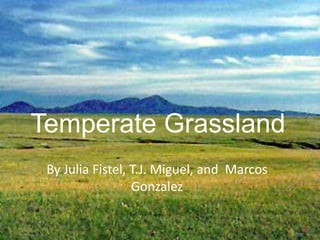
Temperate Grassland
By Julia Fistel, T.J. Miguel, and Marcos
Gonzalez
Location and Names
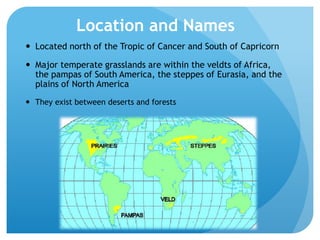
 Located north of the Tropic of Cancer and South of Capricorn
 Major temperate grasslands are within the veldts of Africa,
the pampas of South America, the steppes of Eurasia, and the
plains of North America
 They exist between deserts and forests
ClimateSoil:
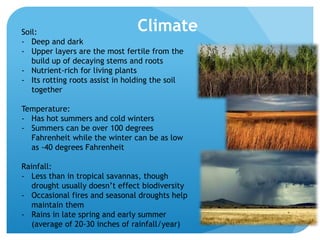
- Deep and dark
- Upper layers are the most fertile from the
build up of decaying stems and roots
- Nutrient-rich for living plants
- Its rotting roots assist in holding the soil
together
Temperature:
- Has hot summers and cold winters
- Summers can be over 100 degrees
Fahrenheit while the winter can be as low
as -40 degrees Fahrenheit
Rainfall:
- Less than in tropical savannas, though
drought usually doesn’t effect biodiversity
- Occasional fires and seasonal droughts help
maintain them
- Rains in late spring and early summer
(average of 20-30 inches of rainfall/year)
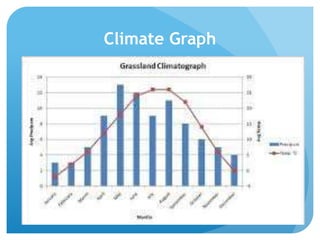
Climate Graph
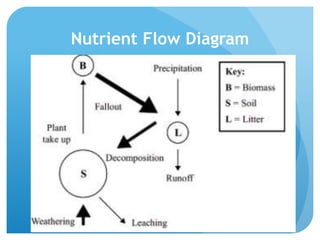
Nutrient Flow Diagram
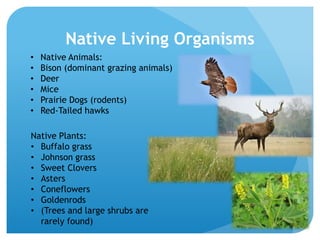
Native Living Organisms
• Native Animals:
• Bison (dominant grazing animals)
• Deer
• Mice
• Prairie Dogs (rodents)
• Red-Tailed hawks
Native Plants:
• Buffalo grass
• Johnson grass
• Sweet Clovers
• Asters
• Coneflowers
• Goldenrods
• (Trees and large shrubs are
rarely found)
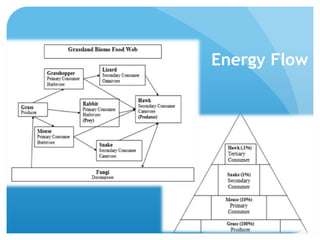
Energy Flow
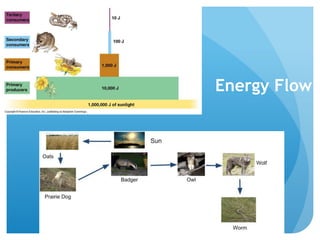
Energy Flow
Gross and Net Primary
Productivity
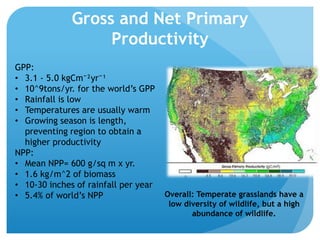
GPP:
• 3.1 - 5.0 kgCm⁻²yr⁻¹
• 10^9tons/yr. for the world’s GPP
• Rainfall is low
• Temperatures are usually warm
• Growing season is length,
preventing region to obtain a
higher productivity
NPP:
• Mean NPP= 600 g/sq m x yr.
• 1.6 kg/m^2 of biomass
• 10-30 inches of rainfall per year
• 5.4% of world’s NPP Overall: Temperate grasslands have a
low diversity of wildlife, but a high
abundance of wildlife.
Succession
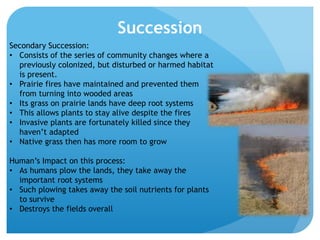
Secondary Succession:
• Consists of the series of community changes where a
previously colonized, but disturbed or harmed habitat
is present.
• Prairie fires have maintained and prevented them
from turning into wooded areas
• Its grass on prairie lands have deep root systems
• This allows plants to stay alive despite the fires
• Invasive plants are fortunately killed since they
haven’t adapted
• Native grass then has more room to grow
Human’s Impact on this process:
• As humans plow the lands, they take away the
important root systems
• Such plowing takes away the soil nutrients for plants
to survive
• Destroys the fields overall
Human Impact
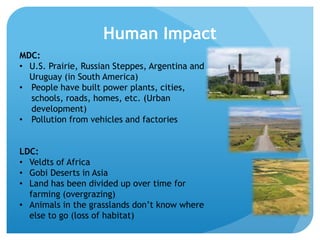
MDC:
• U.S. Prairie, Russian Steppes, Argentina and
Uruguay (in South America)
• People have built power plants, cities,
schools, roads, homes, etc. (Urban
development)
• Pollution from vehicles and factories
LDC:
• Veldts of Africa
• Gobi Deserts in Asia
• Land has been divided up over time for
farming (overgrazing)
• Animals in the grasslands don’t know where
else to go (loss of habitat)
How Each Are Being Handled
Today
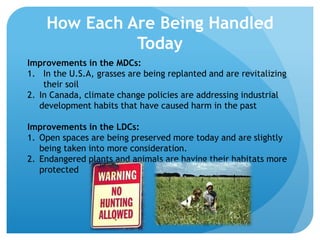
Improvements in the MDCs:
1. In the U.S.A, grasses are being replanted and are revitalizing
their soil
2. In Canada, climate change policies are addressing industrial
development habits that have caused harm in the past
Improvements in the LDCs:
1. Open spaces are being preserved more today and are slightly
being taken into more consideration.
2. Endangered plants and animals are having their habitats more
protected

Temperate grassland PERIOD 3

  • 1.
    Temperate Grassland By JuliaFistel, T.J. Miguel, and Marcos Gonzalez
  • 2.
    Location and Names Located north of the Tropic of Cancer and South of Capricorn  Major temperate grasslands are within the veldts of Africa, the pampas of South America, the steppes of Eurasia, and the plains of North America  They exist between deserts and forests
  • 3.
    ClimateSoil: - Deep anddark - Upper layers are the most fertile from the build up of decaying stems and roots - Nutrient-rich for living plants - Its rotting roots assist in holding the soil together Temperature: - Has hot summers and cold winters - Summers can be over 100 degrees Fahrenheit while the winter can be as low as -40 degrees Fahrenheit Rainfall: - Less than in tropical savannas, though drought usually doesn’t effect biodiversity - Occasional fires and seasonal droughts help maintain them - Rains in late spring and early summer (average of 20-30 inches of rainfall/year)
  • 4.
  • 5.
  • 6.
    Native Living Organisms •Native Animals: • Bison (dominant grazing animals) • Deer • Mice • Prairie Dogs (rodents) • Red-Tailed hawks Native Plants: • Buffalo grass • Johnson grass • Sweet Clovers • Asters • Coneflowers • Goldenrods • (Trees and large shrubs are rarely found)
  • 7.
  • 8.
  • 9.
    Gross and NetPrimary Productivity GPP: • 3.1 - 5.0 kgCm⁻²yr⁻¹ • 10^9tons/yr. for the world’s GPP • Rainfall is low • Temperatures are usually warm • Growing season is length, preventing region to obtain a higher productivity NPP: • Mean NPP= 600 g/sq m x yr. • 1.6 kg/m^2 of biomass • 10-30 inches of rainfall per year • 5.4% of world’s NPP Overall: Temperate grasslands have a low diversity of wildlife, but a high abundance of wildlife.
  • 10.
    Succession Secondary Succession: • Consistsof the series of community changes where a previously colonized, but disturbed or harmed habitat is present. • Prairie fires have maintained and prevented them from turning into wooded areas • Its grass on prairie lands have deep root systems • This allows plants to stay alive despite the fires • Invasive plants are fortunately killed since they haven’t adapted • Native grass then has more room to grow Human’s Impact on this process: • As humans plow the lands, they take away the important root systems • Such plowing takes away the soil nutrients for plants to survive • Destroys the fields overall
  • 11.
    Human Impact MDC: • U.S.Prairie, Russian Steppes, Argentina and Uruguay (in South America) • People have built power plants, cities, schools, roads, homes, etc. (Urban development) • Pollution from vehicles and factories LDC: • Veldts of Africa • Gobi Deserts in Asia • Land has been divided up over time for farming (overgrazing) • Animals in the grasslands don’t know where else to go (loss of habitat)
  • 12.
    How Each AreBeing Handled Today Improvements in the MDCs: 1. In the U.S.A, grasses are being replanted and are revitalizing their soil 2. In Canada, climate change policies are addressing industrial development habits that have caused harm in the past Improvements in the LDCs: 1. Open spaces are being preserved more today and are slightly being taken into more consideration. 2. Endangered plants and animals are having their habitats more protected