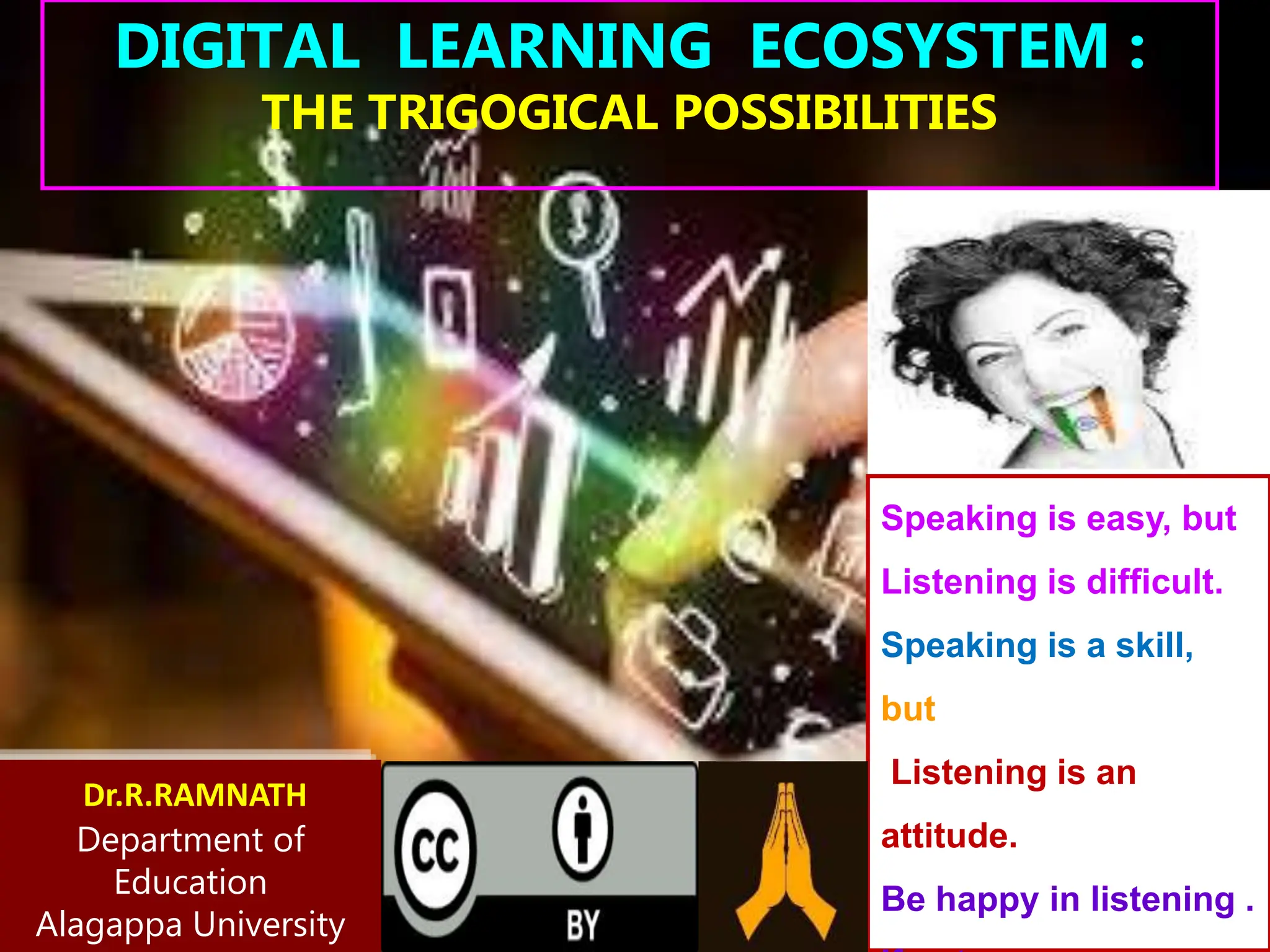
DIGITAL LEARNING ECOSYSTEM :
THE TRIGOGICAL POSSIBILITIES
Dr.R.RAMNATH
Department of
Education
Alagappa University
Speaking is easy, but
Listening is difficult.
Speaking is a skill,
but
Listening is an
attitude.
Be happy in listening .
Readiness
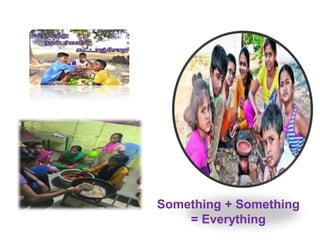
Something + Something
= Everything
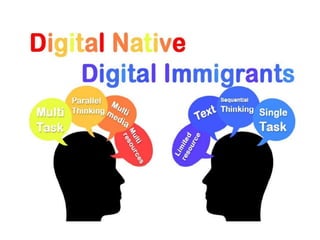
Digital Natives or Digital Immigrants
Email is 54 [October 29th 1969] year old
ARPANET's
PCs [1984] are 39 years old
1990
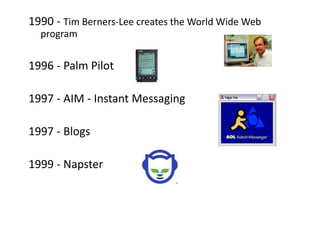
1990 - Tim Berners-Lee creates the World Wide Web
program
1996 - Palm Pilot
1997 - AIM - Instant Messaging
1997 - Blogs
1999 - Napster
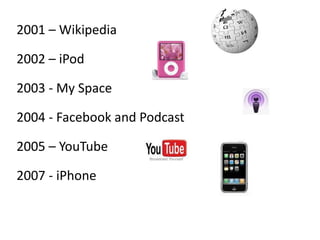
2001 – Wikipedia
2002 – iPod
2003 - My Space
2004 - Facebook and Podcast
2005 – YouTube
2007 - iPhone
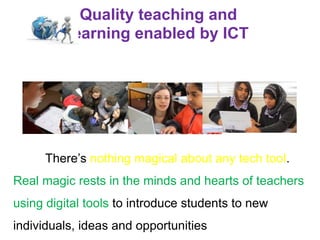
Quality teaching and
learning enabled by ICT
There’s nothing magical about any tech tool.
Real magic rests in the minds and hearts of teachers
using digital tools to introduce students to new
individuals, ideas and opportunities
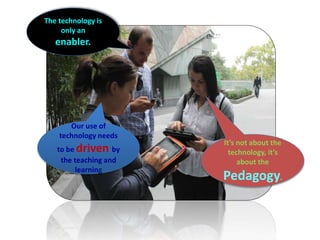
It’s not about the
technology, it’s
about the
Pedagogy.
Our use of
technology needs
to be driven by
the teaching and
learning
The technology is
only an
enabler.
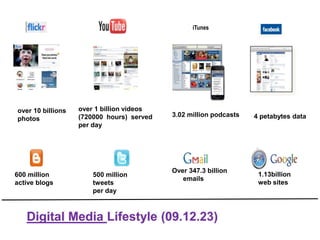
Digital Media Lifestyle (09.12.23)
4 petabytes data
over 10 billions
photos
over 1 billion videos
(720000 hours) served
per day
3.02 million podcasts
iTunes
600 million
active blogs
500 million
tweets
per day
Over 347.3 billion
emails
1.13billion
web sites
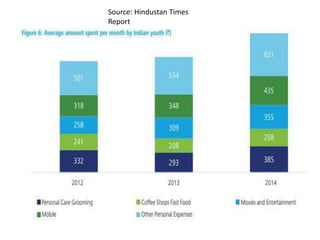
Source: Hindustan Times
Report
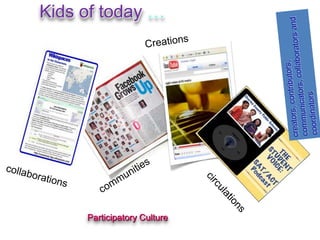
Participatory Culture
Kids of today …
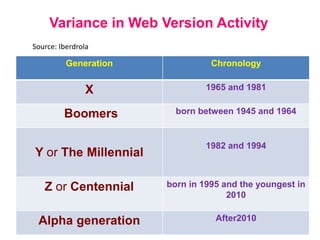
Variance in Web Version Activity
Generation Chronology
X 1965 and 1981
Boomers born between 1945 and 1964
Y or The Millennial
1982 and 1994
Z or Centennial born in 1995 and the youngest in
2010
Alpha generation After2010
Source: Iberdrola
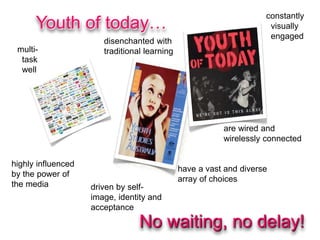
highly influenced
by the power of
the media
constantly
visually
engaged
driven by self-
image, identity and
acceptance
multi-
task
well
have a vast and diverse
array of choices
disenchanted with
traditional learning
are wired and
wirelessly connected
No waiting, no delay!
Youth of today…
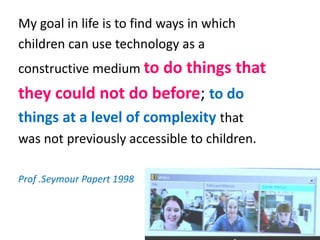
My goal in life is to find ways in which
children can use technology as a
constructive medium to do things that
they could not do before; to do
things at a level of complexity that
was not previously accessible to children.
Prof .Seymour Papert 1998
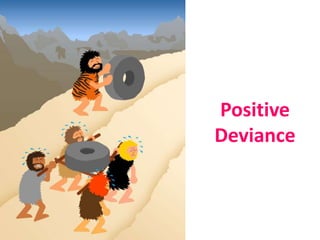
Positive
Deviance
Introduction
• To teach, is to make
someone to learn...
•Change is the end result of
all true learning
Motto
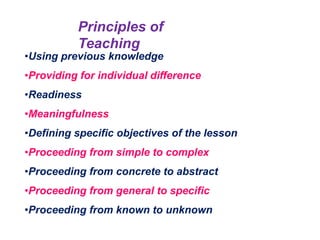
•Using previous knowledge
•Providing for individual difference
•Readiness
•Meaningfulness
•Defining specific objectives of the lesson
•Proceeding from simple to complex
•Proceeding from concrete to abstract
•Proceeding from general to specific
•Proceeding from known to unknown
Principles of
Teaching
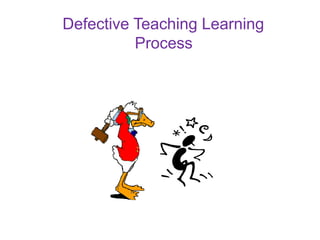
Defective Teaching Learning
Process
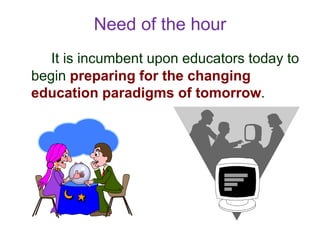
Need of the hour
It is incumbent upon educators today to
begin preparing for the changing
education paradigms of tomorrow.
Working Together, We Can achieve our goal and expected
qualities in higher education
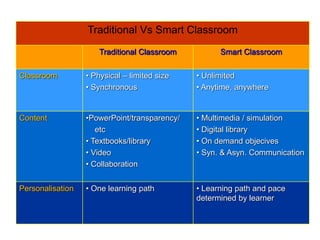
Traditional Vs Smart Classroom
Traditional Classroom Smart Classroom
Classroom • Physical – limited size
• Synchronous
• Unlimited
• Anytime, anywhere
Content •PowerPoint/transparency/
etc
• Textbooks/library
• Video
• Collaboration
• Multimedia / simulation
• Digital library
• On demand objecives
• Syn. & Asyn. Communication
Personalisation • One learning path • Learning path and pace
determined by learner
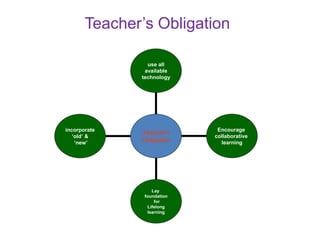
incorporate
‘old’ &
‘new’
Lay
foundation
for
Lifelong
learning
Encourage
collaborative
learning
use all
available
technology
Teacher’s
Obligation
Teacher’s Obligation
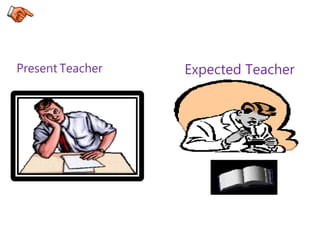
Present Teacher Expected Teacher
Modern Teaching?
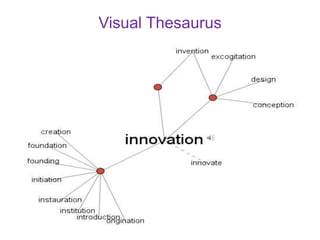
Visual Thesaurus
What is modern /
innovation?
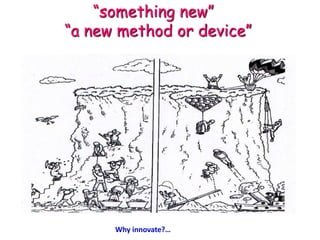
“something new”
“a new method or device”
Why innovate?…
Innovation
in
the
Classroom
=
A vehicle for Progress
How can I get my students to….
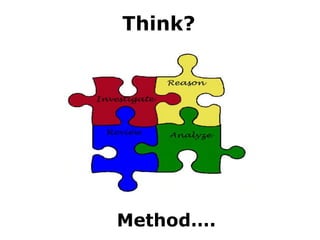
Think?
Method….
Key issues in the introduction of innovation in
institution
1. Organizational
2. Pedagogical
3. Technological
4. Evaluation-Dissemination matters
Some Types of Innovation
1. Changes in the nature of our roles,
– e.g., accountability, disaggregation
2. Changes in the form of our teaching
– e.g., tech tools, Internet courses
3. Changes in the function of our teaching,
– e.g., Active learning methods, such as Service
Learning
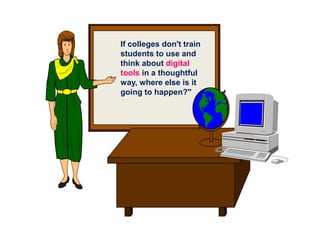
If colleges don't train
students to use and
think about digital
tools in a thoughtful
way, where else is it
going to happen?"
Science of
Teaching-Learning
The Root Words
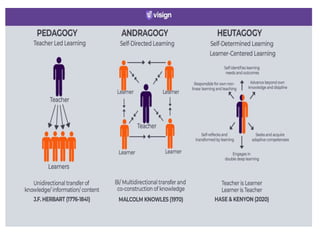
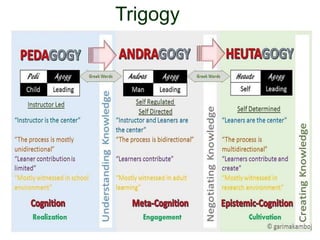
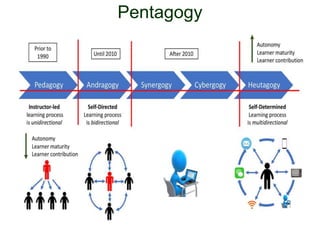
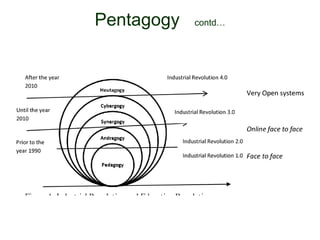
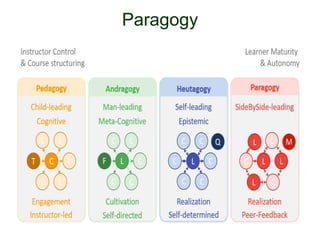
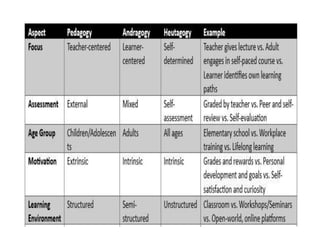
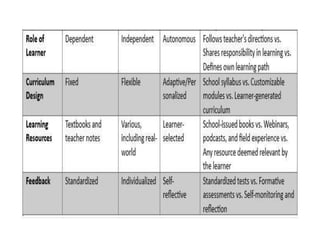
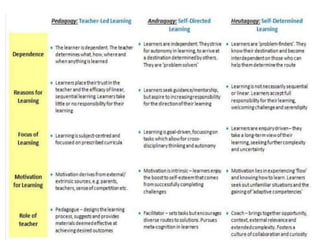
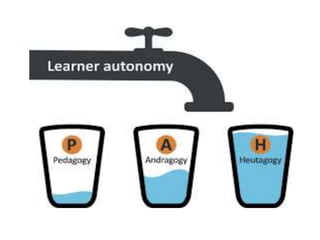
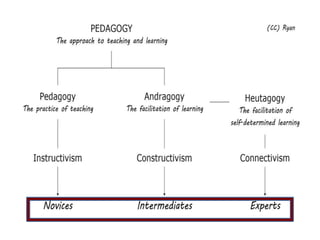
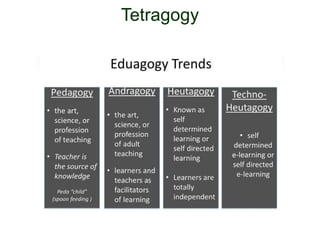
• Pedagogy: From the Greek word
'paidagōgía,' meaning 'leader of children.‘
Primarily deals with the strategies,
techniques, and approaches used to teach
children.
• Andragogy: Rooted in the Greek word 'aner'
or 'andros,' which means 'man,‘ Focuses on
the methods and principles used to teach
adults.
• Heutagogy: Comes from the Greek word
'heutos,' meaning 'self,' and centred on self-
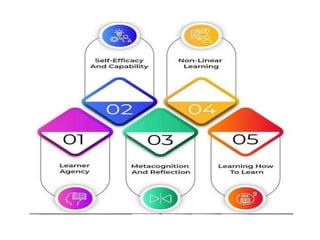
Trigogy
Tetragogy
Pentagogy
Pentagogy contd…
Paragogy
Educational
Technology
Educational Technology
The utilization of modern machines and
gadgets in the field of education to
increase the rate of learning to develop
the learners interest for effective and
productive learning.
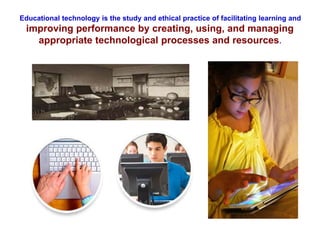
Educational technology is the study and ethical practice of facilitating learning and
improving performance by creating, using, and managing
appropriate technological processes and resources.
The Elder Sophists (450-350 B.C.) used the term
‘techne’ to refer to the process of applying knowledge in
a systematic way to the practical art of instruction.
Socrates (470-399B.C.) taught through question
answer methods.
In the 17th century Johann Comenius introduced
textbooks for children.
The first educational television station went on air in
Houston, Texas, in 1953.
In 1956 CCTV were established for instructional
purposes.
Programmed instruction was developed in the works
ET-
Evolution
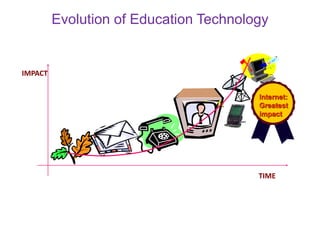
Evolution of Education Technology
TIME
TIME
IMPACT
Internet:
Greatest
impact
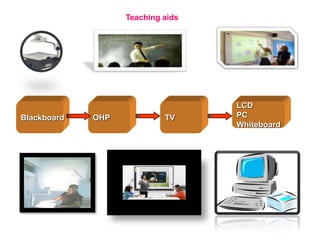
Blackboard OHP TV
LCD
PC
Whiteboard
Teaching aids
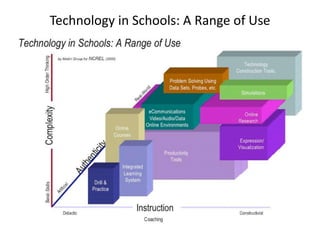
Technology in Schools: A Range of Use
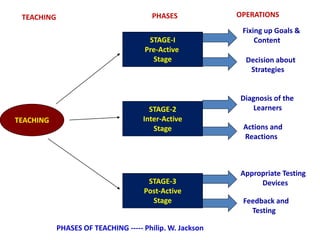
STAGE-I
Pre-Active
Stage
STAGE-2
Inter-Active
Stage
STAGE-3
Post-Active
Stage
TEACHING
STAGE-I
Pre-Active
Stage
Fixing up Goals &
Content
Decision about
Strategies
Diagnosis of the
Learners
Actions and
Reactions
Appropriate Testing
Devices
Feedback and
Testing
TEACHING PHASES OPERATIONS
PHASES OF TEACHING ----- Philip. W. Jackson
Modern Methods
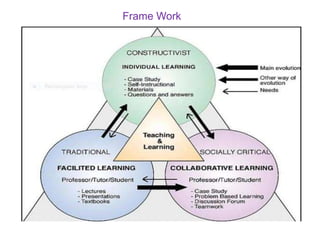
Frame Work
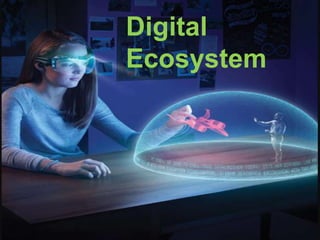
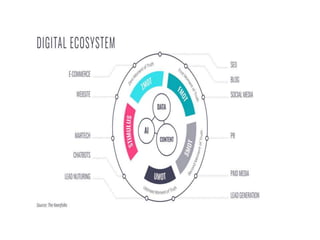
Digital
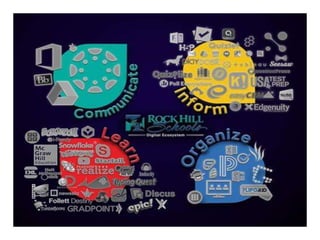
Ecosystem
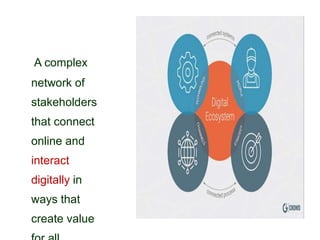
A complex
network of
stakeholders
that connect
online and
interact
digitally in
ways that
create value
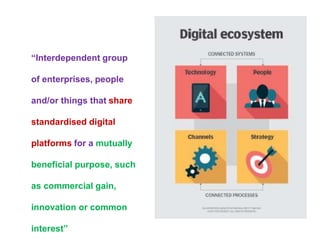
“Interdependent group
of enterprises, people
and/or things that share
standardised digital
platforms for a mutually
beneficial purpose, such
as commercial gain,
innovation or common
interest”
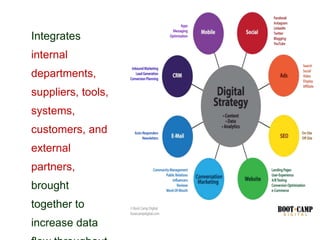
Integrates
internal
departments,
suppliers, tools,
systems,
customers, and
external
partners,
brought
together to
increase data
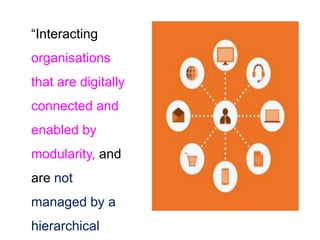
“Interacting
organisations
that are digitally
connected and
enabled by
modularity, and
are not
managed by a
hierarchical
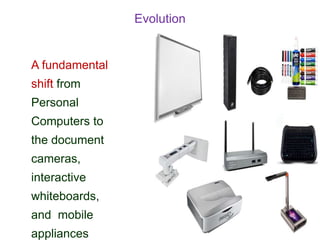
Evolution
A fundamental
shift from
Personal
Computers to
the document
cameras,
interactive
whiteboards,
and mobile
appliances
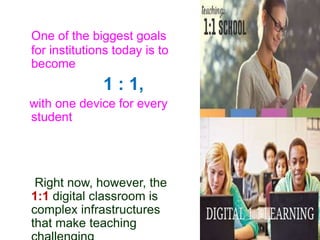
One of the biggest goals
for institutions today is to
become
1 : 1,
with one device for every
student
Right now, however, the
1:1 digital classroom is
complex infrastructures
that make teaching
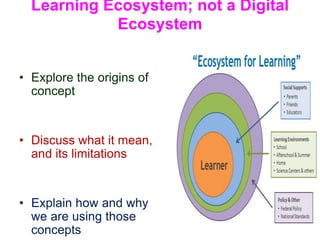
Learning Ecosystem; not a Digital
Ecosystem
• Explore the origins of
concept
• Discuss what it mean,
and its limitations
• Explain how and why
we are using those
concepts
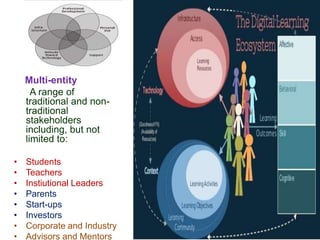
Multi-entity
A range of
traditional and non-
traditional
stakeholders
including, but not
limited to:
• Students
• Teachers
• Instiutional Leaders
• Parents
• Start-ups
• Investors
• Corporate and Industry
• Advisors and Mentors
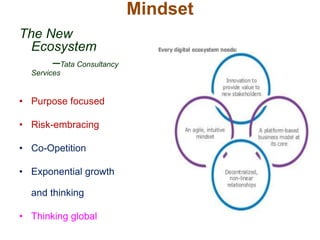
Mindset
The New
Ecosystem
–Tata Consultancy
Services
• Purpose focused
• Risk-embracing
• Co-Opetition
• Exponential growth
and thinking
• Thinking global
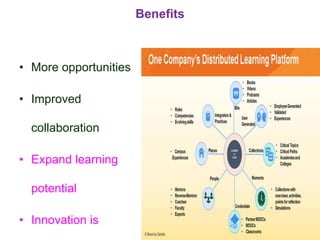
Benefits
• More opportunities
• Improved
collaboration
• Expand learning
potential
• Innovation is
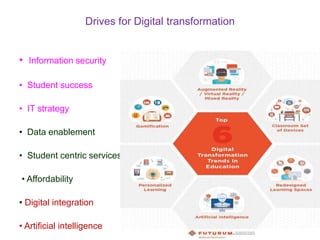
Drives for Digital transformation
• Information security
• Student success
• IT strategy
• Data enablement
• Student centric services
• Affordability
• Digital integration
• Artificial intelligence
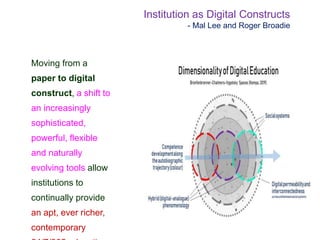
Institution as Digital Constructs
- Mal Lee and Roger Broadie
Moving from a
paper to digital
construct, a shift to
an increasingly
sophisticated,
powerful, flexible
and naturally
evolving tools allow
institutions to
continually provide
an apt, ever richer,
contemporary
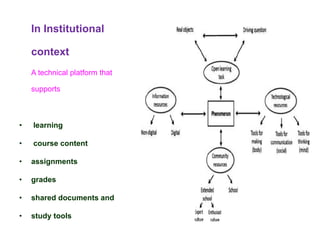
In Institutional
context
A technical platform that
supports
• learning
• course content
• assignments
• grades
• shared documents and
• study tools
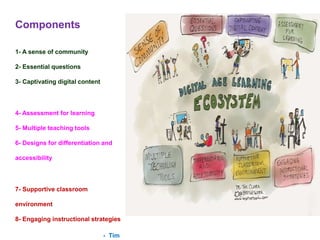
Components
1- A sense of community
2- Essential questions
3- Captivating digital content
4- Assessment for learning
5- Multiple teaching tools
6- Designs for differentiation and
accessibility
7- Supportive classroom
environment
8- Engaging instructional strategies
- Tim
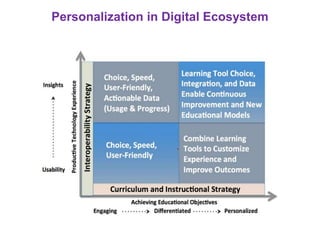
Personalization in Digital Ecosystem
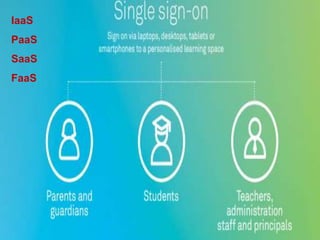
IaaS
PaaS
SaaS
FaaS
The
Action
GTTTT
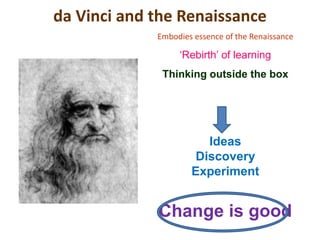
da Vinci and the Renaissance
Embodies essence of the Renaissance
‘Rebirth’ of learning
Thinking outside the box
Ideas
Discovery
Experiment
Change is good
Brainstorm
Write down 5 ways that your
professors/teachers taught you
Effective methods
1
2
3
4
5
Ineffective methods
1
2
3
4
5
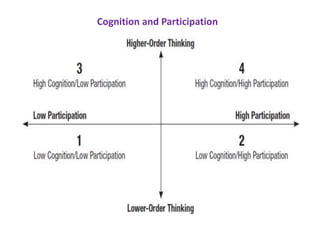
Cognition and Participation
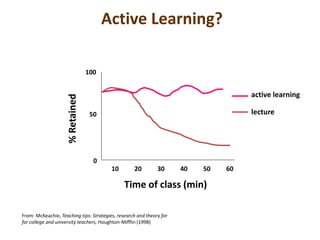
Active Learning?
Time of class (min)
10 20 30 40 60
%
Retained
50
100
50
0
lecture
active learning
From: McKeachie, Teaching tips: Strategies, research and theory for
for college and university teachers, Houghton-Mifflin (1998)
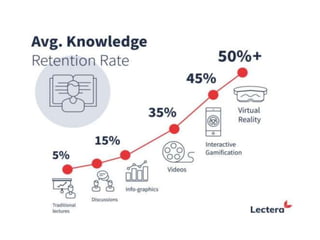
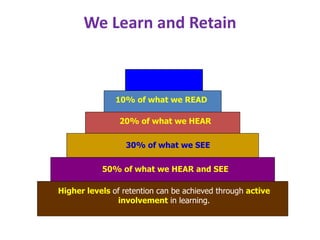
We Learn and Retain
30% of what we SEE
10% of what we READ
20% of what we HEAR
50% of what we HEAR and SEE
Higher levels of retention can be achieved through active
involvement in learning.
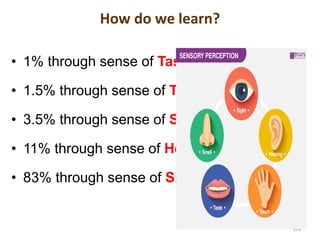
How do we learn?
• 1% through sense of Taste
• 1.5% through sense of Touch
• 3.5% through sense of Smell
• 11% through sense of Hearing
• 83% through sense of Sight
104
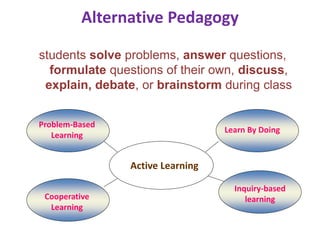
Alternative Pedagogy
students solve problems, answer questions,
formulate questions of their own, discuss,
explain, debate, or brainstorm during class
Active Learning
Problem-Based
Learning
Cooperative
Learning
Learn By Doing
Inquiry-based
learning
Alternative Pedagogy increases;
• student participation
• student engagement
• student retention
• student ownership in course
• exciting classroom experience
• higher level thinking
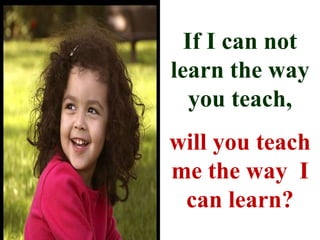
If I can not
learn the way
you teach,
will you teach
me the way I
can learn?
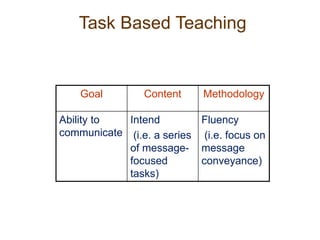
Task Based Teaching
Goal Content Methodology
Ability to
communicate
Intend
(i.e. a series
of message-
focused
tasks)
Fluency
(i.e. focus on
message
conveyance)
A ‘Task’
1. Goal directed.
2. Involves a primary focus on meaning.
3. The participants choose the linguistic
/resources needed to complete the task.
4. Has a clearly defined outcome.
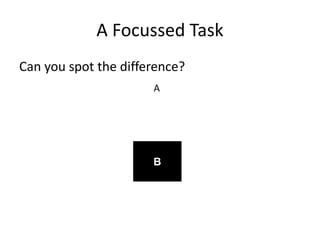
A Focussed Task
Can you spot the difference?
A
B
Picture taken from Google
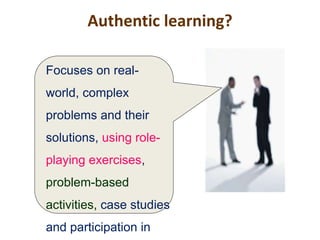
Authentic learning?
Focuses on real-
world, complex
problems and their
solutions, using role-
playing exercises,
problem-based
activities, case studies
and participation in
Five Kind of Questions
1. Inference Questions
2. Interpretation Questions
3. Transfer Questions
4. Questions about Hypotheses
5. Reflective Questions
Types of Task
1. Unfocussed tasks
a. Pedagogic
b. Real world
2. Focused tasks
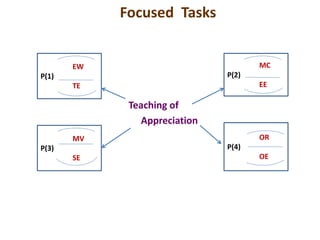
Focused Tasks
Teaching of
Appreciation
MC
P(2)
EE
MV
P(3)
SE
OR
P(4)
OE
EW
P(1)
TE
SKILLS in Knowledge
• Procedural Knowledge
• Decorative Knowledge
• Episodic Knowledge
• Holistic Knowledge
• Mega Knowledge
• Wisdom
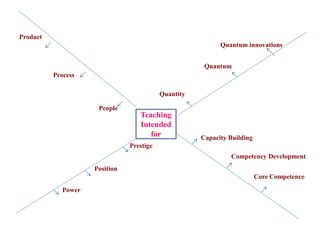
Product
Quantum innovations
Quantum
Process
Quantity
People
Capacity Building
Prestige
Competency Development
Position
Core Competence
Power
Teaching
Intended
for
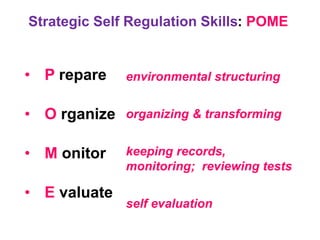
Strategic Self Regulation Skills: POME
• P repare
• O rganize
• M onitor
• E valuate
environmental structuring
organizing & transforming
keeping records,
monitoring; reviewing tests
self evaluation
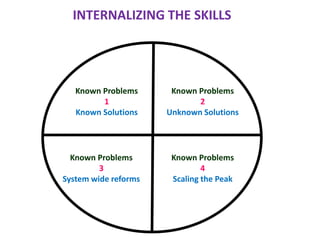
INTERNALIZING THE SKILLS
Known Problems
1
Known Solutions
Known Problems
3
System wide reforms
Known Problems
4
Scaling the Peak
Known Problems
2
Unknown Solutions
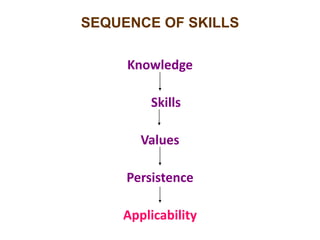
SEQUENCE OF SKILLS
Knowledge
Skills
Values
Persistence
Applicability
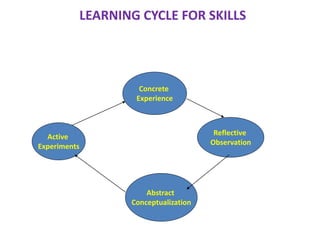
LEARNING CYCLE FOR SKILLS
Concrete
Experience
Reflective
Observation
Active
Experiments
Abstract
Conceptualization
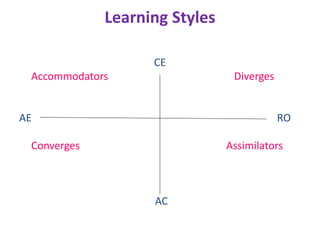
Learning Styles
CE
Accommodators Diverges
AE RO
Converges Assimilators
AC
Activities Tryout
Teachers should
• have a variety of teaching styles.
• if a child does not master a skill the first
time, try again.
• But, not necessarily the same way you
taught it the first
time.”
Questions to be asked by the Teachers
themselves for Effective Teaching
• Why to Teach?
• Whom to Teach?
• Who to Teach?
• Where to Teach?
• What to Teach?
• How to Teach?
• When to Teach?
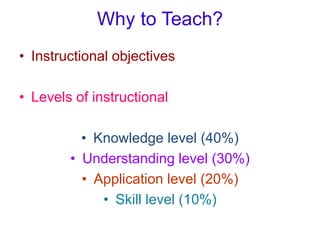
Why to Teach?
• Instructional objectives
• Levels of instructional
• Knowledge level (40%)
• Understanding level (30%)
• Application level (20%)
• Skill level (10%)
Whom to Teach?
Individual difference among students in
terms of…..
• Intellectual ability
• Interest
• Motivation
• Aptitude
• Thinking styles
• Attitude ect…
Who to Teach?
• Qualification of the teacher
• Subject specialization
• Teacher Behavior in the Classroom
• Teacher’s Personal variables
• Teaching Competencies of the teacher
• Personality of the teacher
Where to Teach?
• Classroom?
• Play ground?
• Computer Laboratory?
• Language Laboratory?
• Science Laboratory?
• Field Visits?
• Which environment?
• What facilities?
• Library?
• Simulated Environment?
What to Teach?
• Curriculum
• Content of the text
• Instructional materials
• Workshop activities
• Library collections
• References
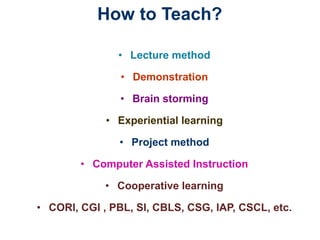
How to Teach?
• Lecture method
• Demonstration
• Brain storming
• Experiential learning
• Project method
• Computer Assisted Instruction
• Cooperative learning
• CORI, CGI , PBL, SI, CBLS, CSG, IAP, CSCL, etc.
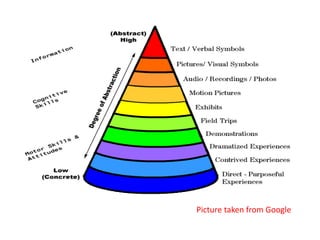
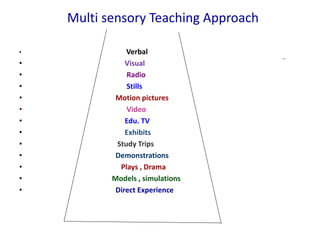
Multi sensory Teaching Approach
• Verbal
• Visual
• Radio
• Stills
• Motion pictures
• Video
• Edu. TV
• Exhibits
• Study Trips
• Demonstrations
• Plays , Drama
• Models , simulations
• Direct Experience
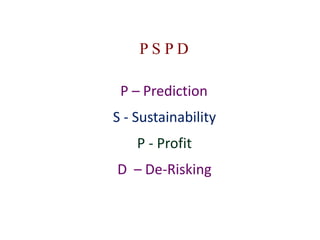
P S P D
P – Prediction
S - Sustainability
P - Profit
D – De-Risking
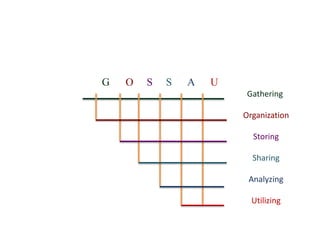
G O S S A U
Gathering
Organization
Storing
Sharing
Analyzing
Utilizing
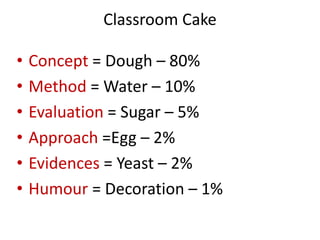
Classroom Cake
• Concept = Dough – 80%
• Method = Water – 10%
• Evaluation = Sugar – 5%
• Approach =Egg – 2%
• Evidences = Yeast – 2%
• Humour = Decoration – 1%
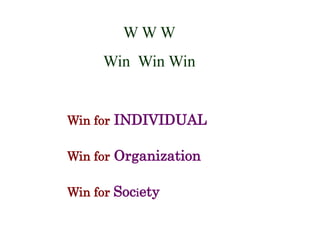
W W W
Win Win Win
Win for INDIVIDUAL
Win for Organization
Win for Society
THANK YOU
rrnathedu@gmail.com
ramnathr@alagappauniversity.ac.in
rrnathedn@yahoo.co.in

Digital Learning Ecosystem: The Trigogical Possibilities

  • 1.
    DIGITAL LEARNING ECOSYSTEM: THE TRIGOGICAL POSSIBILITIES Dr.R.RAMNATH Department of Education Alagappa University Speaking is easy, but Listening is difficult. Speaking is a skill, but Listening is an attitude. Be happy in listening .
  • 2.
  • 8.
  • 9.
    Digital Natives orDigital Immigrants Email is 54 [October 29th 1969] year old ARPANET's PCs [1984] are 39 years old 1990
  • 10.
    1990 - TimBerners-Lee creates the World Wide Web program 1996 - Palm Pilot 1997 - AIM - Instant Messaging 1997 - Blogs 1999 - Napster
  • 11.
    2001 – Wikipedia 2002– iPod 2003 - My Space 2004 - Facebook and Podcast 2005 – YouTube 2007 - iPhone
  • 12.
    Quality teaching and learningenabled by ICT There’s nothing magical about any tech tool. Real magic rests in the minds and hearts of teachers using digital tools to introduce students to new individuals, ideas and opportunities
  • 13.
    It’s not aboutthe technology, it’s about the Pedagogy. Our use of technology needs to be driven by the teaching and learning The technology is only an enabler.
  • 14.
    Digital Media Lifestyle(09.12.23) 4 petabytes data over 10 billions photos over 1 billion videos (720000 hours) served per day 3.02 million podcasts iTunes 600 million active blogs 500 million tweets per day Over 347.3 billion emails 1.13billion web sites
  • 16.
  • 18.
  • 19.
    Variance in WebVersion Activity Generation Chronology X 1965 and 1981 Boomers born between 1945 and 1964 Y or The Millennial 1982 and 1994 Z or Centennial born in 1995 and the youngest in 2010 Alpha generation After2010 Source: Iberdrola
  • 20.
    highly influenced by thepower of the media constantly visually engaged driven by self- image, identity and acceptance multi- task well have a vast and diverse array of choices disenchanted with traditional learning are wired and wirelessly connected No waiting, no delay! Youth of today…
  • 21.
    My goal inlife is to find ways in which children can use technology as a constructive medium to do things that they could not do before; to do things at a level of complexity that was not previously accessible to children. Prof .Seymour Papert 1998
  • 22.
  • 23.
  • 26.
    • To teach,is to make someone to learn... •Change is the end result of all true learning Motto
  • 27.
    •Using previous knowledge •Providingfor individual difference •Readiness •Meaningfulness •Defining specific objectives of the lesson •Proceeding from simple to complex •Proceeding from concrete to abstract •Proceeding from general to specific •Proceeding from known to unknown Principles of Teaching
  • 28.
  • 29.
    Need of thehour It is incumbent upon educators today to begin preparing for the changing education paradigms of tomorrow.
  • 30.
    Working Together, WeCan achieve our goal and expected qualities in higher education
  • 31.
    Traditional Vs SmartClassroom Traditional Classroom Smart Classroom Classroom • Physical – limited size • Synchronous • Unlimited • Anytime, anywhere Content •PowerPoint/transparency/ etc • Textbooks/library • Video • Collaboration • Multimedia / simulation • Digital library • On demand objecives • Syn. & Asyn. Communication Personalisation • One learning path • Learning path and pace determined by learner
  • 32.
  • 33.
  • 34.
  • 35.
  • 36.
    What is modern/ innovation?
  • 37.
    “something new” “a newmethod or device” Why innovate?…
  • 38.
    Innovation in the Classroom = A vehicle forProgress How can I get my students to….
  • 39.
  • 40.
    Key issues inthe introduction of innovation in institution 1. Organizational 2. Pedagogical 3. Technological 4. Evaluation-Dissemination matters
  • 41.
    Some Types ofInnovation 1. Changes in the nature of our roles, – e.g., accountability, disaggregation 2. Changes in the form of our teaching – e.g., tech tools, Internet courses 3. Changes in the function of our teaching, – e.g., Active learning methods, such as Service Learning
  • 42.
    If colleges don'ttrain students to use and think about digital tools in a thoughtful way, where else is it going to happen?"
  • 43.
  • 45.
    The Root Words •Pedagogy: From the Greek word 'paidagōgía,' meaning 'leader of children.‘ Primarily deals with the strategies, techniques, and approaches used to teach children. • Andragogy: Rooted in the Greek word 'aner' or 'andros,' which means 'man,‘ Focuses on the methods and principles used to teach adults. • Heutagogy: Comes from the Greek word 'heutos,' meaning 'self,' and centred on self-
  • 47.
  • 48.
  • 49.
  • 50.
  • 51.
  • 59.
  • 60.
    Educational Technology The utilizationof modern machines and gadgets in the field of education to increase the rate of learning to develop the learners interest for effective and productive learning.
  • 61.
    Educational technology isthe study and ethical practice of facilitating learning and improving performance by creating, using, and managing appropriate technological processes and resources.
  • 62.
    The Elder Sophists(450-350 B.C.) used the term ‘techne’ to refer to the process of applying knowledge in a systematic way to the practical art of instruction. Socrates (470-399B.C.) taught through question answer methods. In the 17th century Johann Comenius introduced textbooks for children. The first educational television station went on air in Houston, Texas, in 1953. In 1956 CCTV were established for instructional purposes. Programmed instruction was developed in the works ET- Evolution
  • 63.
    Evolution of EducationTechnology TIME TIME IMPACT Internet: Greatest impact
  • 64.
  • 66.
    Technology in Schools:A Range of Use
  • 67.
    STAGE-I Pre-Active Stage STAGE-2 Inter-Active Stage STAGE-3 Post-Active Stage TEACHING STAGE-I Pre-Active Stage Fixing up Goals& Content Decision about Strategies Diagnosis of the Learners Actions and Reactions Appropriate Testing Devices Feedback and Testing TEACHING PHASES OPERATIONS PHASES OF TEACHING ----- Philip. W. Jackson
  • 68.
  • 69.
  • 70.
  • 71.
    A complex network of stakeholders thatconnect online and interact digitally in ways that create value
  • 72.
    “Interdependent group of enterprises,people and/or things that share standardised digital platforms for a mutually beneficial purpose, such as commercial gain, innovation or common interest”
  • 73.
  • 75.
    “Interacting organisations that are digitally connectedand enabled by modularity, and are not managed by a hierarchical
  • 76.
    Evolution A fundamental shift from Personal Computersto the document cameras, interactive whiteboards, and mobile appliances
  • 77.
    One of thebiggest goals for institutions today is to become 1 : 1, with one device for every student Right now, however, the 1:1 digital classroom is complex infrastructures that make teaching
  • 78.
    Learning Ecosystem; nota Digital Ecosystem • Explore the origins of concept • Discuss what it mean, and its limitations • Explain how and why we are using those concepts
  • 79.
    Multi-entity A range of traditionaland non- traditional stakeholders including, but not limited to: • Students • Teachers • Instiutional Leaders • Parents • Start-ups • Investors • Corporate and Industry • Advisors and Mentors
  • 80.
    Mindset The New Ecosystem –Tata Consultancy Services •Purpose focused • Risk-embracing • Co-Opetition • Exponential growth and thinking • Thinking global
  • 81.
    Benefits • More opportunities •Improved collaboration • Expand learning potential • Innovation is
  • 82.
    Drives for Digitaltransformation • Information security • Student success • IT strategy • Data enablement • Student centric services • Affordability • Digital integration • Artificial intelligence
  • 84.
    Institution as DigitalConstructs - Mal Lee and Roger Broadie Moving from a paper to digital construct, a shift to an increasingly sophisticated, powerful, flexible and naturally evolving tools allow institutions to continually provide an apt, ever richer, contemporary
  • 85.
    In Institutional context A technicalplatform that supports • learning • course content • assignments • grades • shared documents and • study tools
  • 86.
    Components 1- A senseof community 2- Essential questions 3- Captivating digital content 4- Assessment for learning 5- Multiple teaching tools 6- Designs for differentiation and accessibility 7- Supportive classroom environment 8- Engaging instructional strategies - Tim
  • 89.
  • 91.
  • 92.
  • 93.
  • 94.
    da Vinci andthe Renaissance Embodies essence of the Renaissance ‘Rebirth’ of learning Thinking outside the box Ideas Discovery Experiment Change is good
  • 95.
    Brainstorm Write down 5ways that your professors/teachers taught you Effective methods 1 2 3 4 5 Ineffective methods 1 2 3 4 5
  • 101.
  • 102.
    Active Learning? Time ofclass (min) 10 20 30 40 60 % Retained 50 100 50 0 lecture active learning From: McKeachie, Teaching tips: Strategies, research and theory for for college and university teachers, Houghton-Mifflin (1998)
  • 103.
    We Learn andRetain 30% of what we SEE 10% of what we READ 20% of what we HEAR 50% of what we HEAR and SEE Higher levels of retention can be achieved through active involvement in learning.
  • 104.
    How do welearn? • 1% through sense of Taste • 1.5% through sense of Touch • 3.5% through sense of Smell • 11% through sense of Hearing • 83% through sense of Sight 104
  • 105.
    Alternative Pedagogy students solveproblems, answer questions, formulate questions of their own, discuss, explain, debate, or brainstorm during class Active Learning Problem-Based Learning Cooperative Learning Learn By Doing Inquiry-based learning
  • 106.
    Alternative Pedagogy increases; •student participation • student engagement • student retention • student ownership in course • exciting classroom experience • higher level thinking
  • 107.
    If I cannot learn the way you teach, will you teach me the way I can learn?
  • 108.
    Task Based Teaching GoalContent Methodology Ability to communicate Intend (i.e. a series of message- focused tasks) Fluency (i.e. focus on message conveyance)
  • 109.
    A ‘Task’ 1. Goaldirected. 2. Involves a primary focus on meaning. 3. The participants choose the linguistic /resources needed to complete the task. 4. Has a clearly defined outcome.
  • 112.
    A Focussed Task Canyou spot the difference? A B
  • 113.
  • 115.
    Authentic learning? Focuses onreal- world, complex problems and their solutions, using role- playing exercises, problem-based activities, case studies and participation in
  • 116.
    Five Kind ofQuestions 1. Inference Questions 2. Interpretation Questions 3. Transfer Questions 4. Questions about Hypotheses 5. Reflective Questions
  • 119.
    Types of Task 1.Unfocussed tasks a. Pedagogic b. Real world 2. Focused tasks
  • 123.
  • 124.
    SKILLS in Knowledge •Procedural Knowledge • Decorative Knowledge • Episodic Knowledge • Holistic Knowledge • Mega Knowledge • Wisdom
  • 126.
    Product Quantum innovations Quantum Process Quantity People Capacity Building Prestige CompetencyDevelopment Position Core Competence Power Teaching Intended for
  • 127.
    Strategic Self RegulationSkills: POME • P repare • O rganize • M onitor • E valuate environmental structuring organizing & transforming keeping records, monitoring; reviewing tests self evaluation
  • 128.
    INTERNALIZING THE SKILLS KnownProblems 1 Known Solutions Known Problems 3 System wide reforms Known Problems 4 Scaling the Peak Known Problems 2 Unknown Solutions
  • 129.
  • 130.
    LEARNING CYCLE FORSKILLS Concrete Experience Reflective Observation Active Experiments Abstract Conceptualization
  • 131.
  • 133.
  • 134.
    Teachers should • havea variety of teaching styles. • if a child does not master a skill the first time, try again. • But, not necessarily the same way you taught it the first time.”
  • 135.
    Questions to beasked by the Teachers themselves for Effective Teaching • Why to Teach? • Whom to Teach? • Who to Teach? • Where to Teach? • What to Teach? • How to Teach? • When to Teach?
  • 136.
    Why to Teach? •Instructional objectives • Levels of instructional • Knowledge level (40%) • Understanding level (30%) • Application level (20%) • Skill level (10%)
  • 137.
    Whom to Teach? Individualdifference among students in terms of….. • Intellectual ability • Interest • Motivation • Aptitude • Thinking styles • Attitude ect…
  • 138.
    Who to Teach? •Qualification of the teacher • Subject specialization • Teacher Behavior in the Classroom • Teacher’s Personal variables • Teaching Competencies of the teacher • Personality of the teacher
  • 139.
    Where to Teach? •Classroom? • Play ground? • Computer Laboratory? • Language Laboratory? • Science Laboratory? • Field Visits? • Which environment? • What facilities? • Library? • Simulated Environment?
  • 140.
    What to Teach? •Curriculum • Content of the text • Instructional materials • Workshop activities • Library collections • References
  • 141.
    How to Teach? •Lecture method • Demonstration • Brain storming • Experiential learning • Project method • Computer Assisted Instruction • Cooperative learning • CORI, CGI , PBL, SI, CBLS, CSG, IAP, CSCL, etc.
  • 142.
    Multi sensory TeachingApproach • Verbal • Visual • Radio • Stills • Motion pictures • Video • Edu. TV • Exhibits • Study Trips • Demonstrations • Plays , Drama • Models , simulations • Direct Experience
  • 144.
    P S PD P – Prediction S - Sustainability P - Profit D – De-Risking
  • 145.
    G O SS A U Gathering Organization Storing Sharing Analyzing Utilizing
  • 146.
    Classroom Cake • Concept= Dough – 80% • Method = Water – 10% • Evaluation = Sugar – 5% • Approach =Egg – 2% • Evidences = Yeast – 2% • Humour = Decoration – 1%
  • 150.
    W W W WinWin Win Win for INDIVIDUAL Win for Organization Win for Society
  • 151.