Educational TechnologyEducational Technology
Recent trendRecent trend
Bharti Kumari
Educational TechnologyEducational Technology
PastPast
Today’s Lesson
History
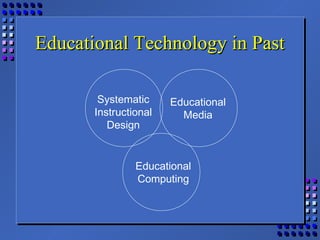
Educational Technology in PastEducational Technology in Past
Systematic
Instructional
Design
Educational
Media
Educational
Computing
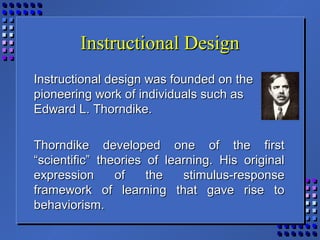
Instructional DesignInstructional Design
Instructional design was founded on theInstructional design was founded on the
pioneering work of individuals such aspioneering work of individuals such as
Edward L. Thorndike.Edward L. Thorndike.
Thorndike developed one of the firstThorndike developed one of the first
“scientific” theories of learning. His original“scientific” theories of learning. His original
expression of the stimulus-responseexpression of the stimulus-response
framework of learning that gave rise toframework of learning that gave rise to
behaviorism.behaviorism.
Theoretical PerspectivesTheoretical Perspectives
The field has been influenced by three majorThe field has been influenced by three major
theoretical perspectives over the last century:theoretical perspectives over the last century:
– BehaviorismBehaviorism
– CognitivismCognitivism
– ConstructivismConstructivism
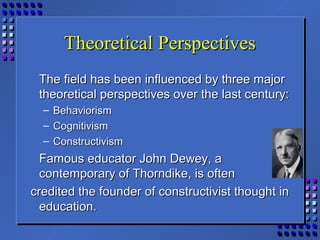
Famous educator John Dewey, aFamous educator John Dewey, a
contemporary of Thorndike, is oftencontemporary of Thorndike, is often
credited the founder of constructivist thought incredited the founder of constructivist thought in
education.education.
Designing InstructionDesigning Instruction
The process of human learning and growingThe process of human learning and growing
understanding in the 20understanding in the 20thth
century supportedcentury supported
the notion that instruction could bethe notion that instruction could be
systematically designed to produce learning.systematically designed to produce learning.
Educational MediaEducational Media
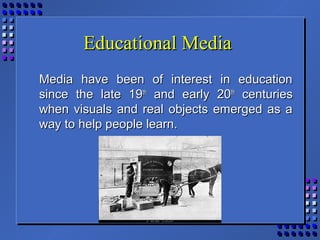
Media have been of interest in educationMedia have been of interest in education
since the late 19since the late 19thth
and early 20and early 20thth
centuriescenturies
when visuals and real objects emerged as awhen visuals and real objects emerged as a
way to help people learn.way to help people learn.
Educational MediaEducational Media
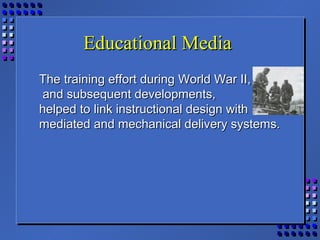
The training effort during World War II,The training effort during World War II,
and subsequent developments,and subsequent developments,
helped to link instructional design withhelped to link instructional design with
mediated and mechanical delivery systems.mediated and mechanical delivery systems.
Educational MediaEducational Media
Films, and later radio, TV, and computersFilms, and later radio, TV, and computers
were the object of much excitement becausewere the object of much excitement because
of the belief that media that could promoteof the belief that media that could promote
learning.learning.
However, until recently, all media wereHowever, until recently, all media were
separately developed and managed.separately developed and managed.
Computing in pastComputing in past
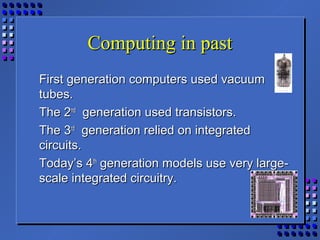
First generation computers used vacuumFirst generation computers used vacuum
tubes.tubes.
The 2The 2ndnd
generation used transistors.generation used transistors.
The 3The 3rdrd
generation relied on integratedgeneration relied on integrated
circuits.circuits.
Today’s 4Today’s 4thth
generation models use very large-generation models use very large-
scale integrated circuitry.scale integrated circuitry.
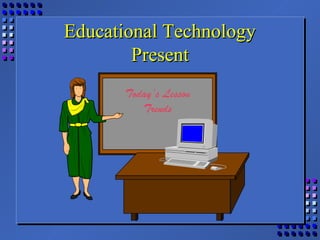
Educational TechnologyEducational Technology
PresentPresent
Today’s Lesson
Trends
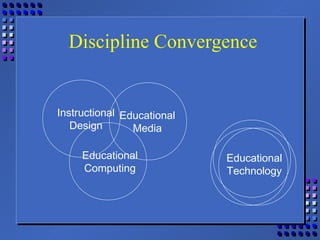
Instructional
Design
Educational
Media
Educational
Computing
Discipline Convergence
Educational
Technology
ID Theory BaseID Theory Base
Behavioral perspectiveBehavioral perspective
Cognitive perspectiveCognitive perspective
Constructivist perspectiveConstructivist perspective
Computers in Schools TodayComputers in Schools Today
Use of Technology in EducationUse of Technology in Education
MotivationMotivation
– Attention, engagement, controlAttention, engagement, control
Unique instructional capabilitiesUnique instructional capabilities
– Finding information, visualizing, linking learnersFinding information, visualizing, linking learners
Support for new instructional approachesSupport for new instructional approaches
– Cooperative learning, problem solving, shared intelligenceCooperative learning, problem solving, shared intelligence
Increased teacher productivityIncreased teacher productivity
– Record keeping, better materials, freeing timeRecord keeping, better materials, freeing time
Required skills for an information ageRequired skills for an information age
– Information literacy, visual literacy, technology literacyInformation literacy, visual literacy, technology literacy
Electronic Ink / Paper / BooksElectronic Ink / Paper / Books
eBooks, portable devices that can holdeBooks, portable devices that can hold
downloaded books, are already available.downloaded books, are already available.
Electronic ink or paper is a developingElectronic ink or paper is a developing
technology in which microcapsules,technology in which microcapsules,
embedded within a thin film that can beembedded within a thin film that can be
mounted in tablet or possibly even somethingmounted in tablet or possibly even something
like normal paper, can display print inlike normal paper, can display print in
response to electrical signals.response to electrical signals.
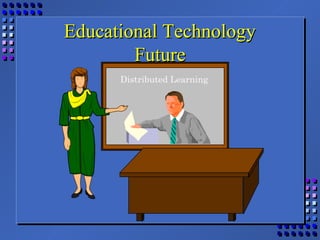
Educational TechnologyEducational Technology
FutureFuture
Distributed Learning
Education expected in futureEducation expected in future
Devices will connect wirelessly and become an integralDevices will connect wirelessly and become an integral
part of the teaching and learning process.part of the teaching and learning process.
Using technology tools for real work on authentic tasks.Using technology tools for real work on authentic tasks.
Full multimedia capability, including routine access to andFull multimedia capability, including routine access to and
storage of video, will also be possible.storage of video, will also be possible.
Increased processing and storage capacity with softwareIncreased processing and storage capacity with software
are likely to make voice interfacing with computing devicesare likely to make voice interfacing with computing devices
more widespread, perhaps at commonplace.more widespread, perhaps at commonplace.
With improving technology and increasing networking,With improving technology and increasing networking,
education will become available anytime and anywhere.education will become available anytime and anywhere.
Higher education, of necessity, will work to reach growingHigher education, of necessity, will work to reach growing
non-traditional audiences.non-traditional audiences.
Education expected in futureEducation expected in future
With access to huge stores of multimedia information,With access to huge stores of multimedia information,
education will focus less on information delivery and moreeducation will focus less on information delivery and more
on finding, evaluating, and using information.on finding, evaluating, and using information.
The teacher’s role will increasingly shift from the “sage onThe teacher’s role will increasingly shift from the “sage on
the stage” to the “guide on the side.”the stage” to the “guide on the side.”
Life-long learning will become the norm, and technologyLife-long learning will become the norm, and technology
will be tool for educators reach those who wantswill be tool for educators reach those who wants
continuing education.continuing education.
Computers and allied technologies will replace traditionalComputers and allied technologies will replace traditional
face-to-face teaching and learning.face-to-face teaching and learning.
But, technology probably will change the face of theBut, technology probably will change the face of the
teaching and learning landscape that we know today.teaching and learning landscape that we know today.
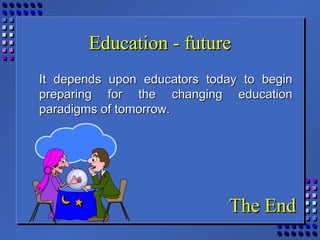
Education - futureEducation - future
It depends upon educators today to beginIt depends upon educators today to begin
preparing for the changing educationpreparing for the changing education
paradigms of tomorrow.paradigms of tomorrow.
The EndThe End

Educational technology

  • 1.
  • 2.
  • 3.
    Educational Technology inPastEducational Technology in Past Systematic Instructional Design Educational Media Educational Computing
  • 4.
    Instructional DesignInstructional Design Instructionaldesign was founded on theInstructional design was founded on the pioneering work of individuals such aspioneering work of individuals such as Edward L. Thorndike.Edward L. Thorndike. Thorndike developed one of the firstThorndike developed one of the first “scientific” theories of learning. His original“scientific” theories of learning. His original expression of the stimulus-responseexpression of the stimulus-response framework of learning that gave rise toframework of learning that gave rise to behaviorism.behaviorism.
  • 5.
    Theoretical PerspectivesTheoretical Perspectives Thefield has been influenced by three majorThe field has been influenced by three major theoretical perspectives over the last century:theoretical perspectives over the last century: – BehaviorismBehaviorism – CognitivismCognitivism – ConstructivismConstructivism Famous educator John Dewey, aFamous educator John Dewey, a contemporary of Thorndike, is oftencontemporary of Thorndike, is often credited the founder of constructivist thought incredited the founder of constructivist thought in education.education.
  • 6.
    Designing InstructionDesigning Instruction Theprocess of human learning and growingThe process of human learning and growing understanding in the 20understanding in the 20thth century supportedcentury supported the notion that instruction could bethe notion that instruction could be systematically designed to produce learning.systematically designed to produce learning.
  • 7.
    Educational MediaEducational Media Mediahave been of interest in educationMedia have been of interest in education since the late 19since the late 19thth and early 20and early 20thth centuriescenturies when visuals and real objects emerged as awhen visuals and real objects emerged as a way to help people learn.way to help people learn.
  • 8.
    Educational MediaEducational Media Thetraining effort during World War II,The training effort during World War II, and subsequent developments,and subsequent developments, helped to link instructional design withhelped to link instructional design with mediated and mechanical delivery systems.mediated and mechanical delivery systems.
  • 9.
    Educational MediaEducational Media Films,and later radio, TV, and computersFilms, and later radio, TV, and computers were the object of much excitement becausewere the object of much excitement because of the belief that media that could promoteof the belief that media that could promote learning.learning. However, until recently, all media wereHowever, until recently, all media were separately developed and managed.separately developed and managed.
  • 10.
    Computing in pastComputingin past First generation computers used vacuumFirst generation computers used vacuum tubes.tubes. The 2The 2ndnd generation used transistors.generation used transistors. The 3The 3rdrd generation relied on integratedgeneration relied on integrated circuits.circuits. Today’s 4Today’s 4thth generation models use very large-generation models use very large- scale integrated circuitry.scale integrated circuitry.
  • 11.
  • 12.
  • 13.
    ID Theory BaseIDTheory Base Behavioral perspectiveBehavioral perspective Cognitive perspectiveCognitive perspective Constructivist perspectiveConstructivist perspective
  • 14.
    Computers in SchoolsTodayComputers in Schools Today
  • 15.
    Use of Technologyin EducationUse of Technology in Education MotivationMotivation – Attention, engagement, controlAttention, engagement, control Unique instructional capabilitiesUnique instructional capabilities – Finding information, visualizing, linking learnersFinding information, visualizing, linking learners Support for new instructional approachesSupport for new instructional approaches – Cooperative learning, problem solving, shared intelligenceCooperative learning, problem solving, shared intelligence Increased teacher productivityIncreased teacher productivity – Record keeping, better materials, freeing timeRecord keeping, better materials, freeing time Required skills for an information ageRequired skills for an information age – Information literacy, visual literacy, technology literacyInformation literacy, visual literacy, technology literacy
  • 16.
    Electronic Ink /Paper / BooksElectronic Ink / Paper / Books eBooks, portable devices that can holdeBooks, portable devices that can hold downloaded books, are already available.downloaded books, are already available. Electronic ink or paper is a developingElectronic ink or paper is a developing technology in which microcapsules,technology in which microcapsules, embedded within a thin film that can beembedded within a thin film that can be mounted in tablet or possibly even somethingmounted in tablet or possibly even something like normal paper, can display print inlike normal paper, can display print in response to electrical signals.response to electrical signals.
  • 17.
  • 18.
    Education expected infutureEducation expected in future Devices will connect wirelessly and become an integralDevices will connect wirelessly and become an integral part of the teaching and learning process.part of the teaching and learning process. Using technology tools for real work on authentic tasks.Using technology tools for real work on authentic tasks. Full multimedia capability, including routine access to andFull multimedia capability, including routine access to and storage of video, will also be possible.storage of video, will also be possible. Increased processing and storage capacity with softwareIncreased processing and storage capacity with software are likely to make voice interfacing with computing devicesare likely to make voice interfacing with computing devices more widespread, perhaps at commonplace.more widespread, perhaps at commonplace. With improving technology and increasing networking,With improving technology and increasing networking, education will become available anytime and anywhere.education will become available anytime and anywhere. Higher education, of necessity, will work to reach growingHigher education, of necessity, will work to reach growing non-traditional audiences.non-traditional audiences.
  • 19.
    Education expected infutureEducation expected in future With access to huge stores of multimedia information,With access to huge stores of multimedia information, education will focus less on information delivery and moreeducation will focus less on information delivery and more on finding, evaluating, and using information.on finding, evaluating, and using information. The teacher’s role will increasingly shift from the “sage onThe teacher’s role will increasingly shift from the “sage on the stage” to the “guide on the side.”the stage” to the “guide on the side.” Life-long learning will become the norm, and technologyLife-long learning will become the norm, and technology will be tool for educators reach those who wantswill be tool for educators reach those who wants continuing education.continuing education. Computers and allied technologies will replace traditionalComputers and allied technologies will replace traditional face-to-face teaching and learning.face-to-face teaching and learning. But, technology probably will change the face of theBut, technology probably will change the face of the teaching and learning landscape that we know today.teaching and learning landscape that we know today.
  • 20.
    Education - futureEducation- future It depends upon educators today to beginIt depends upon educators today to begin preparing for the changing educationpreparing for the changing education paradigms of tomorrow.paradigms of tomorrow. The EndThe End