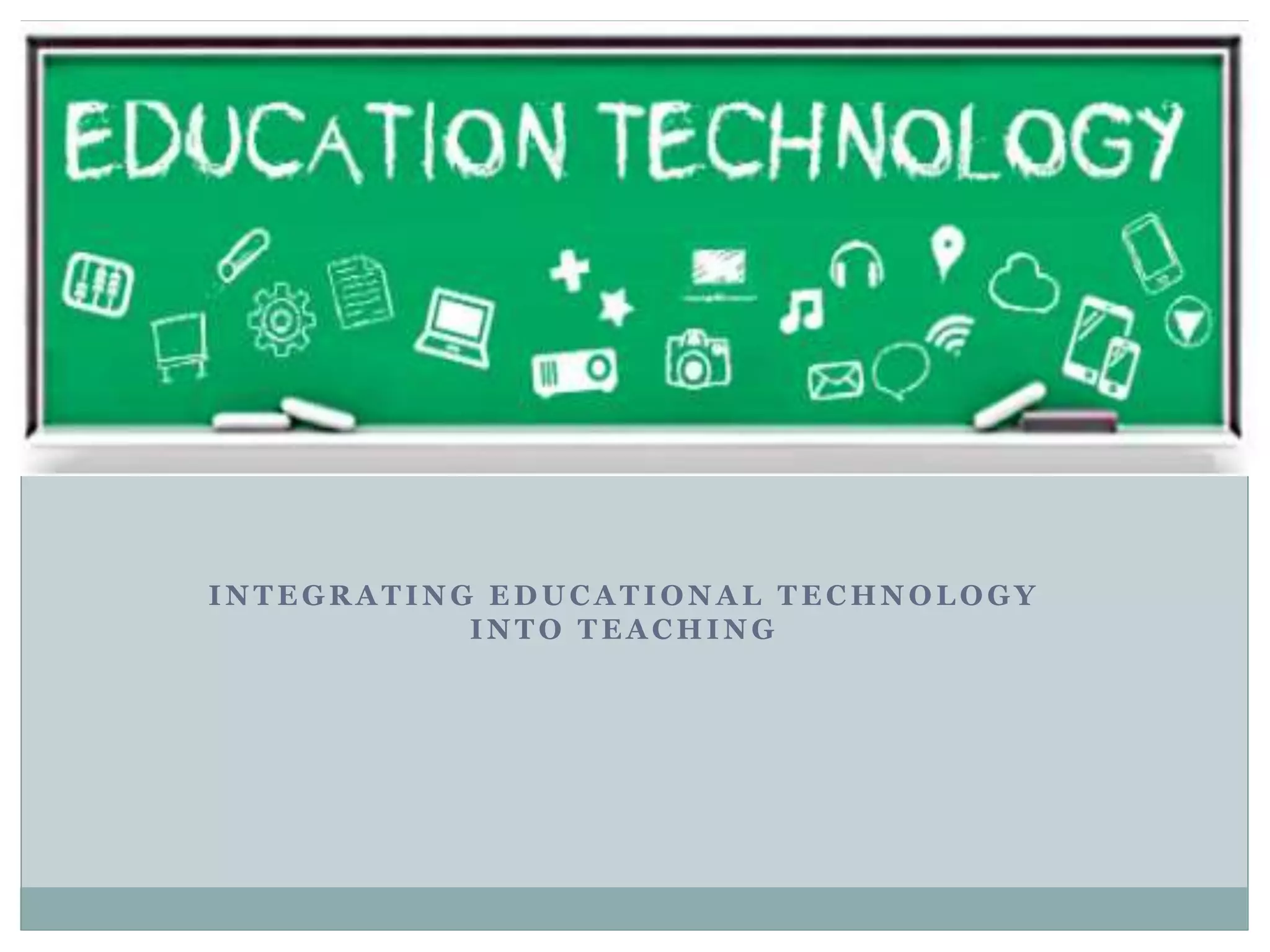
I N T E G R A T I N G E D U C A T I O N A L T E C H N O L O G Y
I N T O T E A C H I N G
OBJECTIVES
 Definition of Educational Technology
 History of Educational Technology
 PROS and CONS
 Media of Educational Technology
 Importance of Educational Technology
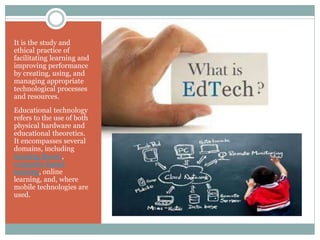
It is the study and
ethical practice of
facilitating learning and
improving performance
by creating, using, and
managing appropriate
technological processes
and resources.
Educational technology
refers to the use of both
physical hardware and
educational theoretics.
It encompasses several
domains, including
learning theory,
computer-based
training, online
learning, and, where
mobile technologies are
used.
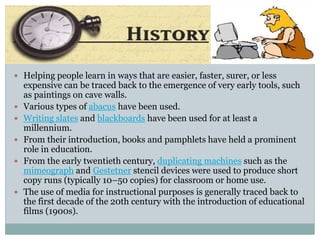
 Helping people learn in ways that are easier, faster, surer, or less
expensive can be traced back to the emergence of very early tools, such
as paintings on cave walls.
 Various types of abacus have been used.
 Writing slates and blackboards have been used for at least a
millennium.
 From their introduction, books and pamphlets have held a prominent
role in education.
 From the early twentieth century, duplicating machines such as the
mimeograph and Gestetner stencil devices were used to produce short
copy runs (typically 10–50 copies) for classroom or home use.
 The use of media for instructional purposes is generally traced back to
the first decade of the 20th century with the introduction of educational
films (1900s).
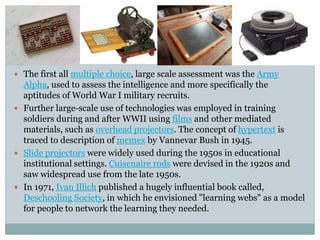
 The first all multiple choice, large scale assessment was the Army
Alpha, used to assess the intelligence and more specifically the
aptitudes of World War I military recruits.
 Further large-scale use of technologies was employed in training
soldiers during and after WWII using films and other mediated
materials, such as overhead projectors. The concept of hypertext is
traced to description of memex by Vannevar Bush in 1945.
 Slide projectors were widely used during the 1950s in educational
institutional settings. Cuisenaire rods were devised in the 1920s and
saw widespread use from the late 1950s.
 In 1971, Ivan Illich published a hugely influential book called,
Deschooling Society, in which he envisioned "learning webs" as a model
for people to network the learning they needed.
 Promotes Independent Learning for the Students. Students can already
learn from their own even without the assistance of their parents and teachers.
They are just going to surf the internet in order to look for the lessons they need
to study.
 Easier Access To Information
The need for heavy books to be brought back and forth from school and home
is no longer needed with technology. The books can stay in the classroom
because the information that they need is easily accessed on a computer.
 Promotes Exciting Way to Educate Students
Since there are lots of images, videos and other graphics and text that may be
found in your computer, more students would feel the excitement in studying
through the use of the gadget. This is very important in order to arouse their
interest in studying.
 Laziness in Studying
Computers make is so easy to find answers that students barely have to
look for them. This may result in them having poor study habits and
developing a lazy attitude toward their education.
 Forgetting the Basic Way of Studying
They would no longer rely on the books that are lent by their teachers
for them to study since they are already interested to study using the
computer.
 Discovering Unusual Things in the Computer
Allowing the students to surf the internet doesn’t necessarily mean that
all the things that they are going to discover are good for their mind
and studies.
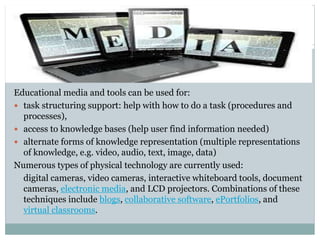
Educational media and tools can be used for:
 task structuring support: help with how to do a task (procedures and
processes),
 access to knowledge bases (help user find information needed)
 alternate forms of knowledge representation (multiple representations
of knowledge, e.g. video, audio, text, image, data)
Numerous types of physical technology are currently used:
digital cameras, video cameras, interactive whiteboard tools, document
cameras, electronic media, and LCD projectors. Combinations of these
techniques include blogs, collaborative software, ePortfolios, and
virtual classrooms.
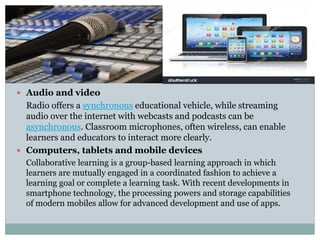
 Audio and video
Radio offers a synchronous educational vehicle, while streaming
audio over the internet with webcasts and podcasts can be
asynchronous. Classroom microphones, often wireless, can enable
learners and educators to interact more clearly.
 Computers, tablets and mobile devices
Collaborative learning is a group-based learning approach in which
learners are mutually engaged in a coordinated fashion to achieve a
learning goal or complete a learning task. With recent developments in
smartphone technology, the processing powers and storage capabilities
of modern mobiles allow for advanced development and use of apps.
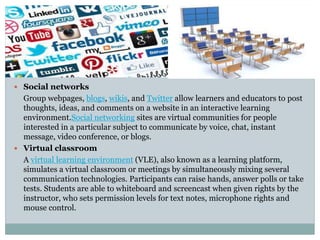
 Social networks
Group webpages, blogs, wikis, and Twitter allow learners and educators to post
thoughts, ideas, and comments on a website in an interactive learning
environment.Social networking sites are virtual communities for people
interested in a particular subject to communicate by voice, chat, instant
message, video conference, or blogs.
 Virtual classroom
A virtual learning environment (VLE), also known as a learning platform,
simulates a virtual classroom or meetings by simultaneously mixing several
communication technologies. Participants can raise hands, answer polls or take
tests. Students are able to whiteboard and screencast when given rights by the
instructor, who sets permission levels for text notes, microphone rights and
mouse control.
Computer based effective teaching offers powerful, interesting
and new way of providing knowledge to students. So, for effective
teaching with new technology every teacher needs to know about
technology. Teachers need to know how to operate & integrate
the tools effectively. Effective teachers maximize the potential of
the technology to develop student’s understanding and stimulate
their interest to improve subject proficiency. Technology can be
used strategically to provide better access for learning and
concept clearance.

Educational Technology

  • 1.
    I N TE G R A T I N G E D U C A T I O N A L T E C H N O L O G Y I N T O T E A C H I N G
  • 2.
    OBJECTIVES  Definition ofEducational Technology  History of Educational Technology  PROS and CONS  Media of Educational Technology  Importance of Educational Technology
  • 3.
    It is thestudy and ethical practice of facilitating learning and improving performance by creating, using, and managing appropriate technological processes and resources. Educational technology refers to the use of both physical hardware and educational theoretics. It encompasses several domains, including learning theory, computer-based training, online learning, and, where mobile technologies are used.
  • 4.
     Helping peoplelearn in ways that are easier, faster, surer, or less expensive can be traced back to the emergence of very early tools, such as paintings on cave walls.  Various types of abacus have been used.  Writing slates and blackboards have been used for at least a millennium.  From their introduction, books and pamphlets have held a prominent role in education.  From the early twentieth century, duplicating machines such as the mimeograph and Gestetner stencil devices were used to produce short copy runs (typically 10–50 copies) for classroom or home use.  The use of media for instructional purposes is generally traced back to the first decade of the 20th century with the introduction of educational films (1900s).
  • 5.
     The firstall multiple choice, large scale assessment was the Army Alpha, used to assess the intelligence and more specifically the aptitudes of World War I military recruits.  Further large-scale use of technologies was employed in training soldiers during and after WWII using films and other mediated materials, such as overhead projectors. The concept of hypertext is traced to description of memex by Vannevar Bush in 1945.  Slide projectors were widely used during the 1950s in educational institutional settings. Cuisenaire rods were devised in the 1920s and saw widespread use from the late 1950s.  In 1971, Ivan Illich published a hugely influential book called, Deschooling Society, in which he envisioned "learning webs" as a model for people to network the learning they needed.
  • 6.
     Promotes IndependentLearning for the Students. Students can already learn from their own even without the assistance of their parents and teachers. They are just going to surf the internet in order to look for the lessons they need to study.  Easier Access To Information The need for heavy books to be brought back and forth from school and home is no longer needed with technology. The books can stay in the classroom because the information that they need is easily accessed on a computer.  Promotes Exciting Way to Educate Students Since there are lots of images, videos and other graphics and text that may be found in your computer, more students would feel the excitement in studying through the use of the gadget. This is very important in order to arouse their interest in studying.
  • 7.
     Laziness inStudying Computers make is so easy to find answers that students barely have to look for them. This may result in them having poor study habits and developing a lazy attitude toward their education.  Forgetting the Basic Way of Studying They would no longer rely on the books that are lent by their teachers for them to study since they are already interested to study using the computer.  Discovering Unusual Things in the Computer Allowing the students to surf the internet doesn’t necessarily mean that all the things that they are going to discover are good for their mind and studies.
  • 8.
    Educational media andtools can be used for:  task structuring support: help with how to do a task (procedures and processes),  access to knowledge bases (help user find information needed)  alternate forms of knowledge representation (multiple representations of knowledge, e.g. video, audio, text, image, data) Numerous types of physical technology are currently used: digital cameras, video cameras, interactive whiteboard tools, document cameras, electronic media, and LCD projectors. Combinations of these techniques include blogs, collaborative software, ePortfolios, and virtual classrooms.
  • 9.
     Audio andvideo Radio offers a synchronous educational vehicle, while streaming audio over the internet with webcasts and podcasts can be asynchronous. Classroom microphones, often wireless, can enable learners and educators to interact more clearly.  Computers, tablets and mobile devices Collaborative learning is a group-based learning approach in which learners are mutually engaged in a coordinated fashion to achieve a learning goal or complete a learning task. With recent developments in smartphone technology, the processing powers and storage capabilities of modern mobiles allow for advanced development and use of apps.
  • 10.
     Social networks Groupwebpages, blogs, wikis, and Twitter allow learners and educators to post thoughts, ideas, and comments on a website in an interactive learning environment.Social networking sites are virtual communities for people interested in a particular subject to communicate by voice, chat, instant message, video conference, or blogs.  Virtual classroom A virtual learning environment (VLE), also known as a learning platform, simulates a virtual classroom or meetings by simultaneously mixing several communication technologies. Participants can raise hands, answer polls or take tests. Students are able to whiteboard and screencast when given rights by the instructor, who sets permission levels for text notes, microphone rights and mouse control.
  • 11.
    Computer based effectiveteaching offers powerful, interesting and new way of providing knowledge to students. So, for effective teaching with new technology every teacher needs to know about technology. Teachers need to know how to operate & integrate the tools effectively. Effective teachers maximize the potential of the technology to develop student’s understanding and stimulate their interest to improve subject proficiency. Technology can be used strategically to provide better access for learning and concept clearance.