








IX
INTERGRATING
 TECHNOLOGY
           IN
    TEACHING

          TIIT
             Gioko, A
      Ph D Candidate
           Coordinator
          Professional
   Development Centre
         A K Academy
            Mombasa
TITLE
HOW DO WE INTEGRATE TECHNOLOGY
IN TEACHING UNDER LOW RESOURCED
          ENVIRONMENT.
”If properly integrated, has
the potential to enhance the
teaching and learning
process”
(Apkan, 2002; Bork, 2003; Dwyer, Ringstaff, and Sandholtz, 1990;Kian-
Sam Hong, Abang Ahmad Ridzuan and Ming-Koon Kuek, 2003; Lee and
Dziuban, 2002;Thompson, 2003; Gioko, 2007).
INTRODUCTION
• Name
• School
• Position in school
• Subject taught

     “A sentence explaining how
    technology is integrated in my
               school”
Session
“Essential Agreements”
Goal
Contextually relevant and innovative instructional approaches
and strategies in technology integration in teaching.

Learning opportunities
• Understanding the difference between integrating
  and using technology in teaching
• Understanding how technology supports learning
• Identifying areas where technology could be
  integrated in different subject at different levels
• Searching for a resource and planning on how to
  integrate it in teaching.
A powerful tool to supplement teachers’
instruction in classroom.
If properly used by teachers, technology
can foster more interest in learning on the
part of students, and teachers can use it
in the instruction of their respective
subjects.
Technology has the potential to make
instruction easier, more challenging and
motivating for teachers.
                                 (Jhurree, 2005).
Session outline
 • Discussions
 • Tasks
   –Reviews
   –Hands on
   –Individual and Collaborative
    Reflection
 • Demonstration
 • Hands On
How DO WE is integrated

    in our schools
     ACTIVITY
How DO WE is integrated

    in our schools
PRESENTATION
A new society requires new skills: Due to the fact that
ICTs are the preeminent tools for information processing,
new generations need to become competent in their use,
should acquire the necessary skills, and therefore must have
access to computers and networks during their school life.
Productivity enhancement: Schools are knowledge-
handling institutions; therefore, ICTs should be fundamental
management tools on all levels of an educational system,
from classrooms to ministries.
A quest for quality learning: Schools should profoundly
revise present teaching practices and resources to create
more effective learning environments and improve life-long
learning skills and habits in their students.
                  Hepp, Hinostroza, Laval and Rehbein (2004)
INTERGRATE VS USE
What's the difference?
Definitions (English)

• transitive and intransitive verb make into whole:
  to join two or more objects or make something
  part of a larger whole, or be joined or made part
  of a larger whole "integrating light rail into the
  regional transportation plan"


• transitive verb benefit from something: to
  benefit or get satisfaction from something
Technology
Information communication technology (ICT):
The term ICT encompasses the range of
hardware (desktop and portable computers,
projection technology, calculators, data-
logging, and digital-recording equipment),
software applications (Generic software such as
excel, access and multimedia resources such as
flash, video and power point), and information
systems (Intranet, Internet)
• …education  that is organized in such as
 way that it cuts across subject-matter lines,
 bringing together various aspects of the
 curriculum into meaningful association to
 focus upon broad areas of study. It views
 learning and teaching in a holistic way and
 reflects the real world, Which is interactive?
                           Shoemarker(1989)
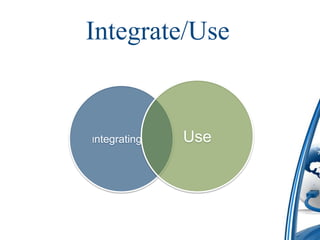
Integrate/Use


Integrating   Use
ICT USE/INTEGRATE
• ICT Integration:            • Adjunct use is the
  Integration is using ICT      use of
  in teaching and learning,     Technology as an
  as part and parcel of the     extra or addition
  curriculum independent        tool in teaching
  of time and place. This       and learning. It
  could be as a tool or as
  technology.                   means that if
                                technology is in
• if it is used to enhance      isolation of the
  the teaching and learning
                                content then it is
  then it is integrated use
                                adjunct use.
Integration
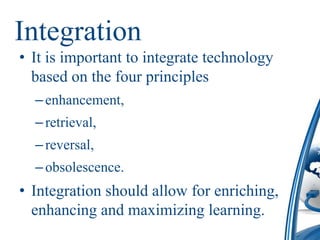
• It is important to integrate technology
  based on the four principles
  – enhancement,
  – retrieval,
  – reversal,
  – obsolescence.
• Integration should allow for enriching,
  enhancing and maximizing learning.
Integration
• This short video was intergraded in a
  science lesson identify aspects of the
  video that bring about
  enhancement,
  retrieval,
  reversal,
  obsolescence.
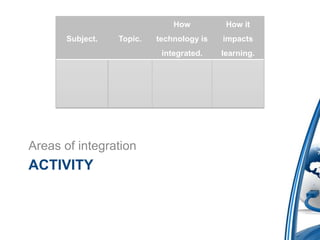
How          How it
       Subject.   Topic.   technology is   impacts
                            integrated.    learning.


Areas of integration
ACTIVITY
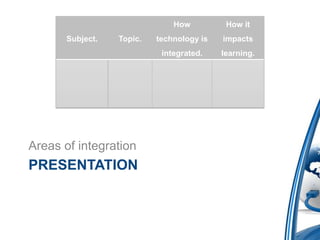
How          How it
       Subject.   Topic.   technology is   impacts
                            integrated.    learning.


Areas of integration
PRESENTATION
WHAT INFLUENCES LEARNING

What the learner already knows – prior knowledge

Learner’s interest – motivation


Prior knowledge:
A determinant of WHAT further learning can
occur
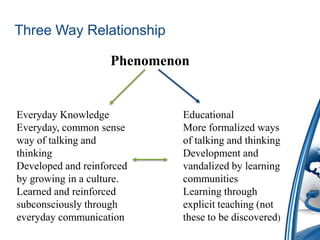
Three Way Relationship

                    Phenomenon


Everyday Knowledge           Educational
Everyday, common sense       More formalized ways
way of talking and           of talking and thinking
thinking                     Development and
Developed and reinforced     vandalized by learning
by growing in a culture.     communities
Learned and reinforced       Learning through
subconsciously through       explicit teaching (not
everyday communication       these to be discovered)
Learning
• Influences the PROCESS
    whereby learning occurs.
• Motivation: Learning styles and
  Multiple Intelligences.
• Ausubel “rote learning
  set/meaningful learning set”
  central
Ausubel
• “If I was to reduce all of educational psychology
  to just one principle, I would say this: the most
  important single factor influencing learning is
  what the learner already knows.” (1968)
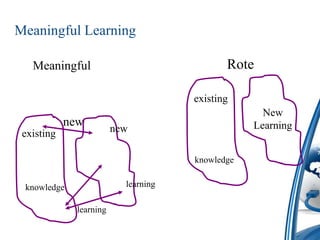
• He argued that for “meaningful learning” the
  learner must make a conscious effort to relate
  new knowledge to existing knowledge, to
  identify key conceptions in the new knowledge
  and relate these to other key ideas.
Meaningful Learning

   Meaningful                                Rote

                                      existing
                                                    New
            new                                   Learning
 existing                new

                                      knowledge


 knowledge                 learning

              learning
Meaningful Learning
• Degree of meaningful learning depends on the
  NATURE of existing knowledge and HOW it
  interacts with new learning
• Those aspects of existing knowledge which
  provide these interactions are “subsumers”
• Logically meaningful materials DO NOT
  AUTOMATICALLY mean psychologically
  meaningful learning
• Advanced organizers – an approach to assisting
  learning when there are no “subsumers”
  (existing knowledge to allow appropriate
  linkages
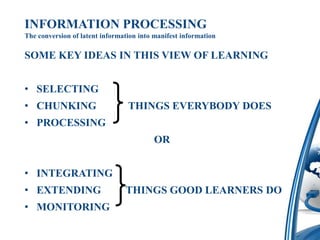
INFORMATION PROCESSING
The conversion of latent information into manifest information

SOME KEY IDEAS IN THIS VIEW OF LEARNING


• SELECTING
• CHUNKING                       THINGS EVERYBODY DOES
• PROCESSING
                                          OR


• INTEGRATING
• EXTENDING                     THINGS GOOD LEARNERS DO
• MONITORING
Information Processing in Classroom
Teaching
1. Gain the students' attention.

2. Bring to mind relevant prior learning.

3. Point out important information.

4. Present information in an organized manner

5. Show students how to categorize (chunk)
related information.
Information Processing in Classroom
Teaching
6. Provide opportunities for students to elaborate
on new information.
7. Show students how to use coding when
memorizing lists.
8. Provide for repetition of learning.
9. Provide opportunities for over learning of
fundamental concepts and skills.
Teaching
Three types of Learning theories that
 have impacted teaching and learning
 with ICT.
Tutor, Tutee and Tool.
  – Computer as tutor
  – Computer as Tutee.
  – Computer as Tool.
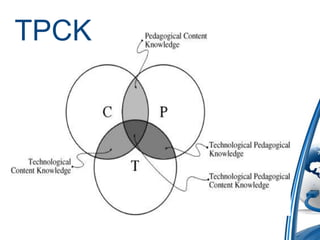
TPCK
What is

AFFORDANCE
Identifying Affordance
1. What is the affordance i.e.
opportunities for learning
2. What is facilitating the affordance or
providing the opportunity.
3. What is promoting the degree of
affordance?
4. What is the source of information?
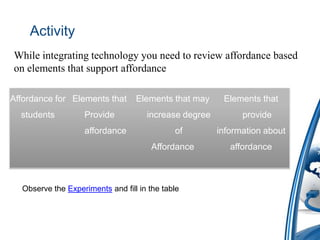
Activity
While integrating technology you need to review affordance based
on elements that support affordance

Affordance for Elements that      Elements that may     Elements that
  students         Provide           increase degree         provide
                   affordance                of        information about
                                       Affordance         affordance


  Observe the Experiments and fill in the table
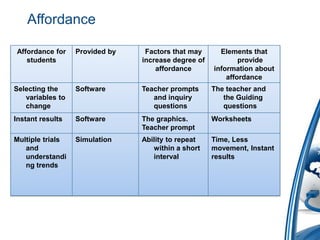
Affordance

Affordance for    Provided by    Factors that may      Elements that
   students                     increase degree of           provide
                                    affordance       information about
                                                         affordance
Selecting the     Software      Teacher prompts      The teacher and
   variables to                    and inquiry          the Guiding
   change                          questions            questions
Instant results   Software      The graphics.        Worksheets
                                Teacher prompt
Multiple trials   Simulation    Ability to repeat    Time, Less
   and                             within a short    movement, Instant
   understandi                     interval          results
   ng trends
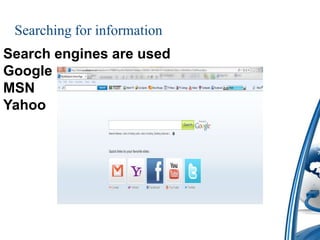
Searching for information
Search engines are used
Google
MSN
Yahoo
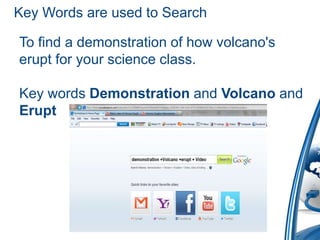
Key Words are used to Search

To find a demonstration of how volcano's
erupt for your science class.

Key words Demonstration and Volcano and
Erupt
Watch your resource and copy for use
PRACTICUM

LET GET TO THE LAB AN GET OUR
RESOURCES
REFLECTION

HOW WAS THE EXPERIENCE
Workshop Feedback

FILL IN THE WORKSHOP FEEDBACK
FORM
Goal
Contextually relevant and innovative instructional approaches
and strategies in technology integration in teaching.

Learning opportunities
• Understanding the difference between integrating
  and using technology in teaching
• Understanding how technology supports learning
• Identifying areas where technology could be
  integrated in different subject at different levels
• Searching for a resource and planning on how to
  integrate it in teaching.
The beginning

Technology Integration

  • 1.
  • 2.
    INTERGRATING TECHNOLOGY IN TEACHING TIIT Gioko, A Ph D Candidate Coordinator Professional Development Centre A K Academy Mombasa
  • 3.
    TITLE HOW DO WEINTEGRATE TECHNOLOGY IN TEACHING UNDER LOW RESOURCED ENVIRONMENT.
  • 4.
    ”If properly integrated,has the potential to enhance the teaching and learning process” (Apkan, 2002; Bork, 2003; Dwyer, Ringstaff, and Sandholtz, 1990;Kian- Sam Hong, Abang Ahmad Ridzuan and Ming-Koon Kuek, 2003; Lee and Dziuban, 2002;Thompson, 2003; Gioko, 2007).
  • 5.
    INTRODUCTION • Name • School •Position in school • Subject taught “A sentence explaining how technology is integrated in my school”
  • 6.
  • 7.
    Goal Contextually relevant andinnovative instructional approaches and strategies in technology integration in teaching. Learning opportunities • Understanding the difference between integrating and using technology in teaching • Understanding how technology supports learning • Identifying areas where technology could be integrated in different subject at different levels • Searching for a resource and planning on how to integrate it in teaching.
  • 8.
    A powerful toolto supplement teachers’ instruction in classroom. If properly used by teachers, technology can foster more interest in learning on the part of students, and teachers can use it in the instruction of their respective subjects. Technology has the potential to make instruction easier, more challenging and motivating for teachers. (Jhurree, 2005).
  • 9.
    Session outline •Discussions • Tasks –Reviews –Hands on –Individual and Collaborative Reflection • Demonstration • Hands On
  • 10.
    How DO WEis integrated in our schools ACTIVITY
  • 11.
    How DO WEis integrated in our schools PRESENTATION
  • 12.
    A new societyrequires new skills: Due to the fact that ICTs are the preeminent tools for information processing, new generations need to become competent in their use, should acquire the necessary skills, and therefore must have access to computers and networks during their school life. Productivity enhancement: Schools are knowledge- handling institutions; therefore, ICTs should be fundamental management tools on all levels of an educational system, from classrooms to ministries. A quest for quality learning: Schools should profoundly revise present teaching practices and resources to create more effective learning environments and improve life-long learning skills and habits in their students. Hepp, Hinostroza, Laval and Rehbein (2004)
  • 13.
    INTERGRATE VS USE What'sthe difference?
  • 14.
    Definitions (English) • transitiveand intransitive verb make into whole: to join two or more objects or make something part of a larger whole, or be joined or made part of a larger whole "integrating light rail into the regional transportation plan" • transitive verb benefit from something: to benefit or get satisfaction from something
  • 15.
    Technology Information communication technology(ICT): The term ICT encompasses the range of hardware (desktop and portable computers, projection technology, calculators, data- logging, and digital-recording equipment), software applications (Generic software such as excel, access and multimedia resources such as flash, video and power point), and information systems (Intranet, Internet)
  • 16.
    • …education that is organized in such as way that it cuts across subject-matter lines, bringing together various aspects of the curriculum into meaningful association to focus upon broad areas of study. It views learning and teaching in a holistic way and reflects the real world, Which is interactive? Shoemarker(1989)
  • 17.
  • 18.
    ICT USE/INTEGRATE • ICTIntegration: • Adjunct use is the Integration is using ICT use of in teaching and learning, Technology as an as part and parcel of the extra or addition curriculum independent tool in teaching of time and place. This and learning. It could be as a tool or as technology. means that if technology is in • if it is used to enhance isolation of the the teaching and learning content then it is then it is integrated use adjunct use.
  • 19.
    Integration • It isimportant to integrate technology based on the four principles – enhancement, – retrieval, – reversal, – obsolescence. • Integration should allow for enriching, enhancing and maximizing learning.
  • 20.
    Integration • This shortvideo was intergraded in a science lesson identify aspects of the video that bring about enhancement, retrieval, reversal, obsolescence.
  • 21.
    How How it Subject. Topic. technology is impacts integrated. learning. Areas of integration ACTIVITY
  • 22.
    How How it Subject. Topic. technology is impacts integrated. learning. Areas of integration PRESENTATION
  • 23.
    WHAT INFLUENCES LEARNING Whatthe learner already knows – prior knowledge Learner’s interest – motivation Prior knowledge: A determinant of WHAT further learning can occur
  • 24.
    Three Way Relationship Phenomenon Everyday Knowledge Educational Everyday, common sense More formalized ways way of talking and of talking and thinking thinking Development and Developed and reinforced vandalized by learning by growing in a culture. communities Learned and reinforced Learning through subconsciously through explicit teaching (not everyday communication these to be discovered)
  • 25.
    Learning • Influences thePROCESS whereby learning occurs. • Motivation: Learning styles and Multiple Intelligences. • Ausubel “rote learning set/meaningful learning set” central
  • 26.
    Ausubel • “If Iwas to reduce all of educational psychology to just one principle, I would say this: the most important single factor influencing learning is what the learner already knows.” (1968) • He argued that for “meaningful learning” the learner must make a conscious effort to relate new knowledge to existing knowledge, to identify key conceptions in the new knowledge and relate these to other key ideas.
  • 27.
    Meaningful Learning Meaningful Rote existing New new Learning existing new knowledge knowledge learning learning
  • 28.
    Meaningful Learning • Degreeof meaningful learning depends on the NATURE of existing knowledge and HOW it interacts with new learning • Those aspects of existing knowledge which provide these interactions are “subsumers” • Logically meaningful materials DO NOT AUTOMATICALLY mean psychologically meaningful learning • Advanced organizers – an approach to assisting learning when there are no “subsumers” (existing knowledge to allow appropriate linkages
  • 29.
    INFORMATION PROCESSING The conversionof latent information into manifest information SOME KEY IDEAS IN THIS VIEW OF LEARNING • SELECTING • CHUNKING THINGS EVERYBODY DOES • PROCESSING OR • INTEGRATING • EXTENDING THINGS GOOD LEARNERS DO • MONITORING
  • 30.
    Information Processing inClassroom Teaching 1. Gain the students' attention. 2. Bring to mind relevant prior learning. 3. Point out important information. 4. Present information in an organized manner 5. Show students how to categorize (chunk) related information.
  • 31.
    Information Processing inClassroom Teaching 6. Provide opportunities for students to elaborate on new information. 7. Show students how to use coding when memorizing lists. 8. Provide for repetition of learning. 9. Provide opportunities for over learning of fundamental concepts and skills.
  • 32.
    Teaching Three types ofLearning theories that have impacted teaching and learning with ICT. Tutor, Tutee and Tool. – Computer as tutor – Computer as Tutee. – Computer as Tool.
  • 33.
  • 34.
  • 35.
    Identifying Affordance 1. Whatis the affordance i.e. opportunities for learning 2. What is facilitating the affordance or providing the opportunity. 3. What is promoting the degree of affordance? 4. What is the source of information?
  • 36.
    Activity While integrating technologyyou need to review affordance based on elements that support affordance Affordance for Elements that Elements that may Elements that students Provide increase degree provide affordance of information about Affordance affordance Observe the Experiments and fill in the table
  • 37.
    Affordance Affordance for Provided by Factors that may Elements that students increase degree of provide affordance information about affordance Selecting the Software Teacher prompts The teacher and variables to and inquiry the Guiding change questions questions Instant results Software The graphics. Worksheets Teacher prompt Multiple trials Simulation Ability to repeat Time, Less and within a short movement, Instant understandi interval results ng trends
  • 38.
    Searching for information Searchengines are used Google MSN Yahoo
  • 39.
    Key Words areused to Search To find a demonstration of how volcano's erupt for your science class. Key words Demonstration and Volcano and Erupt
  • 41.
    Watch your resourceand copy for use
  • 42.
    PRACTICUM LET GET TOTHE LAB AN GET OUR RESOURCES
  • 43.
  • 44.
    Workshop Feedback FILL INTHE WORKSHOP FEEDBACK FORM
  • 45.
    Goal Contextually relevant andinnovative instructional approaches and strategies in technology integration in teaching. Learning opportunities • Understanding the difference between integrating and using technology in teaching • Understanding how technology supports learning • Identifying areas where technology could be integrated in different subject at different levels • Searching for a resource and planning on how to integrate it in teaching.
  • 46.

Editor's Notes