Classroom Instruction
      That Works
      That Works
Research-Based Strategies for Increasing Student
          Achievement, 2nd Edition
Dean, Hubbell, Pitler, & Stone 2012 ASCD McREL
The Essential Nine
• 1st Edition by Marzano, Pickering, &
  Pollock 2004
• Also called, “Notable Nine”, Marzano’s
  Essential Nine
• High expectations for students,
  understanding of kind of support
  students needs to succeed -
  RELATIONSHIPS
Instructional Planning Framework:
Creating the Environment for Learning
              Learning
 • Motivate and focus learning, assure students
   that they are capable
 • Setting Objectives & Providing
   Feedback
 • Reinforcing Effort & Providing
   Recognition
 • Cooperative Learning
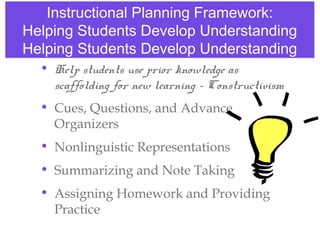
Instructional Planning Framework:
Helping Students Develop Understanding
  • Help students use prior knowledge as
    scaffolding for new learning - Constructivism
  • Cues, Questions, and Advance
    Organizers
  • Nonlinguistic Representations
  • Summarizing and Note Taking
  • Assigning Homework and Providing
    Practice
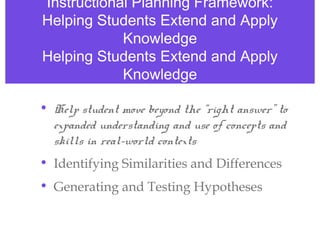
Instructional Planning Framework:
Helping Students Extend and Apply
            Knowledge
Helping Students Extend and Apply
            Knowledge

• Help student move beyond the “right answer” to
  expanded understanding and use of concepts and
  skills in real-world contexts
• Identifying Similarities and Differences
• Generating and Testing Hypotheses
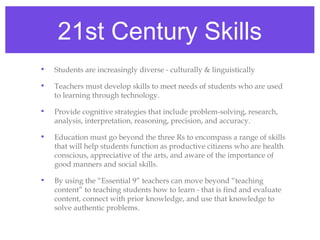
21st Century Skills
•   Students are increasingly diverse - culturally & linguistically

•   Teachers must develop skills to meet needs of students who are used
    to learning through technology.

•   Provide cognitive strategies that include problem-solving, research,
    analysis, interpretation, reasoning, precision, and accuracy.

•   Education must go beyond the three Rs to encompass a range of skills
    that will help students function as productive citizens who are health
    conscious, appreciative of the arts, and aware of the importance of
    good manners and social skills.

•   By using the “Essential 9” teachers can move beyond “teaching
    content” to teaching students how to learn - that is find and evaluate
    content, connect with prior knowledge, and use that knowledge to
    solve authentic problems.
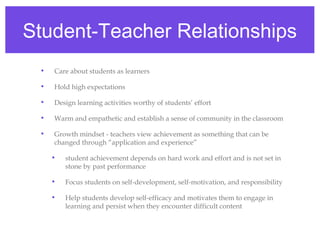
Student-Teacher Relationships
 •   Care about students as learners

 •   Hold high expectations

 •   Design learning activities worthy of students’ effort

 •   Warm and empathetic and establish a sense of community in the classroom

 •   Growth mindset - teachers view achievement as something that can be
     changed through “application and experience”

     •   student achievement depends on hard work and effort and is not set in
         stone by past performance

     •   Focus students on self-development, self-motivation, and responsibility

     •   Help students develop self-efficacy and motivates them to engage in
         learning and persist when they encounter difficult content
Setting Objectives
• Provide focus
• Students build intrinsic motivation
  when they set personal learning
  objectives
• Support students as they self-select
  learning targets, self-monitor their
  progress, and self-assess their
  development.
Recommendation 1
• Set learning objectives that are specific but not
  restrictive
  •   Unpack statements of knowledge in standards to provide more specific
      statements of knowledge and skills

  •   Guide students toward proficiency

  •   The learning objective is what students should know, understand, or be able
      to do as a result of completing the learning activity or assignment.
Recommendation 2
• Communicate the learning objectives to students and
  parents
  •   Explicitly state in student-friendly language, display in writing,
      call attention to them throughout a unit or lesson.

  •   Communicating to parents helps them understand and become
      engaged in what their children and learning.

  •   Provide multiple options - blogs, text messages, e-mails, letters
Recommendation 3
• Connect the learning objectives to previous and future
  learning
  •   Call students’ attention to how the current learning objective is
      connected to something that they have already learned and how
      they will apply what they are learning now to future studies.
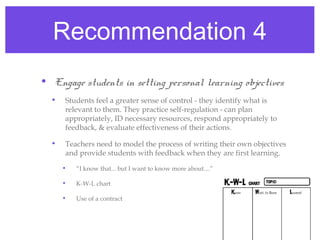
Recommendation 4
• Engage students in setting personal learning objectives
  •   Students feel a greater sense of control - they identify what is
      relevant to them. They practice self-regulation - can plan
      appropriately, ID necessary resources, respond appropriately to
      feedback, & evaluate effectiveness of their actions.

  •   Teachers need to model the process of writing their own objectives
      and provide students with feedback when they are first learning.
      •   “I know that... but I want to know more about....”

      •   K-W-L chart

      •   Use of a contract
Tips for Setting Objectives
  •   State learning objectives in simple language in terms of knowledge
      rather than learning activities

  •   Relate to things that are personally relevant to students

  •   Model how to set learning objectives

  •   Periodically check student understanding of objectives (journals,
      notecards)

  •   Select content sources, discussion questions, activities, assignments,
      and assessment methods according to how well they help students
      achieve learning objectives

  •   Provide students with info about what good performance or high-
      quality work looks like well before an assessment
Final Thought

• By allocating time for students to reflect
  upon their own learning and to give
  and receive feedback from peers, we
  help them develop skills they will need
  throughout their K-12 years, in college,
  and in the workplace.
Technology Book Intro
•   Why Technology?

    •   Multimedia tools have been shown to have a positive effect on student
        understanding and help students fill in missing info and make better inferences.

    •   Tech motivates students to learn, encourages collaborative learning, and helps
        develop critical thinking and problem-solving skills.

    •   Tech tends to move classrooms from teacher-dominated to student-centered
        learning environments.

    •   Allows teachers to differentiate instruction more efficiently.

    •   Can be especially effective with at risk and special needs students.

    •   Technology can be used to address each level of Bloom’s Taxonomy

        •   Bloom’s Taxonomy and Technology Integration

        •   Bloom’s Taxonomy for iPads
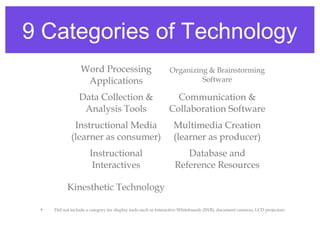
9 Categories of Technology
                  Word Processing                              Organizing & Brainstorming
                   Applications                                         Software

                 Data Collection &                              Communication &
                  Analysis Tools                              Collaboration Software
              Instructional Media                                Multimedia Creation
             (learner as consumer)                               (learner as producer)
                      Instructional                                 Database and
                       Interactives                              Reference Resources

           Kinesthetic Technology

 •   Did not include a category for display tools such as Interactive Whiteboards (IWB), document cameras, LCD projectors
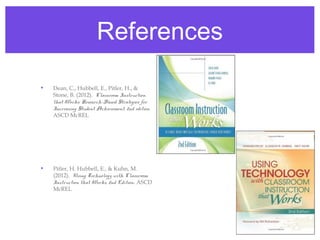
References

•   Dean, C., Hubbell, E., Pitler, H., &
    Stone, B. (2012). Classroom Instruction
    that Works: Research-Based Strategies for
    Increasing Student Achievement, 2nd edition.
    ASCD McREL


•   Pitler, H. Hubbell, E., & Kuhn, M.
    (2012). Using Technology with Classroom
    Instruction that Works, 2nd Edition. ASCD
    McREL

Class worksintroobjectivestransitions

  • 1.
    Classroom Instruction That Works That Works Research-Based Strategies for Increasing Student Achievement, 2nd Edition Dean, Hubbell, Pitler, & Stone 2012 ASCD McREL
  • 2.
    The Essential Nine •1st Edition by Marzano, Pickering, & Pollock 2004 • Also called, “Notable Nine”, Marzano’s Essential Nine • High expectations for students, understanding of kind of support students needs to succeed - RELATIONSHIPS
  • 3.
    Instructional Planning Framework: Creatingthe Environment for Learning Learning • Motivate and focus learning, assure students that they are capable • Setting Objectives & Providing Feedback • Reinforcing Effort & Providing Recognition • Cooperative Learning
  • 4.
    Instructional Planning Framework: HelpingStudents Develop Understanding Helping Students Develop Understanding • Help students use prior knowledge as scaffolding for new learning - Constructivism • Cues, Questions, and Advance Organizers • Nonlinguistic Representations • Summarizing and Note Taking • Assigning Homework and Providing Practice
  • 5.
    Instructional Planning Framework: HelpingStudents Extend and Apply Knowledge Helping Students Extend and Apply Knowledge • Help student move beyond the “right answer” to expanded understanding and use of concepts and skills in real-world contexts • Identifying Similarities and Differences • Generating and Testing Hypotheses
  • 6.
    21st Century Skills • Students are increasingly diverse - culturally & linguistically • Teachers must develop skills to meet needs of students who are used to learning through technology. • Provide cognitive strategies that include problem-solving, research, analysis, interpretation, reasoning, precision, and accuracy. • Education must go beyond the three Rs to encompass a range of skills that will help students function as productive citizens who are health conscious, appreciative of the arts, and aware of the importance of good manners and social skills. • By using the “Essential 9” teachers can move beyond “teaching content” to teaching students how to learn - that is find and evaluate content, connect with prior knowledge, and use that knowledge to solve authentic problems.
  • 7.
    Student-Teacher Relationships • Care about students as learners • Hold high expectations • Design learning activities worthy of students’ effort • Warm and empathetic and establish a sense of community in the classroom • Growth mindset - teachers view achievement as something that can be changed through “application and experience” • student achievement depends on hard work and effort and is not set in stone by past performance • Focus students on self-development, self-motivation, and responsibility • Help students develop self-efficacy and motivates them to engage in learning and persist when they encounter difficult content
  • 8.
    Setting Objectives • Providefocus • Students build intrinsic motivation when they set personal learning objectives • Support students as they self-select learning targets, self-monitor their progress, and self-assess their development.
  • 9.
    Recommendation 1 • Setlearning objectives that are specific but not restrictive • Unpack statements of knowledge in standards to provide more specific statements of knowledge and skills • Guide students toward proficiency • The learning objective is what students should know, understand, or be able to do as a result of completing the learning activity or assignment.
  • 10.
    Recommendation 2 • Communicatethe learning objectives to students and parents • Explicitly state in student-friendly language, display in writing, call attention to them throughout a unit or lesson. • Communicating to parents helps them understand and become engaged in what their children and learning. • Provide multiple options - blogs, text messages, e-mails, letters
  • 11.
    Recommendation 3 • Connectthe learning objectives to previous and future learning • Call students’ attention to how the current learning objective is connected to something that they have already learned and how they will apply what they are learning now to future studies.
  • 12.
    Recommendation 4 • Engagestudents in setting personal learning objectives • Students feel a greater sense of control - they identify what is relevant to them. They practice self-regulation - can plan appropriately, ID necessary resources, respond appropriately to feedback, & evaluate effectiveness of their actions. • Teachers need to model the process of writing their own objectives and provide students with feedback when they are first learning. • “I know that... but I want to know more about....” • K-W-L chart • Use of a contract
  • 13.
    Tips for SettingObjectives • State learning objectives in simple language in terms of knowledge rather than learning activities • Relate to things that are personally relevant to students • Model how to set learning objectives • Periodically check student understanding of objectives (journals, notecards) • Select content sources, discussion questions, activities, assignments, and assessment methods according to how well they help students achieve learning objectives • Provide students with info about what good performance or high- quality work looks like well before an assessment
  • 14.
    Final Thought • Byallocating time for students to reflect upon their own learning and to give and receive feedback from peers, we help them develop skills they will need throughout their K-12 years, in college, and in the workplace.
  • 15.
    Technology Book Intro • Why Technology? • Multimedia tools have been shown to have a positive effect on student understanding and help students fill in missing info and make better inferences. • Tech motivates students to learn, encourages collaborative learning, and helps develop critical thinking and problem-solving skills. • Tech tends to move classrooms from teacher-dominated to student-centered learning environments. • Allows teachers to differentiate instruction more efficiently. • Can be especially effective with at risk and special needs students. • Technology can be used to address each level of Bloom’s Taxonomy • Bloom’s Taxonomy and Technology Integration • Bloom’s Taxonomy for iPads
  • 16.
    9 Categories ofTechnology Word Processing Organizing & Brainstorming Applications Software Data Collection & Communication & Analysis Tools Collaboration Software Instructional Media Multimedia Creation (learner as consumer) (learner as producer) Instructional Database and Interactives Reference Resources Kinesthetic Technology • Did not include a category for display tools such as Interactive Whiteboards (IWB), document cameras, LCD projectors
  • 17.
    References • Dean, C., Hubbell, E., Pitler, H., & Stone, B. (2012). Classroom Instruction that Works: Research-Based Strategies for Increasing Student Achievement, 2nd edition. ASCD McREL • Pitler, H. Hubbell, E., & Kuhn, M. (2012). Using Technology with Classroom Instruction that Works, 2nd Edition. ASCD McREL