Why Teach with ICTs? By Patricia B. Arinto Assistant Professor U.P. Open University
What are ICTs? Information and communication technologies (ICTs) are “technological tools and resources that are used to communicate, and to create, disseminate, store, and manage information .” C. Blurton They “ include hardware, software and netware, as well as institutional, financial, cultural and application-related parameters that determine how ICT [s]  will be shaped and developed by society at large . ” The Research Council of Norway
Types of ICTs: Radio Television Telephony (landlines and cellular/mobile phones) Computers Internet
The Knowledge Society Exponential increase in information Shrinking half-life of information The need to transform information into knowledge Knowledge-dependence Knowledge as the key to social and economic progress
5 Areas where ICTs can contribute to education: Expanding access Promoting efficiency Improving the quality of learning Enhancing the quality of teaching Improving management systems Haddad and Draxler, 2002
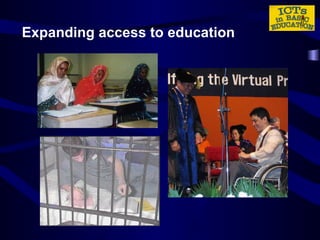
Expanding access to education with ICTs Broadcast technologies have been used to reach geographically dispersed populations (e.g.,  Telesecundaria , radio and TV universities, Strong Republic Schools program) Distance education and open learning: providing education to marginalized sectors (e.g., women, persons with disabilities) and non-traditional learners (adults)
Expanding access to education
Promoting efficiency with ICTs Supplementing conventional delivery mechanisms to make educational provision more cost-effective Increasing  learning time  without extending  classroom time  through self-study modules, educational TV and radio programs, interactive software
Improving educational management with ICTs Facilitating collection and analysis  of data Improving flow of information  and communication Facilitating decentralization  and devolution
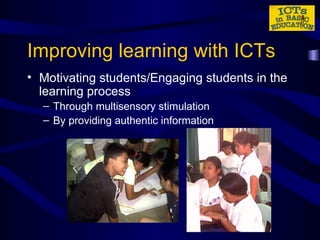
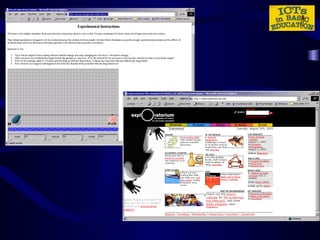
Improving learning with ICTs Motivating students/Engaging students in the learning process Through multisensory stimulation By providing authentic information
 
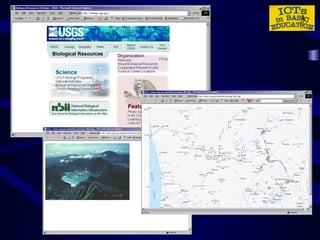
Improving learning with ICTs Facilitating acquisition of basic skills through drill-and-practice  Educational TV shows such as  Sesame Street ,  Batibot ,  Math-Tinik Computer-assisted instruction Fostering inquiry and exploration  Virtual tours Simulations
 
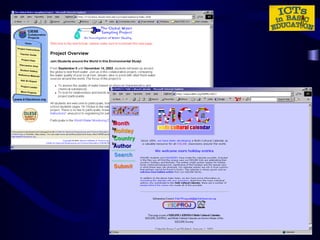
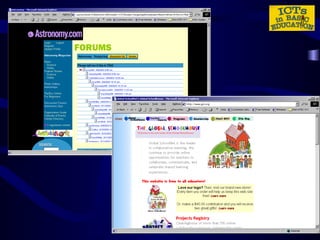
Improving learning with ICTs Developing skills that are necessary for the 21 st  century workplace: technological literacy information literacy communication skills problem solving skills the ability to handle dynamic situations the ability to work collaboratively with others
 
 
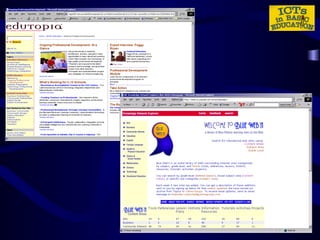
ICTs and improving the quality of teaching Teacher training at a distance (e.g., UP NISMED’s  Iskul on the Air , UPOU’s teacher training programs) Teacher support (e.g., teaching resources online, teacher networks) Teacher empowerment – to be creative, to innovate
 
On ICTs and teachers “ Educational technology is not, and never will be, transformative on its own…computers cannot replace teachers—teachers are the key to whether technology is used appropriately and effectively.” Carlson and Gadio, 2002, p. 119
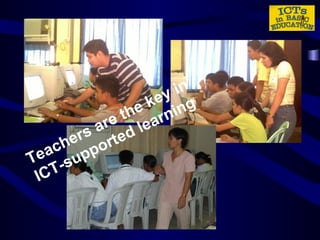
Teachers are the key in ICT-supported learning
Myths about ICTs in education Macro myth: Merely providing ICTs to schools transforms the learning process Micro myth: Providing technologies means acquiring computers and securing a connection to the Internet Haddad and Draxler, 2002, p. 4
Parameters for ICT integration  (Or important considerations in ICT integration): Educational policy Approach (to education)  Infrastructure Contentware Committed and trained personnel Integration
“ How you use technology in education is more important than if you use it at all.” Thornburg, “Technology in K-12 Education:  Envisioning the Future”, 1999
‘ To “tech” or not to “tech” education is not the question. The real question is how to harvest the power of technology to meet the challenges of the 21 st  century and make education relevant, responsive, and effective for [every]one, anywhere, anytime.’  Haddad and Draxler, 2002, p. 16

ICTs in the Classroom-Why Use Them

  • 1.
    Why Teach withICTs? By Patricia B. Arinto Assistant Professor U.P. Open University
  • 2.
    What are ICTs?Information and communication technologies (ICTs) are “technological tools and resources that are used to communicate, and to create, disseminate, store, and manage information .” C. Blurton They “ include hardware, software and netware, as well as institutional, financial, cultural and application-related parameters that determine how ICT [s] will be shaped and developed by society at large . ” The Research Council of Norway
  • 3.
    Types of ICTs:Radio Television Telephony (landlines and cellular/mobile phones) Computers Internet
  • 4.
    The Knowledge SocietyExponential increase in information Shrinking half-life of information The need to transform information into knowledge Knowledge-dependence Knowledge as the key to social and economic progress
  • 5.
    5 Areas whereICTs can contribute to education: Expanding access Promoting efficiency Improving the quality of learning Enhancing the quality of teaching Improving management systems Haddad and Draxler, 2002
  • 6.
    Expanding access toeducation with ICTs Broadcast technologies have been used to reach geographically dispersed populations (e.g., Telesecundaria , radio and TV universities, Strong Republic Schools program) Distance education and open learning: providing education to marginalized sectors (e.g., women, persons with disabilities) and non-traditional learners (adults)
  • 7.
  • 8.
    Promoting efficiency withICTs Supplementing conventional delivery mechanisms to make educational provision more cost-effective Increasing learning time without extending classroom time through self-study modules, educational TV and radio programs, interactive software
  • 9.
    Improving educational managementwith ICTs Facilitating collection and analysis of data Improving flow of information and communication Facilitating decentralization and devolution
  • 10.
    Improving learning withICTs Motivating students/Engaging students in the learning process Through multisensory stimulation By providing authentic information
  • 11.
  • 12.
    Improving learning withICTs Facilitating acquisition of basic skills through drill-and-practice Educational TV shows such as Sesame Street , Batibot , Math-Tinik Computer-assisted instruction Fostering inquiry and exploration Virtual tours Simulations
  • 13.
  • 14.
    Improving learning withICTs Developing skills that are necessary for the 21 st century workplace: technological literacy information literacy communication skills problem solving skills the ability to handle dynamic situations the ability to work collaboratively with others
  • 15.
  • 16.
  • 17.
    ICTs and improvingthe quality of teaching Teacher training at a distance (e.g., UP NISMED’s Iskul on the Air , UPOU’s teacher training programs) Teacher support (e.g., teaching resources online, teacher networks) Teacher empowerment – to be creative, to innovate
  • 18.
  • 19.
    On ICTs andteachers “ Educational technology is not, and never will be, transformative on its own…computers cannot replace teachers—teachers are the key to whether technology is used appropriately and effectively.” Carlson and Gadio, 2002, p. 119
  • 20.
    Teachers are thekey in ICT-supported learning
  • 21.
    Myths about ICTsin education Macro myth: Merely providing ICTs to schools transforms the learning process Micro myth: Providing technologies means acquiring computers and securing a connection to the Internet Haddad and Draxler, 2002, p. 4
  • 22.
    Parameters for ICTintegration (Or important considerations in ICT integration): Educational policy Approach (to education) Infrastructure Contentware Committed and trained personnel Integration
  • 23.
    “ How youuse technology in education is more important than if you use it at all.” Thornburg, “Technology in K-12 Education: Envisioning the Future”, 1999
  • 24.
    ‘ To “tech”or not to “tech” education is not the question. The real question is how to harvest the power of technology to meet the challenges of the 21 st century and make education relevant, responsive, and effective for [every]one, anywhere, anytime.’ Haddad and Draxler, 2002, p. 16

Editor's Notes

  • #2 Secretary Abad, Ambassador Romulo, Usec. Hidalgo, Commissioner Lallana, colleagues from academe and nongovernment organizations working in education, fellow teachers, good morning. My task today is to outline the potential benefits of integrating information and communication technologies in education.