Professional Learning Models
A review of the professional development center in-service offers
By Dr. Maina WaGĩokõ Aga Khan Academy, Mombasa
Ms, Rosemary Waga Aga Khan Primary School, Mombasa
Current demands
 The renewal of the teaching license will only be done is a
teacher has attended a professional learning session within the
last two years.
In-Service Professional Learning Opportunities
 School Based
 Evening
 Study leave
 Weekend
 During School
 Online/Blended
 Universities
 Colleges
 Government
SAGA’s
 NGO
 MOOCs
Flipside
Time
Quality of Training
Value addition
 Ministry of Education
 Teachers Service Commision
 Kenya National Examination council
 Head Teachers Association
 Parents Association
PDC Offer
 A Balance Approach To Facilitating Literacy
 Collaborative Discussion Forum
 Continuous Professional Learning Session
 Educating Girls In Science
 Facilitator Peer Mentorship
 Interactive Mathematic Facilitation
 Pedagogical Leadership Leading Learning
 Professional Learning Networks
 Teacher Preparation Programme
 Technology Infused Pedagogy
 Values Based Education
7 Years @1100 Educators Annually
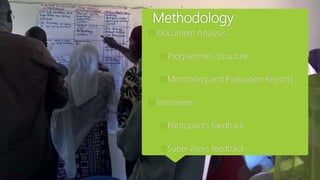
Methodology
 Document Analysis
Programmes Structure
Monitoring and Evaluation Reports
 Interviews
Participants feedback
Supervisors feedback
Learning
 innovative
 personalized
 transformational
 school embedded
 inquiry based
 continuous support
 research driven
 Collaborative
Learning Forward Standards
(2011
Principles into Practice
 Transfer
Low Road
High Road
 Transformation
Time
 Implementation Dip
 First Time attempt
 20 times
 50/80 Hours
 Beliefs
Support
 In-session
 Post-Session
Approaches
 Teachers Succeed when they
lean the concepts in varied,
active ways
(Roy, 2005; Richardnson,
1998)
 Activities
 readings,
 role playing techniques,
 open-ended discussion of
what is presented,
 live modeling,
 visits to classrooms to
observe and discuss the
teaching methodology
(Roy, 2005; Goldberg, 2002;
Rice, 2001; Black, 1998; Licklider,
1997).
Modelling
 Show and Tell
 Demonstration
Specification
 Discipline Specific
 Age group
PENTA PRINCIPLES
Support
Time
Approaches
Specifications
Modelling
EFFECTIVE
PROFESSIOAL
LEANRING
SESSIONS
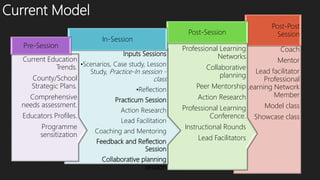
Current Model
Coach
Mentor
Lead facilitator
Professional
Learning Network
Member
Model class
Showcase class
Post-Post
Session
Professional Learning
Networks
Collaborative
planning
Peer Mentorship
Action Research
Professional Learning
Conference.
Instructional Rounds
Lead Facilitators
Post-Session
Inputs Sessions
•Scenarios, Case study, Lesson
Study, Practice-In session -
class
•Reflection
Practicum Session
Action Research
Lead Facilitation
Coaching and Mentoring
Feedback and Reflection
Session
Collaborative planning
session
In-Session
Current Education
Trends.
County/School
Strategic Plans.
Comprehensive
needs assessment.
Educators Profiles.
Programme
sensitization
Pre-Session
Conclusion
 Models are diverse but can be adjusted to be transformative.
 Exposure in small chunks and opportunities of
implementation in a school environment facilitates high
uptake.
 Long term engagement scaffolds and supports the learning
process.
 Mentorship and coaching provides an opportunity to
deepen the learning.

Professional learning models presentation

  • 1.
    Professional Learning Models Areview of the professional development center in-service offers By Dr. Maina WaGĩokõ Aga Khan Academy, Mombasa Ms, Rosemary Waga Aga Khan Primary School, Mombasa
  • 2.
    Current demands  Therenewal of the teaching license will only be done is a teacher has attended a professional learning session within the last two years.
  • 3.
    In-Service Professional LearningOpportunities  School Based  Evening  Study leave  Weekend  During School  Online/Blended  Universities  Colleges  Government SAGA’s  NGO  MOOCs
  • 4.
    Flipside Time Quality of Training Valueaddition  Ministry of Education  Teachers Service Commision  Kenya National Examination council  Head Teachers Association  Parents Association
  • 5.
    PDC Offer  ABalance Approach To Facilitating Literacy  Collaborative Discussion Forum  Continuous Professional Learning Session  Educating Girls In Science  Facilitator Peer Mentorship  Interactive Mathematic Facilitation  Pedagogical Leadership Leading Learning  Professional Learning Networks  Teacher Preparation Programme  Technology Infused Pedagogy  Values Based Education 7 Years @1100 Educators Annually
  • 6.
    Methodology  Document Analysis ProgrammesStructure Monitoring and Evaluation Reports  Interviews Participants feedback Supervisors feedback
  • 7.
    Learning  innovative  personalized transformational  school embedded  inquiry based  continuous support  research driven  Collaborative Learning Forward Standards (2011
  • 8.
    Principles into Practice Transfer Low Road High Road  Transformation
  • 9.
    Time  Implementation Dip First Time attempt  20 times  50/80 Hours  Beliefs
  • 10.
  • 11.
    Approaches  Teachers Succeedwhen they lean the concepts in varied, active ways (Roy, 2005; Richardnson, 1998)  Activities  readings,  role playing techniques,  open-ended discussion of what is presented,  live modeling,  visits to classrooms to observe and discuss the teaching methodology (Roy, 2005; Goldberg, 2002; Rice, 2001; Black, 1998; Licklider, 1997).
  • 12.
    Modelling  Show andTell  Demonstration
  • 13.
  • 14.
  • 15.
    Current Model Coach Mentor Lead facilitator Professional LearningNetwork Member Model class Showcase class Post-Post Session Professional Learning Networks Collaborative planning Peer Mentorship Action Research Professional Learning Conference. Instructional Rounds Lead Facilitators Post-Session Inputs Sessions •Scenarios, Case study, Lesson Study, Practice-In session - class •Reflection Practicum Session Action Research Lead Facilitation Coaching and Mentoring Feedback and Reflection Session Collaborative planning session In-Session Current Education Trends. County/School Strategic Plans. Comprehensive needs assessment. Educators Profiles. Programme sensitization Pre-Session
  • 16.
    Conclusion  Models arediverse but can be adjusted to be transformative.  Exposure in small chunks and opportunities of implementation in a school environment facilitates high uptake.  Long term engagement scaffolds and supports the learning process.  Mentorship and coaching provides an opportunity to deepen the learning.

Editor's Notes

  • #2 A journey of seven years offering professional learning session to 4350 educators with course ranging from a year long 376 hrs. course to a 3 days 18 hours course. The professional development session have been offered to both internal staff and outreach school from two counties 114 MSA and 89 KWL. Courses have been in Literacy, Numeracy, Science, Education leadership and management and Pedagogical and Emerging issues in education.
  • #3 Kenya National Examination Council Parents association They are all demanding quality teaching and learning in the schools
  • #5 Professional Learning are ineffective as they neither changes teacher practice nor improves student learning. The real challenge is how to create opportunities for teacher to grow and develop in their practice so that they in turn can help students grow and develop their knowledge and ability to think critically. 90% of teacher reported having participated in a professional development last year, but the majority also report it was not useful. (DarlingHammond et al., 2009). This is because most development happens in a workshop-style model which research shows has little to no impact on student learning or teacher practice (Darling-Hammond et al., 2009). One comprehensive study analyzed 1,300 studies representing the entire landscape of professional development research (Yoon et al., 2007). The researchers found the only professional development programs that impacted student achievement were lengthy, intensive programme. Programs that were less than 14 hours (like the one-shot workshops commonly held in schools) had no effect on student achievement. Not only did these workshop programs fail to increase student learning, they didn’t even change teaching practices.
  • #7 The Methodology involved Document Analysis. Students examination results and performance was tracked against the trained teacher and the structure of the training. This was also compared with the monitoring and evaluation reports –which included student learning outcomes, classroom observation and deliverables =
  • #8 Innovation Personalized Professional learning is personalized, generative and focused on the actualization of exemplary practice in the learning environment. Transformational High quality professional learning and transformational leadership are integral to sustainable school and system improvement. School Embedded Professional learning is job embedded with collaborative opportunities for guided conversation and co-creation of innovative practice. Inquiry Based As architects and designers of lifelong learning, there is individual and shared responsibility for engaging in inquiry based, professional growth. Continuous support Effective professional learning involves continual innovation of practice to enhance knowledge, skills, attributes and competencies Research Driven Research and data-informed critical reflection play a significant role in establishing high quality professional learning and professional practice. Collaborative School based collaborative and collective inquiry aligned with jurisdictional and provincial priorities is the most meaningful and effective professional learning.
  • #9 Professional development can no longer just be about exposing teachers to a concept or providing basic knowledge about a teaching methodology. Instead, professional development in an era of accountability requires a change in a teacher’s practice that leads to increases in student learning. Allison Gulamhussein Center for Public Education 2013. An earlier study of the various models of professional development found if the training merely described a skill to teachers, as traditional workshops do, only 10 percent of teachers could transfer the skill to practice. The majority of the teachers simply left the training completely unchanged (Bush, 1984). 20 The number, on average, of separate instances of practice it takes a teacher to master a new skill, and this number may increase if a skill is exceptionally complex. (Joyce & Showers, 2002) Why isn’t the workshop effective? Simply put, traditional professional development operates under a faulty theory of teacher learning. The one-time workshop assumes the only challenge facing teachers is a lack of knowledge of effective teaching practices and when that knowledge gap is corrected, teachers will then be able to change. Research finds otherwise. It turns out teachers’ greatest challenge comes when they attempt to implement newly learned methods into the classroom
  • #10 In all forms of learning a new skill, mere knowledge of it is never as difficult as its implementation. Think about this in the context of sports. If a football coach wants to improve his team, he might begin by working on the fundamentals of blocking. In other words, he might recognize the players lack knowledge of a particular strategy, blocking, that will improve their game. He might explain what blocking is, demonstrate it (that is, modeling), and even have the players practice blocking in the artificial setting of practice. However, when players initially bring this new skill into the real life arena of a game, it doesn’t transfer smoothly. They are used to playing the game another way and the other parts of their performance have to also change to make room for the new skill (Joyce & Showers, 1982). Hence, the area of greatest struggle is not in learning a new skill but in implementing it, something referred to as the “implementation dip” (Fuller, 2001). This is true with any new skill—learning about writing isn’t as difficult as actually writing, learning about bicycling isn’t as difficult as actually riding a bike, and learning about a teaching method isn’t as difficult as actually implementing it examined veteran science teachers as they attempted to implement inquiry learning into their classrooms. The group had worked extensively outside of the classroom with experts, learning the theory of inquiry learning. They also observed model lessons and wrote their own together collaboratively. Despite all of that groundwork on the logic and research behind the model, the teachers’ first attempt to apply the new method was unsuccessful and messy (Ermeling, 2010). studies have shown that teacher mastery of a new skill takes, on average, 20 separate instances of practice and that number may increase if the skill is exceptionally complex (Joyce & Showers, 2002). The implementation dip is further complicated by the fact that research shows teachers change their underlying beliefs about how to teach something only after they see success with students (Guskey, 2002). Indeed, when teachers do not see success, they tend to abandon the practice and revert to business as usual. Collectively In fact, in a study analyzing the impact of a science professional development program on teacher’s practice, researchers found that teachers with 80 hours or more of professional development were significantly more likely to use the teaching practice they learned than teachers who had less than 80 hours of training (Corcoran, McVay & Riordan, 2003). French (1997) concluded that teachers may need as many as 50 hours of instruction, practice and coaching before a new teaching strategy is mastered and implemented in class.
  • #11 Truesdale (2003) studied differences between teachers attending just a workshop and teachers attending the workshop and then being coached through implementation. The study found that coached teachers transferred the newly learned teaching practices, but teachers who only had the workshop quickly lost interest in the skill and did not continue to use it in their classrooms. Knight and Cornett (2009) found in a study of 50 teachers that those who had coaching along with an introductory workshop were significantly more likely to use the new teaching practice in their classes than those who only were only exposed to the workshop.
  • #12 Engage teachers through varied approaches so they can participate actively in making sense of a new practice. Teachers need a thorough understanding of research or theory before they can attempt implementation in their classrooms. Therefore, attention also has to be paid to how new practices are introduced. Again, just like students, teachers learn better when they are able to actively participate and make sense of the information being presented (French, 1997). Professional development sessions which aim to make teachers aware of a concept have been shown to be more successful when they allow teachers to learn the concept in varied, active ways (Roy, 2005; Richardson, 1998). These activities can include: readings, role playing techniques, open-ended discussion of what is presented, live modeling, and visits to classrooms to observe and discuss the teaching methodology (Roy, 2005; Goldberg, 2002; Rice, 2001; Black, 1998; Licklider, 1997).
  • #13 Modeling — when an expert demonstrates the new practice — has been shown to be particularly successful in helping teachers understand and apply a concept and remain open to adopting it (Snow-Renner & Lauer, 2005; Carpenter et al., 1989; Cohen & Hill, 2001; Garet et al., 2001; Desimone et al., 2002; Penuel, Fishman, Yamaguchi, & Gallagher, 2007; Saxe, Gearhart, & Nasir, 2001; Supovitz, Mauyer, & Kahle, 2000).
  • #14 The truth is, while there may be a few general principles that apply to all teachers, these are 1) best understood and mediated with attention to how those general principles manifest within the content a teacher teaches and 2) pale in comparison to useful concepts that are discipline-specific. For example, asking open-ended questions can apply to all disciplines and grade-levels. But the more nuanced applications of this concept (how to scaffold the open-ended questions with increasing levels of difficulty, or which open-ended questions to ask) are centered in the content one teaches. Furthermore, there are few pedagogical principles that span all disciplines, but there are many important areas of analysis and exploration that are highly discipline-specific which go unaddressed and unacknowledged in generic professional development. Professional development that addresses discipline-specific concepts and skills has been shown to both improve teacher practice, as well as student learning (Blank, de las Alas & Smith, 2007; Carpenter et al., 1989; Cohen & Hill, 2001; Lieberman & Wood, 2001; Merek & Methven, 1991; Saxe, Gearhart, & Nasir, 2001; Wenglinsky, 200; McGill-Franzen et al., 1999). Teachers themselves report that their top priority for professional development is learning more about the content they teach, giving high marks to training that is content-specific (DarlingHammond et al., 2009).
  • #16 The duration of professional development must be significant and ongoing to allow time for teachers to learn a new strategy and grapple with the implementation problem. There must be support for a teacher during the implementation stage that addresses the specific challenges of changing classroom practice. Teachers’ initial exposure to a concept should not be passive, but rather should engage teachers through varied approaches so they can participate actively in making sense of a new practice. Modeling has been found to be a highly effective way to introduce a new concept and help teachers understand a new practice. The content presented to teachers shouldn’t be generic, but instead grounded in the teacher’s discipline (for middle school and high school teachers) or grade-level (for elementary school teachers)