Novel Drug Delivery System
Presented By :- VIJAY C. JADHAV
B Pharm Final Year
Shri Sambhaji Collage Of Pharmacy
Khadkut, Nanded
Methods of Microencapsulation
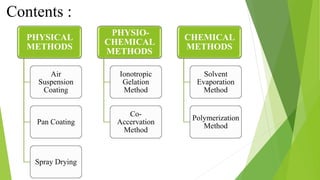
Contents :
PHYSICAL
METHODS
Air
Suspension
Coating
Pan Coating
Spray Drying
PHYSIO-
CHEMICAL
METHODS
Ionotropic
Gelation
Method
Co-
Accervation
Method
CHEMICAL
METHODS
Solvent
Evaporation
Method
Polymerization
Method
PHYSICAL METHODS
Air Suspension Coating ( Wurster Process )
 It Is Also Known As Fludized Bed Method
 It is Applicable For Only Solid Material From The Size Ranging
From 35 – 5000 um
 The Capacity Of This Equipment Should Be 1 Lb – 990 Lb
 The Basic Principle Of This Process is That Dispersing Of Solid
Core Material With The Help Of Air Stream By Spray Coating
To Air Suspended Particles
 Micron Or Submicron Particles Can Be Effectively Encapsulated
By This Technique
Procedure :
 When Core Material Feed From Pipe Into Process Chamber It Get
Suspended Into Air Due To The Air Supply From Perforated Plate
 Spraying Nozzle Can Spray The Coating Material/Solution Onto The
Expension And Segregation Zone
 In This Zone Coating Material Contact With Core Material And
Polymer Coat Apply On It
 This Cyclic Process Repeat Until Uniform Coat Apply On Particle
 After Uniform Coating This Particle Should Be Settle Down And
Collected From Discharge Pipe At Bottom
 In This Technique We Can Apply Coating Solution From Both Side
i.e. Top or Bottom
 High Velocity Of Air Help For The Drying Of The Coating Solution
To Avoid Sticking Of The Particles.
Processing Variables :
Density, Surface Area,
Melting Point,
Solubility, Friability
And Flowability Of
Core Material
Coating Material
Concentration
Coating Material
Application Rate
Volume Of Air
Required To Support
And Fludizes the core
material
Amount of coating
material required
Inlet and outlet
Operating
Temperature
Pan Coating
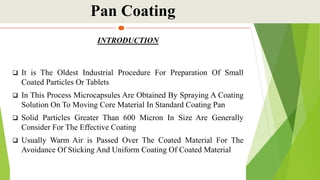
INTRODUCTION
 It is The Oldest Industrial Procedure For Preparation Of Small
Coated Particles Or Tablets
 In This Process Microcapsules Are Obtained By Spraying A Coating
Solution On To Moving Core Material In Standard Coating Pan
 Solid Particles Greater Than 600 Micron In Size Are Generally
Consider For The Effective Coating
 Usually Warm Air is Passed Over The Coated Material For The
Avoidance Of Sticking And Uniform Coating Of Coated Material
Fig : PAN COATING
Mechanism :
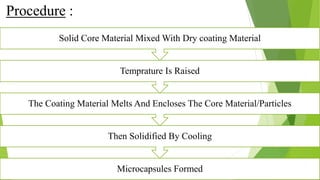
Procedure :
Microcapsules Formed
Then Solidified By Cooling
The Coating Material Melts And Encloses The Core Material/Particles
Temprature Is Raised
Solid Core Material Mixed With Dry coating Material
Spray Drying
INTRODUCTION
 It Is Most Accepted and Widely Used Technique For
Microencapsulation
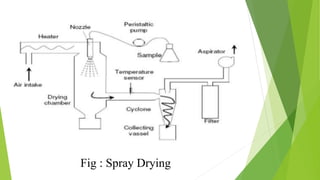
 This Method Involves Production Of Dry Powder Form Of
Active Component From Liquid Slurry By Rapid Drying With
Air / Gas
 Spray Drying Is Effected By Rapid Evaporation Of Solvent In
Which Coating Material Is Dissolved
 Atomizer Helps To Make Uniform Size Of Liquid Droplets
Fig : Spray Drying
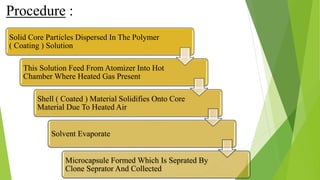
Procedure :
Solid Core Particles Dispersed In The Polymer
( Coating ) Solution
This Solution Feed From Atomizer Into Hot
Chamber Where Heated Gas Present
Shell ( Coated ) Material Solidifies Onto Core
Material Due To Heated Air
Solvent Evaporate
Microcapsule Formed Which Is Seprated By
Clone Seprator And Collected
Process Variables :
1. Viscosity Of Feed Solution
2. Concentration Of Core And Coating Material
3. Feed Rate
4. Degree Of Atomization
5. Drying Rate
PHYSIO-CHEMICAL METHODS
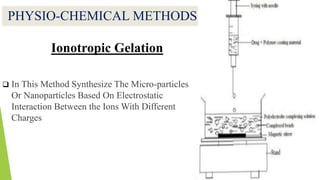
Ionotropic Gelation
 In This Method Synthesize The Micro-particles
Or Nanoparticles Based On Electrostatic
Interaction Between the Ions With Different
Charges
Procedure :
 All The Required Material Weighed Accurately
i.e. Core Material , Sodium Alginate (2%) , CaCl2 (3%)
 In A Beaker Take Weighed Quantity Of Sodium Alginate Along
With Water To Make Aq. Mucilage Solution
( Heat For 5 – 10 Minutes )
 This Solution Is Stirred In A Magnetic Stirrer At Suitable
Speed For 30 Min.
 Then Drug ( Core Material ) Is Dispersed Into It And Stirred
 In Another Beaker Take Weighed quantity Of CaCl2 & Make
Solution By Adding Distilled Water
 Microcapsule / Micro-particles Are Formed By Dropping
Bubble Free Dispersion Through Syringe With The Help Of
Needle ( No.22 ) Into The CaCl2 Solution
 Filter And Wash The Micro-particles With Distilled Water
 Dry This Microcapsule In Hot Air Oven At 50°c For 2-4 Hr
Co-Accervation
Co-Accervation : It Is The Process Of Sepration Of The
Macromolecular Solution Into Two Immiscible Liquid Phases
STEPS OF CO-ACCERVATION MICROENCAPSULATION
Step 1 : Formation Of Three Immiscible Phases
Step 2 : Deposition Of Coating Material
Step 3 : Regidization Of Coating Material
Fig : Co-Accervation
Procedure :
 In This Method Coating Material Is First Dissolved In
Suitable Solvent And Then Core Material Is Uniformly
Dispersed In It.
 By Incresing Temprature Co-Accervate Can Be Formed
i.e. There is Formation Of Three Immiscible Phase
( Solvent,Core Material,Coating Material )
 After Sepration Of Coating Material From Solution They
Get Deposited On The Core Material
 By Continous Agitation And Decresing Temprature This
Coating Material Uniformly Applied Over Core Material
And Make Rigid Microcapsule
Methods For Achieving Co-Accervation
1. Temprature Change
2. Incompatible Polymer Addition
3. Non Solvent Addition
4. Salt Addition
5. Polymer–Polymer Interaction
CHEMICAL METHODS
Solvent Evaporation
 This Technique Is Used For The Poorly Water Soluble Drugs
 This Technique is Carried Out In The Liquid Manufacturing
Vehicle ( O/W Emulsion ) Which Is Prepared By Agitation Of
Two Immiscible Liquids
 This Process involves Dissolving Microcapsule Coating
( Polymer ) In Volatile Solvent Which Is Immiscible With The
Liquid Manufacturing Vehicle Phase
 Core Material To Be Encapsulated Is Dissolved Or Dispersed In
Coating Polymer Solution
Procedure :
Step 1 : Preparation Of Organic Phase
Step 2 : Preparation Of Aqueous Solution Of Surfactant / Surface
Stabilizer
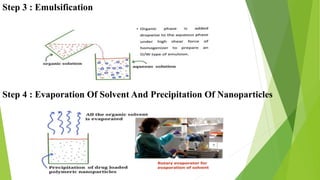
Step 3 : Emulsification
Step 4 : Evaporation Of Solvent And Precipitation Of Nanoparticles
Step 5 : Ultracentrifugation
 The Nanoparticles Are Collected By The
Ultracentrifugation And Washed With Distilled Water To
Remove Stabilizer Residue Or Any Free Drug
Step 6 : Lyophilization ( Freeze Drying )
Polymerization ( In Situ )
A. Dispersion Of Liquid To Be Encapsulated In Water
 In Stirred Tank Liquid To Be Encapsulated Is Dispersed In Water
The Size Of Droplets Obtained Is Regulated By Speed Of Stirrer
B. Introduction Of Monomer A & B Into Solution
 Monomers Which Are Small Molecules Are Introduced Into Stirred Tank
They Will Form Polymer By Polymerization Reaction
C. Initiation Of Polymerization Process
 The Polymerization Reaction Is Initiated By PH Changes And
Temperature Can Be Accelarated By The Use Of Catalyst
 The Polymer Formed Is Deposited Around The Drops Which Leads To
Encapsulation
D. Stabilization Of Polymer Structure
 The Polymer Is Then Consolidated By Changes In PH, Temperature Or
Addition Of Additives
This Leads To Better Isolation Of Encapsulated Assest
TECHNIQUES OF MICROENCAPSULATION.pptx

TECHNIQUES OF MICROENCAPSULATION.pptx

  • 1.
    Novel Drug DeliverySystem Presented By :- VIJAY C. JADHAV B Pharm Final Year Shri Sambhaji Collage Of Pharmacy Khadkut, Nanded Methods of Microencapsulation
  • 2.
    Contents : PHYSICAL METHODS Air Suspension Coating Pan Coating SprayDrying PHYSIO- CHEMICAL METHODS Ionotropic Gelation Method Co- Accervation Method CHEMICAL METHODS Solvent Evaporation Method Polymerization Method
  • 3.
    PHYSICAL METHODS Air SuspensionCoating ( Wurster Process )  It Is Also Known As Fludized Bed Method  It is Applicable For Only Solid Material From The Size Ranging From 35 – 5000 um  The Capacity Of This Equipment Should Be 1 Lb – 990 Lb  The Basic Principle Of This Process is That Dispersing Of Solid Core Material With The Help Of Air Stream By Spray Coating To Air Suspended Particles  Micron Or Submicron Particles Can Be Effectively Encapsulated By This Technique
  • 5.
    Procedure :  WhenCore Material Feed From Pipe Into Process Chamber It Get Suspended Into Air Due To The Air Supply From Perforated Plate  Spraying Nozzle Can Spray The Coating Material/Solution Onto The Expension And Segregation Zone  In This Zone Coating Material Contact With Core Material And Polymer Coat Apply On It  This Cyclic Process Repeat Until Uniform Coat Apply On Particle  After Uniform Coating This Particle Should Be Settle Down And Collected From Discharge Pipe At Bottom  In This Technique We Can Apply Coating Solution From Both Side i.e. Top or Bottom  High Velocity Of Air Help For The Drying Of The Coating Solution To Avoid Sticking Of The Particles.
  • 6.
    Processing Variables : Density,Surface Area, Melting Point, Solubility, Friability And Flowability Of Core Material Coating Material Concentration Coating Material Application Rate Volume Of Air Required To Support And Fludizes the core material Amount of coating material required Inlet and outlet Operating Temperature
  • 7.
    Pan Coating INTRODUCTION  Itis The Oldest Industrial Procedure For Preparation Of Small Coated Particles Or Tablets  In This Process Microcapsules Are Obtained By Spraying A Coating Solution On To Moving Core Material In Standard Coating Pan  Solid Particles Greater Than 600 Micron In Size Are Generally Consider For The Effective Coating  Usually Warm Air is Passed Over The Coated Material For The Avoidance Of Sticking And Uniform Coating Of Coated Material
  • 8.
    Fig : PANCOATING Mechanism :
  • 9.
    Procedure : Microcapsules Formed ThenSolidified By Cooling The Coating Material Melts And Encloses The Core Material/Particles Temprature Is Raised Solid Core Material Mixed With Dry coating Material
  • 10.
    Spray Drying INTRODUCTION  ItIs Most Accepted and Widely Used Technique For Microencapsulation  This Method Involves Production Of Dry Powder Form Of Active Component From Liquid Slurry By Rapid Drying With Air / Gas  Spray Drying Is Effected By Rapid Evaporation Of Solvent In Which Coating Material Is Dissolved  Atomizer Helps To Make Uniform Size Of Liquid Droplets
  • 11.
  • 12.
    Procedure : Solid CoreParticles Dispersed In The Polymer ( Coating ) Solution This Solution Feed From Atomizer Into Hot Chamber Where Heated Gas Present Shell ( Coated ) Material Solidifies Onto Core Material Due To Heated Air Solvent Evaporate Microcapsule Formed Which Is Seprated By Clone Seprator And Collected
  • 13.
    Process Variables : 1.Viscosity Of Feed Solution 2. Concentration Of Core And Coating Material 3. Feed Rate 4. Degree Of Atomization 5. Drying Rate
  • 14.
    PHYSIO-CHEMICAL METHODS Ionotropic Gelation In This Method Synthesize The Micro-particles Or Nanoparticles Based On Electrostatic Interaction Between the Ions With Different Charges
  • 15.
    Procedure :  AllThe Required Material Weighed Accurately i.e. Core Material , Sodium Alginate (2%) , CaCl2 (3%)  In A Beaker Take Weighed Quantity Of Sodium Alginate Along With Water To Make Aq. Mucilage Solution ( Heat For 5 – 10 Minutes )  This Solution Is Stirred In A Magnetic Stirrer At Suitable Speed For 30 Min.  Then Drug ( Core Material ) Is Dispersed Into It And Stirred  In Another Beaker Take Weighed quantity Of CaCl2 & Make Solution By Adding Distilled Water
  • 16.
     Microcapsule /Micro-particles Are Formed By Dropping Bubble Free Dispersion Through Syringe With The Help Of Needle ( No.22 ) Into The CaCl2 Solution  Filter And Wash The Micro-particles With Distilled Water  Dry This Microcapsule In Hot Air Oven At 50°c For 2-4 Hr
  • 17.
    Co-Accervation Co-Accervation : ItIs The Process Of Sepration Of The Macromolecular Solution Into Two Immiscible Liquid Phases STEPS OF CO-ACCERVATION MICROENCAPSULATION Step 1 : Formation Of Three Immiscible Phases Step 2 : Deposition Of Coating Material Step 3 : Regidization Of Coating Material
  • 18.
  • 19.
    Procedure :  InThis Method Coating Material Is First Dissolved In Suitable Solvent And Then Core Material Is Uniformly Dispersed In It.  By Incresing Temprature Co-Accervate Can Be Formed i.e. There is Formation Of Three Immiscible Phase ( Solvent,Core Material,Coating Material )  After Sepration Of Coating Material From Solution They Get Deposited On The Core Material  By Continous Agitation And Decresing Temprature This Coating Material Uniformly Applied Over Core Material And Make Rigid Microcapsule
  • 20.
    Methods For AchievingCo-Accervation 1. Temprature Change 2. Incompatible Polymer Addition 3. Non Solvent Addition 4. Salt Addition 5. Polymer–Polymer Interaction
  • 21.
    CHEMICAL METHODS Solvent Evaporation This Technique Is Used For The Poorly Water Soluble Drugs  This Technique is Carried Out In The Liquid Manufacturing Vehicle ( O/W Emulsion ) Which Is Prepared By Agitation Of Two Immiscible Liquids  This Process involves Dissolving Microcapsule Coating ( Polymer ) In Volatile Solvent Which Is Immiscible With The Liquid Manufacturing Vehicle Phase  Core Material To Be Encapsulated Is Dissolved Or Dispersed In Coating Polymer Solution
  • 22.
    Procedure : Step 1: Preparation Of Organic Phase Step 2 : Preparation Of Aqueous Solution Of Surfactant / Surface Stabilizer
  • 23.
    Step 3 :Emulsification Step 4 : Evaporation Of Solvent And Precipitation Of Nanoparticles
  • 24.
    Step 5 :Ultracentrifugation  The Nanoparticles Are Collected By The Ultracentrifugation And Washed With Distilled Water To Remove Stabilizer Residue Or Any Free Drug Step 6 : Lyophilization ( Freeze Drying )
  • 25.
    Polymerization ( InSitu ) A. Dispersion Of Liquid To Be Encapsulated In Water  In Stirred Tank Liquid To Be Encapsulated Is Dispersed In Water The Size Of Droplets Obtained Is Regulated By Speed Of Stirrer B. Introduction Of Monomer A & B Into Solution  Monomers Which Are Small Molecules Are Introduced Into Stirred Tank They Will Form Polymer By Polymerization Reaction
  • 26.
    C. Initiation OfPolymerization Process  The Polymerization Reaction Is Initiated By PH Changes And Temperature Can Be Accelarated By The Use Of Catalyst  The Polymer Formed Is Deposited Around The Drops Which Leads To Encapsulation D. Stabilization Of Polymer Structure  The Polymer Is Then Consolidated By Changes In PH, Temperature Or Addition Of Additives This Leads To Better Isolation Of Encapsulated Assest

Editor's Notes