MICROENCAPSULATION
TECHNIQUES
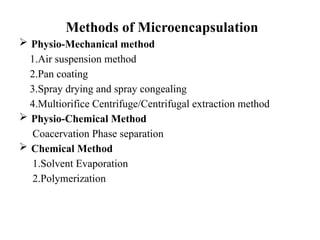
Methods of Microencapsulation
 Physio-Mechanical method
1.Air suspension method
2.Pan coating
3.Spray drying and spray congealing
4.Multiorifice Centrifuge/Centrifugal extraction method
 Physio-Chemical Method
Coacervation Phase separation
 Chemical Method
1.Solvent Evaporation
2.Polymerization
Air suspension process/Fluidized
bed technique
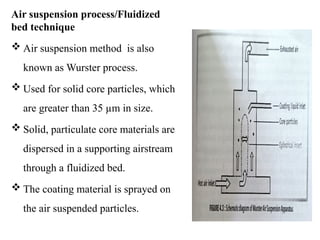
 Air suspension method is also
known as Wurster process.
 Used for solid core particles, which
are greater than 35 µm in size.
 Solid, particulate core materials are
dispersed in a supporting airstream
through a fluidized bed.
 The coating material is sprayed on
the air suspended particles.
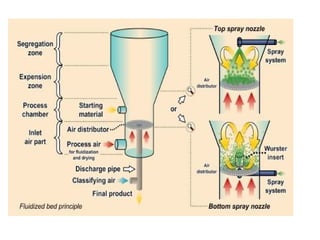
 Within the coating chamber particles are suspended on an
upward moving air stream.
 They are supported by a perforated plate having different
patterns holes inside and outside a cylindrical insert.
 Just sufficient air is permitted to rise through the outer annular
space to fluidize the settling particles.
 The chamber designs and it’s operating parameters effect a
recirculating flow of particles through the coating zone portion
of the chamber, where a Coating material usually a polymer
solution is sprayed to the moving particles.
 During each pass through the coating zone, the core material
receives an increment of coating material.
 The cyclic process is repeated perhaps several hundred times
during processing depending upon:
► The purpose of microencapsulation.
► The desired coating thickness.
► Until the core material particles are thoroughly
encapsulated.
 At the top, as the air stream diverges and slows, they settle back
onto the outer bed and move downward to repeat the cycle.
 The supporting air stream also serves to dry the product while it
is being encapsulated. Drying rates are directly related to the
volume temperature of the supporting air stream.
 Various process variables like core material properties (density,
surface area, melting point, volatility, crystallinity, solubility &
flow ability etc.), coating material concentration, amount and
application rate, inlet &outlet temperature are responsible for
size and shape of the product.
 In this process wide variety of coating material such as solvent
solution, aqueous solution, emulsion, dispersions and hot melts
etc can be used.
 Generally used for encapsulation of solid core material.
Fluidized bed processor
Pan Coating Method
 Widely used in the pharmaceutical industry.
 Used for solid core particles which are greater
than 600µm in size.
 The core materials are tumbled in a pan while
coating material is applied slowly.
 The coating is applied as a solution or an
atomized spray to the desired solid core material
in Coating pan.
 Warm air is passed over the coated materials to
remove the coating solvent.
 In some cases, final solvent removal is
accomplished in a drying oven.
Conventional Coating machine
Spray drying and Spray Congealing
• Spray drying and spray congealing processes are similar.
• Both involve dispersing the core material in a liquefied coating
substance and spraying or introducing the mixture in such
atmospheric condition where rapid solidification of the coating
occurs.
• The principle difference between two process is method used for
solidification of coating.
• In spray drying the core material is dissolved or suspended in a
polymer solution, dried quickly with hot air so rapid evaporation
of solvent occurs.
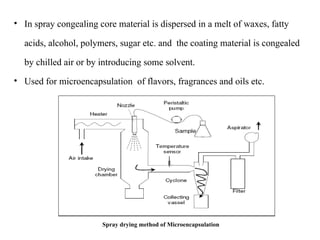
• In spray congealing core material is dispersed in a melt of waxes, fatty
acids, alcohol, polymers, sugar etc. and the coating material is congealed
by chilled air or by introducing some solvent.
• Used for microencapsulation of flavors, fragrances and oils etc.
Spray drying method of Microencapsulation
Spray drying
Core material + Coating Solution
Core is dissolved or dispersed
Atomized in hot air
Solvent evaporated
Polymer coated around the core
Spray Congealing
Polymer melted Core material
Core is dissolved or dispersed
Atomized in cool air
Polymer is Solidified
Polymer coated around the core
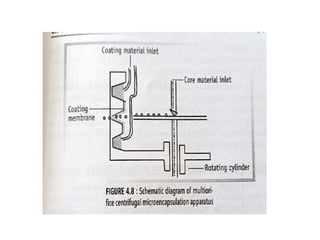
Multiorifice centrifugal extrusion
• This method utilizes the centrifugal forces to hurl a core particle
through a fine orifice in enveloping polymer membrane.
• This process is excellent for forming particles 400 to 2000 µm
in diameter.
• This method microencapsulate both liquids and solids (after
dispersion in some liquid) of varied size range.
• Various processing variables include (i) rotational speed of the
cylinder, (ii) flow rate of the core and coating materials, and (iii)
concentration, viscosity of coating material (iv) surface tension
and viscosity of the core material.
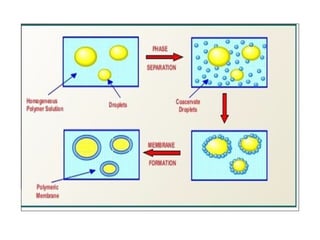
Coacervation-Phase Separation
 Used for solid/liquid core particles which are greater than 2 µm in
size.
 The process of phase separation in liquids containing colloidal solute.
 Coacervation was subdivided into
Simple Coacervation: generally uses one colloid, which is
precipitated out by salts or non solvents or by an increase and
decrease in temperature.
Complex Coacervation: involves two or more than two colloids
and salting out are carried out by oppositely charged polymers.
 Coacervation process involves three steps .
Step1:Formation of three immiscible phases
Step2: Deposition of coating
Step3: Rigidization of coating
Formation of three immiscible phases
• (i) a liquid manufacturing vehicle phase
(ii) a core material phase (iii) a coating material phase.
• The coating material is separated from liquid manufacturing vehicle to
form coacervates by application of anyone of the following principles.
1.) By changing the temperature of the polymer solution
2.) By adding a salt
3.) By adding a non-solvent
4.) By adding incompatible polymer to the polymer solution
5.) By inducing a polymer-polymer interaction.
• Application of above principles decreases the solubility of polymer in
liquid manufacturing vehicle and the polymer starts separating in the
form of small liquid droplets called as “ Coacervates”. Thus resulting
in the formation of 3 phases.
Deposition of coating
• Accomplished by controlled, physical mixing of coating material
(while liquid) and the core material in the manufacturing vehicle.
• Deposition of the liquid polymer coating around the core material
occurs if the polymer is adsorbed at the interface formed between
the core material and the liquid vehicle phase.
Rigidization of coating
• Rigidization is essential to impart stability and protection from drug
leaching of micocapsules.
• Rigidizing the coating by thermal, cross linking agents, desolvation
techniques using aqueous or non aqueous vehicle to form self
sustaining microcapsule.
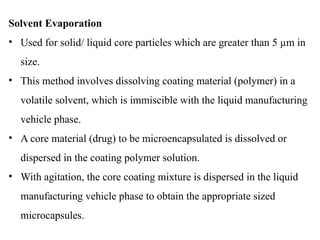
Solvent Evaporation
• Used for solid/ liquid core particles which are greater than 5 µm in
size.
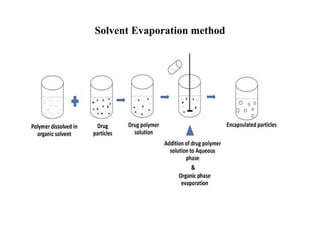
• This method involves dissolving coating material (polymer) in a
volatile solvent, which is immiscible with the liquid manufacturing
vehicle phase.
• A core material (drug) to be microencapsulated is dissolved or
dispersed in the coating polymer solution.
• With agitation, the core coating mixture is dispersed in the liquid
manufacturing vehicle phase to obtain the appropriate sized
microcapsules.
• Agitation of system is continued until the solvent partitions into
the aqueous phase and is removed by evaporation.This process
results in hardened microcapsules.
• The use of a propeller style blade attached to a variable speed
motor is the most common method used to achieve dispersion of
the oil phase in the continuous phase.
• Various process variables namely rate of solvent evaporation for
the coating polymer(s), temperature cycles and agitation rates
influence the methods of forming dispersions.
• The solvent evaporation method is applicable to a wide variety of
liquid and solid core particles.
Solvent Evaporation method
Polymerization method
 Interfacial polymerization
 In-situ polymerization
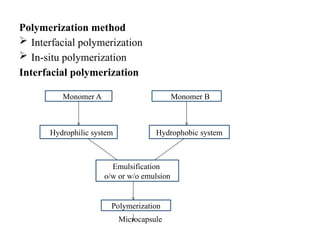
Interfacial polymerization
Microcapsule
MMonomer A MMonomer B
HHydrophilic system Hydrophobic system
Emulsification
o/w or w/o emulsion
Polymerization
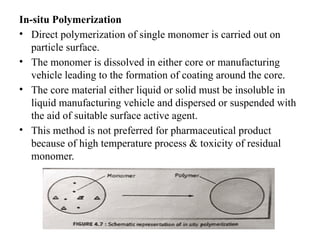
In-situ Polymerization
• Direct polymerization of single monomer is carried out on
particle surface.
• The monomer is dissolved in either core or manufacturing
vehicle leading to the formation of coating around the core.
• The core material either liquid or solid must be insoluble in
liquid manufacturing vehicle and dispersed or suspended with
the aid of suitable surface active agent.
• This method is not preferred for pharmaceutical product
because of high temperature process & toxicity of residual
monomer.
Application
• Separation of incompatible substances has been achieved by
encapsulation.
• Prolonged release dosage forms.
• A liquid can be converted into pseudo solid.
• To prepare enteric-coated dosage forms, so that the medicament will be
selectively absorbed in the intestine rather than stomach.
• It can be used to mask the taste of bitter drugs.
• It has been used to protect drugs from environmental hazards such as
humidity, light, oxygen or heat.
• Microencapsulation can be used to decrease the volatility. An encapsulated
volatile substance can be stored for longer times.
• Microencapsulation has also been used to decrease potential
danger of handling of toxic or noxious substances.
• The hygroscopic properties of many core materials may be
reduced by microencapsulation.
• Many drugs have been microencapsulated to reduce gastric
irritation.
• Beverages production
• In Textiles
Evaluation Of Microcapsules

MICROENCAPSULATION TECHNIQUES B.pharmacy

  • 1.
  • 2.
    Methods of Microencapsulation Physio-Mechanical method 1.Air suspension method 2.Pan coating 3.Spray drying and spray congealing 4.Multiorifice Centrifuge/Centrifugal extraction method  Physio-Chemical Method Coacervation Phase separation  Chemical Method 1.Solvent Evaporation 2.Polymerization
  • 3.
    Air suspension process/Fluidized bedtechnique  Air suspension method is also known as Wurster process.  Used for solid core particles, which are greater than 35 µm in size.  Solid, particulate core materials are dispersed in a supporting airstream through a fluidized bed.  The coating material is sprayed on the air suspended particles.
  • 4.
     Within thecoating chamber particles are suspended on an upward moving air stream.  They are supported by a perforated plate having different patterns holes inside and outside a cylindrical insert.  Just sufficient air is permitted to rise through the outer annular space to fluidize the settling particles.  The chamber designs and it’s operating parameters effect a recirculating flow of particles through the coating zone portion of the chamber, where a Coating material usually a polymer solution is sprayed to the moving particles.  During each pass through the coating zone, the core material receives an increment of coating material.
  • 5.
     The cyclicprocess is repeated perhaps several hundred times during processing depending upon: ► The purpose of microencapsulation. ► The desired coating thickness. ► Until the core material particles are thoroughly encapsulated.  At the top, as the air stream diverges and slows, they settle back onto the outer bed and move downward to repeat the cycle.  The supporting air stream also serves to dry the product while it is being encapsulated. Drying rates are directly related to the volume temperature of the supporting air stream.
  • 6.
     Various processvariables like core material properties (density, surface area, melting point, volatility, crystallinity, solubility & flow ability etc.), coating material concentration, amount and application rate, inlet &outlet temperature are responsible for size and shape of the product.  In this process wide variety of coating material such as solvent solution, aqueous solution, emulsion, dispersions and hot melts etc can be used.  Generally used for encapsulation of solid core material.
  • 8.
  • 9.
    Pan Coating Method Widely used in the pharmaceutical industry.  Used for solid core particles which are greater than 600µm in size.  The core materials are tumbled in a pan while coating material is applied slowly.  The coating is applied as a solution or an atomized spray to the desired solid core material in Coating pan.  Warm air is passed over the coated materials to remove the coating solvent.  In some cases, final solvent removal is accomplished in a drying oven.
  • 10.
  • 11.
    Spray drying andSpray Congealing • Spray drying and spray congealing processes are similar. • Both involve dispersing the core material in a liquefied coating substance and spraying or introducing the mixture in such atmospheric condition where rapid solidification of the coating occurs. • The principle difference between two process is method used for solidification of coating. • In spray drying the core material is dissolved or suspended in a polymer solution, dried quickly with hot air so rapid evaporation of solvent occurs.
  • 12.
    • In spraycongealing core material is dispersed in a melt of waxes, fatty acids, alcohol, polymers, sugar etc. and the coating material is congealed by chilled air or by introducing some solvent. • Used for microencapsulation of flavors, fragrances and oils etc. Spray drying method of Microencapsulation
  • 13.
    Spray drying Core material+ Coating Solution Core is dissolved or dispersed Atomized in hot air Solvent evaporated Polymer coated around the core Spray Congealing Polymer melted Core material Core is dissolved or dispersed Atomized in cool air Polymer is Solidified Polymer coated around the core
  • 14.
    Multiorifice centrifugal extrusion •This method utilizes the centrifugal forces to hurl a core particle through a fine orifice in enveloping polymer membrane. • This process is excellent for forming particles 400 to 2000 µm in diameter. • This method microencapsulate both liquids and solids (after dispersion in some liquid) of varied size range. • Various processing variables include (i) rotational speed of the cylinder, (ii) flow rate of the core and coating materials, and (iii) concentration, viscosity of coating material (iv) surface tension and viscosity of the core material.
  • 16.
    Coacervation-Phase Separation  Usedfor solid/liquid core particles which are greater than 2 µm in size.  The process of phase separation in liquids containing colloidal solute.  Coacervation was subdivided into Simple Coacervation: generally uses one colloid, which is precipitated out by salts or non solvents or by an increase and decrease in temperature. Complex Coacervation: involves two or more than two colloids and salting out are carried out by oppositely charged polymers.
  • 17.
     Coacervation processinvolves three steps . Step1:Formation of three immiscible phases Step2: Deposition of coating Step3: Rigidization of coating Formation of three immiscible phases • (i) a liquid manufacturing vehicle phase (ii) a core material phase (iii) a coating material phase.
  • 18.
    • The coatingmaterial is separated from liquid manufacturing vehicle to form coacervates by application of anyone of the following principles. 1.) By changing the temperature of the polymer solution 2.) By adding a salt 3.) By adding a non-solvent 4.) By adding incompatible polymer to the polymer solution 5.) By inducing a polymer-polymer interaction. • Application of above principles decreases the solubility of polymer in liquid manufacturing vehicle and the polymer starts separating in the form of small liquid droplets called as “ Coacervates”. Thus resulting in the formation of 3 phases.
  • 19.
    Deposition of coating •Accomplished by controlled, physical mixing of coating material (while liquid) and the core material in the manufacturing vehicle. • Deposition of the liquid polymer coating around the core material occurs if the polymer is adsorbed at the interface formed between the core material and the liquid vehicle phase. Rigidization of coating • Rigidization is essential to impart stability and protection from drug leaching of micocapsules. • Rigidizing the coating by thermal, cross linking agents, desolvation techniques using aqueous or non aqueous vehicle to form self sustaining microcapsule.
  • 21.
    Solvent Evaporation • Usedfor solid/ liquid core particles which are greater than 5 µm in size. • This method involves dissolving coating material (polymer) in a volatile solvent, which is immiscible with the liquid manufacturing vehicle phase. • A core material (drug) to be microencapsulated is dissolved or dispersed in the coating polymer solution. • With agitation, the core coating mixture is dispersed in the liquid manufacturing vehicle phase to obtain the appropriate sized microcapsules.
  • 22.
    • Agitation ofsystem is continued until the solvent partitions into the aqueous phase and is removed by evaporation.This process results in hardened microcapsules. • The use of a propeller style blade attached to a variable speed motor is the most common method used to achieve dispersion of the oil phase in the continuous phase. • Various process variables namely rate of solvent evaporation for the coating polymer(s), temperature cycles and agitation rates influence the methods of forming dispersions. • The solvent evaporation method is applicable to a wide variety of liquid and solid core particles.
  • 23.
  • 24.
    Polymerization method  Interfacialpolymerization  In-situ polymerization Interfacial polymerization Microcapsule MMonomer A MMonomer B HHydrophilic system Hydrophobic system Emulsification o/w or w/o emulsion Polymerization
  • 25.
    In-situ Polymerization • Directpolymerization of single monomer is carried out on particle surface. • The monomer is dissolved in either core or manufacturing vehicle leading to the formation of coating around the core. • The core material either liquid or solid must be insoluble in liquid manufacturing vehicle and dispersed or suspended with the aid of suitable surface active agent. • This method is not preferred for pharmaceutical product because of high temperature process & toxicity of residual monomer.
  • 26.
    Application • Separation ofincompatible substances has been achieved by encapsulation. • Prolonged release dosage forms. • A liquid can be converted into pseudo solid. • To prepare enteric-coated dosage forms, so that the medicament will be selectively absorbed in the intestine rather than stomach. • It can be used to mask the taste of bitter drugs. • It has been used to protect drugs from environmental hazards such as humidity, light, oxygen or heat. • Microencapsulation can be used to decrease the volatility. An encapsulated volatile substance can be stored for longer times.
  • 27.
    • Microencapsulation hasalso been used to decrease potential danger of handling of toxic or noxious substances. • The hygroscopic properties of many core materials may be reduced by microencapsulation. • Many drugs have been microencapsulated to reduce gastric irritation. • Beverages production • In Textiles
  • 28.