QUALITY CONTROL TEST FOR
METAL CONTAINER
1
THEORY
 Metal containers are used solely for medicinal products for non-
parenteral administration.
 Metal is strong, opaque, impermeable to moisture, gases, odors, light,
bacteria, and shatterproof, it is the ideal packaging material for
pressurized containers.
 It is resistant to high and low temperatures.
 They include tubes, packs made from foil or blisters, cans, and
aerosol and gas cylinders.
 Aluminium and stainless steel are the metals of choice for both
primary and secondary packaging for medicinal products.
 Form an excellent tamper evident containers.
2
ADVANTAGES & DISADVANTAGES
Advantages of metals:
1. They are light in nature
2. Highly robust for packing of
aerosol system.
3. They can be molded to
different shapes & sizes.
4. They prevent permeation of
air, moisture and microbial
organisms.
5. Printing can be directly done
to the surface.
Disadvantages of metals
1. Highly reactive materials.
2. They are costly, when
compared to glass &
plastics
3
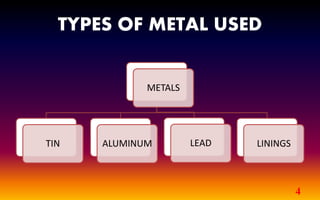
TYPES OF METAL USED
METALS
TIN ALUMINUM LEAD LININGS
4
 ALUMINUM:
 It is relatively light yet strong.
 Barrier to light and chemicals.
 Impermeable and easy to work into a variety of formats, depending
on its thickness.
 Thickest aluminium is used for rigid containers such as aerosol cans
and tubes for effervescent tablets.
 Intermediate thickness are when mechanical integrity is still
important but the pack should be capable of being reformed under a
reasonable force. e.g. Collapsible tubes for semi solid preparations or
roll on screw caps.
 Thinnest aluminium is used in flexible foil that are usually a
component of laminated packaging material.
5
Disadvantages and their
overcome solution:
 Major disadvantage is its reactivity in raw state, although it rapidly
forms a protective film of aluminium oxide it is still liable to
corrosion ( when exposed to some liquids and semi solid
formulations, particularly at extreme pH or if the product contains
electrolytes).
 Overcome:
 To overcome this problem, Aluminium is lined with epoxide, vinyl
or phenolic resins.
 They are work hardening like collapsible tubes are made by impact
extrusion which tends to make aluminium less flexible.
 Overcome: To overcome, flexibility has to restored by an annealing
stage
6
 TIN:
Tin containers are preferred for food,
pharmaceuticals and any product for which
purity is considered.
Tin is the most chemically inert of all
collapsible metal tubes.
7
 LEAD:
Lead has the lowest cost of all tube metals and is
widely used for non food products such as
adhesives, inks. paints and lubricants.
Lead should never be used alone for anything
taken internally because of the risk lead poison.
With internal linings, lead tubes are used for
products such as chloride tooth paste.
8
 LININGS:
 If the product is not compatible with bare metal, the interior
can be flushed with wax-type formulation or with resin
solutions, although the resins or lacquers are usually sprayed
on.
 A tube with an epoxy lining costs about 25% more than the
same tube uncoated.
 Wax linings are most often used with water-based products in
tin tubes, and phenolic, epoxides, and vinyls are used with
aluminium tubes, giving better protection than wax, but at a
higher cost.
9
QUALITY CONTROL TEST FOR METAL
10
Select a sample of 50 tubes from the lot to be
tested and clean each tube by vibration and/or
"blowing". (A lot may be either the tube
manufacturer's day's production or a consignment
delivered to the tube user).
Fill the tubes with a suitable molten eye ointment
base, close the open end of each tube by adouble
fold and allow the filled tubes to cool overnight at
a temperature of 15° to 20°
 Assemble a metal bacteriological filter with a 4.25-cm
filter paper of suitable porosity supported on suitable
perforated plate in place of the standard sintered carbon
disc and heat it in a suitable manner to a temperature
above the melting range of the base.
 Remove the caps from the cooled tubes and apply
uniform pressure to the closed end of each tube in turn,
in such a manner that the time taken to express as much
of the base as possible through each nozzle is not less
than 20 second.
11
 Collect the extruded base from the 50 tubes in the
heated filter, applying suction to the stem of the filter in
order to draw the molten base through the filter paper.
 When the entire melted base has been removed, wash
the walls of the filter and the filter paper with three
successive quantities, each of 30 mL, of chloroform,
allow the filter paper to dry and immediately mount it
between glasses for examination.
12
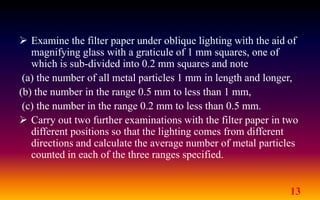
 Examine the filter paper under oblique lighting with the aid of
magnifying glass with a graticule of 1 mm squares, one of
which is sub-divided into 0.2 mm squares and note
(a) the number of all metal particles 1 mm in length and longer,
(b) the number in the range 0.5 mm to less than 1 mm,
(c) the number in the range 0.2 mm to less than 0.5 mm.
 Carry out two further examinations with the filter paper in two
different positions so that the lighting comes from different
directions and calculate the average number of metal particles
counted in each of the three ranges specified.
13
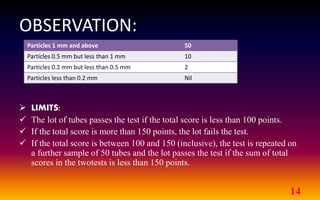
OBSERVATION:
14
 LIMITS:
 The lot of tubes passes the test if the total score is less than 100 points.
 If the total score is more than 150 points, the lot fails the test.
 If the total score is between 100 and 150 (inclusive), the test is repeated on
a further sample of 50 tubes and the lot passes the test if the sum of total
scores in the twotests is less than 150 points.
Particles 1 mm and above 50
Particles 0.5 mm but less than 1 mm 10
Particles 0.2 mm but less than 0.5 mm 2
Particles less than 0.2 mm Nil
References:
 https://www.slideshare.net/KunalPatel257/quality-control-test-for-
packaging-material-ppt
 Pharmaceuticals Packaging Technology,Taylor and Francis by Dean D.A,
Evans E.R fifth edition.
 “Packaging”; Cooper and Gunn’s Tutorial Pharmacy, sixth edition, CBS
publication.
 https://www.pharmatutor.org/articles/quality-control-testing-packaging-
materials
15
16

Quality control test for metal

  • 1.
    QUALITY CONTROL TESTFOR METAL CONTAINER 1
  • 2.
    THEORY  Metal containersare used solely for medicinal products for non- parenteral administration.  Metal is strong, opaque, impermeable to moisture, gases, odors, light, bacteria, and shatterproof, it is the ideal packaging material for pressurized containers.  It is resistant to high and low temperatures.  They include tubes, packs made from foil or blisters, cans, and aerosol and gas cylinders.  Aluminium and stainless steel are the metals of choice for both primary and secondary packaging for medicinal products.  Form an excellent tamper evident containers. 2
  • 3.
    ADVANTAGES & DISADVANTAGES Advantagesof metals: 1. They are light in nature 2. Highly robust for packing of aerosol system. 3. They can be molded to different shapes & sizes. 4. They prevent permeation of air, moisture and microbial organisms. 5. Printing can be directly done to the surface. Disadvantages of metals 1. Highly reactive materials. 2. They are costly, when compared to glass & plastics 3
  • 4.
    TYPES OF METALUSED METALS TIN ALUMINUM LEAD LININGS 4
  • 5.
     ALUMINUM:  Itis relatively light yet strong.  Barrier to light and chemicals.  Impermeable and easy to work into a variety of formats, depending on its thickness.  Thickest aluminium is used for rigid containers such as aerosol cans and tubes for effervescent tablets.  Intermediate thickness are when mechanical integrity is still important but the pack should be capable of being reformed under a reasonable force. e.g. Collapsible tubes for semi solid preparations or roll on screw caps.  Thinnest aluminium is used in flexible foil that are usually a component of laminated packaging material. 5
  • 6.
    Disadvantages and their overcomesolution:  Major disadvantage is its reactivity in raw state, although it rapidly forms a protective film of aluminium oxide it is still liable to corrosion ( when exposed to some liquids and semi solid formulations, particularly at extreme pH or if the product contains electrolytes).  Overcome:  To overcome this problem, Aluminium is lined with epoxide, vinyl or phenolic resins.  They are work hardening like collapsible tubes are made by impact extrusion which tends to make aluminium less flexible.  Overcome: To overcome, flexibility has to restored by an annealing stage 6
  • 7.
     TIN: Tin containersare preferred for food, pharmaceuticals and any product for which purity is considered. Tin is the most chemically inert of all collapsible metal tubes. 7
  • 8.
     LEAD: Lead hasthe lowest cost of all tube metals and is widely used for non food products such as adhesives, inks. paints and lubricants. Lead should never be used alone for anything taken internally because of the risk lead poison. With internal linings, lead tubes are used for products such as chloride tooth paste. 8
  • 9.
     LININGS:  Ifthe product is not compatible with bare metal, the interior can be flushed with wax-type formulation or with resin solutions, although the resins or lacquers are usually sprayed on.  A tube with an epoxy lining costs about 25% more than the same tube uncoated.  Wax linings are most often used with water-based products in tin tubes, and phenolic, epoxides, and vinyls are used with aluminium tubes, giving better protection than wax, but at a higher cost. 9
  • 10.
    QUALITY CONTROL TESTFOR METAL 10 Select a sample of 50 tubes from the lot to be tested and clean each tube by vibration and/or "blowing". (A lot may be either the tube manufacturer's day's production or a consignment delivered to the tube user). Fill the tubes with a suitable molten eye ointment base, close the open end of each tube by adouble fold and allow the filled tubes to cool overnight at a temperature of 15° to 20°
  • 11.
     Assemble ametal bacteriological filter with a 4.25-cm filter paper of suitable porosity supported on suitable perforated plate in place of the standard sintered carbon disc and heat it in a suitable manner to a temperature above the melting range of the base.  Remove the caps from the cooled tubes and apply uniform pressure to the closed end of each tube in turn, in such a manner that the time taken to express as much of the base as possible through each nozzle is not less than 20 second. 11
  • 12.
     Collect theextruded base from the 50 tubes in the heated filter, applying suction to the stem of the filter in order to draw the molten base through the filter paper.  When the entire melted base has been removed, wash the walls of the filter and the filter paper with three successive quantities, each of 30 mL, of chloroform, allow the filter paper to dry and immediately mount it between glasses for examination. 12
  • 13.
     Examine thefilter paper under oblique lighting with the aid of magnifying glass with a graticule of 1 mm squares, one of which is sub-divided into 0.2 mm squares and note (a) the number of all metal particles 1 mm in length and longer, (b) the number in the range 0.5 mm to less than 1 mm, (c) the number in the range 0.2 mm to less than 0.5 mm.  Carry out two further examinations with the filter paper in two different positions so that the lighting comes from different directions and calculate the average number of metal particles counted in each of the three ranges specified. 13
  • 14.
    OBSERVATION: 14  LIMITS:  Thelot of tubes passes the test if the total score is less than 100 points.  If the total score is more than 150 points, the lot fails the test.  If the total score is between 100 and 150 (inclusive), the test is repeated on a further sample of 50 tubes and the lot passes the test if the sum of total scores in the twotests is less than 150 points. Particles 1 mm and above 50 Particles 0.5 mm but less than 1 mm 10 Particles 0.2 mm but less than 0.5 mm 2 Particles less than 0.2 mm Nil
  • 15.
    References:  https://www.slideshare.net/KunalPatel257/quality-control-test-for- packaging-material-ppt  PharmaceuticalsPackaging Technology,Taylor and Francis by Dean D.A, Evans E.R fifth edition.  “Packaging”; Cooper and Gunn’s Tutorial Pharmacy, sixth edition, CBS publication.  https://www.pharmatutor.org/articles/quality-control-testing-packaging- materials 15
  • 16.