By 
Maryum Atique 
M.Phil (Chemistry)
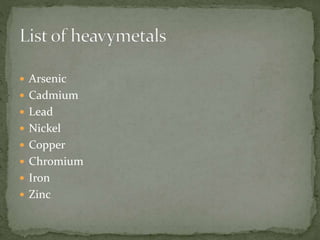
 Arsenic 
 Cadmium 
 Lead 
 Nickel 
 Copper 
 Chromium 
 Iron 
 Zinc
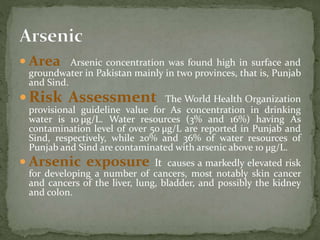
 Area Arsenic concentration was found high in surface and 
groundwater in Pakistan mainly in two provinces, that is, Punjab 
and Sind. 
Risk Assessment The World Health Organization 
provisional guideline value for As concentration in drinking 
water is 10 μg/L. Water resources (3% and 16%) having As 
contamination level of over 50 μg/L are reported in Punjab and 
Sind, respectively, while 20% and 36% of water resources of 
Punjab and Sind are contaminated with arsenic above 10 μg/L. 
 Arsenic exposure It causes a markedly elevated risk 
for developing a number of cancers, most notably skin cancer 
and cancers of the liver, lung, bladder, and possibly the kidney 
and colon.
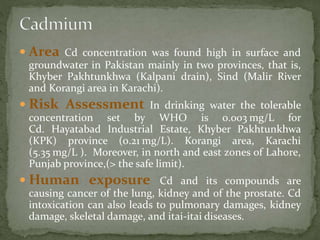
 Area Cd concentration was found high in surface and 
groundwater in Pakistan mainly in two provinces, that is, 
Khyber Pakhtunkhwa (Kalpani drain), Sind (Malir River 
and Korangi area in Karachi). 
 Risk Assessment In drinking water the tolerable 
concentration set by WHO is 0.003 mg/L for 
Cd. Hayatabad Industrial Estate, Khyber Pakhtunkhwa 
(KPK) province (0.21 mg/L). Korangi area, Karachi 
(5.35 mg/L ). Moreover, in north and east zones of Lahore, 
Punjab province,(> the safe limit). 
Human exposure Cd and its compounds are 
causing cancer of the lung, kidney and of the prostate. Cd 
intoxication can also leads to pulmonary damages, kidney 
damage, skeletal damage, and itai-itai diseases.
 Area Azad Jammu Kashmir (AJ&K), Sialkot, Akbarpura 
area of district Nowshera, Hattar Industrial Estate, KPK 
 Risk Assessment In Pakistan, most of the ground 
water samples exceeded the permissible limit of 0.01 mg/L 
set by WHO for drinking water. AJ&K(1.8 and 4.7 mg/L), 
Hattar Industrial Estate (KPK) 0.26 mg/L, Sialkot, 
Punjab (> 0.01 mg/L). 
Human exposure health problems, ranging from 
small effects on metabolism and intelligence to 
convulsions, coma, renal failure, cancer and death.
 Area Karachi( Lyari, Karachi Port Trust (KPT), Lahore 
(North and East zone). 
 Risk Assessment National Standards for Drinking 
Water Quality, Pakistan (NSDWQ-Pak), suggest the 
guideline value of 0.02 mg/L. Jhangar Valley, Punjab 
province, the maximum total content of Ni in soil was 
recorded as 81 mg/Kg , 70 mg/kg in Kohistan region. In 
soil, the highest concentration of Ni is 324 mg/kg (mean 
172 mg/kg) from contaminated Lahore site. 
Human exposure It cause cancers of the lung and 
of the nasal cavity and paranasal sinuses.
 Area Zoab (Balochistan), Kasur (Punjab). 
 Risk Assessment In ground water samples from 
various regions in Pakistan show Cr variation 
ranging from <0.001 to 9.8 mg/L, being the highest 
(mean value 2.12 mg/L) in well water from 
residential area, Kasur, Punjab province , whereas 
surface water contamination was found in the 
range of 0.16–0.29 mg/L Bara River, Nowshera, 
KPK province . 
 Human exposure cancer of the lung, nose and nasal 
sinuses.
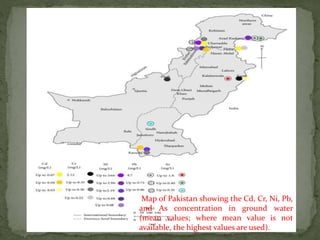
Map of Pakistan showing the Cd, Cr, Ni, Pb, 
and As concentration in ground water 
(mean values; where mean value is not 
available, the highest values are used).
 Rehman, W., Zeb, A., Noor, N., & Nawaz, M. (2008). Heavy 
metal pollution assessment in various industries of 
Pakistan. Environmental geology, 55(2), 353-358. 
 A. Azizullah, M. N. K. Khattak, P. Richter, and D. Häder, 
“Water pollution in Pakistan and its impact on public 
health—a review,” Environment International, vol. 37, no. 
2, pp. 479–497, 2011. 
 Waseem, A., Arshad, J., Iqbal, F., Sajjad, A., Mehmood, Z., 
& Murtaza, G. (2014). Pollution Status of Pakistan: A 
Retrospective Review on Heavy Metal Contamination of 
Water, Soil, and Vegetables. BioMed research 
international,2014.

Heavy metals in pakistan

  • 1.
    By Maryum Atique M.Phil (Chemistry)
  • 2.
     Arsenic Cadmium  Lead  Nickel  Copper  Chromium  Iron  Zinc
  • 3.
     Area Arsenicconcentration was found high in surface and groundwater in Pakistan mainly in two provinces, that is, Punjab and Sind. Risk Assessment The World Health Organization provisional guideline value for As concentration in drinking water is 10 μg/L. Water resources (3% and 16%) having As contamination level of over 50 μg/L are reported in Punjab and Sind, respectively, while 20% and 36% of water resources of Punjab and Sind are contaminated with arsenic above 10 μg/L.  Arsenic exposure It causes a markedly elevated risk for developing a number of cancers, most notably skin cancer and cancers of the liver, lung, bladder, and possibly the kidney and colon.
  • 4.
     Area Cdconcentration was found high in surface and groundwater in Pakistan mainly in two provinces, that is, Khyber Pakhtunkhwa (Kalpani drain), Sind (Malir River and Korangi area in Karachi).  Risk Assessment In drinking water the tolerable concentration set by WHO is 0.003 mg/L for Cd. Hayatabad Industrial Estate, Khyber Pakhtunkhwa (KPK) province (0.21 mg/L). Korangi area, Karachi (5.35 mg/L ). Moreover, in north and east zones of Lahore, Punjab province,(> the safe limit). Human exposure Cd and its compounds are causing cancer of the lung, kidney and of the prostate. Cd intoxication can also leads to pulmonary damages, kidney damage, skeletal damage, and itai-itai diseases.
  • 5.
     Area AzadJammu Kashmir (AJ&K), Sialkot, Akbarpura area of district Nowshera, Hattar Industrial Estate, KPK  Risk Assessment In Pakistan, most of the ground water samples exceeded the permissible limit of 0.01 mg/L set by WHO for drinking water. AJ&K(1.8 and 4.7 mg/L), Hattar Industrial Estate (KPK) 0.26 mg/L, Sialkot, Punjab (> 0.01 mg/L). Human exposure health problems, ranging from small effects on metabolism and intelligence to convulsions, coma, renal failure, cancer and death.
  • 6.
     Area Karachi(Lyari, Karachi Port Trust (KPT), Lahore (North and East zone).  Risk Assessment National Standards for Drinking Water Quality, Pakistan (NSDWQ-Pak), suggest the guideline value of 0.02 mg/L. Jhangar Valley, Punjab province, the maximum total content of Ni in soil was recorded as 81 mg/Kg , 70 mg/kg in Kohistan region. In soil, the highest concentration of Ni is 324 mg/kg (mean 172 mg/kg) from contaminated Lahore site. Human exposure It cause cancers of the lung and of the nasal cavity and paranasal sinuses.
  • 7.
     Area Zoab(Balochistan), Kasur (Punjab).  Risk Assessment In ground water samples from various regions in Pakistan show Cr variation ranging from <0.001 to 9.8 mg/L, being the highest (mean value 2.12 mg/L) in well water from residential area, Kasur, Punjab province , whereas surface water contamination was found in the range of 0.16–0.29 mg/L Bara River, Nowshera, KPK province .  Human exposure cancer of the lung, nose and nasal sinuses.
  • 8.
    Map of Pakistanshowing the Cd, Cr, Ni, Pb, and As concentration in ground water (mean values; where mean value is not available, the highest values are used).
  • 9.
     Rehman, W.,Zeb, A., Noor, N., & Nawaz, M. (2008). Heavy metal pollution assessment in various industries of Pakistan. Environmental geology, 55(2), 353-358.  A. Azizullah, M. N. K. Khattak, P. Richter, and D. Häder, “Water pollution in Pakistan and its impact on public health—a review,” Environment International, vol. 37, no. 2, pp. 479–497, 2011.  Waseem, A., Arshad, J., Iqbal, F., Sajjad, A., Mehmood, Z., & Murtaza, G. (2014). Pollution Status of Pakistan: A Retrospective Review on Heavy Metal Contamination of Water, Soil, and Vegetables. BioMed research international,2014.