MBA/EMBA Program
Business Communication
Fall-2020
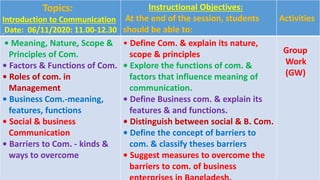
Topics:
Introduction to Communication
Date: 06/11/2020: 11.00-12.30
Instructional Objectives:
At the end of the session, students
should be able to:
Activities
• Meaning, Nature, Scope &
Principles of Com.
• Factors & Functions of Com.
• Roles of com. in
Management
• Business Com.-meaning,
features, functions
• Social & business
Communication
• Barriers to Com. - kinds &
ways to overcome
• Define Com. & explain its nature,
scope & principles
• Explore the functions of com. &
factors that influence meaning of
communication.
• Define Business com. & explain its
features & and functions.
• Distinguish between social & B. Com.
• Define the concept of barriers to
com. & classify theses barriers
• Suggest measures to overcome the
barriers to com. of business
Group
Work
(GW)
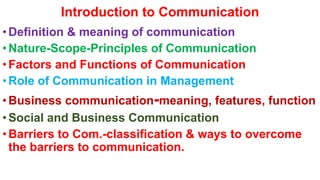
Introduction to Communication
•Definition & meaning of communication
•Nature-Scope-Principles of Communication
•Factors and Functions of Communication
•Role of Communication in Management
•Business communication-meaning, features, function
•Social and Business Communication
•Barriers to Com.-classification & ways to overcome
the barriers to communication.
Definition & meaning of communication
Meaning of Communication
• Meaning: The term communication has been derived from
the Latin word communis which means to share, i.e., sharing
of ideas, concepts, feelings and emotions.
• Literally, communication means to inform, to tell, to show, or
to spread information.
• It may be interpreted as an interchange of thoughts or
information to bring about understanding and confidence for
good industrial relations.
• Communication involves listening and exchanging verbal
and non-verbal messages which may be formal or informal
and may involve a large group or just two people.
• From time immemorial, the need to share or to communicate
has been felt.
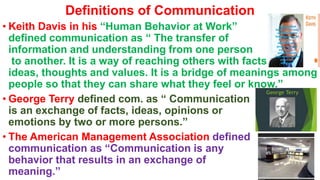
Definitions of Communication
• Keith Davis in his “Human Behavior at Work”
defined communication as “ The transfer of
information and understanding from one person
to another. It is a way of reaching others with facts,
ideas, thoughts and values. It is a bridge of meanings among
people so that they can share what they feel or know.”
• George Terry defined com. as “ Communication
is an exchange of facts, ideas, opinions or
emotions by two or more persons.”
• The American Management Association defined
communication as “Communication is any
behavior that results in an exchange of
meaning.”
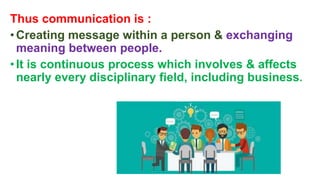
Thus communication is :
•Creating message within a person & exchanging
meaning between people.
•It is continuous process which involves & affects
nearly every disciplinary field, including business.
Nature of Communication
•Communication is a dynamic process.
•Communication is contextual.
•Communication is continuous.
•Communication coordinates our relationships.
•Communication is symbolic.
•Communication is culturally linked.
•.
Nature of Communication
•Communication is collaborative.
•Communication is ethical.
•Communication is unintentional as well as intentional
•Communication is systematic.
•Communication is both interaction & transaction
Scope of Communication
• Communication is so fundamental in our lives from birth to
death that it would be impossible for us to manage human
behaviors and attitudes without it.
• So, it is an ever-present activity in our lives. Efficient &
effective performance of any kind of activity whether it is
religious, cultural, political or social, etc. falls within the
purview of communication.
• All management acts pass through the bottle-neck of
communication.
• Its scope may be wide or narrow depending on the nature &
size of the organization.
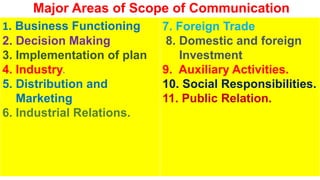
Major Areas of Scope of Communication
1. Business Functioning
2. Decision Making
3. Implementation of plan
4. Industry.
5. Distribution and
Marketing
6. Industrial Relations.
7. Foreign Trade
8. Domestic and foreign
Investment
9. Auxiliary Activities.
10. Social Responsibilities.
11. Public Relation.
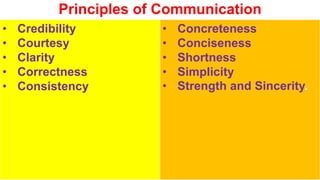
Principles of Communication
• Credibility
• Courtesy
• Clarity
• Correctness
• Consistency
• Concreteness
• Conciseness
• Shortness
• Simplicity
• Strength and Sincerity.
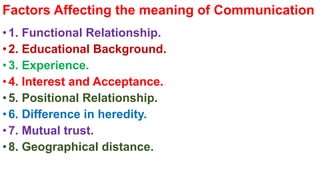
Factors Affecting the meaning of Communication
•1. Functional Relationship.
•2. Educational Background.
•3. Experience.
•4. Interest and Acceptance.
•5. Positional Relationship.
•6. Difference in heredity.
•7. Mutual trust.
•8. Geographical distance.
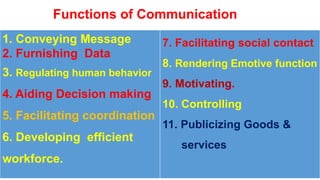
Functions of Communication
1. Conveying Message
2. Furnishing Data
3. Regulating human behavior
4. Aiding Decision making
5. Facilitating coordination
6. Developing efficient
workforce.
7. Facilitating social contact
8. Rendering Emotive function
9. Motivating.
10. Controlling
11. Publicizing Goods &
services
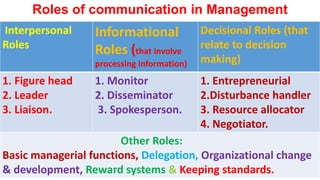
Roles of communication in Management
Interpersonal
Roles
Informational
Roles (that involve
processing information)
Decisional Roles (that
relate to decision
making)
1. Figure head
2. Leader
3. Liaison.
1. Monitor
2. Disseminator
3. Spokesperson.
1. Entrepreneurial
2.Disturbance handler
3. Resource allocator
4. Negotiator.
Other Roles:
Basic managerial functions, Delegation, Organizational change
& development, Reward systems & Keeping standards.
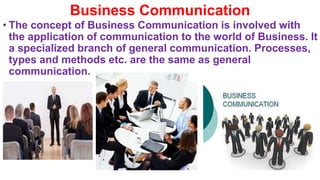
Business Communication
• The concept of Business Communication is involved with
the application of communication to the world of Business. It
a specialized branch of general communication. Processes,
types and methods etc. are the same as general
communication.
Business Communication
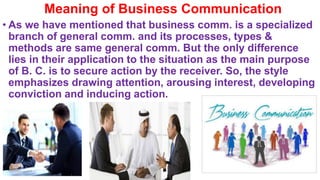
Meaning of Business Communication
• As we have mentioned that business comm. is a specialized
branch of general comm. and its processes, types &
methods are same general comm. But the only difference
lies in their application to the situation as the main purpose
of B. C. is to secure action by the receiver. So, the style
emphasizes drawing attention, arousing interest, developing
conviction and inducing action.
Business Communication
•We know that for survival & development of any
organization, a businessman has to maintain a link
with a host of people such as customers, suppliers,
lenders, govt. & his/her own organizational members.
Such maintenance of link for business purpose is
business communication.
Definitions of Business Communication
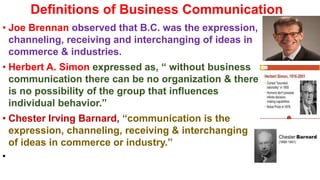
• Joe Brennan observed that B.C. was the expression,
channeling, receiving and interchanging of ideas in
commerce & industries.
• Herbert A. Simon expressed as, “ without business
communication there can be no organization & there
is no possibility of the group that influences
individual behavior.”
• Chester Irving Barnard, “communication is the
expression, channeling, receiving & interchanging
of ideas in commerce or industry.”
•
Now, we can say that B.C :
•is a specialized branch of G. Communication;
•Deals with internal & external business environment;
•is focused to secure some action by receiver;
•uses simple, concise and to the point language to
draw attention, developing interest and inducing
action.
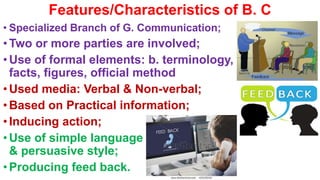
Features/Characteristics of B. C
• Specialized Branch of G. Communication;
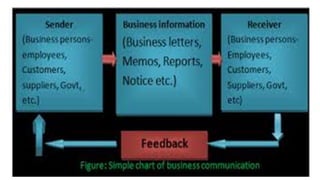
• Two or more parties are involved;
• Use of formal elements: b. terminology,
facts, figures, official method
• Used media: Verbal & Non-verbal;
• Based on Practical information;
• Inducing action;
• Use of simple language
& persuasive style;
• Producing feed back.
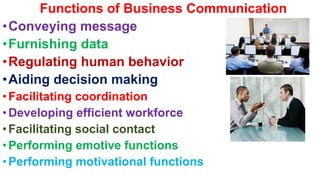
Functions of Business Communication
•Conveying message
•Furnishing data
•Regulating human behavior
•Aiding decision making
•Facilitating coordination
•Developing efficient workforce
•Facilitating social contact
•Performing emotive functions
•Performing motivational functions
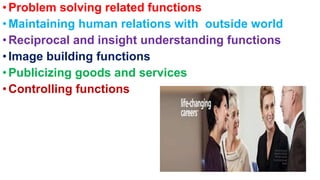
•Problem solving related functions
•Maintaining human relations with outside world
•Reciprocal and insight understanding functions
•Image building functions
•Publicizing goods and services
•Controlling functions
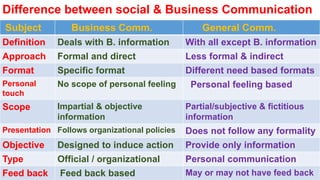
Difference between social & Business Communication
Subject Business Comm. General Comm.
Definition Deals with B. information With all except B. information
Approach Formal and direct Less formal & indirect
Format Specific format Different need based formats
Personal
touch
No scope of personal feeling Personal feeling based
Scope Impartial & objective
information
Partial/subjective & fictitious
information
Presentation Follows organizational policies Does not follow any formality
Objective Designed to induce action Provide only information
Type Official / organizational Personal communication
Feed back Feed back based May or may not have feed back
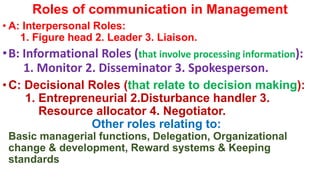
Roles of communication in Management
• A: Interpersonal Roles:
1. Figure head 2. Leader 3. Liaison.
•B: Informational Roles (that involve processing information):
1. Monitor 2. Disseminator 3. Spokesperson.
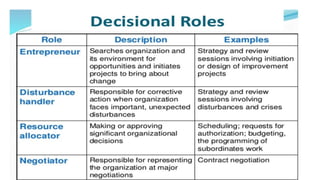
•C: Decisional Roles (that relate to decision making):
1. Entrepreneurial 2.Disturbance handler 3.
Resource allocator 4. Negotiator.
Other roles relating to:
Basic managerial functions, Delegation, Organizational
change & development, Reward systems & Keeping
standards
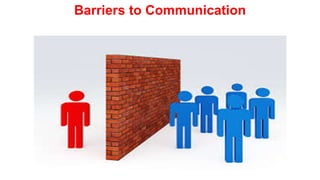
Barriers to Communication
Classifications of Communication barriers:
•Physical and External Barriers
•Semantic and Language Barriers
•Socio-psychological Barriers
•Organizational Barriers
•Corporate Communication Barriers
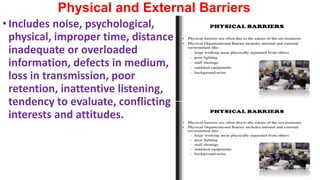
Physical and External Barriers
•Includes noise, psychological,
physical, improper time, distance,
inadequate or overloaded
information, defects in medium,
loss in transmission, poor
retention, inattentive listening,
tendency to evaluate, conflicting
interests and attitudes.
Semantic and Language Barriers
• Symbols with different meanings,
difference in language, faulty
translation, poor vocabulary,
unclarified assumptions, words
having multiple meanings,
misunderstanding due to semantics,
badly exposed message, wrong
interpretation & specialist language.
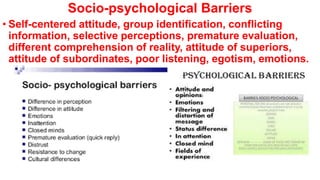
Socio-psychological Barriers
• Self-centered attitude, group identification, conflicting
information, selective perceptions, premature evaluation,
different comprehension of reality, attitude of superiors,
attitude of subordinates, poor listening, egotism, emotions.
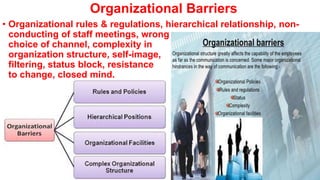
Organizational Barriers
• Organizational rules & regulations, hierarchical relationship, non-
conducting of staff meetings, wrong
choice of channel, complexity in
organization structure, self-image,
filtering, status block, resistance
to change, closed mind.
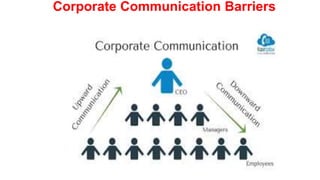
Corporate Communication Barriers
Overcoming the barriers to communication
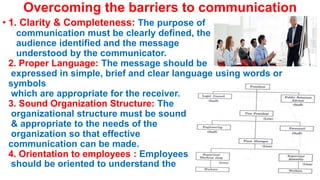
• 1. Clarity & Completeness: The purpose of
communication must be clearly defined, the
audience identified and the message
understood by the communicator.
2. Proper Language: The message should be
expressed in simple, brief and clear language using words or
symbols
which are appropriate for the receiver.
3. Sound Organization Structure: The
organizational structure must be sound
& appropriate to the needs of the
organization so that effective
communication can be made.
4. Orientation to employees : Employees
should be oriented to understand the
• Objectives, rules, policies, authority
relationships and operation of enterprise
which would help them to understand
each other and minimize conflicts
and distortion of messages.
5. Motivation and mutual confidence :
The message should be so designed as to motivate the
receiver to take the desired action by generating a
sense of mutual trust and confidence.
6. Consistence behavior : To avoid credibility
gap, management must ensure that their
actions and deeds are in accordance
with their communication.
•7. Use of grapevine : The formal channels
of communication must be supplemented by
informal channels or grapevine which help to
improve managerial decisions and make
communication effective.
8. Gestures and tone: It is also very
important to have appropriate facial
expression, tone, gestures & mood along
with the message because a twinkle of an
eye, a smile or a handshake,
etc., sometimes convey more meaning
than written or spoken words to make
the communication effective.
•9. Removing incorrect filtering : In business, the
filters between us & our receivers are many like-
secretaries, assistants, receptionists, answering
machines, etc.
•To overcome filtering barriers, try to establish
more than one communication channel, eliminate
as many intermediaries as possible and decrease
distortion by condensing message information to
the bare essentials.
• 10. Empathetic listening and avoid premature evaluation :
Be a good listener is essential to communicate effectively.
Superiors need to develop the habit of patience of listening
& avoid premature evaluation of communication from their
subordinates.
Davis (1985) suggested the following commandments for
good listening: “put talker at ease, show a talker that you
want to listen, remove distractions,
empathize with talker, be patient,
hold your temper, go easy on argument
and criticism, ask questions and stop
talking”.
11. Minimizing differences in perception
12. Get to know the people we communicate with
13. Learn to look at things from the other’s
perspective
14. Seek and offer feedback
15. Choose the right medium and the right channel
16. Good listening
17. Appropriate language.
Communication Problems of Organizations in Bangladesh
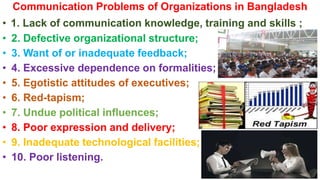
• 1. Lack of communication knowledge, training and skills ;
• 2. Defective organizational structure;
• 3. Want of or inadequate feedback;
• 4. Excessive dependence on formalities;
• 5. Egotistic attitudes of executives;
• 6. Red-tapism;
• 7. Undue political influences;
• 8. Poor expression and delivery;
• 9. Inadequate technological facilities;
• 10. Poor listening.
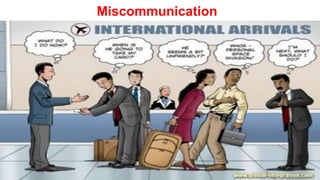
Miscommunication
Miscommunication
•Miscommunication is when the sender and the
receiver of the communication do not come to the
same level of agreement about the indicated reality in
existence.
•Communication is not always successful because
several things can prevent message from reaching
the intended recipient or from having the desired
effect on the recipient.
•There may be fault in system, medium, language,
encoding, decoding. Miscommunication keeps us
from understanding other’s ideas and thoughts which
results in disharmony.

Emba 1.b.com-fall-2020

  • 1.
  • 2.
    Topics: Introduction to Communication Date:06/11/2020: 11.00-12.30 Instructional Objectives: At the end of the session, students should be able to: Activities • Meaning, Nature, Scope & Principles of Com. • Factors & Functions of Com. • Roles of com. in Management • Business Com.-meaning, features, functions • Social & business Communication • Barriers to Com. - kinds & ways to overcome • Define Com. & explain its nature, scope & principles • Explore the functions of com. & factors that influence meaning of communication. • Define Business com. & explain its features & and functions. • Distinguish between social & B. Com. • Define the concept of barriers to com. & classify theses barriers • Suggest measures to overcome the barriers to com. of business Group Work (GW)
  • 3.
    Introduction to Communication •Definition& meaning of communication •Nature-Scope-Principles of Communication •Factors and Functions of Communication •Role of Communication in Management •Business communication-meaning, features, function •Social and Business Communication •Barriers to Com.-classification & ways to overcome the barriers to communication.
  • 4.
    Definition & meaningof communication
  • 5.
    Meaning of Communication •Meaning: The term communication has been derived from the Latin word communis which means to share, i.e., sharing of ideas, concepts, feelings and emotions. • Literally, communication means to inform, to tell, to show, or to spread information. • It may be interpreted as an interchange of thoughts or information to bring about understanding and confidence for good industrial relations. • Communication involves listening and exchanging verbal and non-verbal messages which may be formal or informal and may involve a large group or just two people. • From time immemorial, the need to share or to communicate has been felt.
  • 6.
    Definitions of Communication •Keith Davis in his “Human Behavior at Work” defined communication as “ The transfer of information and understanding from one person to another. It is a way of reaching others with facts, ideas, thoughts and values. It is a bridge of meanings among people so that they can share what they feel or know.” • George Terry defined com. as “ Communication is an exchange of facts, ideas, opinions or emotions by two or more persons.” • The American Management Association defined communication as “Communication is any behavior that results in an exchange of meaning.”
  • 7.
    Thus communication is: •Creating message within a person & exchanging meaning between people. •It is continuous process which involves & affects nearly every disciplinary field, including business.
  • 8.
  • 9.
    Nature of Communication •Communicationis a dynamic process. •Communication is contextual. •Communication is continuous. •Communication coordinates our relationships. •Communication is symbolic. •Communication is culturally linked. •.
  • 10.
    Nature of Communication •Communicationis collaborative. •Communication is ethical. •Communication is unintentional as well as intentional •Communication is systematic. •Communication is both interaction & transaction
  • 11.
  • 12.
    Scope of Communication •Communication is so fundamental in our lives from birth to death that it would be impossible for us to manage human behaviors and attitudes without it. • So, it is an ever-present activity in our lives. Efficient & effective performance of any kind of activity whether it is religious, cultural, political or social, etc. falls within the purview of communication. • All management acts pass through the bottle-neck of communication. • Its scope may be wide or narrow depending on the nature & size of the organization.
  • 13.
    Major Areas ofScope of Communication 1. Business Functioning 2. Decision Making 3. Implementation of plan 4. Industry. 5. Distribution and Marketing 6. Industrial Relations. 7. Foreign Trade 8. Domestic and foreign Investment 9. Auxiliary Activities. 10. Social Responsibilities. 11. Public Relation.
  • 14.
  • 15.
    Principles of Communication •Credibility • Courtesy • Clarity • Correctness • Consistency • Concreteness • Conciseness • Shortness • Simplicity • Strength and Sincerity.
  • 16.
    Factors Affecting themeaning of Communication
  • 17.
    Factors Affecting themeaning of Communication •1. Functional Relationship. •2. Educational Background. •3. Experience. •4. Interest and Acceptance. •5. Positional Relationship. •6. Difference in heredity. •7. Mutual trust. •8. Geographical distance.
  • 18.
  • 19.
    Functions of Communication 1.Conveying Message 2. Furnishing Data 3. Regulating human behavior 4. Aiding Decision making 5. Facilitating coordination 6. Developing efficient workforce. 7. Facilitating social contact 8. Rendering Emotive function 9. Motivating. 10. Controlling 11. Publicizing Goods & services
  • 20.
  • 21.
    Roles of communicationin Management Interpersonal Roles Informational Roles (that involve processing information) Decisional Roles (that relate to decision making) 1. Figure head 2. Leader 3. Liaison. 1. Monitor 2. Disseminator 3. Spokesperson. 1. Entrepreneurial 2.Disturbance handler 3. Resource allocator 4. Negotiator. Other Roles: Basic managerial functions, Delegation, Organizational change & development, Reward systems & Keeping standards.
  • 22.
    Business Communication • Theconcept of Business Communication is involved with the application of communication to the world of Business. It a specialized branch of general communication. Processes, types and methods etc. are the same as general communication.
  • 23.
  • 24.
    Meaning of BusinessCommunication • As we have mentioned that business comm. is a specialized branch of general comm. and its processes, types & methods are same general comm. But the only difference lies in their application to the situation as the main purpose of B. C. is to secure action by the receiver. So, the style emphasizes drawing attention, arousing interest, developing conviction and inducing action.
  • 25.
    Business Communication •We knowthat for survival & development of any organization, a businessman has to maintain a link with a host of people such as customers, suppliers, lenders, govt. & his/her own organizational members. Such maintenance of link for business purpose is business communication.
  • 26.
    Definitions of BusinessCommunication • Joe Brennan observed that B.C. was the expression, channeling, receiving and interchanging of ideas in commerce & industries. • Herbert A. Simon expressed as, “ without business communication there can be no organization & there is no possibility of the group that influences individual behavior.” • Chester Irving Barnard, “communication is the expression, channeling, receiving & interchanging of ideas in commerce or industry.” •
  • 27.
    Now, we cansay that B.C : •is a specialized branch of G. Communication; •Deals with internal & external business environment; •is focused to secure some action by receiver; •uses simple, concise and to the point language to draw attention, developing interest and inducing action.
  • 29.
  • 30.
    Features/Characteristics of B.C • Specialized Branch of G. Communication; • Two or more parties are involved; • Use of formal elements: b. terminology, facts, figures, official method • Used media: Verbal & Non-verbal; • Based on Practical information; • Inducing action; • Use of simple language & persuasive style; • Producing feed back.
  • 31.
    Functions of BusinessCommunication
  • 32.
    Functions of BusinessCommunication •Conveying message •Furnishing data •Regulating human behavior •Aiding decision making •Facilitating coordination •Developing efficient workforce •Facilitating social contact •Performing emotive functions •Performing motivational functions
  • 33.
    •Problem solving relatedfunctions •Maintaining human relations with outside world •Reciprocal and insight understanding functions •Image building functions •Publicizing goods and services •Controlling functions
  • 34.
    Difference between social& Business Communication
  • 35.
    Difference between social& Business Communication Subject Business Comm. General Comm. Definition Deals with B. information With all except B. information Approach Formal and direct Less formal & indirect Format Specific format Different need based formats Personal touch No scope of personal feeling Personal feeling based Scope Impartial & objective information Partial/subjective & fictitious information Presentation Follows organizational policies Does not follow any formality Objective Designed to induce action Provide only information Type Official / organizational Personal communication Feed back Feed back based May or may not have feed back
  • 36.
  • 37.
    Roles of communicationin Management • A: Interpersonal Roles: 1. Figure head 2. Leader 3. Liaison. •B: Informational Roles (that involve processing information): 1. Monitor 2. Disseminator 3. Spokesperson. •C: Decisional Roles (that relate to decision making): 1. Entrepreneurial 2.Disturbance handler 3. Resource allocator 4. Negotiator. Other roles relating to: Basic managerial functions, Delegation, Organizational change & development, Reward systems & Keeping standards
  • 39.
  • 40.
  • 41.
  • 42.
    Classifications of Communicationbarriers: •Physical and External Barriers •Semantic and Language Barriers •Socio-psychological Barriers •Organizational Barriers •Corporate Communication Barriers
  • 43.
    Physical and ExternalBarriers •Includes noise, psychological, physical, improper time, distance, inadequate or overloaded information, defects in medium, loss in transmission, poor retention, inattentive listening, tendency to evaluate, conflicting interests and attitudes.
  • 44.
    Semantic and LanguageBarriers • Symbols with different meanings, difference in language, faulty translation, poor vocabulary, unclarified assumptions, words having multiple meanings, misunderstanding due to semantics, badly exposed message, wrong interpretation & specialist language.
  • 45.
    Socio-psychological Barriers • Self-centeredattitude, group identification, conflicting information, selective perceptions, premature evaluation, different comprehension of reality, attitude of superiors, attitude of subordinates, poor listening, egotism, emotions.
  • 46.
    Organizational Barriers • Organizationalrules & regulations, hierarchical relationship, non- conducting of staff meetings, wrong choice of channel, complexity in organization structure, self-image, filtering, status block, resistance to change, closed mind.
  • 47.
  • 48.
    Overcoming the barriersto communication
  • 49.
    Overcoming the barriersto communication • 1. Clarity & Completeness: The purpose of communication must be clearly defined, the audience identified and the message understood by the communicator. 2. Proper Language: The message should be expressed in simple, brief and clear language using words or symbols which are appropriate for the receiver. 3. Sound Organization Structure: The organizational structure must be sound & appropriate to the needs of the organization so that effective communication can be made. 4. Orientation to employees : Employees should be oriented to understand the
  • 50.
    • Objectives, rules,policies, authority relationships and operation of enterprise which would help them to understand each other and minimize conflicts and distortion of messages. 5. Motivation and mutual confidence : The message should be so designed as to motivate the receiver to take the desired action by generating a sense of mutual trust and confidence. 6. Consistence behavior : To avoid credibility gap, management must ensure that their actions and deeds are in accordance with their communication.
  • 51.
    •7. Use ofgrapevine : The formal channels of communication must be supplemented by informal channels or grapevine which help to improve managerial decisions and make communication effective. 8. Gestures and tone: It is also very important to have appropriate facial expression, tone, gestures & mood along with the message because a twinkle of an eye, a smile or a handshake, etc., sometimes convey more meaning than written or spoken words to make the communication effective.
  • 52.
    •9. Removing incorrectfiltering : In business, the filters between us & our receivers are many like- secretaries, assistants, receptionists, answering machines, etc. •To overcome filtering barriers, try to establish more than one communication channel, eliminate as many intermediaries as possible and decrease distortion by condensing message information to the bare essentials.
  • 53.
    • 10. Empatheticlistening and avoid premature evaluation : Be a good listener is essential to communicate effectively. Superiors need to develop the habit of patience of listening & avoid premature evaluation of communication from their subordinates. Davis (1985) suggested the following commandments for good listening: “put talker at ease, show a talker that you want to listen, remove distractions, empathize with talker, be patient, hold your temper, go easy on argument and criticism, ask questions and stop talking”.
  • 54.
    11. Minimizing differencesin perception 12. Get to know the people we communicate with 13. Learn to look at things from the other’s perspective 14. Seek and offer feedback 15. Choose the right medium and the right channel 16. Good listening 17. Appropriate language.
  • 55.
    Communication Problems ofOrganizations in Bangladesh
  • 56.
    Communication Problems ofOrganizations in Bangladesh • 1. Lack of communication knowledge, training and skills ; • 2. Defective organizational structure; • 3. Want of or inadequate feedback; • 4. Excessive dependence on formalities; • 5. Egotistic attitudes of executives; • 6. Red-tapism; • 7. Undue political influences; • 8. Poor expression and delivery; • 9. Inadequate technological facilities; • 10. Poor listening.
  • 57.
  • 58.
  • 59.
    •Miscommunication is whenthe sender and the receiver of the communication do not come to the same level of agreement about the indicated reality in existence. •Communication is not always successful because several things can prevent message from reaching the intended recipient or from having the desired effect on the recipient. •There may be fault in system, medium, language, encoding, decoding. Miscommunication keeps us from understanding other’s ideas and thoughts which results in disharmony.