Journalism IIDefinitions ProjectBy Erin Tieman
ADD - material to be added to a news story, usually with “first” or “second” in a slug line
AIR – white space
LOWERCASE – small letter as distinguished from a capital letterALIGN – to place adjacent to an even baseline  on a horizontal planeGUTTER – long, unbroken space between two columns of type
ATTRIBUTION – source of the material in a story
AP – short for Associated Pres. A major news agencyBREAK OVER or JUMP, – story that jumps from one page to anotherJUMP LINES – continuation lines: continued on page 4
BAD BREAK – bad phrasing of a headline; bad wrapping of headline type
BANNER or RIBBON – usually a headline stretching across all columns of a newspaperWIDOW – one or two words appearing at the end of a paragraph and on the last line
BARKER or HAMMER – reversed kicker in which the kicker is in larger type than the lines below it.
BLANKET HEAD – headline over several columns of type and/or illustrations
CLOSEUP or HEADSHOT – photo showing head or head and shoulders of an object seen at close rangeBLEED – running an illustration off the page
BLOOPER – any embarrassing error in print (not a typo)
BOLDFACE – type that is blacker than normal typefaceITALICS – slanted letter form, abbreviated itals.
BOX – unit of type enclosed by a border
BRACE – type of layout with a banner headline and the story in the right-hand columnLEAD – the beginning paragraph or paragraphs of a story
BREAK – point at which the story turns from one column to another
BROKEN HEADS – headlines with lines of different widths
BULLETS – larges periods used for decoration, usually at the beginning of paragraphs
BUMPER or TOMBSTONE – two elements placed side by side, also called a Tombstone when it refers to headlines
BYLINE – credit given in print to the article’s author
CANNNED COPY – copy released by syndicate
CAPS – short for capital or uppercase lettersSTANDALONE – a photo without an accompanying story
CAPTION or CUTLINE –explanatory material, usually placed beneath a picture
CENTER SPREAD or DOUBLE TRUCK – two facing pages made up as one in the center of a newspaper sectionSPREAD – story predominately displayed often over several columns and with art
CENTERED – placed in the middle of a lineDROPOUT – a  subsidiary headline
COL. – abbreviation for column
RUNAROUND – method of setting type to run around a pictureCOLUMN INCH – unit of space measurement: one column wide and one inch deep
CROSSLINE – headline composed of a single line
DASH – short line separating parts of headlines or headline and story
DECK – section of a headlineDATELINE – opening phrase of story showing origin, source, and sometimes date of the story
DUMMY – diagram outlining the makeup scheme
DUTCH WRAP – breaking body type from one column to another not covered by the display line [raw wrap]
EARS – small  box on one or both sides of the nameplate carrying brief announcements of weather or circulation, etc.
EDITION – one of several press runs
ENDMARK – symbol used to indicate the close of a story, such as 30 or #.
EYEBROW or KICKER – smaller headline over a headline over a headline
FEATURE – a story that stresses a human-interest angle
FLAG or NAMEPLATE – title of paper appearing on page 1
FLUSH – even with the column margin. Type aligned on one side.
FOLIO – line showing the newspaper’s name, date, and page numberOP ED – page opposite the editorial page
HAIRLINE – finest line available in printing; often used between to columns of type
HALFTONE – a photoengraving: a dot pattern that gives the illusion of tones
HANGER – a headline that descends from a banner
HANGING INDENT – headline style in which the top line is set flush left and subsequent lines are indented from the left.
INDEX – newspaper’s table of contents, usually found on page one
INITIAL – (initial cap) first letter of a paragraph set in type larger than the body type
JUMPHEAD – headline over the continued portion of a storyRUNOVER, JUMP STORY, or TURN STORY – portion of a story that continues from one page to the next
JUSTIFY – spacing out a line of type to fill the column
LEADING – the space between lines of type
LINECUT – Illustrations without tones, used for maps and charts
MASTHEAD – informational material about a newspaper, usually placed on the editorial page
NEWSPRINT – low-quality paper used to print newspapers
OBIT – abbreviation for obituary
POINT – unit of printing measurement, approx. 1/72 of an inch
RIVERS – streaks of white space within typeset columns caused by excessive word spacing or letter spacing
ROP – run of paper.  Ads that my appear anywhere in several editions of the paperROPROP:                      run of the paper.  Ads that may appear anywhere in several editions of the paper
RULES – any line that is printed.
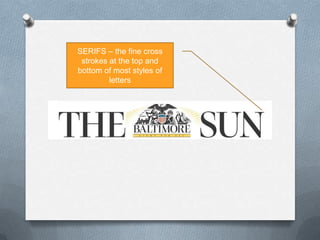
SERIFS – the fine cross strokes at the top and bottom of most styles of letters
SIDEBAR – brief story with a special angle that goes with a more important story
SKYLINE – headline across the top of a page over the nameplate
STANDING BOX  - type box kept on hand for repeated use
SUBHEAD – one- or two-line head used within the body of a story in type
TABLOID – newspaper format usually four or five columns wide and about 14 inches deep
THUMBNAIL – half-column portrait
TYPO – short for typographical error (not a blooper)typoTypo:                      short for typographical error (not a blooper)

Journalism II definitions

  • 1.
  • 2.
    ADD - materialto be added to a news story, usually with “first” or “second” in a slug line
  • 3.
  • 4.
    LOWERCASE – smallletter as distinguished from a capital letterALIGN – to place adjacent to an even baseline on a horizontal planeGUTTER – long, unbroken space between two columns of type
  • 5.
    ATTRIBUTION – sourceof the material in a story
  • 6.
    AP – shortfor Associated Pres. A major news agencyBREAK OVER or JUMP, – story that jumps from one page to anotherJUMP LINES – continuation lines: continued on page 4
  • 7.
    BAD BREAK –bad phrasing of a headline; bad wrapping of headline type
  • 8.
    BANNER or RIBBON– usually a headline stretching across all columns of a newspaperWIDOW – one or two words appearing at the end of a paragraph and on the last line
  • 9.
    BARKER or HAMMER– reversed kicker in which the kicker is in larger type than the lines below it.
  • 10.
    BLANKET HEAD –headline over several columns of type and/or illustrations
  • 11.
    CLOSEUP or HEADSHOT– photo showing head or head and shoulders of an object seen at close rangeBLEED – running an illustration off the page
  • 12.
    BLOOPER – anyembarrassing error in print (not a typo)
  • 13.
    BOLDFACE – typethat is blacker than normal typefaceITALICS – slanted letter form, abbreviated itals.
  • 14.
    BOX – unitof type enclosed by a border
  • 15.
    BRACE – typeof layout with a banner headline and the story in the right-hand columnLEAD – the beginning paragraph or paragraphs of a story
  • 16.
    BREAK – pointat which the story turns from one column to another
  • 17.
    BROKEN HEADS –headlines with lines of different widths
  • 18.
    BULLETS – largesperiods used for decoration, usually at the beginning of paragraphs
  • 19.
    BUMPER or TOMBSTONE– two elements placed side by side, also called a Tombstone when it refers to headlines
  • 20.
    BYLINE – creditgiven in print to the article’s author
  • 21.
    CANNNED COPY –copy released by syndicate
  • 22.
    CAPS – shortfor capital or uppercase lettersSTANDALONE – a photo without an accompanying story
  • 23.
    CAPTION or CUTLINE–explanatory material, usually placed beneath a picture
  • 24.
    CENTER SPREAD orDOUBLE TRUCK – two facing pages made up as one in the center of a newspaper sectionSPREAD – story predominately displayed often over several columns and with art
  • 25.
    CENTERED – placedin the middle of a lineDROPOUT – a subsidiary headline
  • 26.
  • 27.
    RUNAROUND – methodof setting type to run around a pictureCOLUMN INCH – unit of space measurement: one column wide and one inch deep
  • 28.
    CROSSLINE – headlinecomposed of a single line
  • 29.
    DASH – shortline separating parts of headlines or headline and story
  • 30.
    DECK – sectionof a headlineDATELINE – opening phrase of story showing origin, source, and sometimes date of the story
  • 31.
    DUMMY – diagramoutlining the makeup scheme
  • 32.
    DUTCH WRAP –breaking body type from one column to another not covered by the display line [raw wrap]
  • 33.
    EARS – small box on one or both sides of the nameplate carrying brief announcements of weather or circulation, etc.
  • 34.
    EDITION – oneof several press runs
  • 35.
    ENDMARK – symbolused to indicate the close of a story, such as 30 or #.
  • 36.
    EYEBROW or KICKER– smaller headline over a headline over a headline
  • 37.
    FEATURE – astory that stresses a human-interest angle
  • 38.
    FLAG or NAMEPLATE– title of paper appearing on page 1
  • 39.
    FLUSH – evenwith the column margin. Type aligned on one side.
  • 40.
    FOLIO – lineshowing the newspaper’s name, date, and page numberOP ED – page opposite the editorial page
  • 41.
    HAIRLINE – finestline available in printing; often used between to columns of type
  • 42.
    HALFTONE – aphotoengraving: a dot pattern that gives the illusion of tones
  • 43.
    HANGER – aheadline that descends from a banner
  • 44.
    HANGING INDENT –headline style in which the top line is set flush left and subsequent lines are indented from the left.
  • 45.
    INDEX – newspaper’stable of contents, usually found on page one
  • 46.
    INITIAL – (initialcap) first letter of a paragraph set in type larger than the body type
  • 47.
    JUMPHEAD – headlineover the continued portion of a storyRUNOVER, JUMP STORY, or TURN STORY – portion of a story that continues from one page to the next
  • 48.
    JUSTIFY – spacingout a line of type to fill the column
  • 49.
    LEADING – thespace between lines of type
  • 50.
    LINECUT – Illustrationswithout tones, used for maps and charts
  • 51.
    MASTHEAD – informationalmaterial about a newspaper, usually placed on the editorial page
  • 52.
    NEWSPRINT – low-qualitypaper used to print newspapers
  • 53.
  • 54.
    POINT – unitof printing measurement, approx. 1/72 of an inch
  • 55.
    RIVERS – streaksof white space within typeset columns caused by excessive word spacing or letter spacing
  • 56.
    ROP – runof paper. Ads that my appear anywhere in several editions of the paperROPROP:                      run of the paper.  Ads that may appear anywhere in several editions of the paper
  • 57.
    RULES – anyline that is printed.
  • 58.
    SERIFS – thefine cross strokes at the top and bottom of most styles of letters
  • 59.
    SIDEBAR – briefstory with a special angle that goes with a more important story
  • 60.
    SKYLINE – headlineacross the top of a page over the nameplate
  • 61.
    STANDING BOX - type box kept on hand for repeated use
  • 62.
    SUBHEAD – one-or two-line head used within the body of a story in type
  • 63.
    TABLOID – newspaperformat usually four or five columns wide and about 14 inches deep
  • 64.
  • 65.
    TYPO – shortfor typographical error (not a blooper)typoTypo:                      short for typographical error (not a blooper)