

The Telegraph (1): Erasing Time,  Compressing Space Presentation by Mindy McAdams Week 8.1 / MMC 2265
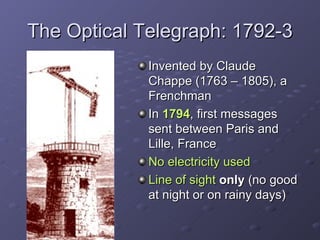
The Optical Telegraph: 1792-3 Invented by Claude Chappe (1763 – 1805), a Frenchman In  1794 , first messages sent between Paris and Lille, France No electricity used Line of sight   only  (no good at night or on rainy days)
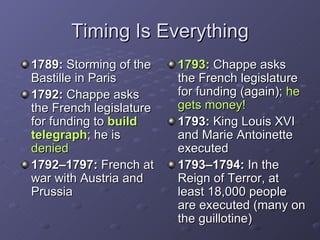
Timing Is Everything 1789:  Storming of the Bastille in Paris 1792:  Chappe asks the French legislature for funding to  build telegraph ; he is  denied 1792–1797:  French at war with Austria and Prussia 1793:  Chappe asks the French legislature for funding (again);  he gets money! 1793:  King Louis XVI and Marie Antoinette executed 1793–1794:  In the Reign of Terror, at least 18,000 people are executed (many on the guillotine)
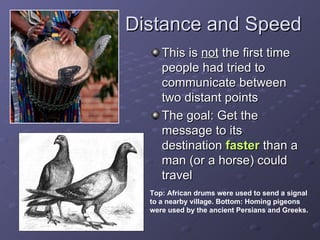
Distance and Speed This is  not  the first time people had tried to communicate between two distant points The goal: Get the message to its destination  faster  than a man (or a horse) could travel Top:   African drums were used to send a signal to a nearby village. Bottom: Homing pigeons were used by the ancient Persians and Greeks.
 
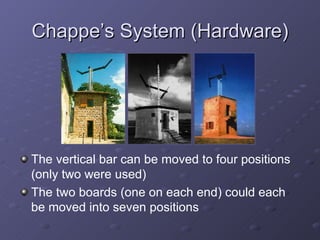
Chappe’s System (Hardware) The vertical bar can be moved to four positions (only two were used) The two boards (one on each end) could each be moved into seven positions
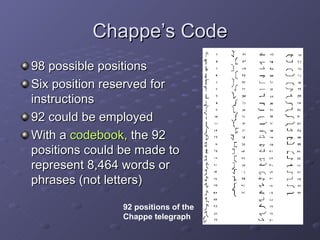
Chappe’s Code 98 possible positions Six position reserved for instructions 92 could be employed With a  codebook,  the 92 positions could be made to represent 8,464 words or phrases (not letters) 92 positions of the Chappe telegraph
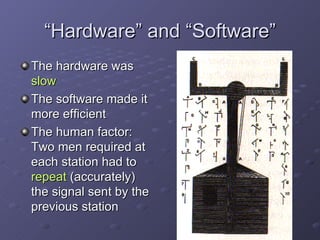
“Hardware” and “Software” The hardware was  slow   The software made it more efficient The human factor: Two men required at each station had to  repeat  (accurately) the signal sent by the previous station
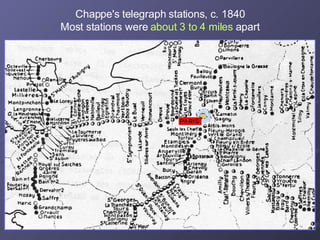
Chappe's telegraph stations, c. 1840 Most stations were  about 3 to 4 miles  apart
Getting the Message Visibility Average 6 hours a day in summer Average 3 hours a day in winter A line of telegraphs transmitted 1 to 3 signals  per minute Speed improved over time It took 15 to 30 minutes to decode the message at the end of the line
Government Control Even though the French government changed drastically several times, each government  supported  the telegraph system Napoleon  provided funds to expand the network along with his growing empire (1804 – 1814)  Military operations  justified the huge expense needed to run the network Public use  of the network was  forbidden  until 1850 (except for transmission of  lottery numbers )
Republic and Empire France had its  revolution  (1789 – 1799) Then seesawed between republic and empire for 80 years 1792–1804: First Republic 1804–1814: First Empire (Napoleon I) 1848–1852: Second Republic 1852–1870: Second Empire (Napoleon III) 1870–1940: Third Republic
Communications and Democracy Claude Chappe, among others, argued that the  network  of telegraph stations would enable the nation-state to coalesce Fast communication over long distances: The key to a republican style of government? Critics (who supported empire) said France was “too large” to operate as a  republic
Connections: The Age of Reason “ Modern” philosophy began  in the 1600s  (with Descartes, who died in 1650) Followed  the  Renaissance  (da Vinci, Michelangelo, Machiavelli; the Protestant Reformation) Preceded  the  Enlightenment  (Voltaire, Rousseau, Thomas Paine), where the seeds of democracy were sown
Connections: The Nation-State State : political and geopolitical ( note:  the liberal state) Nation : cultural and/or ethnic (language, religion, customs) Contrast: An  empire  is a state usually consisting of many diverse (conquered) nations
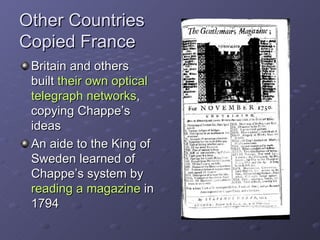
Other Countries Copied France Britain and others built  their own optical telegraph networks , copying Chappe’s ideas An aide to the King of Sweden learned of Chappe’s system by  reading a magazine  in 1794
The Telegraph (1): Erasing Time,  Compressing Space Presentation by Mindy McAdams University of Florida

The Telegraph, Part 1

  • 1.
    The Telegraph (1):Erasing Time, Compressing Space Presentation by Mindy McAdams Week 8.1 / MMC 2265
  • 2.
    The Optical Telegraph:1792-3 Invented by Claude Chappe (1763 – 1805), a Frenchman In 1794 , first messages sent between Paris and Lille, France No electricity used Line of sight only (no good at night or on rainy days)
  • 3.
    Timing Is Everything1789: Storming of the Bastille in Paris 1792: Chappe asks the French legislature for funding to build telegraph ; he is denied 1792–1797: French at war with Austria and Prussia 1793: Chappe asks the French legislature for funding (again); he gets money! 1793: King Louis XVI and Marie Antoinette executed 1793–1794: In the Reign of Terror, at least 18,000 people are executed (many on the guillotine)
  • 4.
    Distance and SpeedThis is not the first time people had tried to communicate between two distant points The goal: Get the message to its destination faster than a man (or a horse) could travel Top: African drums were used to send a signal to a nearby village. Bottom: Homing pigeons were used by the ancient Persians and Greeks.
  • 5.
  • 6.
    Chappe’s System (Hardware)The vertical bar can be moved to four positions (only two were used) The two boards (one on each end) could each be moved into seven positions
  • 7.
    Chappe’s Code 98possible positions Six position reserved for instructions 92 could be employed With a codebook, the 92 positions could be made to represent 8,464 words or phrases (not letters) 92 positions of the Chappe telegraph
  • 8.
    “Hardware” and “Software”The hardware was slow The software made it more efficient The human factor: Two men required at each station had to repeat (accurately) the signal sent by the previous station
  • 9.
    Chappe's telegraph stations,c. 1840 Most stations were about 3 to 4 miles apart
  • 10.
    Getting the MessageVisibility Average 6 hours a day in summer Average 3 hours a day in winter A line of telegraphs transmitted 1 to 3 signals per minute Speed improved over time It took 15 to 30 minutes to decode the message at the end of the line
  • 11.
    Government Control Eventhough the French government changed drastically several times, each government supported the telegraph system Napoleon provided funds to expand the network along with his growing empire (1804 – 1814) Military operations justified the huge expense needed to run the network Public use of the network was forbidden until 1850 (except for transmission of lottery numbers )
  • 12.
    Republic and EmpireFrance had its revolution (1789 – 1799) Then seesawed between republic and empire for 80 years 1792–1804: First Republic 1804–1814: First Empire (Napoleon I) 1848–1852: Second Republic 1852–1870: Second Empire (Napoleon III) 1870–1940: Third Republic
  • 13.
    Communications and DemocracyClaude Chappe, among others, argued that the network of telegraph stations would enable the nation-state to coalesce Fast communication over long distances: The key to a republican style of government? Critics (who supported empire) said France was “too large” to operate as a republic
  • 14.
    Connections: The Ageof Reason “ Modern” philosophy began in the 1600s (with Descartes, who died in 1650) Followed the Renaissance (da Vinci, Michelangelo, Machiavelli; the Protestant Reformation) Preceded the Enlightenment (Voltaire, Rousseau, Thomas Paine), where the seeds of democracy were sown
  • 15.
    Connections: The Nation-StateState : political and geopolitical ( note: the liberal state) Nation : cultural and/or ethnic (language, religion, customs) Contrast: An empire is a state usually consisting of many diverse (conquered) nations
  • 16.
    Other Countries CopiedFrance Britain and others built their own optical telegraph networks , copying Chappe’s ideas An aide to the King of Sweden learned of Chappe’s system by reading a magazine in 1794
  • 17.
    The Telegraph (1):Erasing Time, Compressing Space Presentation by Mindy McAdams University of Florida