Introduction ofMobile Computing?
Mobile computingishuman–computerinteraction bywhichacomputerisexpectedtobe transported
duringnormal usage,whichallowsfortransmissionof data,voice andvideo.Mobile computinginvolves
mobile communication,mobilehardware,andmobile software.Communicationissuesincludeadhoc
networksandinfrastructure networksaswell ascommunicationproperties,protocols,dataformatsand
concrete technologies.Hardware includesmobile devicesordevice components.Mobilesoftware deals
withthe characteristicsandrequirementsof mobileapplications.
Wirelessdevicesthatsupport mobile computing
WirelessLANs(WLANs) allowworkstationsinasmall area(typicallylessthan100 meters) to
communicate witheachotherwithoutusingphysical cables.The mostpopularexampleof Wireless
LANsare the IEEE 802.11 LANsthat deliverbetween11Mbpsto 54 Mbps data rate. Another example is
the BluetoothLANs(forthe datarates inthe 1 Mbps range over10 meters).Veryshortrange LANssuch
as Bluetoothare alsoknownasWirelessPersonal AreaNetworks(WPANs)
Wirelessmetropolitanareanetworks (WMANs) have beenusedintraditional packetradiosystems
oftenusedforlaw-enforcementorutilityapplications.Aninterestingareaof growthforwirelessMANs
isthe wirelesslocal loop(WLL) thatisquite popularwithlongdistance telephone companies.WLLsare
fixedwirelessnetworks wherethe devicesbeingconnectedare stationary.
WirelessWANs(WWANs) provide wirelesssupportoverlongdistances.Traditionalexamplesof wireless
WANsare pagingnetworksandsatellitesystems.However,agreatdeal of wirelessWAN activityat
presentrevolvesaroundthe cellularnetworksthatprovidesupportforcellularphonesandother
handhelddevicessuchasPDAsand laptops.
WirelessPersonal AreaNetworks(WPANs),BluetoothandUWB
 WirelessPersonal AreaNetworks(WPANs) are short-range (10meterorless) radionetworksfor
personal,home,andotherspecial uses.Withinthe WPAN family,several specificationssuchas
Bluetooth,wirelesssensornetworks,andUWB (Ultra-Wideband) have emerged.
 Bluetoothisawirelesscable replacementstandardthatprovidesa1 Mbps data rate over10
metersor less.Ittypicallyconsistsof agroupof linkeddevices,suchasa computerwirelessly
connectingtoa set of peripherals,knownasasa “piconet.”Multiple piconetscanbe formedto
provide widercoverage. Due toitsrelativelylow dataratesand veryshortdistances,
 Bluetoothis beingusedin home appliances,“Bluetooth-enabled” cars,and other such
applications.
1. Founders:Ericsson,IBM,Intel,Nokia,Toshiba;May98
2. Currently:Over850 companies,V1.0specissued7/99
3. Small formfactor,low-cost,shortrange radiolinkbetweenmobilePCs,phonesand
otherportable devices
4. Relativelyfast,shortpackets
5. Software forservice anddevice discovery
6. Typical application:cellularphone toPDA or earphone.
 Ultra-wideband(alsoknownasUWB,ultra-wide bandandultra-band) isaradiotechnologythat
can use a verylowenergylevel forshort-range,high-bandwidthcommunicationsoveralarge
portionof the radio spectrum.
CellularCommunicationNetworks
The userscommunicate withinacell throughwirelesscommunications.A base transceiverstation(BTS)
isusedby the mobile unitsineachcell byusingwirelesscommunication.One BTSisassignedtoeach
cell.Regularcable communicationchannelsare usedtoconnectthe BTSs to the mobile telephone
switchingoffice (MTSO).The MTSOdeterminesthe destinationof the call receivedfromaBTS and
routesitto a properdestination,eitherbysendingittoanotherBTS or to a regulartelephone network.
Keepinmind thatthe communicationsiswirelesswithinacell only.The bulkof cell-to-cell
communicationiscarriedthroughregulartelephonelines.
Cellularnetworks:What is 3G Anyway?
3G actuallystandsfor“third generation”,asitisthe thirdtype of accesstechnologythathas beenmade
widelycommerciallyavailableforconnectingmobile phones
1G: First generationwirelesscellular:Early1980s
 Analogtransmission,primarilyspeech
2G: Second generationwirelesscellular:Late 1980s
 Digital transmission
 Primarilyspeechandlow bit-rate data
 High-tier:GSM,IS-95 (CDMA), etc.
 Low-tier(PCS):Low-cost,low-power,low-mobilitye.g.PACS
2.5G: 2G evolvedtomediumrate (< 100kbps) data
3G: future: Broadband multimedia
 144 kbps - 384 kbpsfor high-mobility,high coverage
 2 Mbps forlow-mobilityandlow coverage
Another wirelessnetworkofour newgenerationis 4G?
4G isthe fourthgenerationof broadbandcellularnetworktechnology,succeeding3G.A 4G systemmust
provide capabilitiesdefinedbyITUin IMT Advanced.
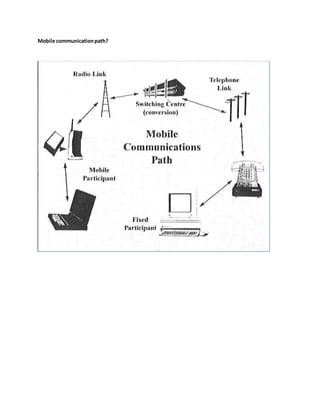
Mobile communicationpath?

Mobile computing Assignment

  • 2.
    Introduction ofMobile Computing? Mobilecomputingishuman–computerinteraction bywhichacomputerisexpectedtobe transported duringnormal usage,whichallowsfortransmissionof data,voice andvideo.Mobile computinginvolves mobile communication,mobilehardware,andmobile software.Communicationissuesincludeadhoc networksandinfrastructure networksaswell ascommunicationproperties,protocols,dataformatsand concrete technologies.Hardware includesmobile devicesordevice components.Mobilesoftware deals withthe characteristicsandrequirementsof mobileapplications.
  • 3.
    Wirelessdevicesthatsupport mobile computing WirelessLANs(WLANs)allowworkstationsinasmall area(typicallylessthan100 meters) to communicate witheachotherwithoutusingphysical cables.The mostpopularexampleof Wireless LANsare the IEEE 802.11 LANsthat deliverbetween11Mbpsto 54 Mbps data rate. Another example is the BluetoothLANs(forthe datarates inthe 1 Mbps range over10 meters).Veryshortrange LANssuch as Bluetoothare alsoknownasWirelessPersonal AreaNetworks(WPANs) Wirelessmetropolitanareanetworks (WMANs) have beenusedintraditional packetradiosystems oftenusedforlaw-enforcementorutilityapplications.Aninterestingareaof growthforwirelessMANs isthe wirelesslocal loop(WLL) thatisquite popularwithlongdistance telephone companies.WLLsare fixedwirelessnetworks wherethe devicesbeingconnectedare stationary. WirelessWANs(WWANs) provide wirelesssupportoverlongdistances.Traditionalexamplesof wireless WANsare pagingnetworksandsatellitesystems.However,agreatdeal of wirelessWAN activityat presentrevolvesaroundthe cellularnetworksthatprovidesupportforcellularphonesandother handhelddevicessuchasPDAsand laptops. WirelessPersonal AreaNetworks(WPANs),BluetoothandUWB  WirelessPersonal AreaNetworks(WPANs) are short-range (10meterorless) radionetworksfor personal,home,andotherspecial uses.Withinthe WPAN family,several specificationssuchas Bluetooth,wirelesssensornetworks,andUWB (Ultra-Wideband) have emerged.  Bluetoothisawirelesscable replacementstandardthatprovidesa1 Mbps data rate over10 metersor less.Ittypicallyconsistsof agroupof linkeddevices,suchasa computerwirelessly connectingtoa set of peripherals,knownasasa “piconet.”Multiple piconetscanbe formedto provide widercoverage. Due toitsrelativelylow dataratesand veryshortdistances,  Bluetoothis beingusedin home appliances,“Bluetooth-enabled” cars,and other such applications. 1. Founders:Ericsson,IBM,Intel,Nokia,Toshiba;May98 2. Currently:Over850 companies,V1.0specissued7/99 3. Small formfactor,low-cost,shortrange radiolinkbetweenmobilePCs,phonesand otherportable devices 4. Relativelyfast,shortpackets 5. Software forservice anddevice discovery 6. Typical application:cellularphone toPDA or earphone.  Ultra-wideband(alsoknownasUWB,ultra-wide bandandultra-band) isaradiotechnologythat can use a verylowenergylevel forshort-range,high-bandwidthcommunicationsoveralarge portionof the radio spectrum.
  • 4.
    CellularCommunicationNetworks The userscommunicate withinacellthroughwirelesscommunications.A base transceiverstation(BTS) isusedby the mobile unitsineachcell byusingwirelesscommunication.One BTSisassignedtoeach cell.Regularcable communicationchannelsare usedtoconnectthe BTSs to the mobile telephone switchingoffice (MTSO).The MTSOdeterminesthe destinationof the call receivedfromaBTS and routesitto a properdestination,eitherbysendingittoanotherBTS or to a regulartelephone network. Keepinmind thatthe communicationsiswirelesswithinacell only.The bulkof cell-to-cell communicationiscarriedthroughregulartelephonelines. Cellularnetworks:What is 3G Anyway? 3G actuallystandsfor“third generation”,asitisthe thirdtype of accesstechnologythathas beenmade widelycommerciallyavailableforconnectingmobile phones 1G: First generationwirelesscellular:Early1980s  Analogtransmission,primarilyspeech 2G: Second generationwirelesscellular:Late 1980s  Digital transmission  Primarilyspeechandlow bit-rate data  High-tier:GSM,IS-95 (CDMA), etc.  Low-tier(PCS):Low-cost,low-power,low-mobilitye.g.PACS 2.5G: 2G evolvedtomediumrate (< 100kbps) data 3G: future: Broadband multimedia  144 kbps - 384 kbpsfor high-mobility,high coverage  2 Mbps forlow-mobilityandlow coverage Another wirelessnetworkofour newgenerationis 4G? 4G isthe fourthgenerationof broadbandcellularnetworktechnology,succeeding3G.A 4G systemmust provide capabilitiesdefinedbyITUin IMT Advanced.
  • 5.